

Is crypto legal in India? The short answer is yes, but the story behind it is a lot more complex. Crypto in India occupies a unique regulatory space where it is permitted to be held, bought, and sold, yet it is not recognized as legal tender, is heavily taxed, and is unfolding into an expanding compliance arena.
If you are new to this industry, then this is the article that will provide you the answer to the question, “Is crypto legal in India?” We’ll cover everything from its legal history and taxes to regulatory oversight and, ultimately, which crypto exchange is legal in India? So let’s start!
The evolution of India’s crypto regulation
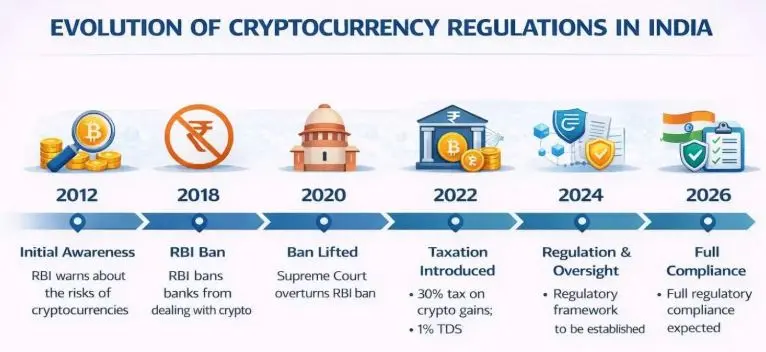
To have an idea of where things are at today, we need to have a quick look at how the regulatory environment has evolved over time in India. The question: Is crypto legal in India? has had different answers at different points of time, and the journey has been anything but straightforward:
- 2018: The Reserve Bank of India (RBI) banned banks from providing services to crypto exchanges, effectively cutting off the industry from the formal financial system.
- 2020: The Supreme Court of India struck down the RBI’s banking ban in the landmark IAMAI vs. RBI case, restoring the industry’s access to banking channels.
- 2022: The Finance Act introduced Section 115BBH, classifying cryptocurrencies as Virtual Digital Assets (VDAs) and imposing a flat 30% crypto tax on all profits, along with a 1% Tax Deducted at Source (TDS) on transactions.
- 2023: The government brought crypto exchanges under the Prevention of Money Laundering Act (PMLA), making FIU-IND registration mandatory for all platforms serving Indian users.
- 2024: The Supreme Court directed the government to create a clear legislative framework for crypto, acknowledging the need for dedicated laws.
This timeline gives a clear answer to the question: is crypto legal in India? India has not moved toward a ban. Instead, it has gradually built a regulatory structure that treats crypto as a high-risk financial asset, legal to use, but closely monitored.
Is crypto legal in India in 2026?
As of 2026, is crypto legal in India? Yes, unequivocally. No law, RBI circular, or Supreme Court ruling outlaws Indians from buying, selling, holding, or transferring crypto. Under the Finance Act 2022, all cryptocurrencies are classified as Virtual Digital Assets (VDAs) in the Income Tax Act, 1961. This classification gives them a defined legal identity, even if that identity does not extend to being currency.
But some restrictions make it clear what crypto cannot be:
- It cannot be used as legal tender. Paying salaries, settling debts, or retail purchases cannot be made using Bitcoin or any other asset with legal protection.
- All trading and trading-based activities must be conducted on exchanges registered with the Financial Intelligence Unit of India (FIU-IND).
- Full KYC has to be completed on any compliant platform before you can trade.
- Crypto balances and income need to be reported in your annual Income Tax Returns under the Schedule VDA.
- Gifts in crypto above ₹50,000 are taxable on the hands of the recipient.
The regulatory environment is one of permissive restraint. The government has not yet deemed crypto money, but it has set up a regime that enables participation but carefully overlays taxation and AML controls.
What we know about crypto taxation in India
If the question is, is investing in crypto legal in India? The correct answer is yes, but with the tax implications carefully considered. India’s taxation scheme is widely considered to be one of the toughest in the world, and non-compliance gets you into serious trouble.
The key elements of the VDA tax framework are as follows:
- 30% flat crypto tax on all profits from the sale or transfer of any Virtual Digital Asset, no matter how long it was held.
- 4% health and education cess brings the effective tax to roughly 31.2% of gains.
- 1% TDS on any transfer or sale over ₹10,000 per transaction (₹50,000 for specified persons). Per transaction TDS is deducted by exchanges registered with the FIU.
- Loss from one cryptocurrency cannot be set-off against profit from other cryptocurrencies or against any other income. Losses also cannot be carried forward to subsequent years.
- No deductions beyond cost of acquisition. Mining hardware costs, electricity bills, exchange fees , none of these can be used to reduce taxable income.
- Income Tax Return now has a Schedule VDA and non disclosure of crypto income attracts penalty and will bring scrutiny under Black Money Act for crypto holdings as foreign.
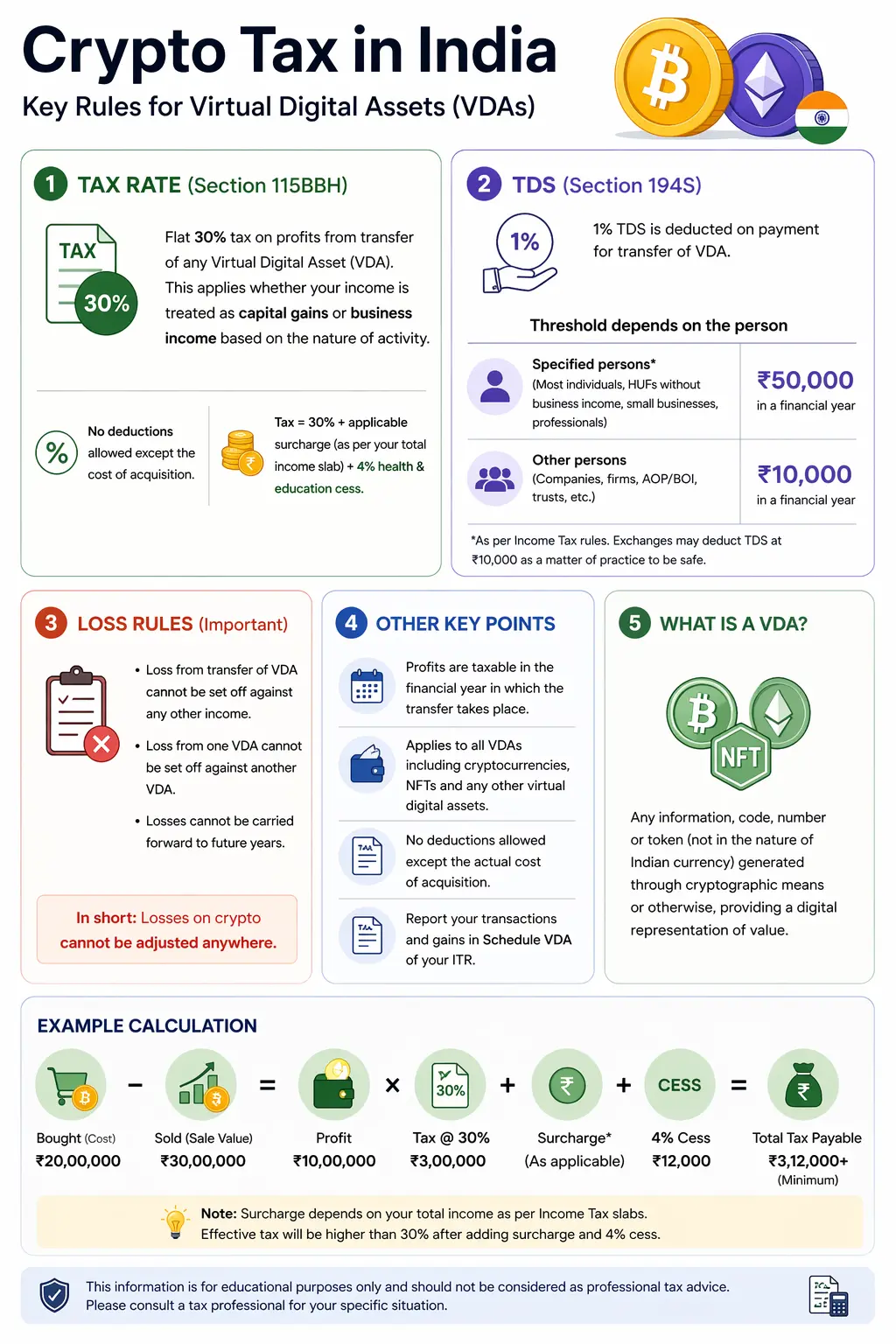
Practically, this means that every profitable trade results in 31.2% of the gain going to the government, with 100% of any losses being absorbed by the investor. While this makes frequent trading financially inefficient, it has not dampened participation — the market continues to grow, driven largely by retail investors from Tier-2 and Tier-3 cities.
The importance of FIU-IND registration
Crypto trading is legal in India if you use a legitimate platform. The requirement for exchanges’ registration with the FIU-IND under the PMLA regime is the core compliance requirement for the crypto ecosystem in India. For 2024–25, the FIU-IND shared that 49 crypto exchanges complied with the anti-money laundering registration, of which 45 exchanges were Indian ones and four were offshore exchanges that re-registered after complying.
If you are a trader, using an FIU-registered exchange is not a choice but a must. Any platform that does not have an FIU Reporting Entity ID (RE-ID) will be blocked immediately by IP with the Ministry of Electronics and Information Technology (MeitY) and will attract heavy PMLA penalties. In addition, using any of these platforms will leave you highly exposed in terms of legal risk since your transaction cannot be verified or protected by the Indian authorities.
Beyond the question of whether crypto is legal in India, FIU-registered exchanges bring several well-documented perks to the table, including automatic deduction of the mandatory 1% TDS on proceeds, proper transaction record keeping for use in filing ITR, KYC and AML standards that help shield users from fraud, and meeting the “Travel Rule,” which mandates that for every VDA transfer, verified originator and beneficiary information is shared between off-takers. The government’s increasing focus on regulation indicates that only compliant platforms will stand a chance in the evolving Indian crypto ecosystem.
Is crypto mining legal in India?
Is crypto mining legal in India? This is one of the most frequently asked questions in the Indian crypto community, and the answer requires some nuance. As of 2026, Bitcoin mining and crypto mining in general are not illegal in India. The authorities have not issued a law, RBI circular, or government notification that criminalizes crypto mining, and there isn’t a licensing requirement in place for individual miners. Commercial operations in India can therefore run without committing any offense.
However, there is a lack of clarity in the area of regulation in the context of the question: Is crypto mining legal in India? The VDA classification introduced in 2022 helped to clarify the taxation aspect but did not categorize mining as a regulated financial activity. FIU-IND registration is mandatory for brokers and exchanges but not for individual miners. Miners are therefore working in a space that is open but does not have specific legislation.
From the taxation angle, revenue from mining is taxed as income from other sources but only at the prevailing individual income tax slab rate, not the flat 30% VDA rate. However, the sale of mined coins is taxed at 30% VDA on the profit that exceeds the amount paid for acquiring the coins. Miners cannot claim electricity costs or hardware depreciation in determining taxable income, which has a major impact on their bottom line. It is strongly recommended that miners keep a proper record of all earnings and consult a professional tax counselor in light of regulatory developments.
Roles of regulators in the Indian crypto ecosystem
India does not have a single regulator for cryptocurrencies as such. Instead, different institutions oversee different aspects of the ecosystem. To hedge against your risk in crypto trading, it is essential to understand these roles and responsibilities.
The Financial Intelligence Unit – India (FIU-IND) is currently the most operationally relevant authority. It handles the registration of Virtual Digital Asset Service Providers (VDASPs), enforces AML and Know Your Customer (KYC) standards, and collects Suspicious Transaction Reports (STRs) from registered exchanges.
The Reserve Bank of India (RBI) does not regulate cryptocurrencies directly; it has made clear that it does not recognize private crypto as currency. The RBI’s primary focus in the digital asset space is the e-rupee (digital rupee), India’s central bank digital currency (CBDC), the pilot of which was expanded in 2025 to cover more use cases and user segments.
The Securities and Exchange Board of India (SEBI) has been discussed as a potential future regulator for crypto-based securities and investment products. While no formal authority has been granted yet, SEBI’s involvement in the broader regulatory conversation indicates that structured oversight of crypto investment products will also be required in the years to come.
The government has indicated that a comprehensive discussion paper addressing stablecoins, Decentralized Finance (DeFi), and cross-border crypto transactions may be released in 2026, which will have a material impact on the regulatory approach going forward.
Which crypto exchange is legal in India?
Now that the legal umbrella is sorted, the practical question comes to the surface which crypto exchange is legal in India? In other words, which exchange is safe and legal for Indian investors to engage in? The answer goes to those exchanges that have the FIU-IND registration. Of those exchanges, one that stands out as the most recommended exchange for newcomers and especially for those in smaller cities is SunCrypto.
SunCrypto is a crypto exchange based in Jaipur, specifically built to cater to the Indian market. SunCrypto is FIU-IND registered under the PMLA. This means every trade made on the platform is in compliance with Indian laws. It also means that all KYC information is secure and stored in compliance with Indian regulations. Here is what makes SunCrypto different from the rest:
- Large coin variety: 600+ crypto pairs for Spot and Futures trading: One of the highest coin varieties across the Indian exchanges.
- Lowest trading fees: Spot trading starts at just 0.5%, one of the most economical rates for high-volume traders in the industry. The maker and taker fees in futures are also low and get progressively lower as one climbs the VIP tiers.
- Crypto SIP (Systematic Investment Plan): This allows India-based investors to invest a fixed amount in a portfolio of cryptocurrencies. On SunCrypto, one can start SIP with just ₹100 with zero buying fees on 10+ blue-chip tokens, including Tether Gold & Pax Gold, with the flexibility to pause, skip, and cancel the SIP any time.
- Crypto Staking: Users can earn passive income by staking supported assets directly on the exchange. On SunCrypto, users can stake their holdings to get up to 15% APY, USDT staking, and no high fees.
- Futures Trading: SunCrypto also allows crypto futures trading in India with features like 150x leverage across 650+ pairs, including precious metals like gold, silver, etc.; tokenized US stocks like Amazon, Google, and more; and advanced risk management strategies like stop loss, take profit, and isolated margin.
- Ledger Insurance: User funds are held in multi-sig cold wallets insured by a custodial partnership with Ledger for up to $150 million.
- Instant INR Deposit and Withdrawal: Deposits and withdrawals can be done instantly with INR through UPI and IMPS; they have no friction for first-time investors.
- Good for Beginners: This app is user-friendly so that people with no trading experience can easily explore and invest.
Final Thoughts
So, is crypto legal in India? YES, 100%. No loophole, no ambiguity. Indian citizens are allowed to buy, sell, hold, and invest in crypto.
However, the compliance requirements are high, the tax rates high, and the regulatory framework a work in progress; the opportunity is there. With over hundreds of millions of Indians entering the crypto market each year, embracing a relatively regulated way to invest, SunCrypto, an FIU-registered and compliant platform, is your one-stop destination to transition from a first-time investor to a next-level futures trader.
Read More: How to file crypto tax in India?
Is crypto legal in India?
Cryptocurrency is legal to own, trade, and invest in across India. The government treats crypto as a Virtual Digital Asset (VDA). While perfectly legal, it is not recognized as legal tender.
Are crypto earnings taxed in India?
Yes, crypto earnings are taxed in India. Crypto profits face a flat 30% tax plus a 4% cess, with no deductions allowed except for the purchase cost. A 1% TDS is automatically deducted on sell and swap transactions exceeding ₹50,000 (or ₹10,000 for specific users) annually.
What is the easiest and safest way to invest in crypto in India?
The safest and the easiest way to invest in crypto in India is through SunCrypto.