
Tether, the issuer behind the world’s largest stablecoin USDT, closed the second quarter of 2026 with a net operating profit of $1.5 billion, marking a sharp jump of about 50% from its Q1 performance of $1.04 Billion. The company disclosed the figures in its latest quarterly attestation released on July 31, reflecting continued market dominance despite a broader slowdown in the stablecoin sector.
How did USDT gain market share in a shrinking market stable?
Even as the overall stablecoin sector contracted in Q2, Tether reported that USDT in circulation rose to approximately $184.6 billion, up about $446 million from the end of March. That growth allowed USDT to capture more than 60% of total stablecoin market share, reinforcing its position as the dominant player even in a softer market environment.
Most of the reserves backing USDT remain parked in short-term U.S. Treasuries, repurchase agreements, and other highly liquid, government-backed instruments. These holdings were the primary driver behind the quarter’s profit, as elevated yields on short-duration government debt continued to work in the issuer’s favor.
What’s behind Tether’s growing allocation to gold?
Tether added 14 metric tons of physical gold during the quarter, pushing its total holdings past 146 metric tons. The move continues a multi-quarter trend of diversifying reserves beyond dollar-denominated instruments, positioning gold as a hedge alongside its Treasury-heavy portfolio.
CEO Paolo Ardoino framed the results around Tether’s broader mission, noting that the company continues to deliver financial inclusion in the developing world. He also contrasted Tether’s reserve strategy with the finance industry’s focus on AI stock valuations. Instead, he said, Tether’s investments aim to expand financial access for underserved populations.
USDT users continued to grow and reached a new all-time high
Tether’s user base crossed 650 million users this quarter, a new all-time high, with the strongest growth coming from emerging markets. Among retail wallets holding $1 to $1,000 (as opposed to institutional or whale holdings), USDT dominates with a 77.4% share globally, while all other stablecoins combined account for just 22.6%.
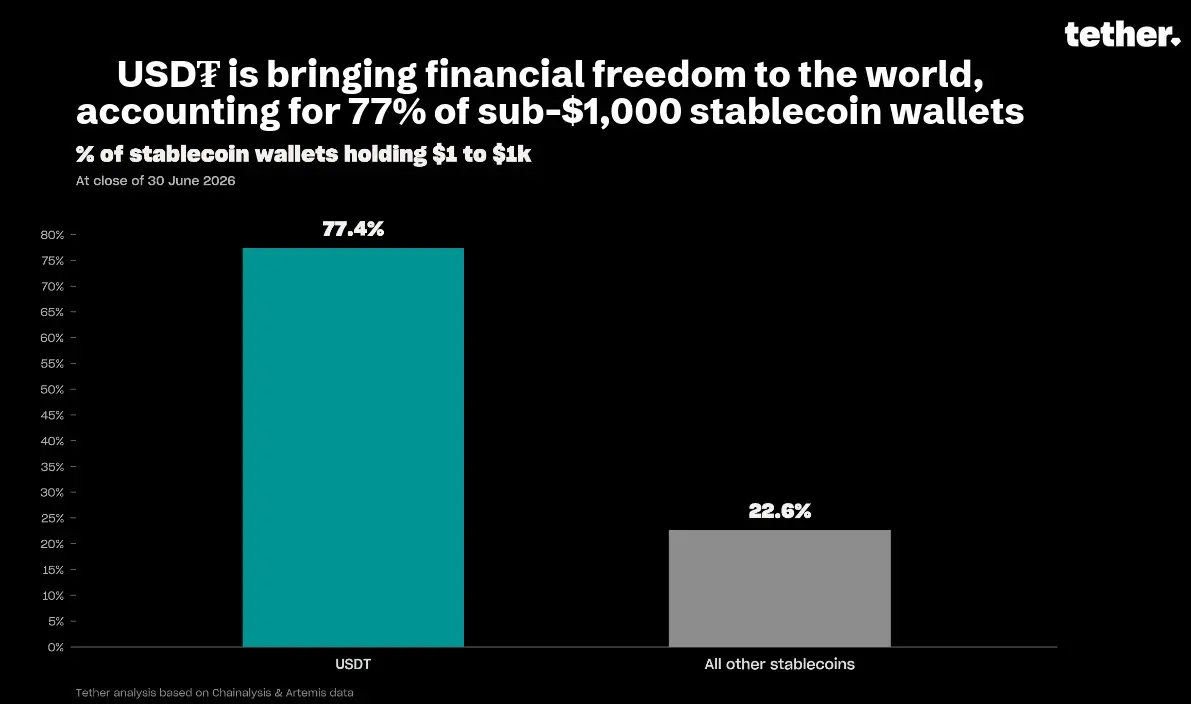
This isn’t a story about traders or institutions parking capital. It’s a story about small-balance wallets, the kind held by someone in an inflation-hit economy trying to preserve the value of their savings, or a freelancer receiving international payments without access to reliable local banking. On that measure, USDT isn’t just the market leader; it’s overwhelmingly the default choice.
Is Tether’s dominance truly risk-free?
Despite the strong numbers, USDT’s growth hasn’t been free of scrutiny. Tether’s quarterly disclosures remain attestations rather than full independent audits, a distinction that has long drawn criticism from transparency advocates comparing it to fully-audited competitors.
Additionally, the EU’s MiCA regulation entered full force on July 1, 2026, tightening compliance requirements for stablecoin issuers operating in or serving European markets, a regulatory shift that has historically posed friction for USDT’s EU availability. Readers evaluating USDT’s dominance should weigh these transparency and regulatory factors alongside the reserve and profit figures.
How can USDT user’s growth impact the crypto market?
For the broader crypto market, this combination of rising user adoption, deepening reserves, and record profitability suggests stablecoins will continue acting as the on-ramp for new capital entering crypto, particularly from emerging markets, indirectly supporting trading volumes and liquidity across Bitcoin, Ethereum, and altcoin markets alike.
Final thought
Tether’s Q2 2026 numbers reinforce a simple takeaway: USDT’s dominance isn’t just holding, it’s compounding. A $1.5 billion profit, $184.6 billion in circulation, and over 650 million users show that stablecoin adoption is increasingly being driven by everyday users in emerging markets rather than institutional flows alone. The steady build-up in gold reserves alongside Treasury holdings also signals Tether’s intent to diversify its balance sheet without straying from its liquidity-first approach.
For the broader crypto ecosystem, this matters beyond Tether itself. As USDT continues to serve as the primary on-ramp for retail users in inflation-affected and underbanked regions, its growth trajectory could keep feeding fresh liquidity into Bitcoin, Ethereum, and altcoin markets. Investors and traders tracking stablecoin flows may find USDT’s dominance a useful proxy for gauging retail-driven capital entering the crypto space in the coming quarters.
How much profit did Tether reported in Q2 2026?
Tether posted a net operating profit of $1.5 billion for Q2 2026, a sharp jump from its Q1 performance, driven mainly by elevated yields on its Treasury-heavy reserves.
How much gold does Tether hold in its reserves?
Tether added 14 metric tons of gold during Q2, taking its total holdings past 146 metric tons, as part of a continued push to diversify reserves beyond dollar-denominated instruments.
How many users does USDT have now?
Tether’s user base crossed 650 million in Q2, a new all-time high, with the strongest growth coming from emerging markets and small-balance retail wallets.