
The Indian crypto market has matured rapidly and crypto futures trading in India presents itself as one of the most exciting ways for traders looking to diversify from passive token holding. Whether you’re looking to profit from the next big bull run or hedge your portfolio from any major market drawdowns, crypto futures trading in India gives you the ability to do exactly that, all without owning the underlying cryptocurrency at any point in time.
This guide walks you through everything you need to know to embark on your crypto futures trading journey in India; from key concepts and terminologies to tax benefits, platform selection, and risk management. So without further ado, let’s start!
What is Crypto Futures Trading?
Essentially, crypto futures trading is about entering into a contract that states you’ll buy or sell a specific cryptocurrency at a certain price on a specific future date. In contrast to the spot market, where you buy or sell the actual crypto, futures contracts are essentially tools for either speculating or hedging positions and can give traders access to take both long and short positions, long if they expect the price to go up, or short if they believe the price will go down without any ownership over the coin itself.
The most popular kind used by most Indian retailers is INR perpetual futures, commonly known as crypto perpetual futures India, which don’t have any expiration date and are used for both short-term speculation or longer-term trading strategies by maintaining themselves to the current underlying price using funding rates. The funding rate mechanism is used to balance long and short traders in the market from time to time.
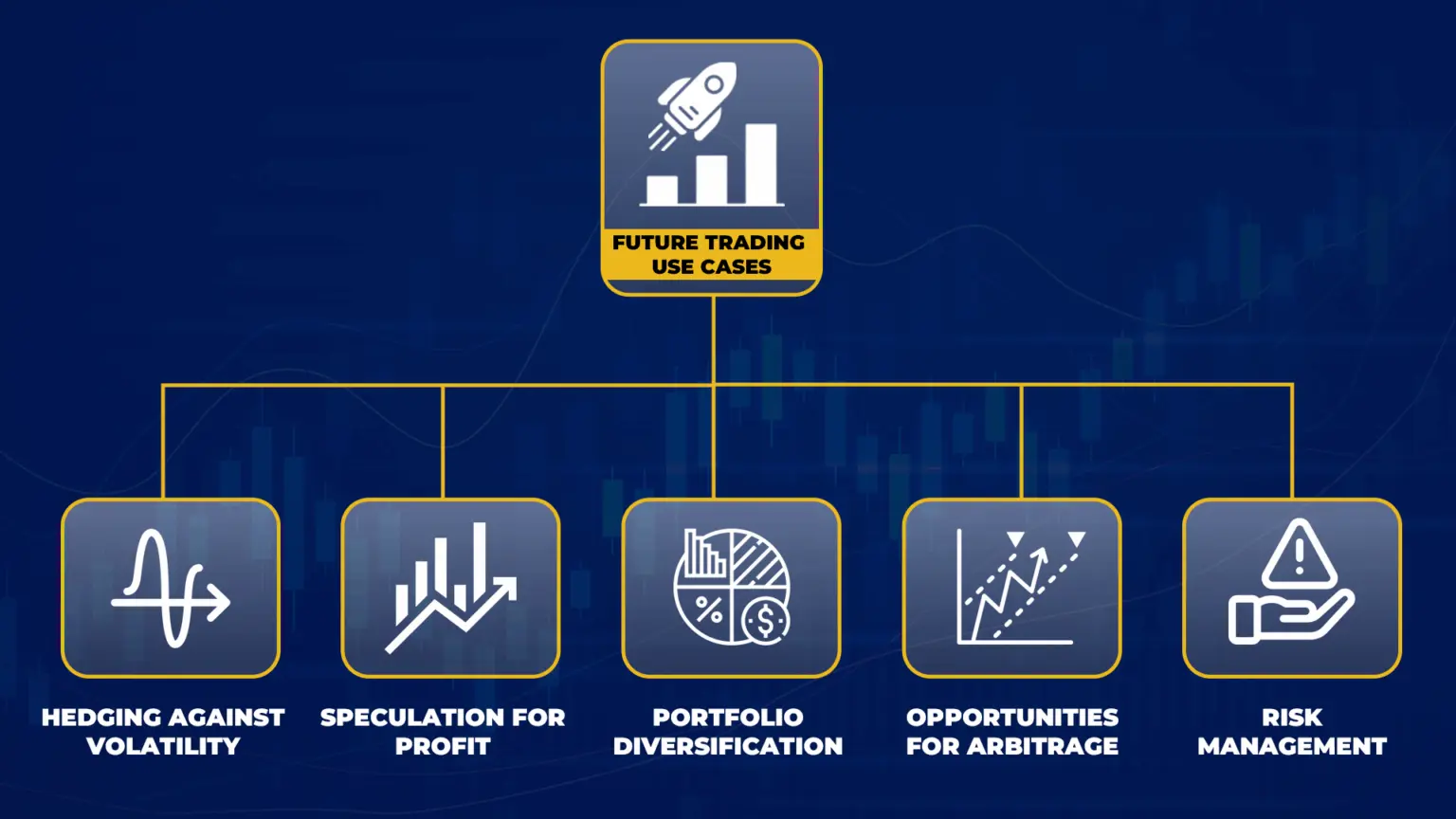
In short, crypto futures trading in India offers the following benefits:
- Hedge against volatility: By providing the mechanism for fixing the price, it acts as a protection for the portfolio from sudden drop in the crypto markets.
- Speculation for profits: In both bull and bear markets, traders utilize this feature to place bets on price movements and leverage their gains.
- Diversification of investment: Enables traders gain exposure to crypto without holding them physically thereby diversifying the investment strategy.
- Opportunities for arbitrage: Allows one to take advantage of price differences between exchanges, thereby securing low-risk profits.
- Risk management: By allowing profit during downturns and offsetting spot market losses, this short-selling feature helps traders manage risk.
Key terminologies in Crypto Futures Trading
Before going to the core of crypto futures trading in India, one needs to understand all the key terms that will be used. These are:
- Leverage: Leverage is like a credit, which increases trading power. For example, if you take 10x leverage, ₹1000 will become ₹10,000, which multiplies the potential profit and loss.
- Margin Type: Traders use margin as security for leveraged positions. Types include:
- Isolated Margin: The amount of money put in a trade is fixed by the isolated margin, so the maximum risk is set.
- Cross Margin: All available funds are used, which makes trading easier but poses the risk of losing the entire balance.
3. Market Orders: They help to ultimately execute the trade in the market. Types include:
- Market Order: Placing a market order means that you buy or sell right away at the existing prices.
- Limit Order: It allows you to decide the price you want to buy/sell before it is finalized in a trade.
- Stop Market Order: It will place a buy/sell order at the market price as soon as the stop price is hit.
- Stop Limit Order: It triggers a limit order when the stop price is hit and is executed when the specified price is reached.
- Liquidation: It occurs when a position’s losses exhaust the margin, forcing closure to prevent further debt, often at a loss.
- Funding Rate: For long and short positions in futures, funding rates balance perpetual contracts by charging fees between long and short positions, ensuring market stability.
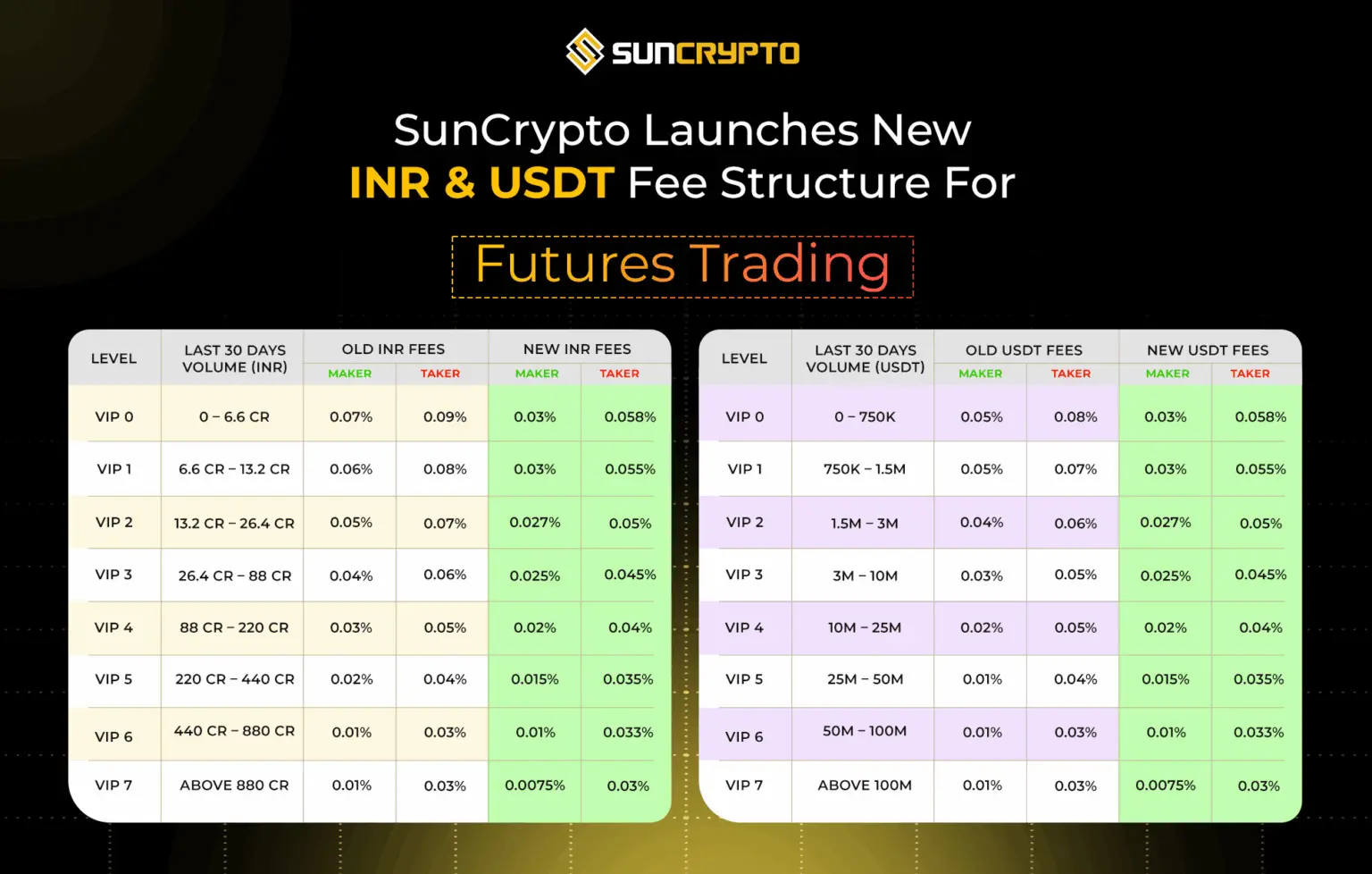
- Maker Fee– It is the charge for placing limit orders that add liquidity to the order book, typically lower.
- Taker Fee– It is the charge for market orders that remove liquidity, usually higher than maker fees.
How does leverage work in INR margin futures?
Perhaps the most interesting and important feature to understand in INR margin futures is leverage. As explained earlier, leverage allows you to control a much larger position than your actual capital. For example, with 10x leverage, a deposit of ₹1,000 gives you the buying power of ₹10,000.
While this can dramatically increase profits if it works in your favor, it can also dramatically reduce your margin if it goes against you. For instance, there are chances that you could wipe out your entire account balance within seconds by a 1% adverse movement in a 100x leverage position. Therefore, traders, especially those who are beginners in crypto futures trading in India, are very strict and careful while implementing leverage.
What is the tax advantage of crypto futures trading in India?
One of the most compelling and frequently overlooked benefits of crypto futures is the tax advantage in India. When you trade cryptos on the spot market, your gains are classified under VDA (Virtual Digital Assets), and you get a hefty 30% tax on your profits with no set-off permitted for losses from other trades. On top of that, every spot transaction attracts a 1% TDS deduction, which progressively ties up capital across an active trading month.
Crypto futures trading in India works totally differently. These are not classified under VDA, so your income falls under the normal income tax slab, which benefits you a lot more than the 30% fixed tax if you fall in a lower income slab. Additionally, no 1% TDS is applied to the futures trades, so your funds don’t get locked. Isn’t that amazing?
Spot Trading vs Crypto Futures Trading
| Features | Spot Trading | Crypto Futures Trading |
| Asset Ownership | The trader owns the actual crypto | No ownership; purely contract-based exposure |
| Profit Direction | Profit only in rising markets | Profit in both bull and bear markets |
| Leverage | Unavailable | Up to 150x on select pairs |
| Taxation | 30% flat VDA tax + 1% TDS | Business income at slab rate; no TDS |
| Risk Level | Limited to invested capital | Higher due to leverage; manageable with tools |
| Order Types | Market only | Market, Limit, Stop Loss, Take Profit, Trailing SL |
| Margin Requirement | Full amount required upfront | Only a fraction of position size needed |
| Settlement | Instant; asset is delivered | Cash-settled; no crypto delivery required |
Why is SunCrypto the best platform for crypto futures trading in India?
SunCrypto is one of the best crypto platforms when it comes to crypto futures trading in India, with a list of various features and capabilities which are best suited for the novices as well as for experienced traders:
- High leverage up to 150x on select crypto pairs like BTC and ETH to boost your profit potential.
- Over 600 crypto futures pairs, giving traders a variety of opportunities.
- Futures trading for Precious Metals such as Gold, Silver, Platinum and Palladium as well as commodities like Crude Oil and Natural Gas with up to 50x leverage.
- Tokenized US Stocks such as Robinhood, Amazon, Palantir etc are also available on INR futures with up to 10x leverage.
- Lowest trading fee charges in the entire country for Indian traders with tier based discounts on trades.
- Advanced risk management tools like Isolated Margin, Stop Loss, Take Profit, Trailing Stop Loss.
- Enhanced Chart Analysis on SunCrypto Futures Web for precise trading decisions.
- INR Auto-Conversion facility available on the USDT trading pairs without having to buy USDT.
- Free Telegram channel called SunCrypto trade alerts where traders get professional trade calls and analysis which helps them in their futures trading journey.
- Expert picks feature which makes futures trading on SunCrypto a whole lot easier as you have to just copy the trade alerts provided by professionals, just adjust your leverage and margin according to your risk potential.
How to start crypto futures trading in India with SunCrypto?
Here’s how to start crypto futures trading on SunCrypto:
- First, download the app from the Google Play Store or Apple App Store.
- After installing, complete your registration and KYC (Know Your Customer).
- After the KYC, add your bank account and then fund it using bank transfer (IMPS/RTGS/NEFT) or UPI.
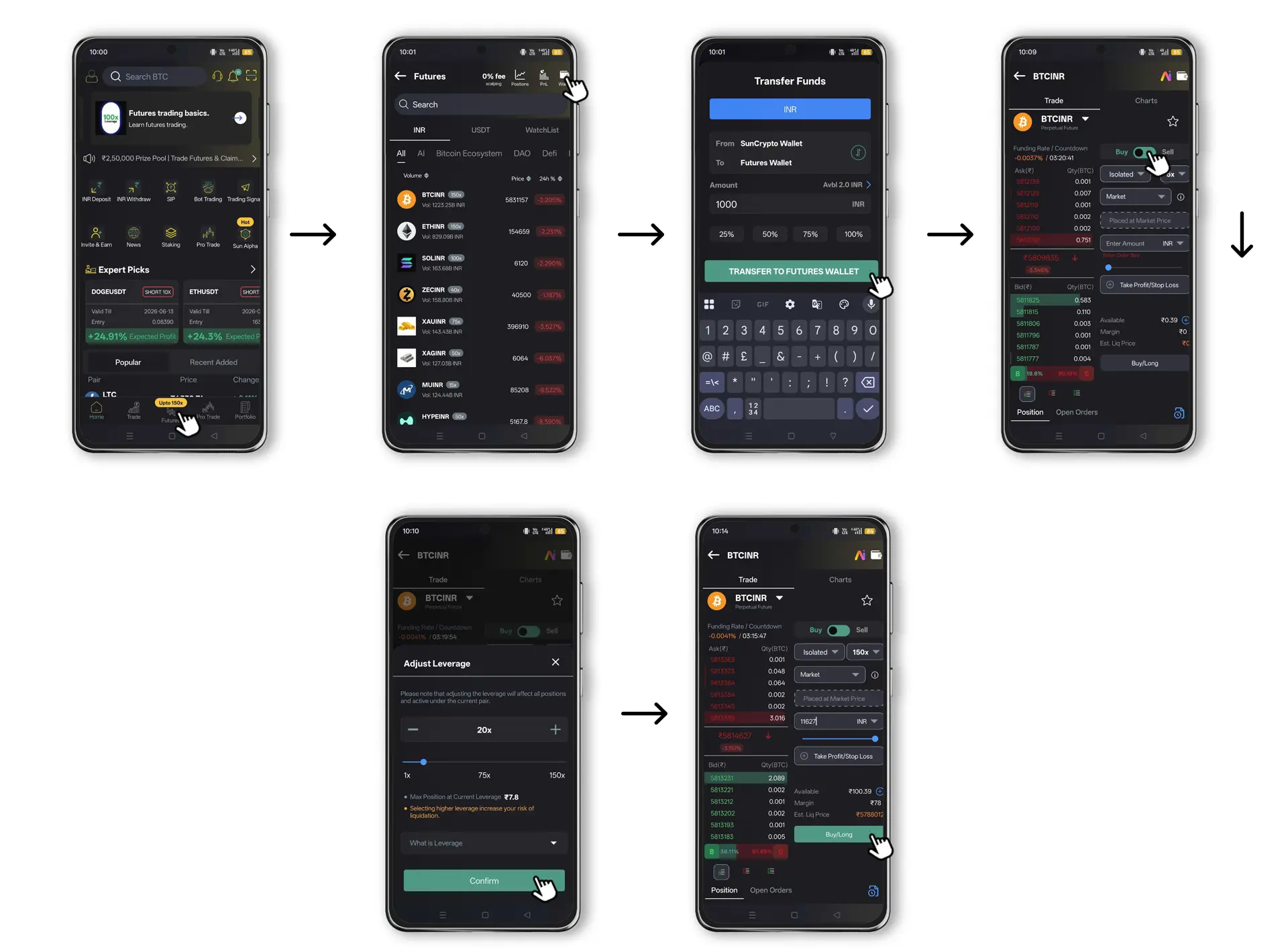
- Click on the “FUTURES” icon at the bottom of the SunCrypto Home screen.
- You will be redirected to a new screen and will need to transfer the amount from your SunCrypto wallet to the Futures wallet.
- Click on the wallet icon on the top right, enter the amount you want to transfer, and confirm.
- Select the trading pair you wish to trade in either INR or USDT.
- You don’t need to deposit separately in USDT; if you wish to trade in a USDT pair, the available INR balance will be auto-converted.
8. Select the trading pair, let’s say BTC/INR. You will be able to see—
- Trade section (to place orders)
- Chart section (to check market trends)
9. You will then decide whether to
- Long (Buy): If you are of the opinion that the price will go up.
- Short (Sell): If you are of the opinion that the price will go down.
10. Select the margin type. SunCrypto currently supports only Isolated Margin.
- This is a much safer option for beginners, since you only stand to lose the amount you have invested.
11. Select the order type:
- Market order, recommended for beginners, as your order is executed instantly.
- Limit order, stop limit, or stop market order for more control over the trade.
- Select whether you wish to place the trade in INR.
12. Fill in the order amount; also enter leverage
- For example, with 1,000 amounts, you can trade 50,000 if you choose 50x leverage. To control the risk, you can even trade 6,000 only with 50x leverage.
- You can also enter SL (Stop Loss) and TP (Take Profit) for further risk control.
13. Finally, click on Buy to place your order.
14. You can check the open position and P&L at the bottom of the screen.
Final Thoughts
The opportunities in crypto futures trading in India have expanded tenfold in 2026. With a better understanding of leverage, margin systems, risk tools, and the clear benefits of futures over spot in terms of taxation, Indian traders are more prepared than ever to trade through all types of markets.
SunCrypto is already providing one of the broadest futures ecosystems for Indian traders today, with over 600+ crypto pairs, metals, tokenized US stocks, and commodities with powerful risk management tools and one of the lowest fee structures in the Indian market. Whether you’re a beginner who wants to start trading futures or you’re trying to grow your existing strategy, SunCrypto’s is the best option for you. With a well-defined strategy, a robust approach to risk management, relevant learning materials, discipline, and a logical trading approach, you can ensure success in crypto futures trading in India for the long term.
What is the maximum leverage provided on SunCrypto futures?
The maximum leverage provided on SunCrypto futures is 150x, on select trading pairs like Bitcoin and Ethereum.
Why is there no 1% TDS on Crypto futures in India?
The 1% Tax Deducted at Source (TDS) does not apply to crypto futures in India because they are treated as derivatives and financial contracts, rather than a direct transfer of a Virtual Digital Asset (VDA).
What metals are available on SunCrypto futures?
SunCrypto futures provides precious metals like Gold, Silver, Platinum and Palladium as well as commodities like Crude Oil and Natural Gas with up to 50x leverage.