

XRP is experiencing a great wave of network activity around it recently, and interestingly, it doesn’t look like a normal speculative rally. Fresh data from treasury firm Evernorth shows three separate demand signals rising together: roughly $4 billion in tokenized real-world assets now live on the ledger, close to $1.47 billion in cumulative spot ETF inflows, and a 40% jump in new wallet creation in a single week.
Each metric in isolation is worth paying attention to. Together, the rise of these fundamentals is quite meaningful. It indicates something that is more than hype, a transition to longer-term institutional and retail XRP adoption beyond just short-term speculation. Come, let’s break it down and understand it in detail.
What is XRP?
XRP is the native digital asset of the XRP Ledger (XRPL), an open-source, decentralized blockchain that was originally designed in 2012 to facilitate fast, low-cost cross-border payments. While proof-of-work networks such as Bitcoin settle transactions at a cost of multiple dollars, XRPL operates on a consensus algorithm that can finalize most simple transactions within 3-5 seconds for a dime of a cent.
Over the past decade, the various features and tools built into XRP Ledger have evolved far beyond payments, adding native support for decentralized exchanges, automated market makers, and most relevant to this story, tokenization of real-world assets like treasuries, bonds, and funds. Having a broader use case is precisely what’s driving the current cycle of demand, and it’s why the XRP coin is increasingly being evaluated on fundamentals rather than price charts alone.
Why are multiple XRP adoption signals rising together?
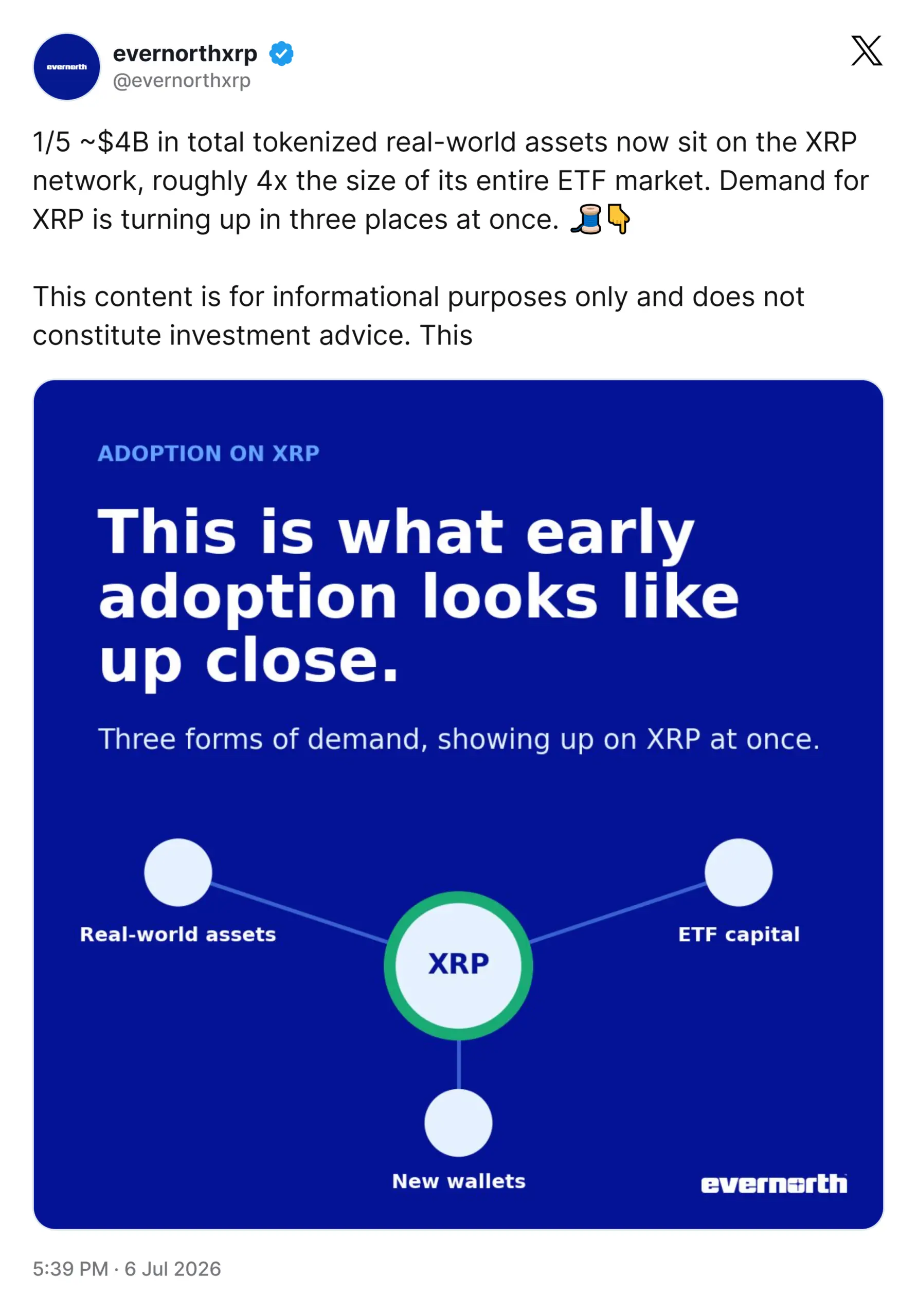
A convergence of growth across assets, capital and users is unfolding across the ecosystem. In a July 6 thread on X, Treasury firm Evernorth laid out the case plainly: tokenized real-world assets on the network now total roughly $4 billion, spot ETFs are seeing consistent inflows, and wallet creation is accelerating. What’s important about this is that it isn’t exactly any one of these numbers, it’s that all three of them are moving in the same direction at the same time.
Historically the price rallies of this asset class. have been largely driven by retail market speculation and exchange-listing news. This cycle looks structurally different, with tokenization, institutional capital, and organic user growth reinforcing one another rather than moving independently.
How large is XRP’s Tokenized Real-World Asset footprint?
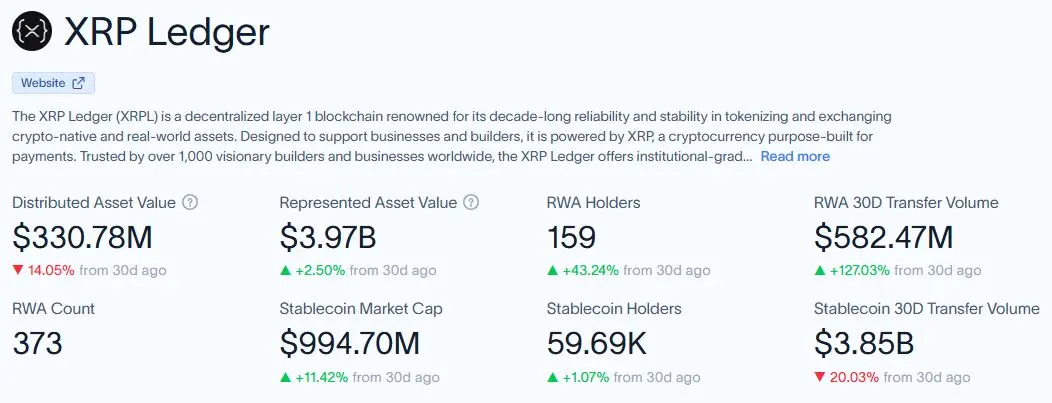
Tokenized real-world assets (RWAs) have become the biggest growth driver of the year on the ledger, growing from ~$150M a year ago to almost $4B today, almost a 27x jump, according to Evernorth data. Over 500 distinct tokenized products are now available, covering treasuries, credit funds and a variety of other financial instruments now available on-chain.
This expansion matters because tokenized assets represent actual claims on real financial instruments, not speculative wrapped tokens. Their steady growth suggests institutions increasingly view the ledger as viable settlement infrastructure, not just a venue for trading.
Why does the JPMorgan-Mastercard-Ondo settlement matter?
Maybe the clearest signal of institutional confidence in XRP adoption came earlier this year, when a tokenized U.S. Treasury redemption involving JPMorgan, Ondo Finance, and Mastercard settled on the ledger in approximately four seconds. For context, comparable settlements through traditional banking rails can take one to two business days.
While this was a single transaction rather than evidence of widespread daily use, it demonstrated that major financial institutions are willing to route real transactions through the XRP network when speed and cost efficiency matter. The natural next question is whether this becomes routine practice across more issuers and asset types, rather than a one-off pilot.
What do ETF inflows reveal about XRP adoption?
Institutional appetite is reflected in regulated investment products as well. Spot ETFs tracking the token have posted net inflows for eight straight weeks running, adding roughly $23 million in the last full week of June, for cumulative inflows of around $1.47 billion since the launch of the funds. In total, issuers like Bitwise, Franklin Templeton, Grayscale and 21Shares, now have hundreds of millions of tokens in custody.
What stands out is the persistence of these flows even during a broader market downturn, a signature for commitment-based flow rather than retail momentum slicking.

Why are new wallets surging across the XRP network?
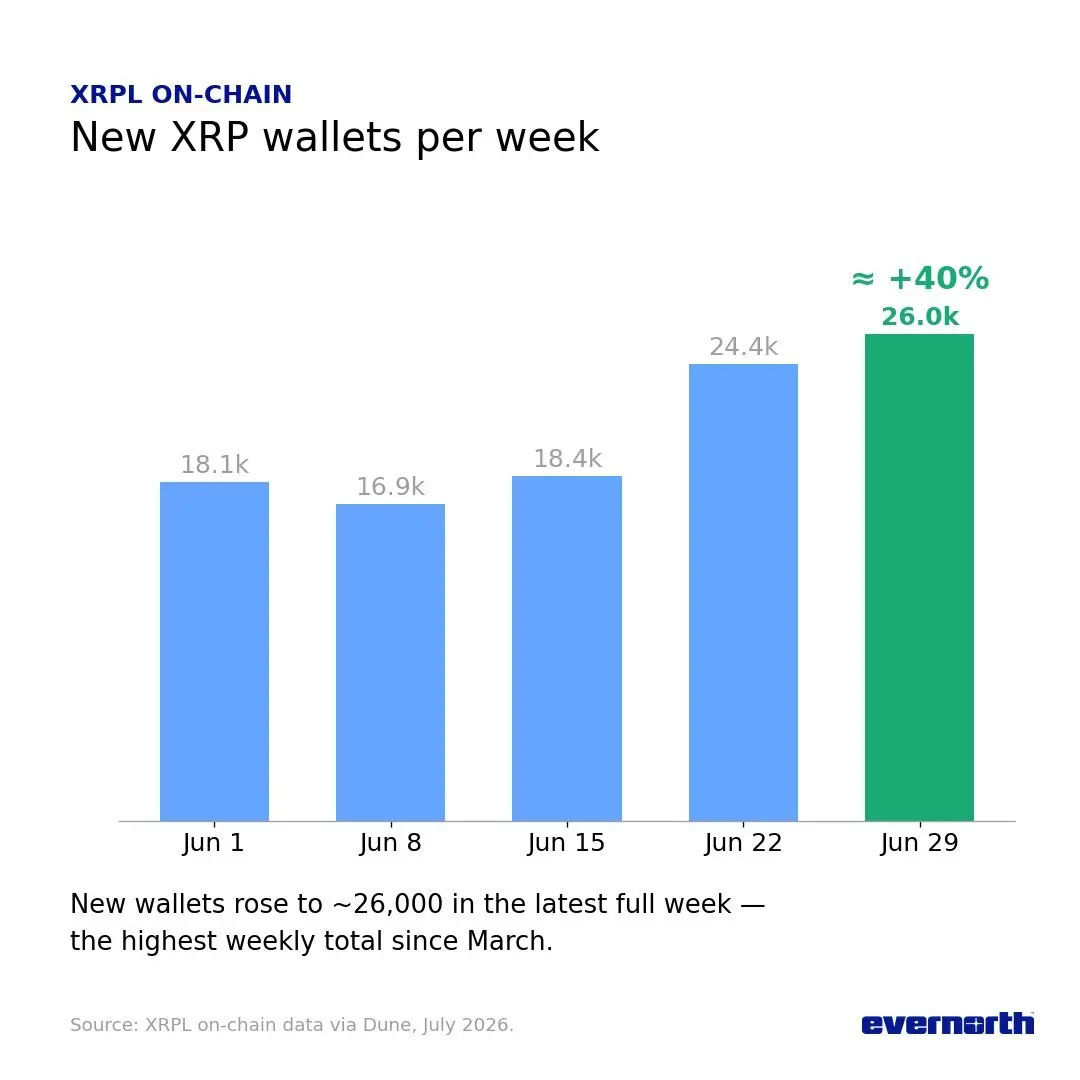
The third part of this XRP adoption story is that demand is coming from regular users as well. Evernorth reports a roughly 40% increase in wallet creations in the last full week of June, the largest weekly level since March. In weekly terms, this is how it looks:
- New wallets rose from about 18,100 to 26,000 in weeks
- That marks the strongest weekly wallet growth since March 2026
- Rising wallet counts often signal fresh retail and builder interest
- Higher participation typically supports stronger long-term network effects
- Growth coincided with renewed price momentum in late June
- Developer and application activity tends to follow user growth
Rising wallet counts are typically read as a proxy for organic network health, since they capture genuine onboarding rather than capital already sitting with existing holders.
Did all this network activity impact XRP price?
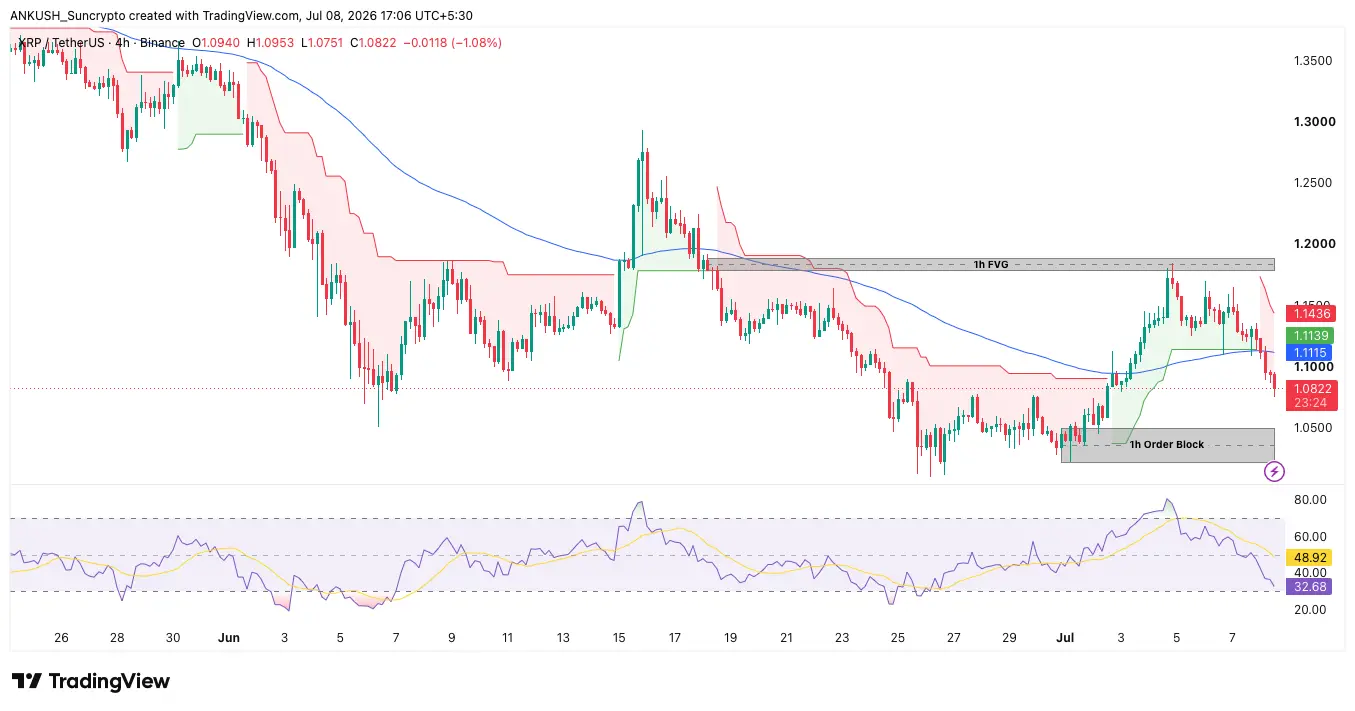
Despite this wave of structural demand, the price reaction has been more muted than the underlying metrics might suggest. XRP is currently trading around $1.09 (₹103.89) with a surge of 4.81% in the past 7 days, having climbed off a low near $1.00 after a rough first half of 2026 that saw the token shed more than 44% amid a broader market-wide downturn.
The late-June bounce was in sync with the surge in wallets and the subsequent surge in ETF buying, with a roughly 5–8% bounce off the lows coinciding with a eighth consecutive week of net ETF inflows in early July. Despite that, price action hasn’t matched network fundamentals as yet — and some analysts see this as another indicator that the on-chain growth hasn’t been fully priced in yet, whereas others attribute it to Bitcoin’s own volatility and the still-pending CLARITY Act passing in the U.S. Senate as bigger near-term drivers than tokenization or wallet data alone.
Key technical levels for investors to watch out are as follows:
- Immediate support sits near $1.05, tested multiple times in June.
- The psychological floor at $1.00 remains critical for bullish continuation setups.
- A break below $1.00 opens an air pocket toward $0.80.
- First resistance stands near $1.14, where recent rallies have stalled.
- A close above $1.20 would signal a genuine trend reversal.
- Stronger resistance sits at $1.27, last year’s early consolidation range.
- Extended upside targets sit near $1.35 to $1.49 zone.
What does this mean for the future of XRP adoption?
None of these signals could be expected to produce a lasting impact on their own. Tokenized assets could plateau, ETF inflows could slow if broader crypto markets weaken further, and wallet growth could prove temporary. What makes the current moment worth watching is that three independent demand channels , asset tokenization, institutional capital, and grassroots user growth, are expanding in parallel rather than in isolation.
That kind of alignment is rare and, according to analysts tracking the space, resembles the early stages of genuine network effects rather than a single-narrative rally. The coming quarters, particularly how issuers scale tokenized offerings and whether ETF inflows hold through market volatility, will determine whether this becomes a defining chapter in the XRP adoption story.
Final Thoughts
The story unfolding around XRP adoption this week isn’t just about a single headline number, but rather convergence. Nearly $4 billion in tokenized real-world assets, sustained ETF inflows approaching $1.5 billion, and a 40% surge in new wallets are each meaningful signals of demand on their own. Seen together, they suggest a network moving from speculative attention toward practical, institution-grade utility.
Whether this momentum compounds into lasting adoption will depend on continued execution , more tokenized products, sustained capital flows, and genuine user retention. For now, the data paints a picture of an ecosystem building real infrastructure, one settlement and one wallet at a time.
Are banks actually using XRP for transactions?
Yes, leading financial institutions—such as SBI Remit in Japan, Siam Commercial Bank in Thailand, and Onafriq in Africa—use XRP-powered liquidity (ODL) corridors for real-time cross-border settlements.
How are ETFs impacting XRP adoption?
Spot and futures XRP ETFs have seen significant capital inflows. These regulated wrappers allow traditional investors, asset managers, and institutional treasuries to easily allocate capital to the asset without directly holding the token.
What is Ripple’s RLUSD and does it replace XRP?
RLUSD is Ripple’s regulated US dollar-backed stablecoin that runs on both the XRPL and Ethereum. It complements XRP by serving as an on-chain digital dollar for institutional settlements but does not replace XRP, which remains the native asset for network liquidity and gas fees