

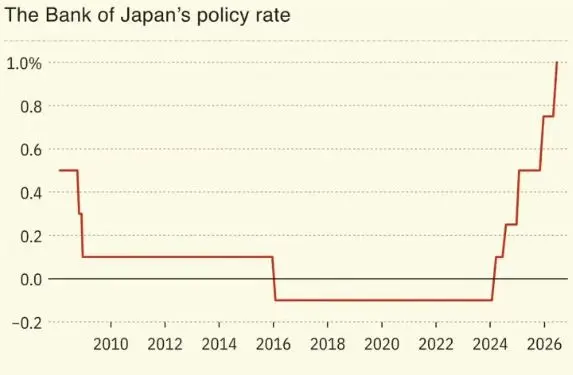
The Japan Bank rate raised its benchmark borrowing cost to 1% in the recent meeting, its highest level since 1995. This move generally signals trouble for risk assets, since pricier Yen funding tends to choke off the carry trades that quietly prop up crypto and equity markets alike. But in this case, traders shrugged off the headline number and paid attention to the finer details of the announcement instead.
So come, let’s understand what actually happened in the recent Bank of Japan meeting and why the rate climbed so steeply, as well as possible implications for Bitcoin and other digital assets in the future.
What is the Japan Bank Rate and why does it matter?
The Japan Bank rate is the benchmark short-term borrowing cost set by the Bank of Japan, the country’s central bank. It functions similarly to policy rates set by the U.S. Federal Reserve or the European Central Bank, and influences everything from mortgages to bond yields, and, increasingly, appetite for risk assets like Bitcoin.
For years, Japan had kept this rate near zero, or even below that, meaning the Yen was the cheapest major currency to borrow in. There were investors making profits from borrowing Yen abroad, to purchase higher-yielding assets, a widely known yield vehicle called the Yen Carry Trade. A large change in the Japan Bank rate therefore is bound to affect liquidity in Tokyo and markets around the globe, including crypto.
What happened during the Bank of Japan interest rate decision time?
The latest Bank of Japan interest rate on June 16, 2026, at the end of a two-day policy meeting. Here’s a quick rundown of what unfolded:
- Policy rate raised 25 bps to exactly 1%.
- Japan’s highest borrowing rate level since 1995.
- The board voted 7-1 for the latest hike.
- Deputy Governor Himino chaired the meeting; Governor Ueda absent.
- The single dissenting vote was in opposition to concern about the economy’s growth momentum.
- Decision largely in line with expectations suggested by a recent poll.
- Bond taper paused, monthly purchases fixed at close to two trillion Yen.
- Japanese Yen around ¥160.2/USD after the announcement.
This marked the fourth increase in a tightening cycle that began back in March 2024, when Japan first exited its long-running negative rate policy.
Why did the Japan Bank Rate climb to a 31-year high?
Multiple factors propelled the Japan Bank rate to its highest level in 31 years since 1995. The key factors behind this tightening include:
- Geopolitical uncertainty shot up in the Middle East driving the pass-through of rising global energy costs into consumer goods.
- Japan’s core inflation remained below the BOJ’s 2% target in April, although policymakers expressed concern that higher energy prices could reignite inflation pressures.
- Three Bank of Japan members already called for a rate hike prior to the meeting.
- A widely reported Reuters survey indicated that most economists had foreseen the move well ahead of the official announcement.
- Impressive wage gains in the Japanese economy gave the central bank reassurance that inflation can remain durable in the long run.
- Three decades of ultra-expansionary policy meant that there was very little room allowing the central bank to normalize policy before it became inevitable.
What else did the Bank of Japan interest rate decision reveal?
More than just headline hike, the Bank of Japan interest rate decision carried details that mattered just as much to traders watching closely:
- Bond purchase taper will officially pause from April 2027.
- Monthly government purchases remain stuck at ¥2 trillion bond purchases
- Aim is to limit pressure on long-term bond yields.
- Dovish bond signals helped offset hawkish headline rate hike.
- There is still room for more tightening if inflation continues to rise.
- Future policy moves will be tightly linked to incoming economic data.
Impact of Japan Bank Rate hike on crypto market
History gave traders every reason to brace for a rough session. Every prior round of tightening since the Bank of Japan first exited negative rates in March 2024 has dragged Bitcoin down somewhere between 18% and 32% in the following weeks: 18% for the March 2024 hike, 30% for the July 2024 increase, 31% for January 2025, and 32% for December 2025. That is why the most recent rise felt so unusual. Despite cutting 18% at its peak in the UK session, Bitcoin dipped slightly in the Asian session before bouncing back and closing near $66,000 after a subtle and almost orderly decline.
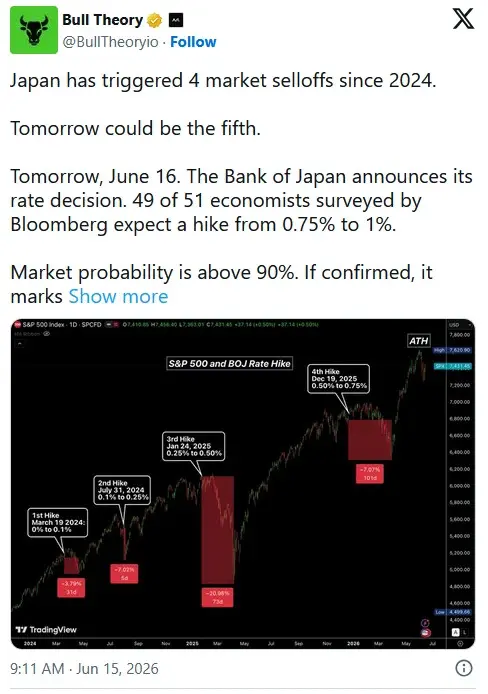
The dovish detail buried in the announcement deserves most of the credit. By pledging to pause its bond-purchase taper and hold monthly government bond buying near 2 trillion yen from April 2027, the central bank signaled it wants to keep a lid on long-term borrowing costs even while raising the short-term policy rate. That combination told leveraged traders the Japan Bank rate isn’t sprinting toward aggressive tightening, which reduced the urgency to unwind yen-funded positions all at once.
The reaction wasn’t uniform across the crypto market, though, and a look at individual tokens shows where the strength and the lingering risk really sit:
- Bitcoin (BTC) dipped early, then steadied near $65,800–$66,000, supported by sizable whale accumulation.
- Ethereum (ETH) outperformed the broader market, climbing close to 2% to trade around $1,793.
- XRP stayed choppy near $1.20–$1.22, reflecting its history as the token most exposed to yen carry-trade unwinds.
- Solana (SOL) pushed nearly 0.5% higher to around $73.70, a slight upside bounce after a grim macro run.
- Stellar (XLM), Injective (INJ) and Uniswap (UNI) made up the day’s strongest performers of the top 100 cryptos by market cap.
- Spot bitcoin ETFs also helped, snapping a longer outflow run with new net inflows led by BlackRock’s IBIT fund.
But the broader crypto market remains more complicated than that. The carry trade remains one of the most effective transmission mechanisms in the market for Tokyo’s monetary stance and crypto price swings, and tokens like XRP, with comparatively thin order books and concentrated speculative positioning, tend to feel that pressure faster and harder than bitcoin or ethereum.
A sharper-than-expected strengthening of the yen, or any signal that the central bank intends to move faster than the data-dependent pace it has promised, could still trigger forced deleveraging across exchanges. For now though, the Japan bank rate hike seems to be getting a cushion from new institutional flows, continued whale activity and a market that’s given up on all-but-catastrophic macro moves never translating into a selloff.
Final Thoughts
Japan’s decision to lift borrowing costs to a 31-year high is a genuine turning point after decades of near-zero rates but markets seemed to accept the reality with some calm. Bitcoin’s resilience this time indicates that crypto investors are becoming more sophisticated, factoring in the entire policy picture rather than concentrating on a single rate print.
Whether this decoupling is sustainable will be decided by how inflation plays out in Japan and whether the next Bank of Japan interest rate decision keeps following a slow, data-dependent pace or quickly speeds up for further hikes in the coming months. Either way, this is one macro thread that is worth keeping an eye on for anyone looking to trace bitcoin’s next move.
Read More: How to file crypto tax in India?
What time is the Bank of Japan interest rate decision?
The Bank of Japan (BOJ) typically announces its monetary policy decisions between 11:45 AM and 1:00 PM Japan Standard Time (JST) (02:45–04:00 GMT). Because BOJ meetings span two days, the decision is always released on the final day of the meeting.
When was the latest Bank of Japan interest rate decision?
The latest Bank of Japan (BOJ) interest rate decision occurred on Tuesday, June 16, 2026.
Why did the Bank of Japan increase the interest rate?
The BOJ raised rates to 1% because policymakers were concerned that rising energy costs, a weak yen, and potential future inflation pressures could push inflation above its 2% target. The move also reflects Japan’s gradual normalization of monetary policy after decades of ultra-low interest rates.