
Bitcoin mining has always been a game of margins, where the cost of running a rig quietly decides who survives a downturn. However, in June 2026, that math turned against the miners. JPMorgan analysts led by managing director Nikolaos Panigirtzoglou now say Bitcoin has traded below its estimated production cost for five straight months, leaving close to one in five miners underwater. With BTC hovering near $63,000 and an all-in cost of Bitcoin mining about $78,000, the gap is a structural squeeze that has the potential to change the market substantially. Here’s what’s happening and why it matters.
What is Bitcoin Mining?
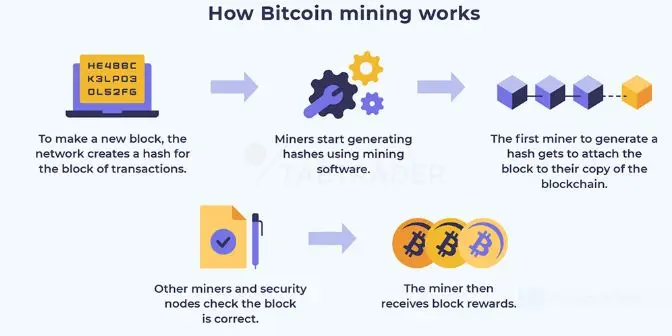
Bitcoin mining is the process through which specialized computers known as ASICs perform trillions of cryptographic hash calculations to find a valid block hash. Successful miners add new blocks to the Bitcoin blockchain and receive block rewards plus transaction fees. That process securely maintains the network while incentivizing the controlled creation of coins, with a reward that halves every four years.
The current Bitcoin mining reward is 3.125 BTC per block after the most recent halving. Since this is an energy-intensive business, electricity rates, hardware efficiency, and Bitcoin’s market price together decide whether an operation turns a profit or bleeds cash.
Why has Bitcoin mining suddenly turned unprofitable for many operators?
The most obvious reason is that BTC’s market price has dipped below the production cost of 1 Bitcoin. Analysts estimate Bitcoin’s all-in production cost, including electricity, hardware depreciation, and operating expenses, at approximately $78,000 per BTC.
As of mid-June 2026, Bitcoin is trading at $63,500-$65,500, which translates to a 19-20% gap between its market price and production cost. Keeping this gap in mind, many analysts estimate that about 20% of the global mining industry is currently unprofitable.
How is Bitcoin mining difficulty affected by price fluctuations?
A key finding concerns the “beta of difficulty to BTC prices,” which measures how strongly this metric reacts to price moves. Over six months, this beta climbed to 0.62, pointing to a network where many operators run near their cost floor, switching machines on or off rather than holding steady, reported by JP Morgan’s note.
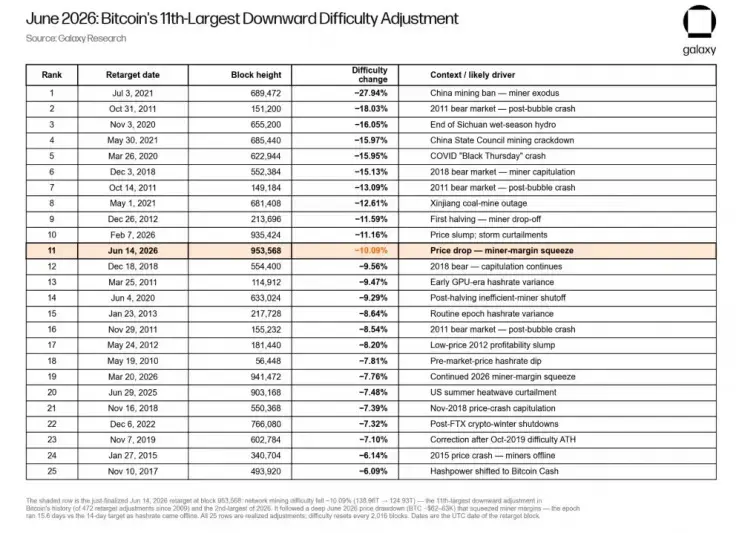
This showed up mid-June, when difficulty fell roughly 10.09%, and occurred specifically at block 953,568 on June 14, the second drawdown of that scale this year. Galaxy Research separately reported hashrate dropping around 12% in June, after a comparable 10% difficulty adjustment in January.
What are public Bitcoin mining companies doing to survive?
Faced with shrinking Bitcoin mining rewards, listed companies have leaned hard on their balance sheets. MARA, CleanSpark, Riot Platforms, Cango, Core Scientific, and Bitdeer together sold around 32,000 BTC in Q1 2026 alone, per TheEnergyMag data cited by JPMorgan. That already exceeds their combined 2025 sales and sets a new quarterly record, beating 20,000 BTC sold in Q2 2022 during the post-Terra-Luna bear market. A few patterns emerge here:
- Public miners are prioritizing liquidity over reserves
- Quarterly coin sales now exceed full-year 2025 totals
- Older, less efficient rigs are being powered down
- Smaller operators face more pressure
Why has BTC mining revenue per unit of power dropped?
A useful lens is “hashprice,” which measures revenue earned per unit of computing power. Hashrate Index puts this at roughly $33 per petahash per day [reported by JP Morgan] and $28 per petahash per day [reported by Galaxy Research], low enough to push a fifth of the sector into the red.
The compression comes with soft prices, higher difficulty during periods of strength and stagnant fee revenue, conditions under which older hardware becomes uneconomical especially where power is expensive.

Is there a silver lining for Bitcoin Mining?
Amid this gloominess, analysts generally don’t have a bearish take on Bitcoin itself. Periods of sentiment shift this negative throughout history have typically been contrarian signals and had foreshadowed recoveries. The higher-cost operators capitulate first, allowing difficulty to come down and margins to be higher for the remaining participants, as seen in 2022.
The bank expects that the sensitivity to remain elevated as long as BTC sits well below the base case production cost, and further capitulation is expected up to the remaining part of 2026 if there is no good price recovery.
What do Bitcoin Mining treasuries tell us about this cycle?
Collectively, BTC miners now hold around 1.8 million BTC at the time of publication, down from roughly 1.86 million at the end of 2023 [not properly confirmed]. That looks modest at a glance but reflects an ongoing drawdown rather than a one-off. For Indian investors tracking these trends, this matters because the resulting sell pressure adds another layer to short-term price action.
Final Thoughts
This stretch for Bitcoin mining ranks among the more demanding and crucial phases the industry has faced recently, with a fifth of operators running at a loss and listed miners offloading record BTC volumes just to stay operational.
Yet, as JPMorgan notes, these exact conditions have historically preceded recoveries, making this less a story of decline and more one of cyclical recalibration. Tracking hash price, difficulty trends, and treasury movements remains one of the more reliable ways to gauge the network’s underlying health.
Is Bitcoin mining legal?
In most regions (including India), mining is completely legal but entirely unregulated by specific permits. However, earnings from mined Bitcoins are subject to applicable tax laws (such as a 30% flat tax on cryptocurrency income in India, with strict caveats on deduction claims).
What is the current Bitcoin mining reward?
The current Bitcoin mining block reward is 3.125 BTC per block. In addition to this fixed subsidy, miners also collect all the transaction fees included in that specific block.
Can I start BTC mining too?
Yes, you can start Bitcoin mining, but because the network is so competitive, you cannot use a regular home computer. To be successful, you must invest in specialized hardware (ASIC miners), join a mining pool to combine computing power, and have access to extremely low-cost electricity.