
For years, crypto projects generated significant trading fees and user activity without creating a direct benefit for their native tokens. Now, crypto revenue is increasingly becoming the link between protocol growth and token value, as projects direct platform fees toward buybacks, burns and other forms of token value accrual.
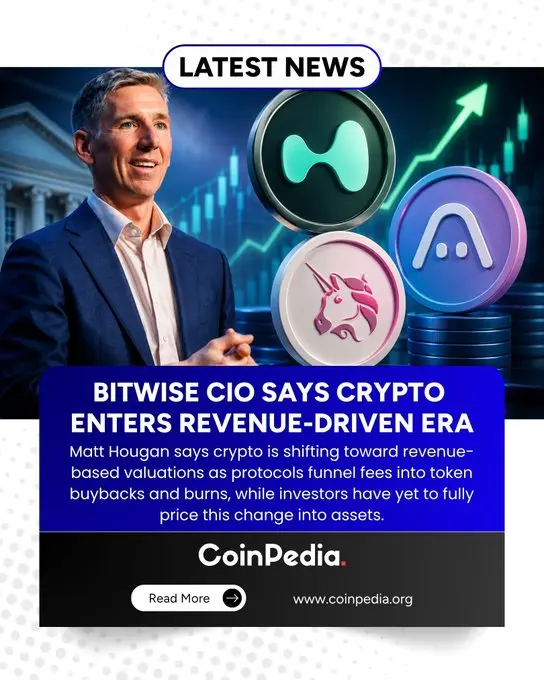
Bitwise CIO Matt Hougan recently highlighted this shift, pointing to protocols including Hyperliquid, Pump.fun, Uniswap, Aave, Aptos and Solana as examples of projects changing how their tokens capture value. The broader trend suggests crypto revenue is moving closer to the center of the token-investment narrative.
The model is straightforward: a protocol generates fees from user activity, uses a portion to purchase its native token, then burns those tokens or removes them from circulation. In theory, stronger protocol activity creates additional demand for the token while reducing its available supply.
Crypto revenue makes Hyperliquid a key example
Hyperliquid is one of the strongest examples of this model in practice. The decentralized derivatives platform routes 97% to 99% of the fees generated by its perpetuals and spot markets into an on-chain mechanism called the Assistance Fund, which buys HYPE on the open market continuously and automatically, with no manual intervention.
The scale is substantial. By May 2026, the Assistance Fund had deployed more than $1.3 billion and held roughly 28.5 million HYPE, with the buyback running at close to 7% of the token’s market capitalization each year, several times the effective rate returned to holders by Ethereum or BNB.
Purchased tokens are held in a protocol-controlled wallet rather than burned automatically from the outset. A December 2025 governance vote, passed by around 85% of validators, raised the allocation toward 99% for certain fee categories and committed to permanent burns on a portion of the Fund’s holdings, moving the programme from discretionary policy toward a fixed commitment.
What makes the model significant is the connection between usage and demand: more trading activity means more fees, and more fees mean greater buying pressure on HYPE. That is why crypto revenue could become an increasingly important metric for investors looking beyond price charts and market narratives.
It also comes with a specific risk. The allocation is set by validator vote, not hard-coded, so a future vote could lower it or redirect fees. And the engine runs on a single fuel source: perpetual futures trading fees.
Crypto revenue is reaching Uniswap and Aave.
Uniswap has moved from proposal to execution. Its UNification proposal passed in late December 2025 with 99.9% governance support more than 125 million votes in favor against 742 opposed activating the protocol’s long-discussed fee switch and routing a portion of trading fees, previously paid entirely to liquidity providers, into a UNI burn mechanism.
The proposal also executed a one-time retroactive burn of 100 million UNI from the treasury, worth close to $600 million at the time, representing an estimate of what would have been burned had the fee switch existed since launch.
The mechanism is now producing recurring burns. Total UNI destroyed passed 100 million within weeks of activation, equivalent to roughly 10% of the original 1 billion supply, and burn activity has since accelerated: a recent single-day burn reached 106,000 UNI, with annualised burns tracking around $170 million. Uniswap governance subsequently extended the fee switch to v4 pools across seven networks under Proposal 100, collecting roughly one-sixth of swap fees into TokenJar contracts and lifting daily protocol revenue to about $325,000 from a prior run rate near $114,000.
Aave has also moved toward recurring AAVE buybacks using protocol revenue. Its updated Aavenomics framework directs revenue from the protocol and GHO stablecoin ecosystem toward automated buybacks. Across these models, the underlying idea is similar: if a protocol earns more through genuine user activity, some of that value can flow back to the token.
Crypto revenue is driving more aggressive token burns
Crypto revenue is driving Pump.fun to take the trend even further. The platform burned roughly $370 million worth of PUMP tokens, about 36% of its circulating supply, and committed 50% of net revenue for one year to programmatic buybacks and burns. The scale shows how crypto revenue is being used not just as a metric, but as a mechanism for actively reshaping token supply.
Crypto revenue alone cannot guarantee token growth
Crypto revenue alone cannot guarantee that buybacks and burns will lift token prices. The bigger question is sustainability. A protocol can execute a large one-time burn, but if user activity declines afterward, recurring revenue may not support the same buyback pace. Token unlocks, emissions and broader market selling can also offset supply reductions.
The real value of crypto revenue lies not in how much a protocol earns, but in whether that revenue is consistent, growing and meaningfully tied to the token, a distinction that could separate protocols with genuinely improving economics from those using buybacks mainly as a short-term catalyst.
Crypto revenue could redefine how tokens are valued
Crypto revenue could ultimately redefine how tokens are valued, reflecting a broader attempt to move valuation toward fundamentals. Instead of asking only how large a protocol could become, investors can increasingly examine how much revenue it generates, where that revenue goes, and whether holders actually benefit from growing usage.
That doesn’t eliminate the risks around crypto assets; tokenomics can still change through governance, supply can still expand through emissions, and prices remain influenced by sentiment. But the direction is notable. As more protocols connect fees to buybacks and burns, crypto revenue could become one of the metrics investors watch most closely. The bigger test is whether these mechanisms hold up once market excitement fades and growth has to stand on its own.
For an industry often criticized for relying more on narratives than fundamentals, the growing emphasis on crypto revenue could mark a meaningful shift in how tokens are evaluated.
What does “crypto revenue” mean in the context of token buybacks?
It refers to the actual fees a protocol earns from user activity (trading, borrowing, transactions), as opposed to token issuance or speculative valuation. A growing number of protocols now route a share of this crypto revenue into buying back and burning their native token.
How is crypto revenue used differently from traditional stock buybacks?
The mechanism is similar in spirit, using earnings to reduce supply and support value, but crypto revenue-funded buybacks are typically automated, on-chain, and often burn the repurchased tokens permanently rather than holding them as treasury shares.
Does more crypto revenue guarantee a higher token price?
No. Price still depends on sustained crypto revenue, ongoing user activity, token unlocks, emissions, and broader market sentiment. A one-time burn without recurring revenue may have only a short-term effect.