
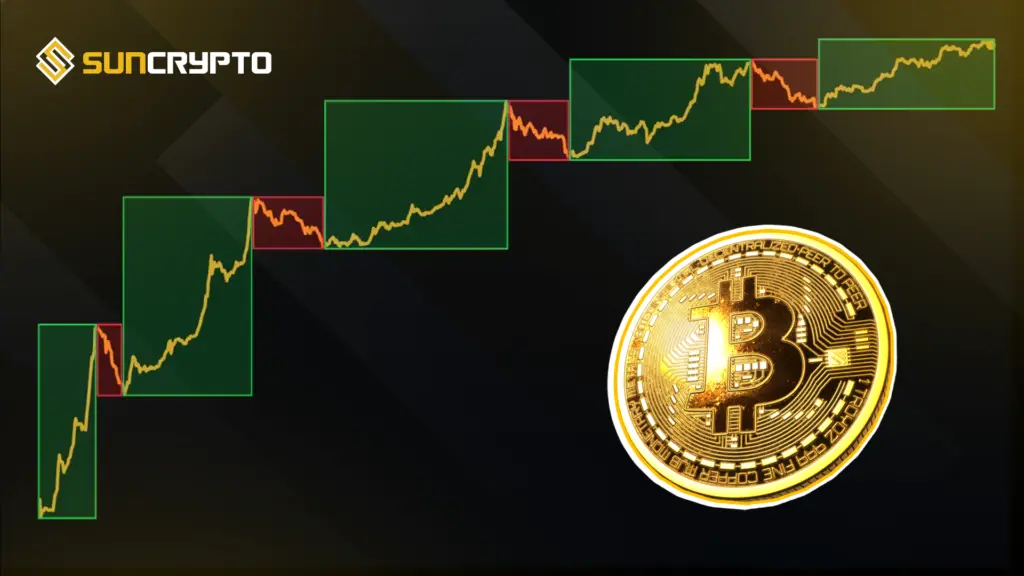
The Bitcoin four year cycle is one of the most highly watched patterns in the financial markets. Over the years, the Bitcoin prices have moved through distinct phases of accumulation, bull run, blow-off top, and bear market, all of which roughly coincide with the key event known as the halving.
Although no two cycles are identical, it has maintained a consistent rhythm enough to influence the trading, analysis, and investment perspective of the market participants. By understanding this setup, investors can make more informed decisions rather than reacting emotionally to short-term volatility.
What is a typical Bitcoin four year cycle?
Market experts believe that typical Bitcoin cycles start with the accumulation phase of the market. This phase starts after the crash that follows the previous cycle’s peak. This time period is characterized by low price volatility, a low number of active transactions, and a ‘neutral to negative’ sentiment of the markets.
It’s named as such because long-term Bitcoin holders start to slowly accumulate coins believed to be highly discounted. This makes for a slow and quiet downward trend in the price, which is largely ignored by the general public. On-chain analytics reveal steady buying by seasoned investors, but most of the retail crowd remains burned and wary from the previous crash, keeping participation thin.
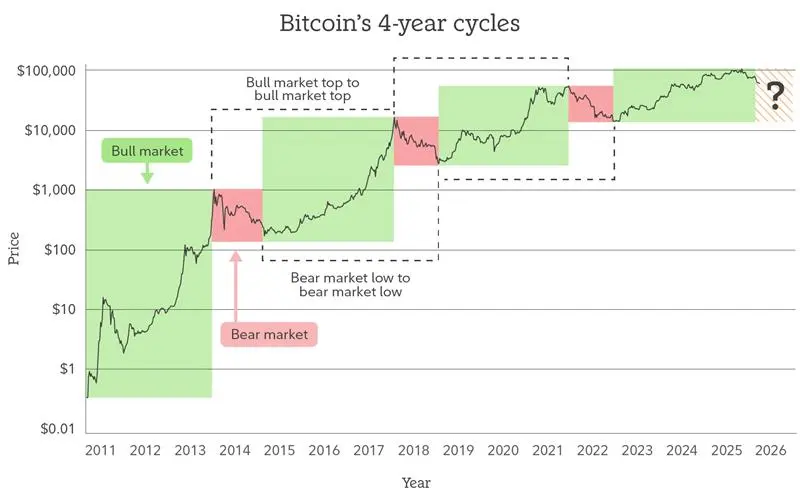
After the accumulation phase, which typically lasts around 12 to 15 months, the bitcoin four year cycle historically transitions into the early stages of a new bull market. This transition usually happens in the immediate preceding period before halving, due to the rise in Bitcoin prices and other cryptocurrencies as the demand outweighs the rest of their supply.
The atmosphere becomes more positive, the volume of cash interested in the market begins to grow, and attention from the media increases. The number of new wallet addresses gradually increases, which is a good on-chain indicator of new entrants to the ecosystem.
Once the halving actually occurs, the bull market has historically turned parabolic. Market action starts slow but gets faster and faster, even near explosive, as the retail flow gets in and traders begin running off capital. New all-time highs are set as a huge amount of new investors enter the market. At this point, leveraging increases at a high rate, and traders take on debt to gain even more leverage and ride the momentum. Then the price action starts to become a lot more dynamic, and altcoins often register even higher percentage gains in addition to Bitcoin, attracting even more speculation.
Historically, bull market cycles have lasted for about 12-18 months followed by a robust and sometimes severe correction. Leveraged traders are wiped out in cascading liquidations, altcoin holders experience even greater losses than the Bitcoin holders, and the overall sentiment is turned down.
The bear market begins when many investors start dumping their holdings at a loss just to preserve whatever capital they have left. Over time the volatility fades, the bottom of the market takes shape, and the process starts all over again. Activity and excitement often sink precipitously from the high point, but dedicated developers and builders keep quietly toiling in the background.
How does Bitcoin Halving trigger a new cycle?
The process of halving is the heart of Bitcoin four year cycle theory, a programmed event in the Bitcoin blockchain that reduces the mining reward by 50% every 210,000 blocks, which corresponds to approximately 4 years. The initial miner payout was 50 BTC/block when the network was launched by Satoshi Nakamoto in 2009. With the next halving scheduled for April 2024, that reward is now down to 3.125 BTC. The halving cycle is projected to reach 2028, further cutting the block reward down to 1.5625 BTC, resulting in an even tighter situation of new supply issuance.
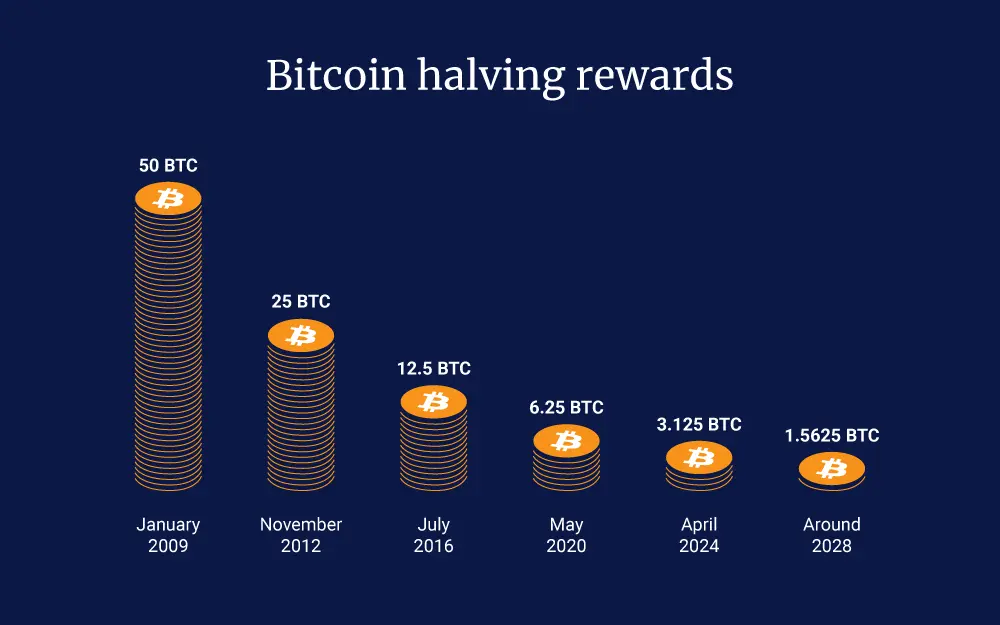
This constructed scarcity is similar to that of gold, which becomes more difficult to extract with the passage of time. This engineered scarcity mirrors gold, which becomes harder to mine over time. As new supply shrinks, the demand-supply imbalance historically pushes prices higher, forming the foundation of every Bitcoin four year cycle.
Every major Bitcoin four year cycle from 2013 to 2025
- 2013: The first Bitcoin four year cycle, representing the era of cryptography communities and early internet forums. Mt. Gox was responsible for more than 70% of all Bitcoin wallets in the world until it went under when more than 850,000 coins vanished. This resulted in a reduction in the price by 85%, setting the tone for the first big bear market.
- 2017: This year brought the cryptocurrency into reality. In 2015, Ethereum was launched, and since then, thousands of ERC-20 tokens were found, leading to the creation of ICO mania, which pumped high amounts of capital into the cryptocurrency market. But Bitcoin prices have increased from $200 to $20,000 in 2.5 years before crashing 84% to $3,200 as the SEC cracked down on unregistered securities and overleveraged investors were wiped out.
- 2021: This year was governed by the pandemic-era money printing and an explosion of global fiscal stimulus. The demand for Bitcoin liquidity increased as institutions started investing; Strategy and Tesla made their BTC purchases, while DeFi and NFT projects saw retail investment reach a new high. The bitcoin four year cycle finally ended with the Luna/UST collapse and bankruptcies of Voyager, Celsius, BlockFi, and FTX, then saw the price fall near $15,500.
- 2025: At an all-time high market cap of approximately $2.5 trillion as of October 2025, BTC became much more liquid than in previous cycles. It crossed the mark of $126,210 on October 6, 2025, marking its highest cycle peak ever. However, one of the biggest contributors was the Spot Bitcoin ETF itself, approved in January 2024, which has channeled an estimated $15 billion into its fund since its launch, which has effectively ushered in the era of institutional-driven price discovery.
Why do Bitcoin prices follow a recurring cycle?
The cyclicality of Bitcoin prices is fueled by several interwoven factors. The Stock-to-Flow (S2F) model compares existing supply to annual new supply, and with each halving, BTC’s S2F ratio doubles. Right now, the S2F ratio is about 110, which is much lower than gold’s S2F indicator that is in the 60s, and thus BTC is the more scarce of the two resources.
Besides the economies of supply, there is a psychology to consider as well. Since the Bitcoin four year cycle have repeated themselves many times, traders are programmed to behave in cycle-synchronous ways, leading to a self-fulfilling prophecy. Global cycles of liquidity also have an impact: the 2021 peak was when the money printing started at the end of the COVID main cycle, and a tightening of money policy was a factor in the subsequent crashing.
Are Bitcoin cycles becoming irrelevant?
The trends surrounding the price of Bitcoin have been developing over the last few cycles, and the question of whether the Bitcoin four year cycle is still relevant or not is intensifying. Historically, cycle tops and bottoms have featured bounces but are moderated by the institutional investors, whose disciplined risk management and predictable purchasing patterns have tempered the volatility.
Furthermore, BTC’s sensitivity to macroeconomic factors, such as the Fed’s monetary policy, international liquidity, etc., has been growing, and they occur on a monthly or quarterly rather than a four-year basis. The halving also makes the reward-to-price ratio significant; the lesser the reward/price, the more significant the supply shock. The first halving was 50 BTC to 25 BTC, which was far more significant in terms of supply shock and price than the current 6.25 to 3.125 BTC.
Will the Bitcoin cycles continue? What the data says
A few important indicators will help make things a bit more clear, whether or not the Bitcoin four year cycle repeats itself in the future. In previous cycles, blow-off tops at ~12-18 months after the halving have driven cascading liquidations resulting in 70%+ withdrawal from the crypto space and a retail FOMO-driven surge in altcoin activity.
The latest retail cycle to run in 2025, interestingly, didn’t feature quite the same retail frenzy as earlier cycles with institutional buying dominating the narrative. BTC is no longer an outlier within the financial market, a change that is increasingly evident in the data. No matter how it proceeds in the next cycle, or if it changes course altogether, all of the pressure of scarcity, liquidity, and human psychology will not disappear forever.
Final Thoughts
The Bitcoin four year cycle continues to be one of the most intriguing phenomena in modern finance, a phenomenon that is rooted in code, which is fueled by psychology, and which is inevitably increasing in its influence from a trillion-dollar institution. Each cycle brings along a set of maturity in the asset and the participants, ranging from the 2013 Mt. Gox to 2025 ETF and institutional trading.
The cyclical nature of accumulation, bull runs, and bear markets may become mild and change in composition; however, BTC is constantly providing a reward to those understanding the moves driving its price. With the 2028 halving fast approaching, the very existence of cycles is not the issue already, but rather how they will manifest in the future.
Disclaimer: Crypto products and NFTs are unregulated and can be highly risky. There may be no regulatory recourse for any loss from such transactions.
What is the Bitcoin Four Year Cycle?
The Bitcoin Four Year Cycle is a recurring market pattern driven by BTC’s programmatic supply dynamics, historically resulting in a multi-year cycle of bull markets, peak euphoria, bear markets, and accumulation.
When is the next Bitcoin Halving?
The next Bitcoin halving is projected to occur in April 2028, at block height 1,050,000. During this event, the block reward for miners will be cut in half, dropping from 3.125 BTC to 1.5625 BTC per block.
How to secure your Bitcoin wallet?
To secure your Bitcoin wallet, use a hardware wallet to keep your private keys offline. Never store your 12- or 24-word seed phrase on a computer or in the cloud. Write the words down on paper or stamp them into titanium, and store them securely in a fireproof and waterproof location.