
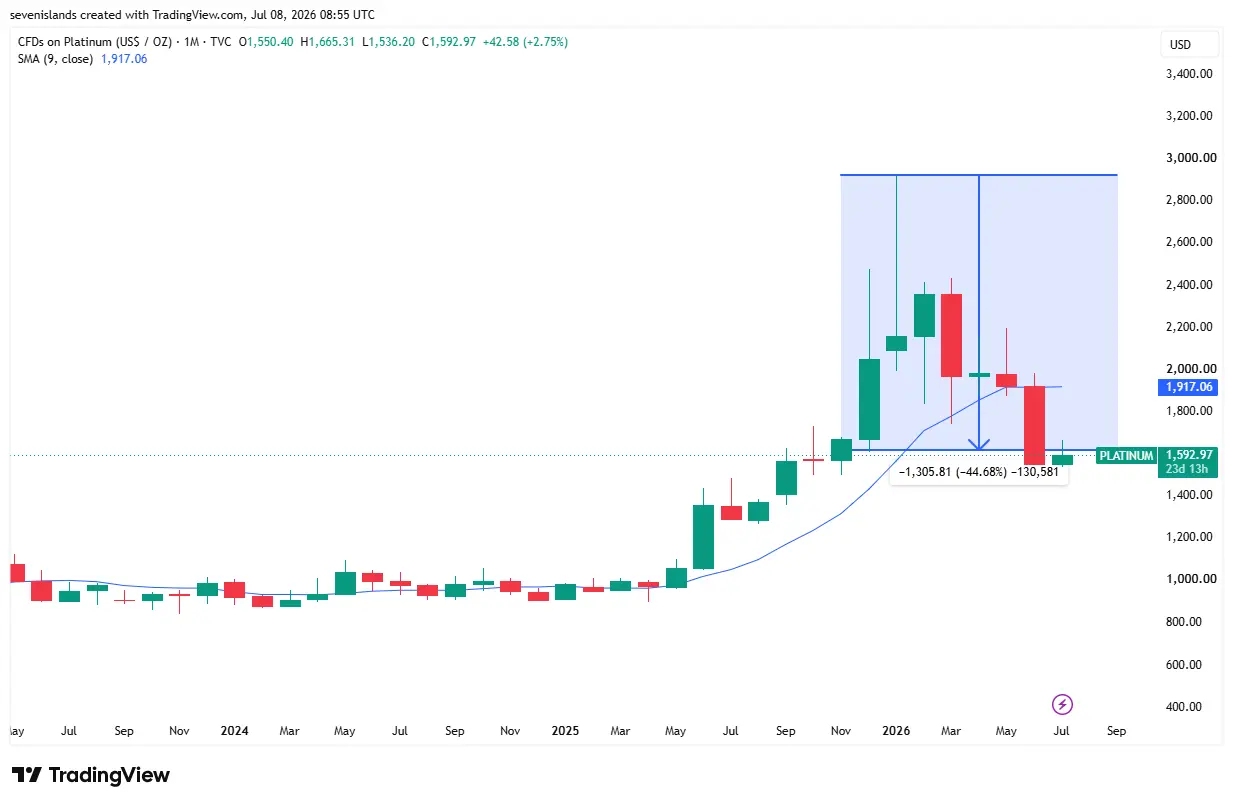
Platinum price has just lived through one of the wildest twelve months in its 250-year trading history, and most retail investors still haven’t noticed it yet. After reaching an astonishing ATH of above $2,923.70 per troy ounce on January 26, 2026, it has since dropped by almost 44% from that value, currently trading at $1,583 per troy ounce as of July 8, 2026. If anyone is looking at the platinum price today, well, it isn’t a flat, dead market, but a market complicated by both a structural current supply shortfall that doesn’t seem to go away and a pocketful of trades that are taking profits after what will likely be the most remarkable roaring rally in precious metal history.
This guide breaks down everything driving XPT price right now: the live numbers, the historical context, the futures positioning, the mining and industrial fundamentals, the macro backdrop, and where the metal could realistically head over the coming months and years. Whether you’re a long-term holder, a futures trader, or someone exploring platinum through a tokenized asset like SunCrypto’s XPT/INR pair, this is the deep-dive reference built for both today and the months ahead.
What is Platinum (XPT) and why does it trade as a commodity and crypto asset?
Platinum is a heavy, naturally white, corrosion-resistant metal that is part of the platinum-group metals (PGM) family with palladium and rhodium. Unlike gold, which is mostly a monetary and a jewelry metal, platinum is a fundamental heavy-industry metal used in automotive catalytic converters, petroleum refining, chemical manufacturing, glassmaking, and increasingly, the hydrogen economy.
Because of this nature, the price of the metal is influenced both by investor sentiment (the same thing that drives gold) and by industrial cycles (the same thing that drives copper or oil). Furthermore, in the last few years or so, platinum has also started to be tradable as a synthetic or tokenized commodity-backed instrument on crypto platforms. Here it is listed under the ticker XPT and can be traded with 24/7 liquidity and directional leverage like everything else on crypto exchanges. This lets traders access platinum price action with leverage and 24/7 liquidity, something the traditional bullion and futures markets never offered retail participants in Asia.
What is the Platinum price today?
Here is where things stand as of July 8, 2026, based on live spot data from major bullion desks:
| Platinum spot (bid/ask) | $1,583.00 / $1,599.00 per oz |
| 24-hour change | -(4.18%) |
| Price in INR (approx.) | ₹1,55,400 – ₹1,56,400 per oz |
| Price per gram (USD) | $52.80 |
| Distance from January 2026 all-time high | ~43% |
| Palladium spot (for comparison) | $1,205 / $1,245 |
| Rhodium spot (for comparison) | $7,925 / $8,925 |
| Gold spot (for comparison) | $4052 / $4054 |
How does Platinum trade differently across Spot, Futures, and Crypto markets?
The spot market is the price when you can get physical metal immediately, quoted continuously by dealers based in London, New York and Zurich. The futures market is the price for delivery ahead of today, dominated by NYMEX (a CME Group company), allowing hedgers and traders to lock in prices months forward, and this curve becomes the global benchmark for the spot market used by refiners and jewelers.
Crypto-native platforms like SunCrypto offer a third route: a derivative token XPT whose price moves with the spot price but settles instantly on-chain and offers leverage and INR margin that commodity exchanges in India do not offer to retail users.
Where does Platinum rank in the precious metals hierarchy versus Gold and Silver?
This is genuinely one of the more remarkable stories in metals markets right now. For most of the 1990s and 2000s, platinum price traded at a significant premium to gold; it was considered the “aristocrat” of precious metals. The relationship turned around after 2012, and today gold trades at about $4052 an ounce while platinum trades at $1583 an ounce, meaning gold now costs about 2.5 times as much as platinum per ounce. Silver, meanwhile, sits near $60 an ounce. Many analysts view this gold-to-platinum gap as historically stretched, which is part of why platinum has attracted fresh institutional interest even after its recent pullback.
What is Platinum’s all-time high and all-time low, and where does it stand today?
The platinum price history is a story of two extraordinary spikes separated by seventeen quiet years. The metal first hit a then-record high near $2,290 an ounce in March 2008, driven by European diesel-engine demand and severe electricity shortages that shut down South African mines. That record stood untouched through the 2010s, a decade in which platinum actually traded at a persistent discount to gold following the 2015 “Dieselgate” scandal, which crushed demand for diesel catalytic converters.
But everything changed in 2025. A structural supply shortfall and high lease rates in London, combined with an upsurge of new Chinese investment demand channeled through the Guangzhou Futures Exchange, catapulted the metal up once more, 150%+/YoY, setting the stage for an all-time high better than 2008 at an intraday high of roughly $2,923.70 per troy ounce on 26th January 2026.
Since then, the metal has cooled to today’s $1583 per troy ounce range, meaning the current platinum price today sits roughly 44% below its peak and still well above 2024’s average of under $1,000.
How has the Platinum price performed over 30 Days, 90 Days, 1 Year, and 5 Years?
| Timeframe | Approximate Performance | Key Driver |
| 30 days | Roughly flat to modestly higher, recovering off a 7-month low near $1,600 (June 30, 2026) | Weaker US dollar, cooling labor data |
| 90 days | Down double digits from Q1 2026 highs | Profit-taking after record rally, ETF outflows |
| 1 year | Still up meaningfully year-over-year despite the 2026 pullback | Base effect from 2025’s historic rally |
| 5 years | Up several multiples from the sub-$1,000 lows of 2021–2023 | Structural mine supply deficits, Chinese investment demand |
What caused Platinum’s last major rally and crash?
The 2025–26 rally was fundamentally a supply story layered on top of speculative momentum. South African output remained constrained by power disruptions and aging infrastructure, while above-ground inventories, the buffer stock that normally absorbs demand spikes, shrank to their lowest levels in over a decade. But when some Chinese investors began to view platinum as an undervalued alternative to gold with high potential for appreciation, demand surged, leading to a classic melt-up, which topped out in January 2026.
The subsequent correction wasn’t triggered by a single event so much as an unwinding: exchange-traded fund holders and exchange-warehouse participants who had piled in during 2025 began taking profits once trade-tension premiums started fading, while a stronger dollar through parts of Q2 2026 added extra pressure on dollar-denominated metals.
How has XPT price behaved in previous bull and bear market cycles?
Historically, platinum price bull cycles have been shorter and sharper than gold’s, and its bear markets have often lasted years longer, largely because industrial demand (unlike jewelry or investment demand) is slower to recover once auto production cycles shift. The 2008 spike was followed by more than a decade of underperformance versus gold.
The current cycle looks structurally different because it’s anchored in genuine multi-year mine-supply deficits rather than pure speculation, which is why many analysts believe the current pullback is a correction within a longer uptrend rather than the start of a new multi-year bear phase, though that view isn’t universally shared, and short-term volatility should be expected either way.
How do Platinum Futures work on NYMEX, CME, and which contracts matter most?
Platinum futures trade primarily on NYMEX (part of CME Group), with the standard contract representing 50 troy ounces, alongside smaller-sized contracts for retail-scale participants. These futures contracts are the reference price that the broader platinum price today is built around, since spot quotes are essentially derived from the nearest-month futures price adjusted for financing costs.
The Tokyo Commodity Exchange and London Bullion Market Association (LBMA) fixes are the other two pillars of global price discovery for the metal, with the LBMA’s twice-daily fix still used as the benchmark for many industrial and jewelry contracts.
What is XPT Futures Open Interest telling us right now?
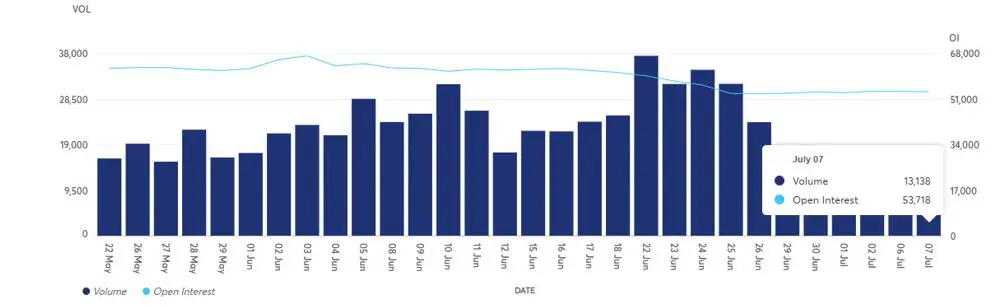
Open interest in NYMEX platinum futures has been elevated through mid-2026 and sits at 53,718 contracts, down from around 57,738 the previous week. Active months driving this open interest include July 2026 and October 2026, with overall market liquidity and pricing currently hovering around the $1583 per ounce, indicating that the position swings that occurred when the metal rallied and confirmed in January and then corrected just as sharply are still present.
When open interest is high and the price is decreasing, as it has been right now for weeks, it traditionally indicates that either new short positions or profitable longs are rolling over at the front end and driving the price action, rather than the market just going quiet, which is a hint platinum’s valuation is still a highly contested position for both bulls and bears.
How are institutional traders positioning in XPT Futures this month?
The CFTC Commitment of Traders data up until mid-2026 indicates that managed money (hedge funds and CTAs) maintains a net long position on platinum futures, but this positioning has been jacked around as the rally and pullback have gone one leg at a time.
Producer and merchant categories, mainly miners and industrial users hedging their physical exposure, remain net short, as they typically are, since they’re locking in prices for future output rather than speculating on direction. The swing factor to watch is whether managed money continues trimming longs into further dollar strength or starts rebuilding positions as the deficit narrative reasserts itself heading into Q3.
Do retail traders take an active role in the Platinum price rally?
Retail participation in platinum has grown significantly through 2025–26, a shift from the precious metal’s historical status as an institutional and industrial metal. In particular, retail buying of platinum bars and coins is expected to increase by 27% over 2026 to about 718,000 oz, as demand from the US, Asia and Europe ran strong in Q1. Finally, retail traders are also gaining direct access to leveraged XPT positions on crypto-native platforms, a new structural element that didn’t exist even two years ago, creating new demand for the metal that the old supply and demand model couldn’t entirely predict.
What’s driving Platinum supply from South Africa, Russia, and the Global Mining landscape?
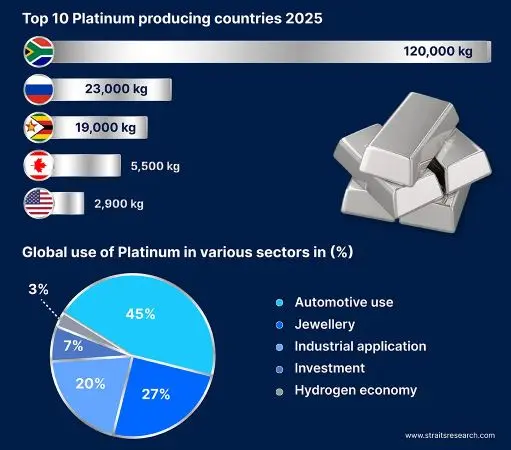
South Africa remains the world’s top producer of platinum, delivering about 70-80%(120,000 Kg) of global annual production, with Russia supplying a further 10-12% (23,000 Kg) and smaller volumes mined in Zimbabwe and North America. South Africa’s production has again and again been impacted by curtailments due to power supply problems and incidents of criminal sabotage of mining site electricity infrastructure, and Russia’s Nornickel is rapidly expanding mine capacity with production expected to run into the 2040s, but technical expansion has not been sufficient to meaningfully reduce the persistent structural tightness in the market.
The World Platinum Investment Council (WPIC) expects mine supply to remain broadly flat at about 5,551,000 ounces for the full year 2026, with losses in the other regions partially offset by a modest 2026 increase in supply from South Africa, a supply outlook that means that whenever demand surprises to the upside, we expect that to exert pressure on the market upward to raise prices.
What is fueling Platinum price demand from Automotive Catalysts to Hydrogen and jewelry?
- Automotive catalysts remain platinum’s single largest use case worldwide.
- Roughly 45% of annual demand comes from vehicle emission-control systems.
- Jewelry consumes close to a quarter of total global platinum output.
- Industrial demand is rebounding sharply on glass sector expansion.
- Hydrogen fuel cell and electrolyser demand is still an early-stage driver.
- India’s jewelry demand is forecast to grow about 5% in 2026.
- China’s jewelry demand is falling sharply after 2025’s stockpiling wave.
- Recycling supply is rising as high prices incentivize scrap collection.
How do Palladium and Rhodium prices influence the long-term outlook for XPT prices?
Palladium and Rhodium are mined in the same or similar ores and are often chemically processed from the same ore bodies, so their prices are correlated on a structural level with the platinum price even though each metal has a different demand profile. Palladium is trading in the $1,205-1,245/oz range today, while rhodium, the most expensive and most volatile of the trio, is trading in the awfully wide $7,925-8,925 range.
Automakers routinely substitute between platinum and palladium in catalytic converter formulations depending on relative pricing, so when palladium becomes expensive relative to platinum price, manufacturers shift loadings toward XPT, which has been a quiet but persistent tailwind for platinum demand over the past few years.
Is the Hydrogen economy reshaping long-term Platinum demand?
Platinum is a vital catalyst in proton-exchange-membrane (PEM) electrolyser and hydrogen fuel cells, and although this is still a very small fraction of total demand, it is one of the few truly new demand drivers that are expected to emerge. According to WPIC, hydrogen-related stationary demand is expected to grow about 7% in 2026 to c. 69,000 oz, which is still small, but the trend is what matters, particularly as governments in Europe, Japan and India announce energy-security policies that promote building domestic hydrogen infrastructure.
Is the EV transition a threat or opportunity for Platinum price outlook?
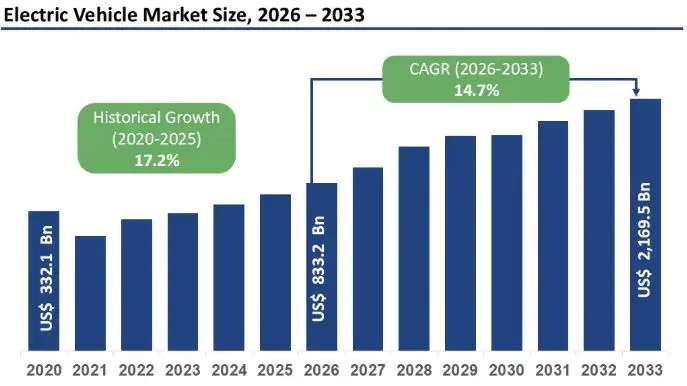
On the surface, the narrative that the EV transition will kill platinum demand has not worked out as expected. The market size of purely battery-electric vehicles grew about 17.2% till 2025, and this is a real headwind as EVs don’t use catalytic converters. But the production growth of hybrids, which still use platinum-based emissions control systems, was even higher in relative terms.
Add the rollback of EV incentives in the US and the European Commission’s policy of multi-year averaging of CO2 compliance and full-year automotive platinum demand for 2026 should only fall by a modest 2–3%, far smaller than expected from the early EV-transition expectations on platinum demand. This could be arguably one of the most underappreciated stabilizers for the long-term platinum demand story.
How do Central Bank Policy, US Dollar Strength, and Real Rates affect the XPT price?
Like all dollar-denominated metals, platinum appears to be highly sensitive to Federal Reserve policy and the overall health and direction of the US Dollar Index. With the Fed’s June 2026 policy meeting wrapping up, the benchmark rate sits in a 3.50%–3.75% band, and policymakers appear to be taking a slightly hawkish stance in the face of inflationary pressure caused by supply concerns around Middle East oil.
Thus far, the Fed’s stance has presented a tailwind for the dollar and made dollar-priced platinum too costly for overseas buyers and hence, the metal has further underperformed, particularly through the first half of 2026. However, with weaker labor market data, triggered by a surprisingly flat June payrolls report, the dollar has largely weakened and allowed platinum prices to rebound. This seasonality will likely repeat itself around each meeting of the Fed, with the next scheduled for late July 2026.
Is Platinum living up to its safe-haven, inflation-hedge reputation?
Platinum’s safe-haven case is more complicated than gold’s, precisely because industrial demand cuts both ways; a global slowdown that boosts safe-haven flows also tends to reduce automotive and industrial consumption. That’s why 2025-26 has been a reasonably good test case: geopolitical tension in the Middle East, persistent inflation worries, and a weakening dollar all bolstered platinum prices alongside gold, even as the metal’s industrial demand cooled off. The verdict is that this metal is a hybrid asset part inflation hedge, part industrial commodity, and that hybrid nature is why its volatility tends to be broader than gold’s, both ways.
What global economic conditions are shaping the Platinum price in 2026?
2026 has been defined by easing geopolitical tensions and persistent inflation risks. Oil prices were pulled back as tanker traffic slowly normalized through the Strait of Hormuz and US-Iran peace talks were advancing, quelling one important driver of recent inflation. Meanwhile, the US labor market dwindled, repeatedly adjusting expectations for rate hikes, creating a push-pull effect with oil where we didn’t see a clean direction.
How do Fed Policy and rate decisions impact XPT price?
Fed meetings in 2026 have moved precious metals markets by a wide margin. Platinum’s no different. As of early July, the market priced in a little over a 50% chance of a 2026 September rate hike. There was genuine uncertainty about whether the Fed under Chair Kevin Warsh would shift further hawkish or pause. Higher-for-longer rates increase the opportunity cost of holding non-yielding precious metals such as XPT, while any dovish surprise reduction has historically sparked sharp relief rallies, the sort of event-driven volatility that has defined Platinum price trends this year.
Why are China and India still the major Platinum demand markets to watch?
China and India sit at opposite ends of the current demand cycle: while China’s jewelry fabrication plunged 40% in 2025, as Chinese jewelry buyers treated platinum as deeply undervalued compared with gold in Shenzhen’s Shuibei district, that stockpiling wave is now dissolving, as 2026 Chinese jewelry demand is forecast to drop sharply, a new removal of a VAT rebate on platinum delivered through the Shanghai Gold Exchange exacerbating the downturn.
By comparison, India is experiencing ongoing structural growth, with 2026 jewelry demand forecast to increase 5% because the metal in discussion is gaining an increasing share in the diamond-jewelry market across hundreds of Indian cities.
How does risk-on vs. risk-off sentiment move the Platinum price?
- Risk-off periods often boost demand for gold more than platinum.
- This metal leans more heavily on global industrial production trends
- A booming stock market can pull speculative money away from metals
- Recession fears tend to hurt automotive demand for platinum
- Geopolitical shocks still lift platinum through its safe-haven appeal
- Strong manufacturing data supports platinum more than it supports gold
- Currency volatility in emerging markets affects local platinum buying power
Why does a stronger Dollar Index pressure the Platinum price?
Because XPT is priced globally in US dollars, a stronger Dollar Index mechanically makes the metal more expensive for buyers transacting in euros, yen, rupees, or yuan, which tends to soften physical demand at the margin. Consistent with this economic relationship, platinum has declined healthily on days when the dollar index went higher in 2026, even on days when the occasional sharp damage to physical demand was unrelated to currency strength.
What does the Gold-to-Platinum ratio reveal about value?
At today’s prices, gold trades at roughly 2.5 times the price of platinum a ratio that would have seemed absurd before 2012, when the latter routinely traded above the former.
Some analysts believe that this dramatically wide, unsustainable price differential is due to platinum price being fundamentally undervalued relative to its scarcity (platinum is indeed rarer than gold) and to its industrial component, while others see this as due to only gold’s better monetary status and platinum’s cyclical industrial demand. Regardless, this ratio is one of the most closely watched signals to look at across the entire precious metals market.
How does XPT trade as a Tokenized Asset on SunCrypto?
SunCrypto, India’s simplest and most secure FIU-registered crypto exchange, listed Platinum (XPT) and Palladium (XPD) on its futures platform in early 2026 after the introduction of gold (XAU) and silver (XAG) pairs. This gives Indian traders direct exposure to global platinum trends via INR and USDT pairs, without the need for separate demat accounts or international brokerage access.
Traders can take a position in XPT futures with Leverage available up to 30x . This effectively amplifies gains and risks dramatically, which is why risk management tools such as stop-losses and take-profits matter a great deal when dealing with a leveraged XPT price as opposed to physical bullion.
How does XPT price perform during Bitcoin bull and bear cycles?
Platinum’s correlation with Bitcoin is generally low, since one is an industrial precious metal and the other is a purely digital, non-yielding asset with entirely different demand drivers.
That said, on crypto-native platforms, capital flows can blur this distinction during periods of broad crypto market stress, such as the roughly $2.3 billion liquidation event referenced by several exchanges earlier in 2026, some traders rotate capital from volatile altcoins into tokenized precious metals like XPT as a relative safe harbor within the same trading app, even though platinum itself carries plenty of volatility of its own.
What is the Platinum price prediction for the next 7–30 days?
| Scenario | 7-30 Day Range (approx) | Key Assumptions |
| Bear case | $1,550 – $1,600 | Dollar strengthens, Fed signals further hikes |
| Base case | $1,620 – $1,720 | Range-bound consolidation, mixed Fed signals |
| Bull case | $1,750 – $1,850 | Dovish Fed surprise, renewed ETF inflows |
What is the XPT medium-term outlook for Q3–Q4 2026?
Heading into the later half of 2026, the WPIC’s own forecast points to a fourth consecutive annual market deficit, now estimated at roughly 297,000 ounces, with above-ground stocks falling to just under three months of demand cover — the tightest buffer in years.
Continuing trade tension easing and ETF profit-taking could lead to the platinum market staying range-bound in view of current conditions; however, a supply shock from South Africa or an outburst of Chinese investment demand could turn the price up before the year ends.
Where could Platinum price go from 2027 to 2030?
For the longer term, the WPIC projects platinum market deficits will average around 331,000 troy ounces per year from 2026-30, indicating that while the structural undersupply narrative will not vanish, the number will swing up and down from year to year.
Politically, a resolution of Middle East tensions or a real escalation affecting oil prices and the dollar, a major South African power grid failure, a surprise Fed pivot in either direction and a reacceleration of Chinese investment buying will likely drive the next big one up or down.
On the crypto side, an upsurge in tokenized commodity trading on platforms such as SunCrypto could add another layer of demand that wasn’t there in previous cycles.
What are the biggest risks to the Platinum price outlook?
- A stronger-for-longer US dollar could keep pressuring prices lower
- Faster-than-expected EV adoption may still erode automotive demand
- Chinese jewellery destocking could extend well beyond 2026
- A South African supply recovery could unexpectedly ease the deficit
- Leveraged crypto positions can trigger cascading liquidations quickly
- Global recession risk would hit industrial platinum demand hardest
- Rising above-ground recycling supply could offset mine constraints
Final Thoughts
The platinum price today finds itself in a truly interesting crossroad. It is now down by almost 44% from its January 2026 peak, yet the fundamentals behind it-a fourth straight year of market deficit, shrinking above-ground stocks, resilient hybrid-vehicle demand, and a slowly emerging hydrogen-economy use case, haven’t materially deteriorated.
What’s changed is sentiment, positioning and the dollar, not the fundamental scarcity that led to the 2025 upsurge in the first place. For the long term investors, it is exactly this combination of lower entry point and unchanged long-term fundamentals that is worth watching over the next few months, whether you invest through physical bullion, regulated futures, or tokenized instruments such as XPT on platforms such as SunCrypto.
As always, this metal remains a truly volatile, cyclical asset, and any trader, leveraged or not, should be sizing positions to acknowledge that, rather than chase the next big headline.
What is the current platinum price?
As of July 8, 2026, the global spot platinum price is trading at approximately $1,583.00 per troy ounce, marking a daily decline of roughly 4.18% – 4.34%.
Why is platinum cheaper than gold right now?
Platinum is currently cheaper than gold because it trades primarily as an industrial commodity, whereas gold is universally viewed as a safe-haven asset. Sluggish demand in the automotive sector, combined with investors flocking to gold during economic uncertainty, has kept platinum prices lower.
Is platinum a good investment in 2026?
Yes, platinum is considered a highly compelling, asymmetric investment in 2026. Driven by a structural market deficit projected at roughly 300,000 ounces and robust investment demand, analysts expect prices to test the $2,400 per troy ounce mark following highs above $2,700 earlier in the year.
What moves the platinum price the most?
The platinum price is most heavily driven by South African mining output, automotive industry demand, and global economic sentiment. Because platinum has a relatively small, illiquid market compared to gold or silver, these factors create amplified price swings.
How is XPT different from physical platinum?
XPT is the standard financial ticker for a troy ounce of platinum. When comparing XPT to physical platinum, the primary difference is form and accessibility: XPT represents a digital or paper tracking of the metal’s price, whereas physical platinum refers to tangible bullion bars or coins you can physically hold.
What is the Platinum-to-Gold ratio and why does it matter?
The gold-to-platinum ratio measures how many ounces of platinum it takes to buy one ounce of gold. It is calculated by dividing the current price of gold by the price of platinum. It highlights relative value, signaling whether platinum is undervalued or overvalued compared to the ultimate safe-haven asset.
Where can you trade XPT futures?
Users can easily trade XPT futures in India through SunCrypto, with a leverage of upto 30x.
Is platinum used in electric vehicles?
Traditional battery electric vehicles (BEVs) do not use platinum in their drivetrains since they do not have exhaust systems or catalytic converters. However, platinum is critical for Fuel Cell Electric Vehicles (FCEVs), where it acts as a core catalyst to generate electricity from hydrogen and air with zero emissions.