

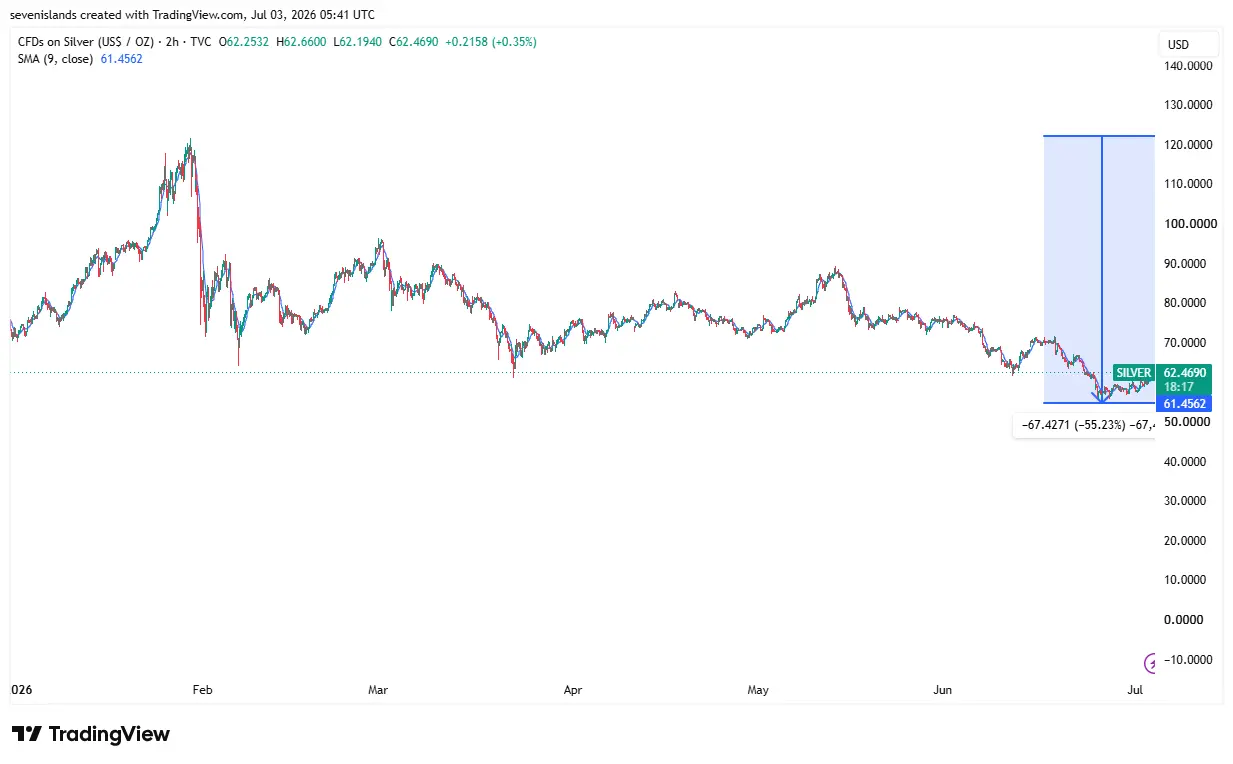
The silver price has recently gone through something that many investors couldn’t have predicted. In a span of just five months, the precious metal has fallen from a record peak of $121.62 per troy ounce to sit near the $60 mark, shedding nearly 50% of its value. For anyone tracking commodities, or for crypto traders who like to draw parallels between hard assets, this is not a moment to look away from. The silver price today tells a story of central bank policy, geopolitical tension in the Middle East, and a cooling of the speculative fever that drove the metal to unprecedented heights earlier this year.
Whether you are a dedicated commodity investor or a crypto enthusiast watching Bitcoin charts, understanding where the silver price stands right now and why offers a genuinely useful lens on where global risk appetite is headed next.
What is the silver price today across global and Indian markets?
The silver price today is trading somewhere at near $60 on the international market, up roughly 1.67% from the previous session. That’s still a big 63% rise on prices one year ago even after enduring a tough month in which the price plunged more than 17%.
In India, where silver is bought as much for weddings and festivals as for investment, the domestic rate mirrors this global move: the metal is trading around ₹2,50,000 per kg, or roughly ₹250 per gram, adjusted for the rupee-dollar exchange rate and import duties. Anyone tracking the silver price live right now will notice the number flickering within the range of $56.64 through the trading session, a sign that volatility hasn’t gone anywhere.
| Market | Current Level (July 3, 2026) | 1-Month Change | 1-Year Change |
| Global Spot (USD/oz) | $62.46 | -17.36% | +63.01% |
| India (INR/kg) | ₹2,50,000 | Tracks global rate + INR movement | Sharply higher |
| Gold-Silver Ratio | 68–69 | Rising from cycle lows | Near 14-year range shift |
Here’s a simple way to picture it: think of silver as a sprinter rather than a marathon runner. It can post gains that leave gold in the dust during a bull phase, but it tires and stumbles, far more dramatically when sentiment turns. That is exactly the behavior on display this week.
Why did the silver price drop 50% from its all-time high?
To understand today’s number, we’ve got to roll the tape back to late January 2026, when silver clawed up to an all-time intraday high of about $121.62 per ounce. That was a truly historic move, with the metal surging more than 250% in roughly a year as capital poured into the market amid tariff uncertainty, tight physical supply, a surge of retail buying across Asia, and a broader flight to hard assets. The correction that followed was almost inevitable: once the froth began to clear, forced liquidations and profit-taking compounded the fall, leaving silver down more than 50% from its peak.
A number of factors overall have contributed to this decline.
- Industrial buyers slowed 2025’s rushed silver purchases once prices spiked.
- Physical premiums across major Asian markets softened as demand cooled.
- COMEX raised silver futures margin requirements, over-sharply, in January.
- Leveraged traders were forced to quickly unwind their crowded positions.
- New Fed Chair Kevin Warsh signaled a hawkish shift in policy.
- Markets now price real odds of hikes instead of rate cuts.
- Rising yields made non-yielding silver comparatively less attractive to hold.
- That rising opportunity cost hit silver’s price almost immediately afterward.
None of this means the long-term bull case is dead. The silver price has fallen from previous highs by 35% to 45% before, including during the famous 1970s bull run, and the metal was able to eventually reach new highs. However, margin calls, profit-taking, and a stronger dollar have negatively impacted the price of this precious metal in the meantime.
Silver and Bitcoin are two sides of the same “Hard Asset” trade
This is where crypto traders have to listen up. Silver and Bitcoin are, in many ways, similar enough to be two sides of the same coin; both are goods people flock to when they lose faith in fiat, and both are finite/scarcity-priced. Consequently, both attract a similar type of investor who doesn’t trust central banks to simply print more money. Bitcoin is even sometimes referred to in trading circles as “digital gold,” while gold keeps the “digital store of value” analogy more so reserved for itself. Just as the silver price today reflects investors’ appetite for physical hedges, Bitcoin’s price action reflects appetite for digital hedges, and lately, both have been trending in the same direction.
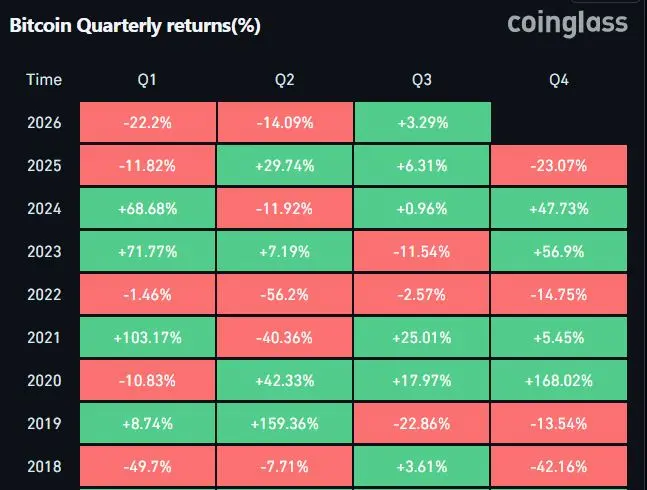
Bitcoin has had a truly bitter first half of 2026, dropping in both Q1 and Q2 only the third time in its short history, after 2018 and 2022 and is now trading in the above $62.46K price range, down more than 20% just in June. Spot Bitcoin ETFs recorded the biggest monthly outflows on record, a $4B dip at a time that closely mirrors silver’s own correction. suggesting both assets are being squeezed by the same macro pressure: a market that is repricing for higher-for-longer interest rates rather than the rate cuts many had expected entering the year.
That’s like two boats tied together to the same dock; when the tide of risk appetite goes out they both go down together, even if their day-to-day drivers are technically different.
Could loss in silver be a gain for crypto as retail capital rotates?
And here comes the part that should really interest anyone involved in crypto markets. So when a high-debt, high-cost trade like silver gets crowded and then corrects sharply, some of that retail capital doesn’t just sit on the sidelines; some of it tends to look for the next high-beta opportunity, and that’s been exactly what the crypto market has been known for. It’s still too soon to say this is a real trend, but it’s one to keep an eye on.
- Retail traders burned by silver’s margin calls often chase quicker rebound trades.
- Bitcoin dominance near 55.5–61% shows capital still concentrated in BTC.
- Altcoin Season Index sits around 30, firmly in “Bitcoin Season” territory.
- ETH/BTC ratio strength is the earliest confirmed signal of real rotation.
- A confirmed break below 55% BTC dominance often precedes altcoin rallies.
- Indian retail investors frequently shift between bullion and crypto exposure.
- Silver’s volatility spike has pushed some traders toward regulated crypto exchanges.
- Historical altseasons started 18–30 months after a Bitcoin market bottom.
None of these signals alone confirms a rotation is underway, but combined they suggest that we’re in a market coiled up and ready for a trigger. One of those triggers has been a cooling in the silver price, coupled with Bitcoin stabilizing.
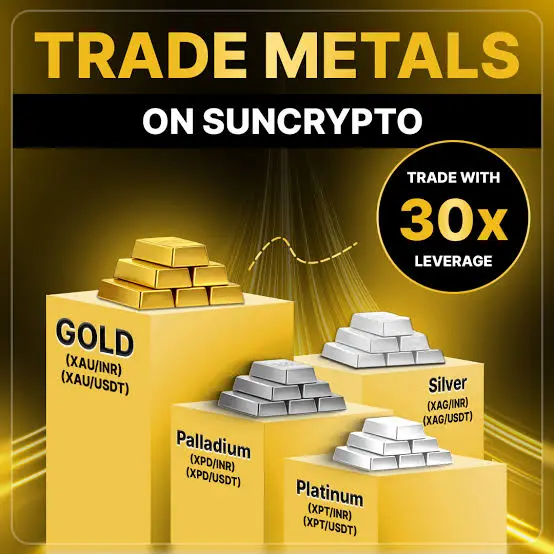
Interestingly, you no longer have to choose between the two trades. SunCrypto, an Indian crypto platform, has listed silver directly in its futures market with both XAG/USDT and XAG/INR pairs, letting you go long or short on silver with up to 30x leverage from the same account you trade crypto on. The INR-margined pair is especially useful for Indian traders; you can trade silver straight from your INR balance, with no P2P conversion or separate USDT purchase needed. So whether the capital rotates from silver into crypto or back again, both sides of the “hard asset” trade now sit on one screen. (As always, leveraged futures amplify losses as well as gains; size positions carefully.)
The macro story behind the silver price today
Zooming out, three macro threads are doing most of the work behind today’s number.
First is the Federal Reserve. Chair Warsh’s comments at the ECB’s Sintra forum signaled that while inflation risks have moderated somewhat, the central bank isn’t in a hurry to cut rates and that as of now, markets are pricing in a probability of over 70% for a September hike and 54% for any 2026 hike, meaning that there will be a hike later this year rather than easing. That is a markedly different backdrop to that which fed silver to its January peak, when rate-cut expectations were still intact.
Second is the geopolitical backdrop. Tensions between the United States and Iran over the Strait of Hormuz caused oil prices to surge earlier in the year, raising inflation concerns that once bolstered the gold and silver markets. However, since then, renewed peace talks in Doha have relaxed that tension, and global crude prices have dropped almost 20% in the past month alone. When oil retreats so much, it takes some of the gold and silver inflation-hedge story with it, impacting the silver price as well as the gold response.
In the World Gold Council‘s June 2026 survey of a record 76 central banks, 89% said they expect global central bank gold reserves to keep rising over the next 12 months, a structural, price-insensitive demand base that silver doesn’t enjoy to the same degree, since it is priced more around industrial cycles than sovereign reserve strategy. This divergence is part of why the gold-silver ratio has climbed back toward 68–69, up from a 14-year low near 50 seen right at January’s peak.
What crypto traders should watch next?
If you are a crypto trader, it would be wrong to focus only on the silver story. The silver price is also a barometer of the “risk versus safety” struggle that BTC / altcoins are embroiled in. A few practical checkpoints are worth bookmarking over the coming weeks.
- Watch whether silver stabilizes above $57 or breaks toward $54.
- Track Bitcoin dominance for a decisive move below the 55% line.
- Monitor Fed commentary for any softening on rate-hike language.
- Follow global oil prices for signs inflation pressure is truly easing
- Note ETF flow data, since spot BTC ETFs mirror silver’s outflow pattern.
- Compare gold-silver ratio shifts against ETH-BTC ratio movements weekly.
- Keep an eye on Indian rupee moves affecting local silver and crypto pricing.
These signals rarely move in isolation. If you can find a way to combine at least two or three of the above signals for your final reading, the chances would increase of getting a more reliable signal from them.
Silver vs. Bitcoin as a store of value for long term
This is the debate that refuses to die, and honestly, it probably shouldn’t because both sides have genuinely strong arguments. Silver has a 5,000-year track record as money and an industrial input, used today in solar panels, electronics, and healthcare, meaning it has a real-world demand separate from behavioral modeling.
Bitcoin, on the other hand, has been around for less than two decades but has already produced returns that silver could never match over a comparable stretch, thanks to an inflation-proof, absolutely fixed supply cap of 21 million coins that no central bank or mining company will be able to get past.
For most serious investors, this isn’t an “either-or” question. Silver is effectively a leveraged version of gold, a safe-haven asset that is also fueled by industrial demand and works as a hedge against inflation. prone to violent swings in both directions; the 50% drawdown we’re seeing right now is a case study in that volatility. Bitcoin, too, is an energy investment, with cycles on a faster clock measured in months, not years.
A diversified investor arguably benefits from understanding both rather than picking a permanent winner. What matters more than the debate itself is recognizing that both assets currently sit well off their all-time highs, both are driven by the same underlying distrust of fiat stability, and both reward patient, well-informed positioning over panic-driven decisions.
Final Thoughts
The silver price story right now is about the limits of a parabolic rally meeting the reality of higher-for-longer interest rates, cooling geopolitical risk, and profit-taking after an extraordinary run. A 50% correction from an all-time high sounds alarming in isolation, but placed in historical context, it’s a pattern silver has lived through before and one it has ultimately recovered from.
For crypto traders, the real value in tracking this isn’t the commodity itself; it’s what silver’s swings reveal about broader risk sentiment, Fed policy expectations, and the conditions that have historically preceded capital rotating into higher-beta assets like Bitcoin and altcoins. Keep watching the data, keep the macro picture in view, and treat both silver and crypto as pieces of the same larger puzzle rather than isolated bets.
Why is silver falling in 2026?
Silver prices are falling in 2026 due to a strong US dollar, expectations for higher US interest rates, and waning industrial demand following a massive early-year rally. Because silver is both a safe haven and an industrial input, this combination of macro and sector pressures caused prices to drop from January peaks.
Does silver price affect Bitcoin?
Silver prices do not have a direct, causal effect on Bitcoin, but both assets often respond to the same underlying macroeconomic factors. They are both considered scarce, alternative stores of value that typically react to changes in the U.S. dollar (USD), interest rates, and global inflation.
Is silver or crypto better right now?
Whether silver or crypto is “better” depends on your risk tolerance: choose silver for a tangible, historically stable hedge against economic uncertainty or crypto (like Bitcoin) if you want higher growth potential but are willing to stomach extreme, market-wide volatility.
What is today’s silver rate in India?
Today, the silver price in India is trading at around ₹228 per gram or ₹2,45,000 per 1 kg