
USDT to INR conversion is one problem that many people in India face, whether they have ever sold crypto, earned a freelance income in stablecoins, or received a payout from an overseas client. As of now, 1 USDT is somewhere in the rupee range of ₹94-₹96; the amounts involved are rarely small, and getting the process wrong can mean frozen funds, compliance notices, or straight-up losses.
In this article, we will discuss the easiest and the most reliable way to convert USDT to INR in India through SunCrypto, India’s simplest and most secure crypto exchange, and also understand why certain ways of conversion are riskier than they seem.
Why do people need to convert USDT to INR?
USDT has become the default settlement currency for a huge slice of the crypto economy, which is exactly why so many Indians end up holding it without ever planning to. Freelancers and remote employees working for overseas companies are frequently paid in USDT because it avoids the delays and fees of traditional international wire transfers. Traders, miners, and stakers also accumulate USDT as a stable space for profits between trades, since it does not carry the volatility of Bitcoin or Ethereum.
Sooner or later, though, that USDT needs to become spendable rupees, whether that is to pay rent, cover business expenses, or simply move profits into a savings account. This is where the actual challenge begins, because not every method of converting USDT to INR is built with Indian banking and tax rules in mind, and choosing the wrong one can create far more problems than it solves. That is why choosing SunCrypto for USDT to INR conversion proves to be the safest way, as this platform follows all the necessary crypto regulatory guidelines in India.
Why is USDT to INR conversion via P2P risky?
The first option that comes to mind after hearing “USDT to INR conversion in India” is P2P. And why not? It feels like the most natural, straightforward way and without any complications. You place an order, find a buyer, agree on a rate, and get paid through a bank transfer in lieu of USDT. The obvious disadvantage is that P2P rates are often less favorable than the market rates, meaning you’ll miss out on part of that profit margin, and the bigger your trade, the bigger that price gap.
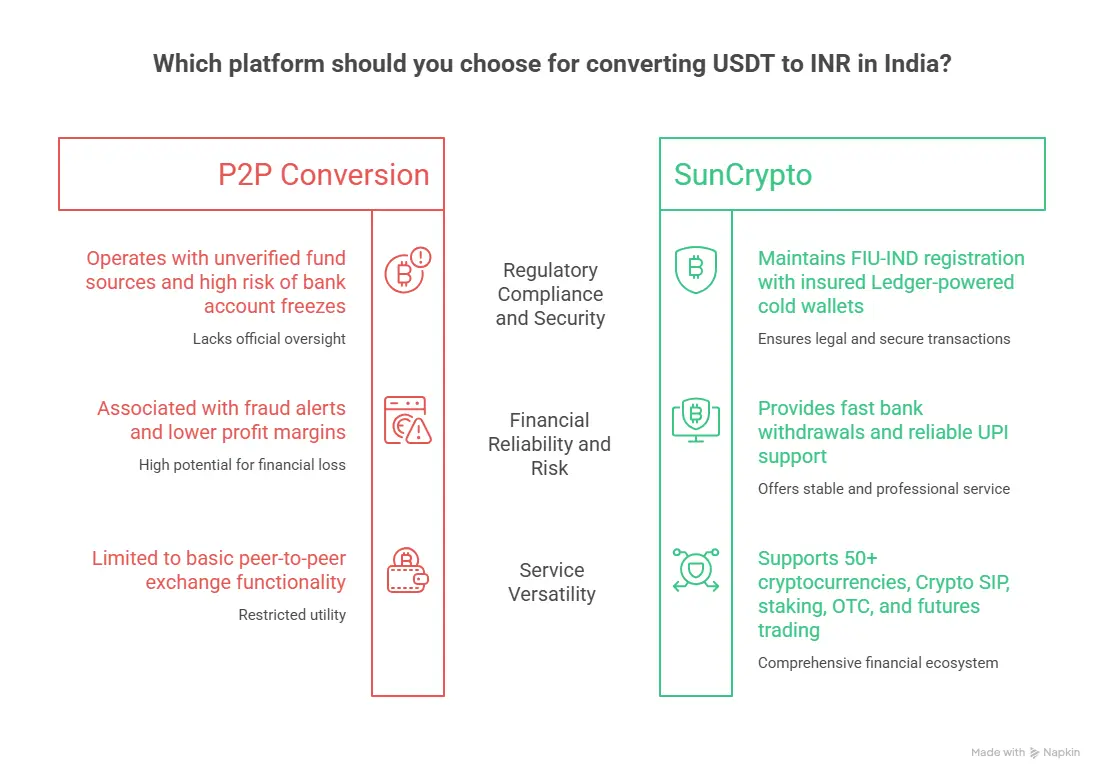
And the bigger issue for most traders is the fact that they can’t verify where the money came from. If the person you’re dealing with is pulling his money from a source that is involved in fraud, money laundering, or other illegal activities, that bank will freeze your receiving account to be safe. It can take several weeks to unfreeze it, meaning you end up with a not-so-prosperous return, and that is the biggest reason why USDT to INR conversion in India through P2P is considered highly risky!
Why is SunCrypto the most reliable platform for USDT to INR conversion?
SunCrypto is among the easiest and most secure FIU-registered crypto exchange in India. Therefore, SunCrypto meets all the compliance and regulatory requirements implemented by the Indian regulators for USDT to INR conversion in India.
SunCrypto offers INR conversion in more than 50 cryptocurrencies like USDT, USDC, BTC, ETH, BNB, SOL, TRX, etc., and does so on various blockchain networks like ERC20, BEP20, Polygon, and Arbitrum. So your crypto is not locked into one blockchain network; you can simply use another one if you wish to avoid the high gas fee on your original network for a particular crypto-to-fiat conversion.
- Funds are secured through Ledger-powered cold wallets, which are insured.
- Withdrawals reach your bank account within roughly a day.
- The platform supports UPI-linked INR deposits and withdrawals for convenience.
- SunCrypto also offers a Crypto SIP starting at just ₹100, along with staking, an OTC desk, and futures trading with leverage for users who want more than a simple conversion.
Steps to convert USDT to INR on SunCrypto?
Stage 1: Deposit Your USDT
- Open the SunCrypto app and head to the Portfolio section.
- Search for USDT and select the Deposit option.
- Choose your blockchain network carefully — sending on an unsupported network can cause permanent loss of funds.
- Compare fees across networks; BEP20 is currently a zero-fee option on the platform.
- Copy the wallet address SunCrypto generates for that network.
Stage 2: Transfer USDT From Your External Wallet
- Open your external wallet (Trust Wallet, MetaMask, etc.).
- Select Send, then choose USDT.
- Paste the SunCrypto wallet address you copied.
- Enter the amount you wish to transfer and confirm the transaction.
- Wait for network confirmation; your USDT will then reflect in your SunCrypto portfolio.
Stage 3: Sell USDT For INR
- Return to the Portfolio section and select USDT.
- Tap Sell and choose the amount you want to convert.
- Confirm the order using your MPIN.
- The sell order executes instantly, converting your USDT to its INR equivalent within your portfolio.
Stage 4: Complete the Originator Form and Withdraw
- Go to the Reports section under your profile.
- Open the Crypto Deposit/Withdraw Report.
- Click Submit Originator Info against your latest transaction (this is a mandatory compliance step under Indian crypto regulations).
- Fill in the requested details and submit; approval typically takes one to two minutes, with a confirmation notification once approved.
- Return to Portfolio and select INR Withdraw.
- Choose your linked bank account and enter the withdrawal amount.
- Verify using the OTP sent to your registered phone number.
- Confirm with your MPIN to finalize the withdrawal.
- Funds typically land in your bank account within a day.
How can you avoid common mistakes while converting USDT to INR?
Interestingly enough, a significant portion of account suspensions and tax notices during USDT to INR conversions were the result of user mistakes rather than actual tax avoidance. Do make a point to look up the blockchain network before sending your USDT, as this is a leading cause of permanently lost funds. Make sure your KYC is up-to-date and your bank account name matches your exchange profile name, as mismatches can delay your INR withdrawal.
It is also beneficial for you to maintain your own transaction records, including transaction dates, transaction amounts, and the INR conversion at the time you sold your USDT, as they enable you to file your ITR with Schedule VDA more easily when the time comes. Relying on a platform’s transaction history as your sole record is risky if you ever need to cross-verify figures independently.
Final Thoughts
Converting USDT to INR does not have to be a stressful or complaint uncertain process, but it does require choosing the right method. Informal routes like P2P trading might look convenient on the surface, yet they expose you to rate disadvantages and serious banking risks that simply are not worth taking.
A registered platform like SunCrypto, backed by FIU registration, transparent fees, and a guided withdrawal process including the mandatory Originator Form, offers a far steadier path from digital asset to spendable rupees. Whether you are converting a small freelance payment or a large trading profit, taking the compliant route protects both your funds and your peace of mind, making it the smarter choice for anyone serious about their long-term crypto journey in India.
Read More: How to file crypto tax in India?
Is converting USDT to INR legal in India?
Yes, it is completely legal to convert USDT (or other Virtual Digital Assets) to Indian Rupees. However, it is mandatory to process these transactions through KYC-compliant platforms and ensure you fully comply with Indian tax regulations.
What are the tax implications in this process?
In India, converting USDT to INR requires strict tax compliance, including 30% tax on net profits and 1% TDS to all crypto sales, including stablecoin conversions. This TDS can be claimed as a credit when you file your Income Tax Return (ITR).
Should I use Telegram groups for USDT to INR transfer?
No, you should not use Telegram groups for converting USDT to INR. While these escrow groups claim to offer better conversion rates and zero tax, they are highly risky and mostly fraudulent.
Every thing is possible in crypto business…