

Crypto futures trading has emerged as one of the fastest-growing segments of the Indian digital asset market in 2026. Rather than just buying and holding a coin, you can make an informed speculation on where the coin price is going, from either direction, by putting up only a small portion of the position value as collateral. With India’s crypto user base going well beyond tens of millions, with many Indian exchanges now offering INR-denominated futures contracts, a previously niche, institutional-only instrument has now become available for retail trades.
This article explains exactly what crypto futures trading is, how it works, the rules governing it in India, the risks that every trader must consider, and which is the best platform to start futures in India.
What is Crypto Futures Trading?
Crypto futures trading is a way to trade digital assets without owning the underlying asset. When you open a futures position, you agree to buy or sell a cryptocurrency at a certain price. However, you never actually own the underlying coin. In futures, you are purely trading the price movement, which means you can profit whether the market goes up or down.
Perpetual futures do not have a specific expiry date like what we see in the case of stock futures. You can keep your position “alive” as long as you have the margin available and you pay the required funding, which keeps the contract price in line with the spot.
How does Crypto Futures Trading work?
Suppose BTC is trading at ₹85,00,000 and you think the price will go up in the next few hours. Rather than buying a whole Bitcoin through the spot market, you take a BTC/INR futures position using leverage, the mechanism that allows you to control a position larger than the cash you actually have to invest.
If you deposit ₹10,000 as margin and select 10x leverage, you’re effectively putting ₹1,00,000 worth of BTC at risk despite only having ₹10,000 of your own capital on the line. In this situation, margin is just collateral that you lock to open and maintain that position. SunCrypto allows you to deposit your margin directly in the rupees via crypto futures. Once your position is active, you should also set proper Stop Loss and Take Profit levels to exit your trade for you automatically, either if the market goes in your favor or against you.
Now suppose that BTC rises 2% to ₹86,70,000. A spot trade using up your ₹10,000 would net you 2% of that, i.e. ₹200. But on the other hand, with 10x leverage that 2% rise just happens to be 2% on your entire exposure of ₹1,00,000, which would yield you 1/5th of your margin or ₹2,000, a 20% return. The entire point of leverage is that the 2% rise/decline is relative to your total exposure, no matter how big that is. The reverse is also true. A 2% decline would result in a ₹2,000 loss, which equals 20% of your ₹10,000 margin.
That’s pretty much why liquidation exists; it’s like a safeguard for the exchange. If the price starts to move against you, and your losses approach the size of your margin, the platform will automatically close your position before your account balance goes negative. The higher the leverage, the less that price needs to move. At 10x leverage, a move approaching 10% against your position may be sufficient to trigger liquidation depending on maintenance margin requirements. Hence the use of leverage is practically a risky decision. Therefore most beginners should start with 2x-5x instead of maxing out the multiplication factor.
The last part is the settlement. As most of the Indian counterparties offer Perpetual crypto futures contracts, there’s no predetermined expiry, thus you choose when to book your profit or cut your loss and the trade is settled in cash, be it INR or USDT as per your margin type, with the difference between your entry and exit price credited or debited to your account.
What are the order types in Crypto Futures?
Starting to trade in the crypto futures market is one thing, but proper execution is another. That’s why most exchanges that offer crypto futures trading provide you with the same fundamental type of orders. They should all be familiar with you before you place a position:
- Market Orders complete instantly at a current price
- Limit Orders complete only at a specified price
- Stop Market Orders will place a buy/sell order at the market price as soon as the stop price is hit.
- Stop Limit Orders will trigger a limit order when the stop price is hit and is executed when the specified price is reached.
These are all instruments that are specifically created to help you cope with the extreme volatility of rapid price changes.
Is Crypto Futures Trading legal in India?
That’s the question that most beginners ask first, and the answer is a little complicated. Crypto futures trading is legal in the sense that it’s not outlawed in India; but at the same time it’s not regulated by a derivatives law in the same way that equity or commodity futures are regulated by SEBI.
It operates outside SEBI’s regulated derivatives market, but that doesn’t mean it’s illegal. It simply means that crypto futures exchanges and trading platforms need to register as reporting entities by the Prevention of Money Laundering Act and fulfill KYC and anti-money laundering (AML) duties enforced by the Financial Intelligence Unit (FIU-IND). Users are advised to trade only occur via platforms that comply with PMLA requirements. That means you should stay on the right side of the law by trading futures on FIU-IND registered, compliant Indian exchanges.
How is Crypto Futures Trading taxed in India?
One of the most compelling and frequently overlooked benefits of crypto futures trading in India is the tax advantage it provides. When you trade cryptos on the spot market, your gains are classified under VDA (Virtual Digital Assets), and you get a hefty 30% tax on your profits with no set-off permitted for losses from other trades. On top of that, every spot transaction attracts a 1% TDS deduction, which progressively ties up capital across an active trading month.
However, crypto futures trading in India works totally differently. These are not classified under VDA, so your income falls under the normal income tax slab, which benefits you a lot more than the 30% fixed crypto tax if you fall in a lower income slab. Additionally, no 1% TDS is applied to the futures trades, so your funds don’t get locked. Isn’t that amazing?
What risks should you know before trading Crypto Futures?
Risk management isn’t optional in this market, it’s the difference between longevity and an account wiped out in a single volatile session. A few risks deserve particular attention:
- Liquidation can wipe out your entire margin in no time
- High leverage amplifies both gains and losses
- Funding rates cumulate position costs slowly
- Indian regulatory rules could change in the future
- Volatility spikes can trigger rapid forced exits
Because crypto markets trade continuously and react instantly to global news, positions can move against a trader far faster than in traditional markets, making stop-loss discipline essential rather than optional.
Does crypto trade have the same futures as stock trade?
No. There are quite a few essential differences between crypto futures trading and stock futures trading. Here’s a detailed breakdown:
| Parameter | Stock Futures Trading | Crypto Futures Trading |
| Regulator | SEBI (India) | No dedicated derivatives regulator; exchanges follow PMLA/FIU-IND |
| Trading Hours | Limited to exchange hours (NSE: 9:15 AM–3:30 PM) | 24/7, including weekends and holidays |
| Expiry | Fixed monthly/weekly expiry | Mostly perpetual, no fixed expiry |
| Leverage | Typically capped (regulator-defined limits) | Often 5x to 150x depending on the platform |
| Settlement Currency | INR only | INR and/or stablecoins (USDT), platform dependent |
| Volatility | Moderate, tied to broader equity market | High, can move sharply within minutes |
Why are so many traders in India shifting to Crypto Futures Trading?
The primary allure of crypto futures trading is capital efficiency. A trader need not have the full value of a position to trade it, leverage enables traders to deploy smaller amounts of capital across more opportunities.
Crypto derivatives constitute the vast majority of the global trading volume in the digital asset space, and Indian platforms, which have rolled out dedicated futures sections complete with INR settlement, multiple order types, and risk tools, have reached the level of availability that previously could only be found on international exchanges. Those traders who already started with the spot market will find crypto futures trading a comfortable next step in escalating their sophistication to techniques such as hedging and shorting.
Why is SunCrypto the best platform for crypto futures trading in India?
SunCrypto is one of the best crypto platforms when it comes to crypto futures trading in India, with a list of various features and capabilities which are best suited for the novices as well as for experienced traders:
- High leverage up to 150x on select crypto pairs like BTC and ETH to boost your profit potential.
- Over 600 crypto futures pairs, giving traders a variety of opportunities.
- Futures trading for Precious Metals such as Gold, Silver, Platinum and Palladium as well as commodities like Crude Oil and Natural Gas with up to 50x leverage.
- Tokenized US Stocks such as Robinhood, Amazon, Palantir etc are also available on INR futures with up to 10x leverage.
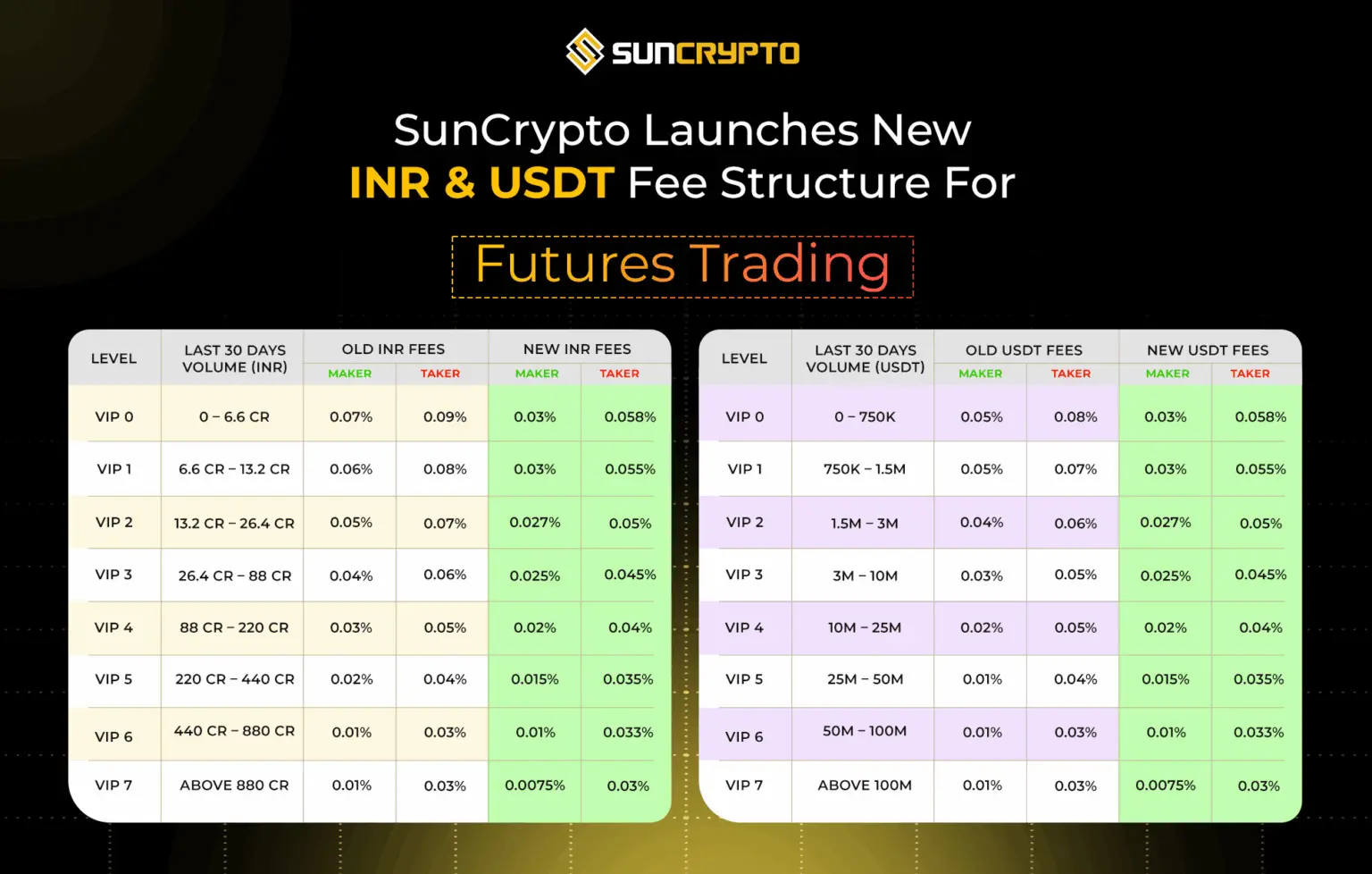
- Lowest trading fee charges in the entire country for Indian traders with tier based discounts on trades.
- Advanced risk management tools like Isolated Margin, Stop Loss, Take Profit, Trailing Stop Loss.
- Enhanced Chart Analysis on SunCrypto Futures Web for precise trading decisions.
- INR Auto-Conversion facility available on the USDT trading pairs without having to buy USDT.
- Free Telegram channel called SunCrypto trade alerts where traders get professional trade calls and analysis which helps them in their futures trading journey.
- Expert picks feature which makes futures trading on SunCrypto a whole lot easier as you have to just copy the trade alerts provided by professionals, just adjust your leverage and margin according to your risk potential and execute the trade.
How to start Crypto Futures Trading in India?
Here’s how to start crypto futures trading on SunCrypto:
- First, download the Suncrypto app from Google Play Store or Apple App Store.
- After installing, complete your registration and KYC (Know Your Customer).
- After the KYC, add your bank account and then fund it using bank transfer (IMPS/RTGS/NEFT) or UPI.
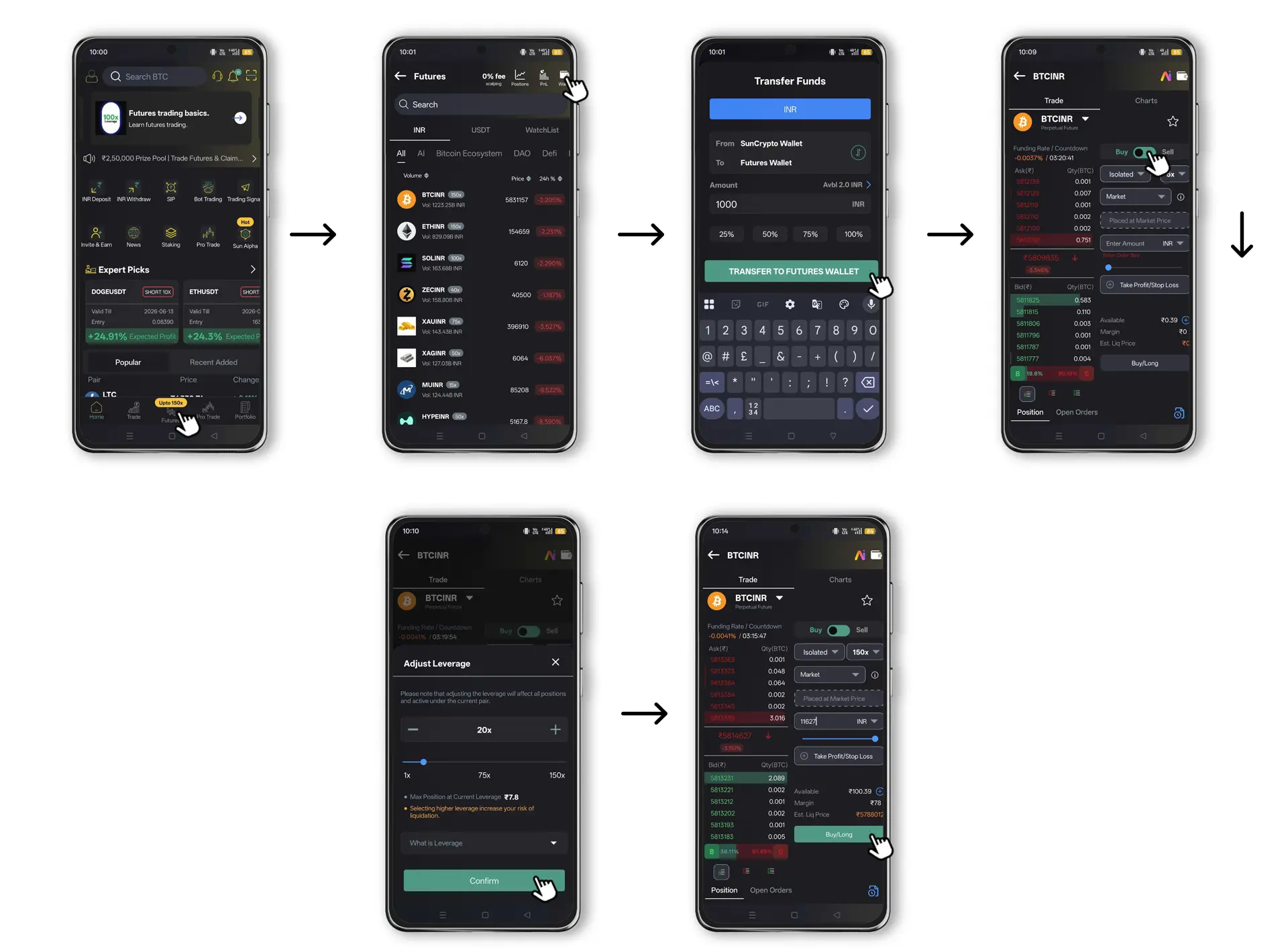
- Click on the “FUTURES” icon at the bottom of SunCrypto Home screen.
- You will be redirected to a new screen and will need to transfer the amount from your SunCrypto wallet to the Futures wallet.
- Click on the wallet icon on top right, enter the amount you want to transfer and confirm.
- Select the trading pair you wish to trade in either INR or USDT.
- You don’t need to deposit separately in USDT, If you wish to trade in USDT pair, the available INR balance will be auto-converted.
- Select the trading pair, let’s say BTC/INR. You will be able to see-
- Trade section (to place orders)
- Chart section (to check market trends)
- You will then decide whether to
- Long (Buy): If you are of the opinion that the price will go up.
- Short (Sell): If you are of the opinion that the price will go down.
- Select the margin type. SunCrypto currently supports only isolated margin.
- This is a much safer option for beginners, since you only stand to lose the amount you have invested.
- Select the order type:
- Market order, recommended for beginners as your order is executed instantly.
- Limit order, Stop limit or Stop market order for more control over the trade.
- Select whether you wish to place the trade in INR.
- Fill in the order amount, also enter leverage
- For example, with 1,000 amounts you can trade 50,000 if you choose 50x leverage. To control the risk, you can even trade 6,000 only with 50x leverage.
- You can also enter SL (Stop Loss) and TP (Take Profit) for further risk control.
- Finally click on Buy to place your order.
- You can check the open position and P&L at the bottom of the screen.
Final Thoughts
No longer a “nice-to-have”, “experienced trader” type of investment, crypto futures trading has to some extent become the norm in the trading landscape. However, as futures has made its presence felt, a lot of disadvantages are still associated with it and the gains cannot be replicated with the same level of success that was experienced when this was a relatively newer tool. Fortunately, we see opportunities arising for everyday Indian traders.
The advent of crypto futures along with trader-friendly exchanges and platforms (SunCrypto being one of them) have made it possible to participate in this new and potentially lucrative space. While these have indeed made trading futures relatively “easy” for Indian traders, the close risk profile of this new environment makes it necessary for traders to constantly adapt to ardent risk management practices and have a very strict and disciplined approach to trading.
What is the maximum leverage provided on SunCrypto futures?
The maximum leverage provided on SunCrypto futures is, on select trading pairs like Bitcoin and Ethereum.
Why is there no 1% TDS on Crypto futures in India?
The 1% Tax Deducted at Source (TDS) does not apply to crypto futures in India because they are treated as derivatives and financial contracts, rather than a direct transfer of a Virtual Digital Asset (VDA).
What metals are available on SunCrypto futures?
SunCrypto futures provides precious metals like Gold, Silver, Platinum and Palladium as well as commodities like Crude Oil and Natural Gas with up to 50x leverage.