

Cryptocurrency is no longer limited to simply buying an asset and waiting for its price to increase. As blockchain technology continues to evolve, crypto holders have several ways to participate in the ecosystem, and staking is one of them.
Crypto staking in India is gaining attention among investors who want to understand how certain cryptocurrencies can be used to support blockchain networks while potentially earning rewards. Instead of keeping eligible crypto assets idle, staking allows users to participate in the operations of proof-of-stake blockchain networks.
However, staking is not the same as earning guaranteed interest on a savings account. Rewards can vary, crypto prices remain volatile, and different networks have different rules regarding staking and withdrawals.
For beginners, understanding how staking works before committing any assets is essential. This guide explains everything you need to know about crypto staking in India, including how it works, the different ways to stake crypto, important factors to consider, and how to choose a suitable staking platform.
What is crypto staking in India?
Crypto staking is the process of committing or delegating eligible cryptocurrency to help support a blockchain network that uses a Proof-of-Stake (PoS) or a similar consensus mechanism.
Blockchain networks need a system to verify transactions and maintain security. Bitcoin uses a mechanism called proof of work, where miners use computing power to validate transactions. Proof-of-stake networks work differently.
Instead of relying primarily on miners, these networks use participants known as validators. Validators commit cryptocurrency to the network and help verify transactions, maintain consensus, and secure the blockchain.
In return for successfully performing these responsibilities, validators may receive rewards. Depending on the network and staking method, users who delegate or stake their crypto may also receive a share of these rewards.
In simple terms:
Stake eligible crypto → Support the network → Potentially earn rewards
That is the basic idea behind crypto staking in India.
How does crypto staking work?
The exact process can differ depending on the blockchain, but the general concept remains similar.
Proof-of-Stake networks
Proof-of-stake is a consensus mechanism used by several blockchain networks to validate transactions and maintain the blockchain.
Participants commit cryptocurrency as a stake, giving them a financial interest in helping the network operate properly. Validators are then selected according to the rules of the specific blockchain to perform tasks such as validating transactions and adding new blocks.
Validators help secure the blockchain.
Validators play an important role in a proof-of-stake network.
Their responsibilities can include:
- Verifying transactions
- Proposing or validating new blocks
- Participating in network consensus
- Helping maintain blockchain security
Validators are expected to follow the rules established by the blockchain protocol.
Staking rewards are distributed.
When validators successfully perform their responsibilities, the network may distribute rewards according to its rules.
Users who participate in staking may receive rewards based on factors such as
- The cryptocurrency being staked
- Network reward mechanisms
- Validator performance
- Platform or validator fees
- The total amount of crypto staked
- Network participation
The potential reward rate can vary significantly from one cryptocurrency to another. This is why users should look beyond a high advertised APY before deciding where to stake.
Why do people stake crypto?
Crypto staking in India is popular because it allows eligible crypto holders to participate in blockchain networks rather than simply holding their assets.
Potential to earn rewards
The primary reason many users explore staking is the possibility of earning additional crypto rewards.
If someone already plans to hold an eligible cryptocurrency for a longer period, staking may allow those assets to participate in the network’s reward mechanism.
However, rewards should not be considered guaranteed profits. Even if a user receives additional tokens, the market value of those tokens can rise or fall.
Supporting blockchain networks
Staking also contributes to the functioning of proof-of-stake networks.
By participating directly or delegating assets to validators, users contribute to the broader system responsible for validating transactions and maintaining network security.
Long-term participation
For users who already intend to hold certain cryptocurrencies for an extended period, staking can be another way to participate in the ecosystem.
However, users should always consider whether they may need immediate access to their assets before choosing a staking option.
Different Types of Crypto Staking in India
There is more than one way to participate in crypto staking. The right option depends on a user’s technical knowledge, preferred level of control, and the specific blockchain involved.
Direct staking
Direct staking generally involves participating directly in a blockchain’s staking mechanism.
In some cases, users may run their own validator infrastructure. This can require technical knowledge, reliable hardware or servers, and regular monitoring.
Running a validator may involve responsibilities such as maintaining uptime, updating software, and securing private keys.
This option can provide greater control but may not be suitable for beginners.
Delegated staking
Delegated staking allows users to delegate their crypto to an existing validator instead of running their own infrastructure.
The validator handles the technical responsibilities, while the delegator may receive a share of the staking rewards.
Before delegating, users should research the validator’s performance and understand any commissions or applicable conditions.
Platform-based staking
Some crypto platforms simplify the staking process by allowing users to stake supported cryptocurrencies through their platform.
This can be a more convenient option for beginners because users do not need to manage validator infrastructure themselves.
However, users should understand the platform’s terms, lower crypto trading fees, custody arrangements, and unstaking conditions before getting started.
Liquid staking
Liquid staking is a more advanced form of staking.
In certain systems, users receive another token representing their staked position. This may allow them to use that token within other decentralized finance applications while their original assets remain staked.
While this can offer greater flexibility, it may also introduce additional smart contract and liquidity risks. Beginners should understand how these systems work before participating.
Things to consider before crypto staking in India
Before getting started with crypto staking in India, it is important to consider more than just the potential reward rate.
Understand the cryptocurrency you are staking.
Before staking any crypto asset, research the asset and its blockchain.
Consider questions such as
- What is the purpose of the cryptocurrency?
- How does its blockchain work?
- What staking mechanism does it use?
- How are rewards generated?
- What factors could affect the value of the asset?
A high staking reward does not necessarily mean that an asset is a better investment. The value of the cryptocurrency itself remains an important factor.
Consider market volatility.
Staking rewards are generally paid in cryptocurrency, which means their value can fluctuate.
For example, you may receive additional tokens through staking, but the market value of your holdings could still decrease if the price of the cryptocurrency falls significantly.
Staking does not remove the volatility associated with crypto markets.
Check Lock-Up and Unbonding Periods
Some staking options require crypto assets to remain committed for a specific period.
In certain cases, even after you decide to stop staking, there may be an unbonding period before your assets become available.
Before staking, check:
- Whether your assets are locked
- How long the lock-up period lasts
- How the unstaking process works
- When you can access your assets again
This is particularly important if you may need liquidity quickly.
Understand fees and rewards
Different validators and platforms may charge different fees.
Before choosing a staking option, understand:
- The advertised reward rate
- Validator commissions
- Platform fees
- Any applicable withdrawal charges
The highest advertised APY does not always result in the best overall experience.
Prioritize security.
Security should always be a major consideration when dealing with digital assets.
Users should protect their accounts by using strong passwords and two-factor authentication and should remain cautious of phishing links and suspicious websites.
If you are using a third-party platform, research its security practices and understand how your assets are held.
How to choose a crypto staking platform
The platform you choose can affect your overall crypto staking experience. A good staking platform should offer a balance between convenience, transparency, security, and ease of use.
Check supported cryptocurrencies.
Not every platform supports the same cryptocurrencies.
Before creating an account specifically for staking, check whether the platform supports the crypto asset you want to stake.
Review staking conditions.
Understand how the platform handles staking and unstaking.
Look for information about:
- Available reward rates
- Lock-up periods
- Unstaking conditions
- Applicable fees
- Reward distribution
Reading these conditions beforehand can help you avoid surprises later.
Look for a simple and transparent experience.
For beginners, a complicated staking process can make participation difficult.
A platform with a simple interface and clear information about staking conditions can make it easier to understand where your assets are going and how rewards work.
Explore Crypto Staking with SunCrypto.
For users looking for a simpler way to explore crypto staking in India, SunCrypto offers staking options for supported cryptocurrencies through its platform.
Instead of managing validator infrastructure independently, users can access eligible staking options through the SunCrypto app. Available assets, reward rates, and staking conditions may vary depending on the cryptocurrency and the platform’s current offerings.
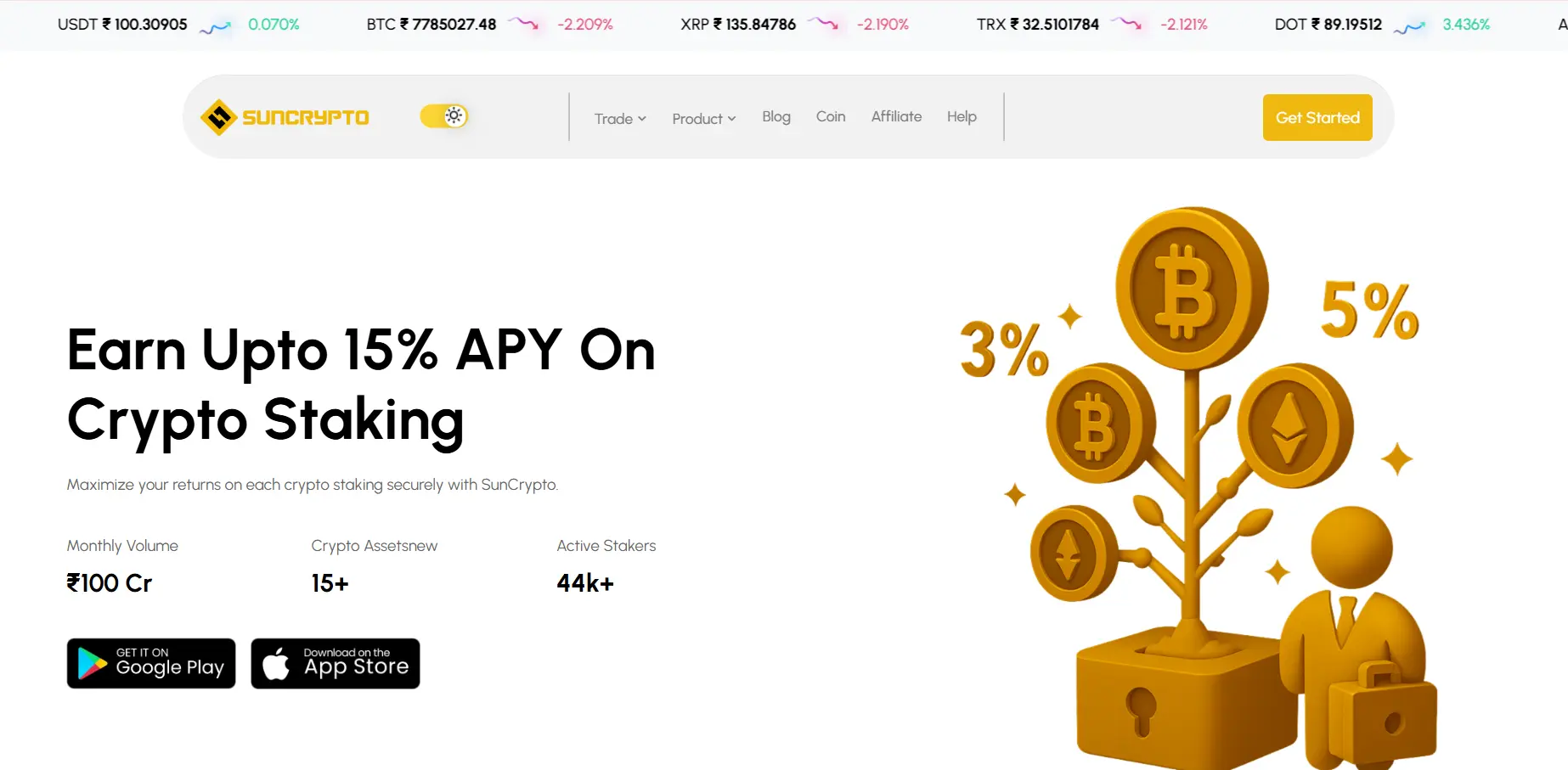
For beginners, the main advantage of a platform-based approach is convenience. Users can explore supported staking options through a familiar interface while keeping track of their crypto activity in one place.
Before staking, users should still review the specific asset, potential rewards, and applicable terms to make an informed decision.
Taxation and regulatory considerations
Anyone participating in crypto activities should remain aware of applicable taxation and regulatory requirements in India.
Cryptocurrencies are treated as virtual digital assets under India’s tax framework, and transactions involving crypto can have tax implications. The treatment of staking rewards may depend on the nature of the transaction and an individual’s specific circumstances.
Keeping accurate records can make it easier to understand and manage crypto-related transactions.
Users should maintain records of:
- The date staking rewards were received
- The quantity of crypto received
- The value of the assets at the relevant time
- Crypto purchases and sales
- Staking and transaction history
Since tax and regulatory interpretations can evolve, consulting a qualified tax professional for personalized guidance may be helpful.
Is crypto staking worth it?
Whether crypto staking in India is worth considering depends on your investment goals, risk tolerance, and understanding of the cryptocurrency involved.
Staking may be suitable for someone who already plans to hold an eligible cryptocurrency for the longer term and understands the conditions associated with staking.
Before getting started, ask yourself:
- Do I understand the cryptocurrency I am staking?
- Am I comfortable with crypto market volatility?
- Do I need immediate access to these funds?
- Do I understand the staking and unstaking conditions?
- Have I researched the platform or validator?
If you can answer these questions confidently, you may be better prepared to evaluate whether staking fits your approach to crypto.
Final thoughts
Crypto staking in India offers eligible crypto holders another way to participate in blockchain networks while potentially earning rewards.
But staking should not be approached simply as a way to earn passive income. The cryptocurrency you choose, market conditions, lock-up periods, and the platform you use can all affect your experience.
For beginners, the best approach is to understand the basics, start with careful research, and review all staking conditions before committing assets. Whether you choose a platform-based option such as SunCrypto or another staking method, informed decisions and proper risk awareness should always come first.
What is crypto staking?
Crypto staking is the process of committing or delegating eligible cryptocurrency to help support a blockchain network that uses a Proof-of-Stake consensus mechanism. Participants may receive rewards according to the rules of the network.
Is crypto staking in India legal?
The regulatory landscape for crypto-assets in India continues to evolve. Crypto users should stay updated on applicable laws, platform compliance requirements, and tax obligations before participating in staking or other crypto activities.
Can beginners participate in crypto staking?
Yes, beginners can explore staking options, but they should first understand how the cryptocurrency, blockchain, platform, fees, and unstaking process work.
Are staking rewards guaranteed?
No. Staking rewards depend on the blockchain’s rules, validator performance, network conditions, and other factors. The value of the cryptocurrency can also change significantly.