

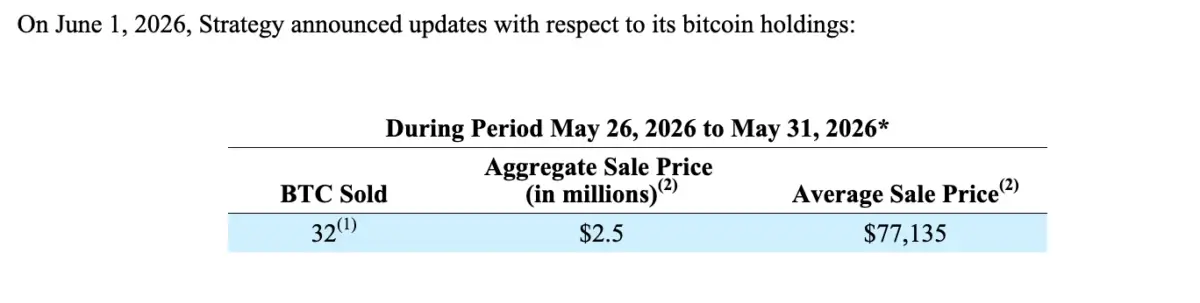
Strategy has recently revealed that it had sold 32 Bitcoin in the last week, its first BTC selling since December 2022. While the transaction was minimal in scale relative to the firm’s massive reserves, the market reaction was swift and severe. This sale marked a departure from Strategy’s long-standing “never sell” narrative.
Following this, MSTR shares tumbled 6% on the day, while the sell-off raised fresh concerns about dividend funding pressures and the potential for more frequent liquidations going forward.
Why did Strategy sell 32 Bitcoin?
Between May 26 and May 31 2026, Strategy sold 32 Bitcoin worth around $2.5 million at an average price of $77,135 per BTC. This was also the end of a long-running buying streak of 41 months. The proceeds, the company said in its SEC form 8-K filing, would be used “specifically” to pay the distributions for the preferred stock. Unlike the December 2022 sale, which took place in order to harvest tax losses, this 2026 sale was in response to corporate liquidity due to the preferred stock dividend.
In a previous interview, CEO Phong Le said they might have to implement some selective disposals to maximize BTC-per-share in the upcoming seven years, but generally could sell BTC at cost basis to avoid the tax consequences. This pivot away from the rigid “never sell” doctrine signals a more operationally flexible treasury framework and places emphasis on per-share performance rather than the notion of perpetually holding a stock.
How did the Bitcoin sell impact MSTR stock price?
There was an immediate and pronounced impact on the MSTR share price:
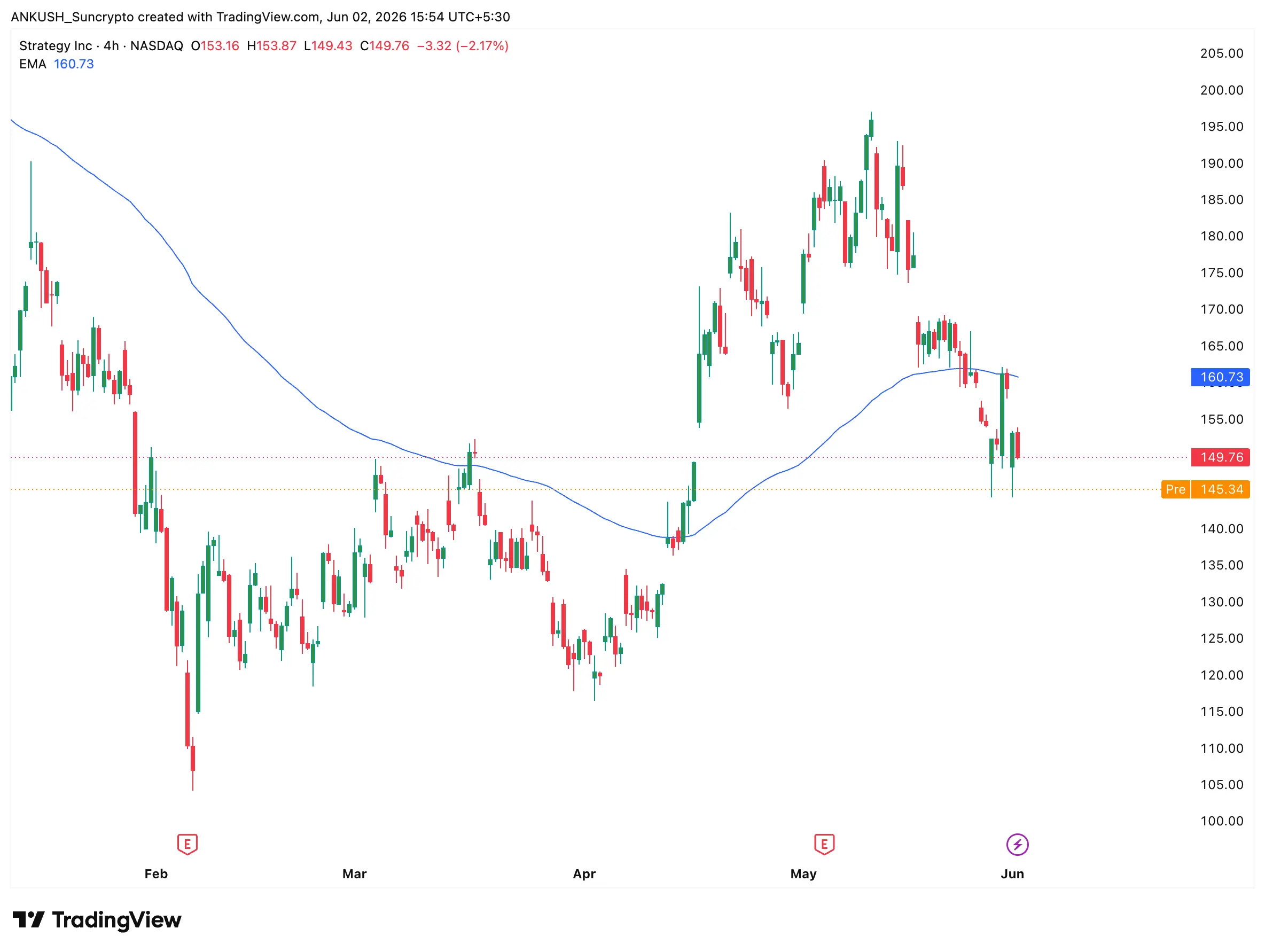
- MSTR stock was trading near $150 after dropping 5.5% following news that Strategy was selling BTC for the first time since 2022.
- MSTR has broken below a joint trendline and lower Bollinger Band and was 6% down for the week. The stock was sitting 12.7% below its 20-day SMA at $173.58 and down 57.26% over 12 months.
- Failure to test the 200-week moving average (WMA) could raise downside risk to MSTR’s stock price following its recent move made with BTC sale, while the stock’s next important support is around $135.
- MSTR sagged down to pre-market lows below the $150 mark, but made a brief recovery from $149.75 to the end of the trading session.
How did BTC price react to the Strategy selling?
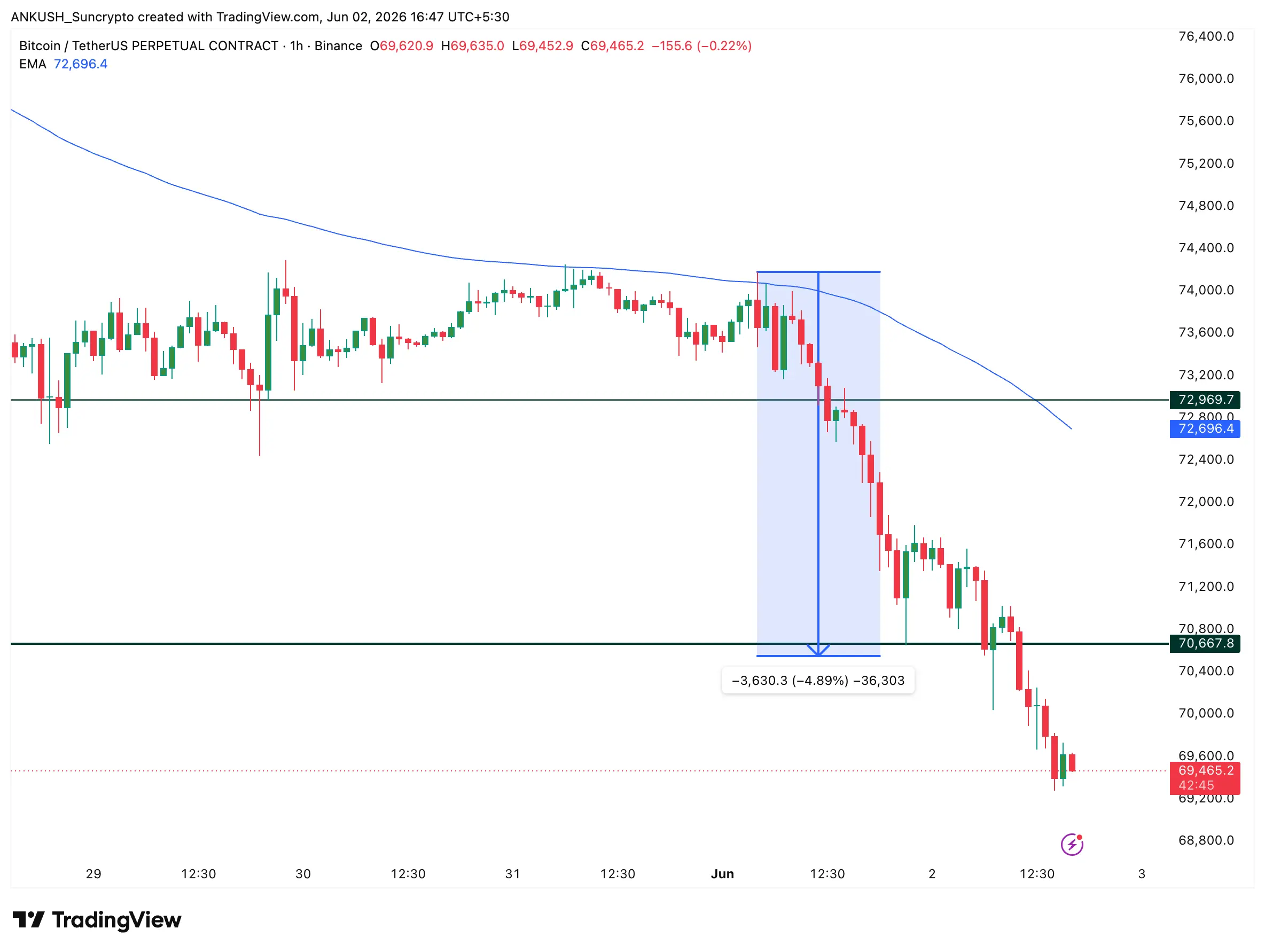
Strategy’s announcement to sell Bitcoin also had a ripple effect on the wider crypto market. It briefly pushed the BTC price below $72,000, retail traders’ panic further worsened the price decline and brought it down to $70,700, the lowest price for the Bitcoin in two months.
The psychological weight of the event far outweighed its actual size. Strategy selling was only 32 BTC, or 0.0379% of its treasury, which remained at 843,706 BTC. But the feeling that the industry’s leading corporate owner had violated its most crucial commitment proved sufficient to deal a blow to both equity and crypto markets.
What does Strategy’s new move mean for future BTC management?
By changing its tone from “never sell Bitcoin,” Strategy’s call is a clear sign of a shift in the company’s strategy to actively managing its assets and liabilities to maximize shareholder value. One of the main elements of this new strategy is STRC, a yield-generating perpetual preferred stock issued by Strategy.. The investment product is intended to appeal to investors interested in earning income, while multiplying Strategy’s holdings more rapidly via a credit fueled capital engine, as opposed to pure “buy-and-hold.”
The company forecasted some planned future transactions during its Q1 earnings call and rumours had been swirling the week prior with Strategy transferring $30 million of Bitcoin to Coinbase Prime. Strategy sells 32 BTC today, but leadership has been careful to frame any disposals as net-positive moves — the company simultaneously raised $128.3 million by selling 801,994 shares of common stock, reinforcing that its capital strategy remains aggressive even as its Bitcoin posture becomes more nuanced.
Is Saylor’s “Never Sell” narrative officially dead?
The “never sell” era is not just bending, it has officially broken. Saylor had repeatedly stated that Strategy intended to hold Bitcoin long term and was associated with a “never sell” narrative., but lately that sentiment has turned around and Strategy successfully completed its first strategic sale. On the previous earnings call CEO Phong Le had said that the company would not just sit and say it would never sell any of its BTC.
The disclosure came at the same time that the SEC made it in routine filings, rather than through a public announcement of the sort one normally expects at a press conference, suggesting that Strategy did not want to appear to be hiding anything in the narrative and wanted the disclosure to stick to the facts. Nevertheless, markets got it. Strategy pointed out it had already bought 2.6 times the amount of Bitcoin mined in 2026 so far, which it is no doubt trying to offer to buyers to assure them its buy-and-hold strategy continues to be more powerful than the sell-and-run methodology the market has embraced.
Final Thoughts
Strategy selling 32 Bitcoin is small but big in terms of implications. It marks the formal end of one of the most closely watched corporate commitments in modern financial history. MSTR shares could rally back up to $166 resistance if no more trading takes place in the near term, assuming that the market comes to terms with the fact that Saylor has switched his “never sell” plan. Each time the quarterly dividend payment obligations weigh on the treasury any more, subsequent rounds of selective sell-offs could happen, too.
Investors need to keep an eye on three major areas: if Q2 treasury statements show more selling disposition, if Saylor issues any public document that signals a change in his plan, and whether Bitcoin stabilizes above the critical $70,000 support zone.
Disclaimer: Crypto products and NFTs are unregulated and can be highly risky. There may be no regulatory recourse for any loss from such transactions.
Did Saylor personally approve the 32 BTC sale?
Yes, Michael Saylor actively approved and previewed the sale. He stated on a quarterly earnings call that the company would probably sell some Bitcoin to fund a dividend just to inoculate the market.
Is the 32 BTC sale linked to STRC dividend funding?
Yes. According to an SEC 8-K filing, Strategy (formerly MicroStrategy) explicitly confirmed that the proceeds from the 32 BTC sale were earmarked to fund distributions and dividend payments on its STRC preferred stock.
Does this BTC sale change the long-term Strategy plan?
The recent sale of 32 BTC does not change its long-term strategy of accumulating Bitcoin, though it marks a tactical shift in how the company manages its capital structure and dividend obligations