
It looks like Ethereum is about to make a decisive move. There is a mix of technical signals, institutional activity from big investors and an upcoming significant upgrade – with all this going, a question that everyone is asking is: “Whether it is time for a breakout or a or just another fake signal?” Let’s decode it properly.
What is the Ethereum price today?
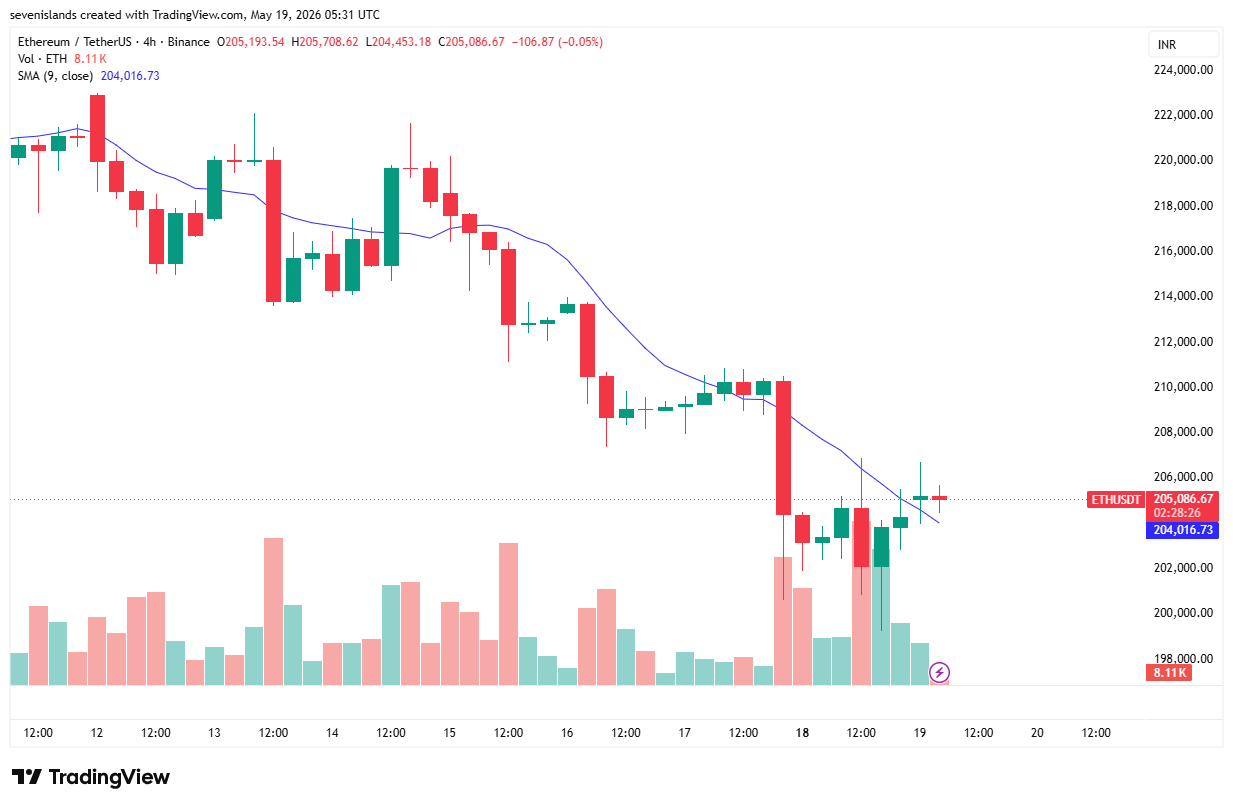
As of 18th May 2026, the Ethereum price is returning to the critical resistance zone, hovering near $2,128.23 (₹205,005.18). The second-largest cryptocurrency by market capitalization, which is valued at about $256.8 billion at the time of writing, has managed to recover from its lows of February 2026, approximately $1,743, but still, is far away from its highest price in August 2025, where it hit nearly $4,897.
If the Indian investor is following the ETH price INR, then they will have to look at the current value of this asset which is ranging from around ₹191,000 to ₹2,22,000 per coin.
The $2,400 mark is proving to be a key battleground. Several attempts to break it have failed to take place and analysts are marking up a possible close above $2,400 for the first time to indicate a move toward a true recovery, and not just a breakout. THIS is where ETH is right now, in no man’s land. The subsequent conversation jumps to $2,500, $2,600 and then the $3,000 psychologically significant mark.
What does on-chain data say about Ethereum accumulation?
One of the most important signals at the moment is under the surface. On chain data suggests that this asset is currently undergoing a major accumulation phase, not a breakdown. Let’s take a look at some of the major statistics that help this picture:
- In early May, 2026, whale wallets collected more than 140,000 ETH, valued at around $322 Million within just 96 hours!
- The volume of locked ETH at 37 million (approx. 30%) is a positive trend, and is equally structurally reducing sell pressure from the liquid market.
- Aggregated Open Interest across ETH perpetual futures is holding above $12.7 billion, recovering steadily from February lows.
- With all the volatility in the market, there’s been a steadiness of active addresses on the network, ranging in numbers from 400,000-700,000 accounts.
- Recently ETH’s trading volume on the major exchanges has reached $27.32 billion within 24 hours, which is more than 103% increase compared to the previous trade sessions.
- The aggregated funding rate hit positive yet again, and this indicates that long-position traders are willing to pay premiums to keep a “bull” position.
Will the Glamsterdam upgrade break Ethereum’s resistance?
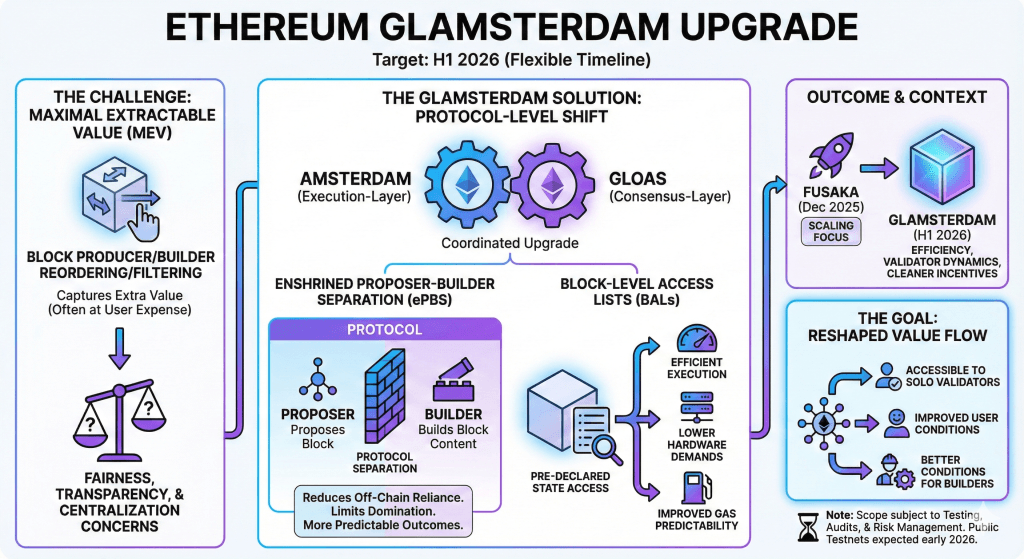
Collectively, the greatest near-term catalyst that could potentially tip the market could be the Glamsterdam upgrade: the next big hard fork for the coin that is scheduled for June 2026. With this upgrade, it is expected that:
- Introduce enshrined proposer-builder separation (ePBS), cutting centralized control over block building
- Release parallel operation of transactions and lists for blocks for better data management.
- A new potential breakthrough that triples the L1 transaction speeds, which is yet to be fully adopted by the market.
- Work towards fulfilling their long-term aim of working with more than 100,000 TPS enabled on the layer 2 networks.
- The Hegota upgrade will follow later this year, also concentrating on the changes and improvements in the consensus layer and cross-layer coordination.
Historically, significant upgrades have been effective catalysts for the rise or fall in ETH price. Both the Merge 2022 and Shapella 2023 upgrades preceded significant rallies. Glamsterdam might just offer the needed backdrop that can break the $2400 resistance level of ETH if it can help improve L1 scalability.
How is Wall Street positioning to buy Ethereum?
Institutional interest in this blockchain platform has never been stronger, and smart investors seem to be taking advantage of the recent vital bear market that offered them a chance to buy Ethereum smartly before the breakout. The information forms a story. In May 2026, Binance’s stop-loss orders resulted in an ETF with a $82 million ETH stake as the firm dramatically reduced its Bitcoin weights by around 70% in the process, indicating that it was pivoting from Bitcoin to Ethereum. Meanwhile, Charles Schwab launched direct spot ETH trading for its 39 million account holders on May 13, 2026, greatly increasing the trading volume of retail and institutional investors.
There were signs of short-term gains with $36.3 million worth of outflows on May 13 for spot ETH ETFs, the biggest withdrawal in the past three weeks. But that is regarded as a short-term rebalancing and not a fundamental change in institutional sentiment. The overall sentiment remains relatively strong for more institutional involvement, one of the three propellants driving ETH’s bull run.
What are the risks that can prevent a breakout?
It would be impossible to have a bull thesis without considering the bear side of the trade. There are several risks that could be blocking the predicted move in Ethereum:
- Expect appetite to be dampened more broadly if the macro risk-off theme takes off and the Fed raises rates or begins taking further steps to normalize trade policies.
- The competition is fierce, and it remains to be seen how the Layer 1 networks will perform in the future. But there are a lot of rivals, both from Layer 1 networks like Solana and Sui, that deliver faster and lower-cost options.
- Technical indicators are mixed too: the monthly RSI is at level 38, which is viewed as the zone of neutral to bearish overstimulation, and the monthly 200-day moving average line, which is now linking the RSI reading, continues to be a ceiling as opposed to a floor ($2,335).
- As mid-May 2026 approaches, the Fear & Greed Index is indicating that the bulk of the market is still not convinced, at just 39 (fear). A slowdown or failure in the Glamsterdam upgrade, coupled with the continued consolidation of the operations, could also remove the near-term catalyst and extend the consolidation phase well into summer.
Final Thoughts
Ethereum sits at a genuinely pivotal moment. This isn’t just the on-chain fundamentals that are solid; the institutional narrative is in the early stages, and the potential technical catalyst of Glamsterdam’s upgrade seems like a good bet for a price re-rate.
But there is also a possibility that the breakout will not happen at all. The $2,400 level of resistance is true, macro headwinds have remained unchanged, and sentiment in the market is still bearish. Whether this coin will escape from its stagnation in May or June 2026 will rely on whether the upgrade actually comes in, whether more large-scale investors enter the scene, and whether the macro environment becomes more risk-on. In any case, users are advised to stay alert and conduct their own research before investing.
Disclaimer: Crypto products and NFTs are unregulated and can be highly risky. There may be no regulatory recourse for any loss from such transactions.
What is the Glamsterdam upgrade?
Glamsterdam is Ethereum’s next major hard fork targeting June 2026, expected to triple Layer 1 throughput and introduce proposer-builder separation, a key catalyst that the market has not yet fully priced in.
What is the ETH gas fee and why does it fluctuate?
Gas fees are the transaction costs paid to validators for processing operations on the network; they fluctuate based on network demand. Higher activity means higher fees.
How to buy Ethereum in India?
You can purchase cryptocurrencies like ETH on platforms such as SunCrypto, which offer INR and USDT trading pairs.