
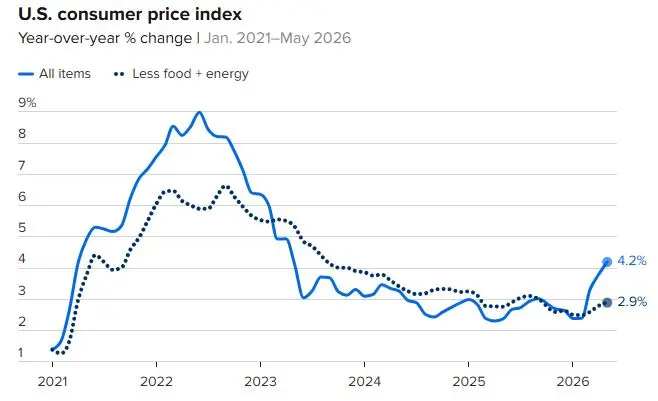
The latest US CPI inflation data has rattled global financial markets and renewed concerns about persistent inflation. The annual Consumer Price Index reached 4.2% in May 2026, crossing the 4% threshold for the first time in three years. This figure, which was in line with expectations, highlighted how price pressures in the American economy are still high and also the fact that this has repercussions beyond US borders, even impacting India’s crypto market.
What is US CPI?
The US Consumer Price Index (CPI) is a statistical gauge of the average change in prices of goods and services that people pay for every month, covering food, energy, housing, transportation, and healthcare. Issued by the U.S. Bureau of Labor Statistics (BLS), it gives a fuller picture of price pressures at the consumer level in the American economy.
Knowing about US CPI inflation data is critical for global investors as it shapes the policy of the Federal Reserve. When prices rise, the central bank moves to hold or increase the interest rate at restrictive levels, a decision that cascades across equity markets, currencies, and digital assets worldwide.
What was the US CPI inflation rate in May 2026?
According to the BLS, the US CPI inflation rate in May 2026 rose 0.5% on a seasonally adjusted monthly basis, following a 0.6% gain in April. The 4.2% yearly US CPI rate is up from 3.8% in April and 3.3% in March. This latest US CPI inflation data print marks the fastest pace of price growth in over three years.
The core CPI, which strips out volatile food and energy categories, rose a cooler 0.2% monthly and 2.9% annually. While above the Fed’s 2% goal, higher core inflation still suggests that the overall inflationary spiral hasn’t fully taken hold yet.
What are the primary drivers behind the US CPI inflation spike?
- Energy goods prices have jumped 3.9% in May and are up a staggering 23.5% from last year.
- Gasoline has gone up 7.0% month-on-month and 40.5% from last year, the clearest driver of the spike.
- Escalating Middle East tensions and disruptions to oil flows through key shipping routes have pushed energy prices sharply higher
- Airline fares swelled 2.7% in May out of rising fuel costs.
- Healthcare costs rose 0.5% higher as dental and hospital services across the country increased.
- Food prices rose 0.2%, while higher fertilizer costs continue to pose upside risks to future food inflation.
- Real average hourly earnings fell 0.7% year-over-year, so inflation is roaring through workers’ savings.
How will this spike in the US CPI inflation rate impact crypto?
There is a direct relationship between the US CPI inflation rate and crypto investments. When headlines on inflation run hot, there is a pressure on the Fed to keep interest rates elevated or hike them again, both of which make risk assets such as Bitcoin and other altcoins less attractive for institutional investors.
Bitcoin traded in the $59,000–$61,000 range in the days around the data release, reflecting that macro anxiety. A hawkish Fed further amplifies volatility in the Indian crypto space by putting pressure on the Indian rupee, accelerating the outflows of FPI, and making the Indian rupee volatile for Indian crypto investors.
That said, the cooler core CPI reading at 2.9% has kept the immediate panic in check. In order for the Fed to conduct sharp tightening, core CPI should not produce an upward trend that follows after the headline figure, economists said. It will remain the most important macro variable to watch going forward, especially leading up to the FOMC meeting on 16-17 June. Investors are advised to watch that meeting closely, maintain diversified positions, and avoid reactive trading based solely on headline numbers.
Major macroeconomic events such as US CPI inflation releases often trigger significant volatility across cryptocurrency markets. Traders who anticipate market swings frequently use crypto futures to hedge risk or capitalize on short-term price movements. On SunCrypto, users can access crypto futures trading to trade major cryptocurrencies during high-impact events like CPI releases, Federal Reserve meetings, and interest rate announcements while managing risk through advanced trading tools.
Final Thoughts
The spike in the US CPI inflation rate from May 2026 to 4.2% is a very real macro signal to watch. Energy inflation has kicked the headline CPI into a three-year high, and with Fed rate hike odds rising and rupee pressure building, crypto markets are already feeling the nerves; this is a time for informed, measured decision-making rather than panic. Stay updated, stay disciplined, and let data guide your investment strategy.
What is the difference between CPI and Core CPI?
CPI measures all goods, including volatile food and energy. Core CPI strips these out to reveal long-term underlying inflation trends.
How is the CPI data calculated and collected?
The Bureau of Labor Statistics (BLS) tracks 94,000 monthly prices across categories like housing and food, comparing them to a historical base period to measure changes.
Is the CPI the same thing as a “cost-of-living” index?
No. CPI only measures price changes. It does not track how consumers change their lifestyle or standard of living to avoid high costs