

The MicroStrategy Bitcoin sale authorization is one of the most discussed corporate treasury stories about crypto this week, and for good reason. The company filed an SEC Form 8-K on June 29, 2026, to disclose a new “Digital Credit Capital Framework” that gave the strategy board approval to sell up to $1.2 billion of Bitcoin under a set of pre-defined conditions.
This isn’t a Bitcoin liquidation event or an indicator that the company now has changed its long-standing confidence in Bitcoin; it is a structural shift in how Strategy manages liquidity around its growing preferred-stock obligations.
For anyone tracking crypto treasury companies, ETF flows, or Bitcoin’s price action, understanding the mechanics of this MicroStrategy Bitcoin sale program matters more than reacting to the headline number.
What is this MicroStrategy bitcoin sale authorization?
The MicroStrategy Bitcoin Sale authorization is actually included in the Digital Credit Capital Framework launched recently by the company, which is a five-part policy framework consisting of the following:
- A board-approved USD reserve policy protecting a $2.55 billion cash cushion.
- STRC preferred dividend rate raised to 12.00%, effective July 1, 2026.
- A one billion dollar buyback program for digital credit preferred securities.
- One billion dollar repurchase authorization covering Class A common stock.
- Bitcoin Monetization Program, capping potential BTC sales at $1.2 billion.
The last part is the MicroStrategy Bitcoin sale everyone is talking about, as it allows Strategy to sell Bitcoin up to $1.2 billion in order to fund or replenish its USD reserve, or cover the payment of preferred dividends and interests, or fund its repurchase program when that is a more efficient use of capital than issuing bank equity.
Michael Saylor, Founder and Executive Chairman, explained that Strategy’s purpose in creating this policy framework was to “introduce liquidity, discipline, and active capital management into the world of the company’s digital credit securities and strengthen the company’s market position, while positioning Strategy at the forefront of Bitcoin adoption as the leading treasury reserve asset.”

Why is this MicroStrategy Bitcoin sale framework launched now?
Several factors have converged to set the stage for Strategy’s shift from a purely accumulation strategy to active liability management:
- Preferred stock dividends and interests now cost the company $1.76B per year
- MicroStrategy shares fell out of line with par value, leading to a dividend hike
- MSTR stock tracked near or below 1x mNAV for weeks on end
- Institutional owners wanted more concrete evidence of liquidity discipline
- Earnings dilution from equity flips that price below fair value hurts existing BTC holders
Rather than defaulting to fresh share sales during a weak stock stretch, MSTR, which has lost roughly 40% of its value in June alone, built a dedicated cash buffer instead. The MicroStrategy Bitcoin sale authorization exists as a backstop, not a default plan.
How is the current MicroStrategy Bitcoin holding?
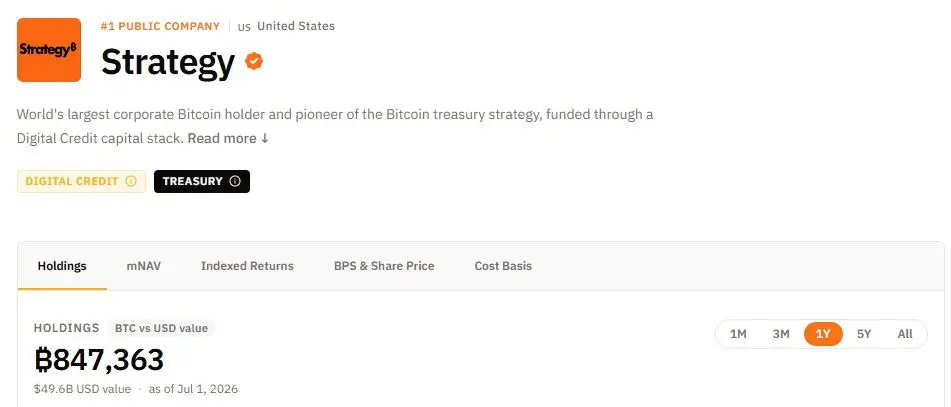
This is the detail most likely to get distorted in headlines, so it deserves attention. At the time of filing, the MicroStrategy Bitcoin holding was around 847,363 BTC, unchanged from the week ended June 28, 2026. These were acquired for roughly $64.1 billion at an average cost near $75,650 per coin. There were no purchases or sales of coins on account of the filing.
If Strategy were to deploy the full $1.2B Bitcoin sale authorization at the time of filing and were to use the full $1.2 billion authorization at Bitcoin’s current price near $58,000–$60,000, that would translate to roughly 21,000–22,000 BTC, or about 2.5% of the total stack a cap, not a commitment.
The framework also locks in a $2.55 billion USD reserve as of June 28, 2026, which management says covers more than 12 months of preferred dividend and interest obligations at current run rates, satisfying an internal board policy requirement.
How did the Bitcoin sale framework affect STRC’s price?
STRC, Strategy’s Variable Rate Perpetual Stretch Preferred Stock, was under real pressure heading into the June 29 announcement, which is exactly why the framework mattered so much to holders. Through most of June, STRC traded well below its $100 par value, sliding to a low near $73, a roughly 27% discount that pushed its effective yield toward 15-16% even though the stated dividend rate had been frozen at 11.50% for four straight months.
This drop was a direct knock-on effect of investors buying STRC on margin and a forced sell-off driving its price lower as they got margin called. Also, many STRC holders have been waiting to see whether MicroStrategy Bitcoin holdings would grow enough so there was something to back the preferred security. Whether STRC fully recovers towards its $100 value will depend on what Bitcoin does in the coming months and years.
The Digital Credit Capital Framework directly addressed this problem by announcing a raise in the STRC dividend rate to 12.00% effective July 1, 2026, along with the existing $2.55 billion USD Reserve and capped Bitcoin sale authorization strategy is clearly communicating that it has both the intent and the liquidity to support STRC’s price and, in turn, protect its yield-seeking shareholder base.
The market has already begun to react; MSTR common stock rallied nearly 5-6% pre-market with a stronger +12.6% once regular trading opened, and STRC shareholders can see for the first time how future dividend payments might be funded, even if Bitcoin’s price remains weak.
Whether or not STRC will recover fully to its par value will still hinge heavily on the broader trajectory of Bitcoin, but the framework at least eliminates the immediate liquidity question that had been driving the sell-off.
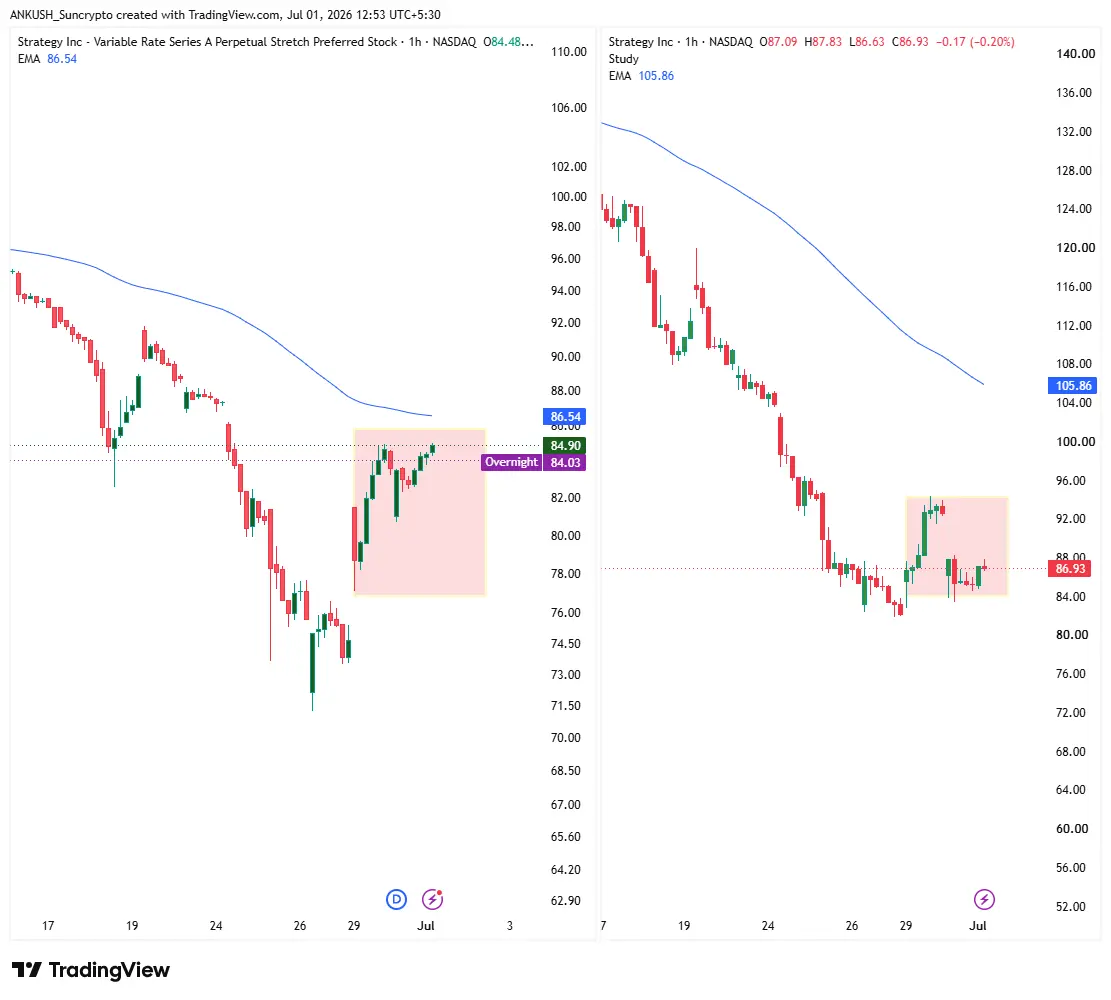
Image: A side-by-side comparison of the price movements of MSTR & STRC stocks after the announcement
How has the MicroStrategy Bitcoin sale impacted altcoin prices?
Altcoin traders, in particular, were treating this MicroStrategy Bitcoin sale announcement as another liquidity signal to watch:
- Authorization alone can influence how traders price future BTC issuance.
- Altcoins are quicker to respond to institutional liquidity scares than Bitcoin.
- Footprint thickness for derivatives is amplifying short-term sentiment swings much more now.
- Treasury company decisions are bleeding over into broader ETF flow expectations.
- Markets are learning to correctly separate board approvals from actual sales of coins.
Since Bitcoin has been trading far below its 2025 peak, close to the $58,000–$60,000 range in early July 2026, and facing ETF outflows and institutional reluctance, any signal touching a large holder like Strategy tends to get amplified. The distinction between “authorized to sell” and “has sold” is the single most important nuance for traders parsing this story.
What should investors expect next?
Strategy has committed to disclosing material monetization activity through standard 8-K filings; the next real sign will come from whether any of the Bitcoin sale actually goes through and how fast.
Analysts will also focus on the monthly renewal of the STRC dividends rate, the rate of the $2 billion in combined buybacks, and whether the USD reserve needs to be replenished before its 12-month coverage is depleted. Support for a moderate Bitcoin price above the key $58,000 level would relieve pressure to draw down the reserve, but a deeper drop could test the monetization program’s speed of uptake.
Final Thoughts
The MicroStrategy Bitcoin sale authorization should be seen as a liquidity insurance policy rather than Strategy retreating from Bitcoin. Strategy still has 847,363 BTC in its wallet, has raised a $2.55 billion cash reserve, and capped any sale to around 2.5% of its Bitcoin holdings.
For institutional, retail, and speculative market players, the narrative is not one of panic, but rather one of crypto’s biggest corporate holders getting the balance sheet process made even more professional as we march into a volatile and unpredictable second half of 2026.
Why did Strategy start selling Bitcoin?
When the crypto market stalled and the premium on their stock disappeared, traditional financing windows became more expensive. To meet annual obligations like preferred stock dividends and interest payments (totaling ~$1.8B annually), they opted to selectively sell small amounts of BTC or establish a dedicated USD reserve.
What is the current MicroStrategy Bitcoin holding?
The current MicroStrategy Bitcoin holding is around 847,363 BTC.
Did they sell any BTC recently?
Yes. Strategy Inc. (formerly MicroStrategy) filed an SEC Form 8-K disclosing that it sold 32 Bitcoin (BTC) for approximately $2.5 million. The sale took place between May 26 and May 31, 2026, at an average net price of $77,135 per coin.