
S&P, Dow Jones and Pantera have launched its first ever crypto index and have not included the leader of cryptocurrency, Bitcoin. “CEO Cathy Clay said Bitcoin fails the index’s core test, generating real protocol revenue and instead trades purely on speculation.”
What is Cboe’s involvement in the newly launched Crypto index by S&P?
Cboe Global Markets acts as the primary real-time calculator and data distributor for the newly launched index. S&P Dow Jones Indices and Pantera Capital designed the core methodology, while Cboe processes live price feeds and disseminates the index values.
The specific role of Cboe
Real-Time Calculation & Feeds: Cboe leverages its advanced infrastructure to compute intraday values for the 18-token S&P Pantera crypto Index, streaming this data directly to global trading desks, terminals, and financial media through the Cboe Global Indices Feed.
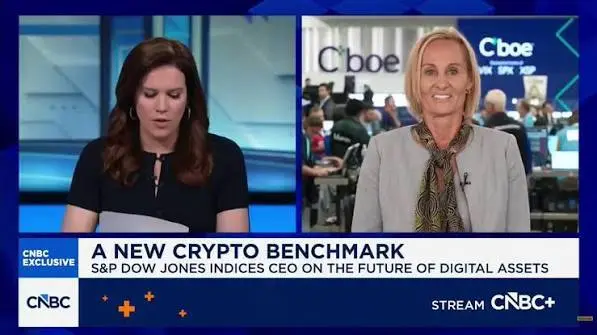
Executive Leadership Connection: Cathy Clay, the recently appointed CEO of S&P Dow Jones Indices who actively led launch publicity for the index, including an appearance on CNBC’s The Exchange, previously served as Global Head of Derivatives at Cboe Global Markets.
Foundation for Listed Products: Although no tracking fund has launched yet, the index’s design leaves room for Cboe to eventually list derivatives, covered-call strategies, or option-based products built on the S&P Pantera crypto Index baseline.
What is a crypto index?
A crypto index is a statistical tool that tracks the performance of a group of digital assets, such as the top 10 coins or tokens from a specific sector. It works much like traditional stock market indices, such as the S&P 500, offering investors a clear snapshot of market trends without the need to buy every individual token.
How does global crypto indexes work?
- Asset Selection: Tokens are included based on defined criteria such as minimum trading volume, liquidity thresholds, regulatory compliance, or market capitalization.
- Weighting Methods: Most indexes follow market-cap weighting, giving larger assets like Bitcoin and Ethereum a bigger share, while others use equal weighting or fundamental metrics such as protocol revenue.
- Periodic Rebalancing: Index components and their weightings are reviewed and adjusted on a set schedule, usually monthly or quarterly, to keep the index aligned with current market conditions.
Benefits and limitations
- Diversification: Spreads investment risk across multiple digital assets instead of relying on a single coin, reducing exposure to any one asset’s price swings.
- Passive Management: Removes the need for manual token selection and tracking, making it a beginner-friendly option for newer participants entering the crypto market.
- Drawbacks: Does not eliminate market volatility entirely and may involve management fees when accessed through a fund or ETF-style product.
What are the top holdings Cboe Global Markets added?
Ethereum (ETH)
ETH leads the index as a primary foundational holding, with a market capitalization of $232.21B, ranking 2nd in the crypto industry. As the settlement layer for the majority of DeFi, stablecoins, tokenized real-world assets, and NFT activity, Ethereum’s value proposition extends well beyond price speculation; it’s the infrastructure other crypto index sectors are built on. It has remained bullish over the past few weeks and, based on technical charts, is expected to sustain this momentum.
For an investor who isn’t holding BTC, ETH offers a compelling alternative “core holding” precisely because its use case is different from Bitcoin’s store-of-value narrative: it’s a productive, yield-bearing asset (via staking) with continuous protocol upgrades aimed at scalability and efficiency. For those who hold both BTC and ETH, Ethereum adds diversification within crypto’s two largest assets, since ETH’s price drivers, network usage, gas fees, DeFi TVL, and institutional ETH ETF flows, don’t move in perfect lockstep with Bitcoin’s macro-driven cycles, giving a portfolio a second, semi-independent growth engine.
Binance Coin (BNB)
BNB’s market capitalization stands at roughly $75–86B, keeping it consistently among the top five assets by market cap, and it is backed by its role as the native token of Binance, the world’s largest crypto exchange by trading volume. What makes BNB particularly attractive as a standalone or complementary holding is its structural deflationary mechanism: BNB undergoes a quarterly auto-burn (its latest quarterly burn removed roughly 1.6 million BNB, worth close to $930 million, from circulation), permanently reducing total supply from an original 200 million toward a 100-million-token cap.
Beyond the burn, BNB carries real utility, transaction fee discounts on Binance, gas fees on BNB Chain, staking, governance rights, and growing exposure to real-world asset (RWA) tokenization and AI agent ecosystem growth on BNB Chain. For an investor not holding BTC, BNB offers exposure to the health and growth of the world’s largest exchange ecosystem rather than to Bitcoin’s price cycle alone, meaning its performance is tied to trading volumes, new product launches, and BNB Chain adoption, a genuinely different profitability driver than BTC’s.
Solana (SOL)
Solana ranks 7th in the crypto industry with a market capitalization of approximately $44–45B. It stands out for its consistently high network activity, regularly processing over 100 million daily transactions with millions of daily active addresses, reflecting genuine, sustained usage rather than speculative spikes alone. Solana’s technical edge, sub-second finality, extremely low transaction costs, and continued upgrades like the Alpenglow consensus overhaul (targeting 150-millisecond finality) have made it a preferred base layer for DeFi, tokenized assets, payments, and increasingly, AI-agent applications.
Institutional recognition has also grown meaningfully: spot Solana ETFs launched in late 2025 and have already surpassed $1 billion in combined assets, with major players like Fidelity, Bitwise, and even corporate treasury strategies (such as Forward Industries’ multi-million-SOL treasury) adding further legitimacy. For an investor looking beyond BTC, SOL offers a fundamentally different profitability thesis: exposure to high-throughput blockchain adoption and the “Solana vs. Ethereum” market-share narrative, where analysts have floated scenarios of SOL capturing a growing share of Ethereum’s valuation as the ecosystem matures.
Tron (TRX)
Tron has a market capitalization of approximately $31B, keeping it among the top 10 cryptocurrencies by market cap (ranked 8th). TRX has begun recovering after a sharp fall and shows potential to perform positively going forward, supported by tangible fundamentals rather than pure sentiment: TRON hosts one of the largest stablecoin settlement networks in crypto index, with roughly $55 billion in USDT circulating on the chain, and the network regularly processes several million active addresses daily thanks to its low-cost, high-speed transaction design.
Adding to the bullish case, corporate treasury vehicle Tron Inc. has been steadily accumulating TRX (with holdings surpassing 700 million tokens), and the project has benefited from a dismissed regulatory case along with a growing Mastercard-linked partnership narrative. For an investor not holding BTC, TRX represents exposure to the “payments and stablecoin rails” niche of crypto rather than a store-of-value bet, a genuinely different profitability angle tied to real-world stablecoin transfer volume and remittance-style use cases, which can perform well even when broader market sentiment toward BTC is lukewarm.
Hyperliquid (HYPE)
HYPE rounds out the top tier of the basket, showing strong potential for solid returns, with the token having surged significantly year-to-date in 2026, reporting gains in the range of 127%–147% at various points this year, dramatically outperforming both Bitcoin and Ethereum over the same stretch. HYPE’s profitability case is rooted in its position as the native token of Hyperliquid, a leading decentralized perpetuals exchange built on its own Layer-1 blockchain (combining HyperEVM and HyperBFT), with daily trading volume on the platform frequently exceeding $1 billion.
The token carries real utility, staking, governance, and trading fee discounts and has attracted growing institutional attention, including its own spot ETF products from issuers like 21Shares. For an investor not holding BTC, HYPE offers a distinctly different profitability driver: direct exposure to the growth of on-chain derivatives trading volume, a sector largely uncorrelated with Bitcoin’s own price action, though as with any high-growth token, it has also shown sharp pullbacks from its all-time highs, underscoring that its outsized upside comes with correspondingly higher volatility.
SunCrypto is an FIU-compliant crypto exchange in India that offers 600+ cryptocurrencies, including all blue-chip tokens, tokenized metals and commodities, tokenized US stocks, DeFi, RWA, utility, governance, security, and payment tokens with global partnerships and potential listing criteria. Also, the platform offers diverse crypto products like spot trading, futures trading, staking, crypto SIP, otc desk trading, Web3 trading, and many more.
To trade or invest securely, SunCrypto is a great choice due to its multisig cold storage fund security and PMLA and FIU compliance; it follows proper KYC, AML, and CFT guidelines.
Pantera gives three reasons why Bitcoin was not included
Panthers explained in its blockchain letter why Bitcoin was excluded.
First, Bitcoin functions as a monetary asset rather than a productive one; institutional allocators typically already gain exposure through single-asset BTC ETFs, governed by their own dedicated allocation policies. Second, most existing crypto indices lump Bitcoin together with meme coins and protocols that generate real revenue, forcing institutions to underwrite a basket that mixes fundamentally different risk profiles. Third, since Bitcoin produces no protocol revenue, it doesn’t clear the index’s financial viability screen in the first place.
Pantera argues that the digital asset industry’s core narrative problem lies in the measuring stick itself. Mainstream benchmarks track only Bitcoin’s price, unable to distinguish between a protocol with real, paying users and a token with no underlying economic function.
Final Thoughts
The launch of the S&P Pantera crypto index marks a notable shift in how traditional finance is beginning to frame the digital asset space, not as a single “Bitcoin trade,” but as a diversified ecosystem where revenue-generating protocols are treated distinctly from purely speculative, monetary assets. By excluding Bitcoin and instead weighting the index toward tokens like Ethereum, Binance Coin, Solana, Tron, and Hyperliquid, S&P and Pantera are signaling that institutional interest is maturing beyond price speculation toward measurable, fundamentals-driven metrics like protocol revenue.
That said, this doesn’t diminish Bitcoin’s role in the broader crypto market. Its exclusion stems from a specific methodological choice, not a reflection of its dominance or relevance as the industry’s leading store-of-value asset. Investors should view this index as one lens among many, useful for tracking revenue-generating protocols, but not a substitute for a well-rounded portfolio strategy.
As with any market development, this is not financial advice. Crypto markets remain volatile, and index inclusion or exclusion shouldn’t be the sole basis for investment decisions. Always do your own research before allocating capital.
Why was Bitcoin excluded from the S&P Pantera Digital Asset Index?
Bitcoin was left out because it functions primarily as a monetary asset rather than a revenue-generating one.
What tokens are included in the S&P Pantera Digital Asset Index?
The index tracks 18 tokens, with Ethereum (ETH), Binance Coin (BNB), Solana (SOL), Tron (TRX), and Hyperliquid (HYPE) forming the top holdings.
How does a crypto index differ from just tracking Bitcoin’s price?
A crypto index tracks a diversified basket of digital assets using defined criteria like liquidity and revenue, offering a broader market snapshot.