

Major cryptocurrency assets slid Tuesday as the Senate failed to pass the Digital Asset Market Clarity Act, which seeks to create a federal regulatory framework for digital assets and faces opposition from some Democrats who say the legislation’s provisions are too weak.
What is the Clarity Act?
The CLARITY Act (Digital Asset Market Clarity Act) aimed to end years of regulatory confusion in US crypto by clearly dividing oversight between two agencies, the SEC and the CFTC. Currently, it’s often unclear whether a crypto asset is a “security” (SEC) or a “commodity” (CFTC), leaving exchanges and issuers stuck in a grey zone and facing surprise enforcement actions instead of clear rules.
The bill laid out tests to decide which regulator oversees a token, based on factors like its stage of development and decentralization. Beyond classification, it also covered customer protections, compliance requirements, and ethics rules for officials trading crypto.
It had strong bipartisan momentum through early 2026, with passage odds hitting 82% in February, before ethics disputes eroded support.
What happened in the senate vote?
The vote
On Tuesday, September 15, 2026, the Senate held a cloture vote on the CLARITY Act, a procedural step needed to move the bill to formal debate. It required 60 votes to pass. The final tally was 49-50, falling well short (some early unofficial counts showed numbers like 39-36 or 46-43 before all votes were recorded).
Republican defections
Three Republicans broke ranks and voted no: Susan Collins (Maine), Josh Hawley (Missouri), and Jerry Moran (Kansas). Thom Tillis also voted no, though procedurally, as part of a motion to recommit.
Democratic holdouts
Several Democrats who had spent months negotiating the bill, including Kirsten Gillibrand, Mark Warner, Cory Booker, Raphael Warnock, Ruben Gallego, Angela Alsobrooks, and Catherine Cortez Masto, ultimately voted no as well.
What this means procedurally
Since it failed to close, the Senate never even opened formal debate on the bill; it couldn’t reach the floor at all. This wasn’t a vote on the bill’s merits; it was a defeat before merits were even discussed.
Market reaction
Bitcoin slipped toward $76,000 as the vote unfolded, and crypto-linked stocks like Coinbase, Circle, and Bullish extended losses.
Why did the Clarity Act bill collapse?
Ethics provisions seen as too weak
Senator Elissa Slotkin, explaining her no vote, said the bill’s ethics provisions were “simply too thin,” a direct jab at concerns over conflicts of interest tied to officials’ personal crypto holdings, including Trump’s own business interests in the sector, which had fueled Democratic opposition throughout the process.
AML and terror-financing gaps
Beyond ethics, critics flagged that anti-money-laundering and terror-financing safeguards in the bill still needed work, along with concerns that the CFTC wasn’t adequately staffed or funded to actually implement the new framework it would be handed.
A late, tougher Democratic counteroffer
In final negotiations, Senate Democrats pushed for stricter ethics rules, expanding restrictions beyond officials themselves to include their family members’ crypto transactions. This broader scope reportedly went further than Republican negotiators were willing to accept.
Bipartisan negotiations collapsed right before the vote.
Talks between the two sides reportedly ended abruptly just ahead of the vote, with Senator Tim Scott’s staff ending discussions. That last-minute breakdown meant the compromises needed to hit 60 votes never materialized.
Republican defections compounded it.
Even with all Democratic support, the bill needed GOP unity, but Collins, Hawley, and Moran broke ranks too, meaning it fell short even of a simple majority (49-50), not just the 60-vote threshold.
What was the immediate market reaction after Clarity Act rejection?
Bitcoin slid from nearly $78,000 toward $75,000, down about 3.27% in 24 hours, while Ethereum, XRP, Solana, and BNB also posted daily losses. Crypto-linked stocks like Coinbase, Circle, and Bullish extended their declines as the cloture vote failed.
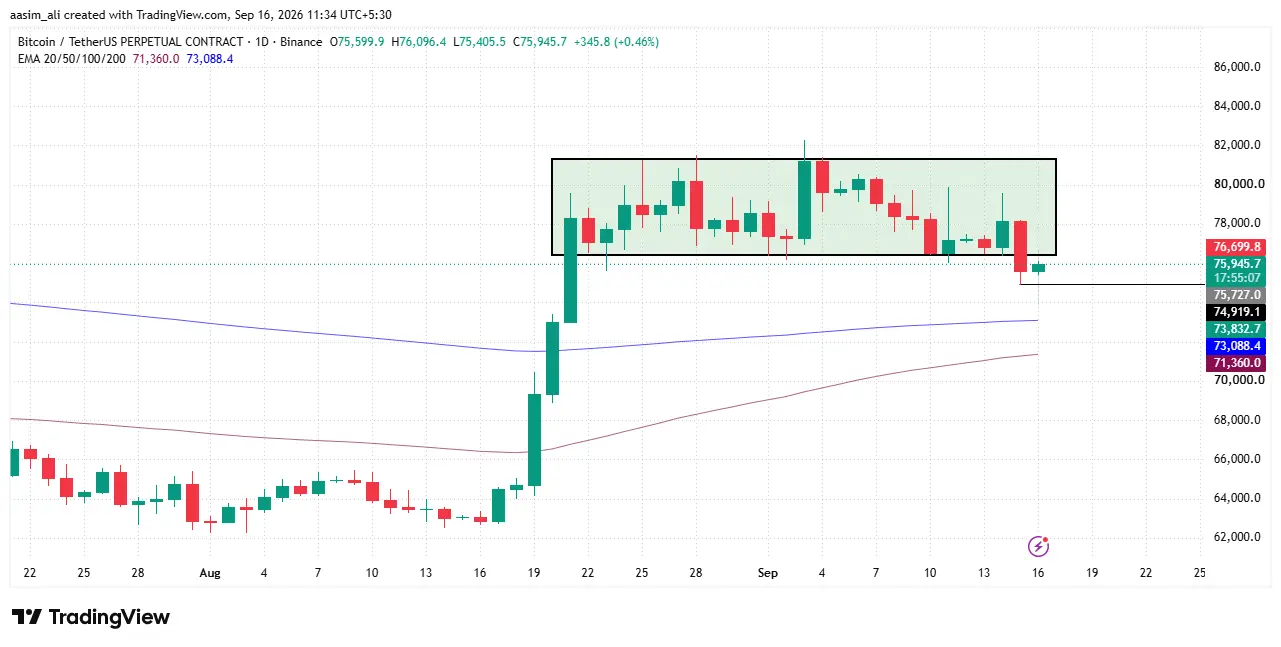
As the CLARITY Act failed, BTC price has experienced a breakdown from a 3 week support level of $76,500. This could be a bearish signal and the price can drop further. A bearish rally in Bitcoin could impact the cryptocurrency market negatively so we can see a fall in altcoins.
Prediction markets had already flagged the collapse in advance, Polymarket’s odds on the CLARITY Act becoming law in 2026 had fallen to around 7%, down sharply from 82% back in February, showing traders had priced in the failure well before the official result.
The drop came against an already fragile macro backdrop, with markets closely watching the Fed’s next move. The failed vote added to that pressure, reinforcing fears that regulatory uncertainty around crypto isn’t going away anytime soon.
Overall, the reaction reflected more than just disappointment over one bill it signaled that the industry’s biggest hope for clear US rules this year is effectively off the table, at least until after the midterms.
Impact on the Regulatory Clarity Act for crypto
The CLARITY Act’s core goal: separating SEC and CFTC oversight of crypto assets, remains unresolved. Exchanges and investors are back in the same regulatory grey zone as before.
With no law passed, clarity now depends on the SEC and CFTC’s own rulemaking rather than binding legislation, a slower, less predictable path that can shift with leadership changes. Enforcement-led regulation is likely to continue in the meantime.
Given the compressed calendar before the midterms and an expected split Congress afterward, a revival looks unlikely soon. Some call the bill “dead,” while others, like Sen. Thom Tillis, see a path forward but no quick movement is expected.
For crypto businesses, this extends uncertainty around compliance and long-term planning in the US market.
What is next for crypto regulation?
With legislation stalled, near-term clarity depends on the SEC and CFTC’s own guidance and rulemaking rather than a binding law. A late-2026 revival isn’t fully ruled out: Sen. Thom Tillis still sees a path but the narrow pre-midterm window and expected split Congress afterward make quick progress unlikely.
Any future attempt will need stronger ethics provisions (especially around officials’ and family crypto holdings) and clearer AML safeguards to win back Democratic support. Industry groups like Grayscale say they’ll keep engaging with regulators regardless, though market expectations have dropped sharply, Polymarket odds for a 2026 law are down to 7%.
Continued US uncertainty could also push crypto businesses toward clearer regulatory jurisdictions like the EU, UAE, or Singapore.
Final Thoughts
The CLARITY Act’s collapse isn’t just a legislative setback, it’s a signal that US crypto regulation stays stuck in limbo well into 2026. With cloture failing 49-50, both ethics disputes and last-minute GOP defections proved fatal, despite months of bipartisan groundwork. Markets reacted predictably, with Bitcoin sliding toward $75,000 as traders priced in the uncertainty. The bigger takeaway: rulemaking now falls to the SEC and CFTC rather than Congress, a slower and less predictable route. Until ethics and AML gaps are addressed, expect continued regulatory grey zones, cautious institutional participation, and possible migration of crypto businesses toward friendlier jurisdictions like the UAE or Singapore.
What is the CLARITY Act and why does it matter for crypto?
The Digital Asset Market Clarity Act aimed to end regulatory confusion by clearly dividing oversight of crypto assets between the SEC (securities) and CFTC (commodities). It also included customer protections, compliance rules, and ethics requirements for officials trading crypto, making it a key step toward legal clarity for exchanges and investors.
Why did the CLARITY Act fail in the Senate?
It failed by a cloture vote 49-50, short of the 60 votes needed to open formal debate. The main reasons were weak ethics provisions around officials’ (and their families’) crypto holdings, unresolved AML/terror-financing safeguards, and a last-minute breakdown in bipartisan negotiations led by Senator Tim Scott’s staff.
Who voted against the bill?
Three Republicans defected: Susan Collins, Josh Hawley, and Jerry Moran. Several Democrats who had negotiated the bill for months, including Kirsten Gillibrand, Mark Warner, Cory Booker, and Ruben Gallego also voted no, citing insufficient ethics safeguards.