

The Senate Banking Committee approved the groundbreaking Clarity Act in a 15–9 vote on 14th May 2026. Let’s get a complete breakdown of all that and what is set to happen next.
What is the Clarity Act and why does it matter?
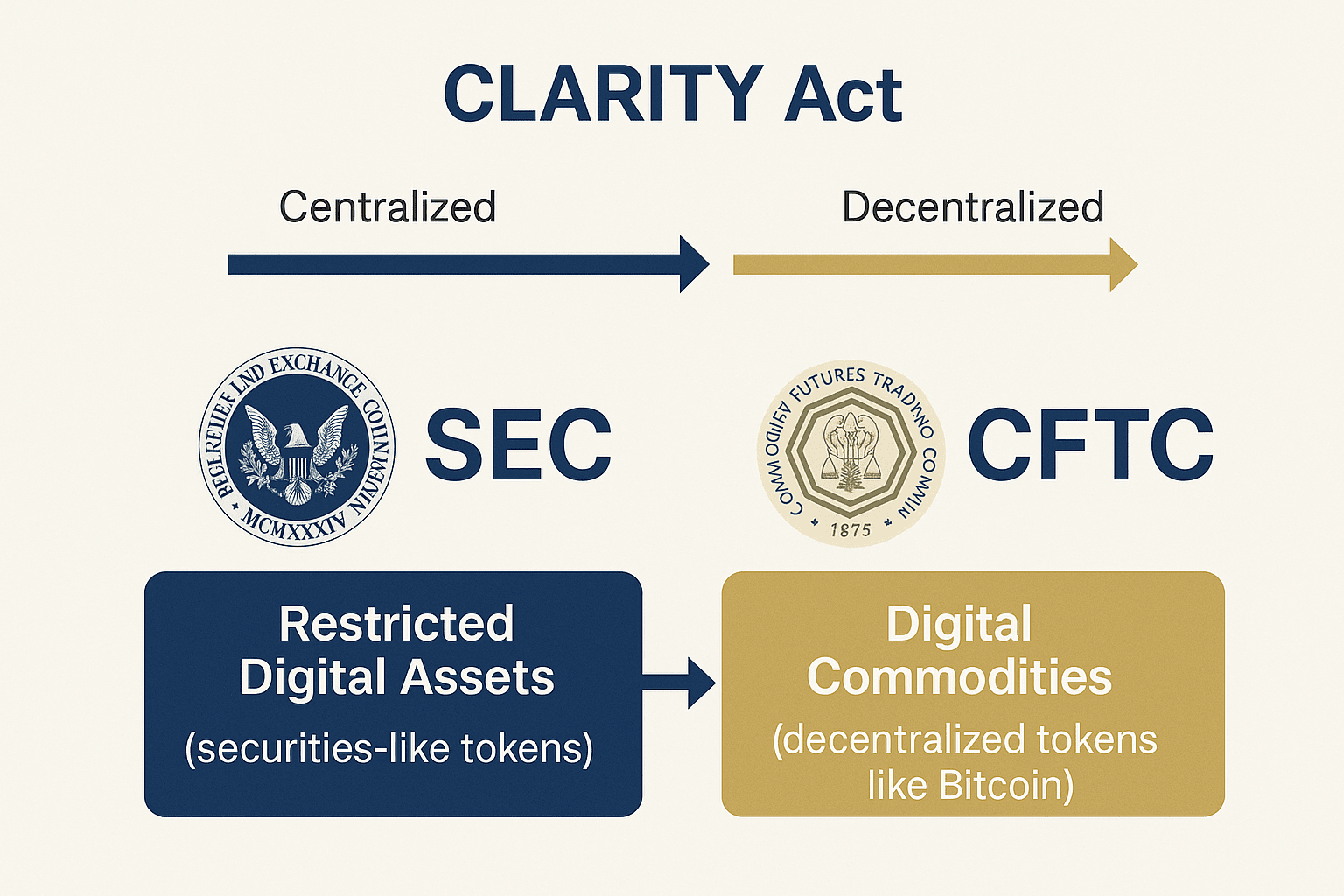
The Digital Asset Market Clarity Act of 2025- also known as the Clarity Act, is perhaps one of the most impactful crypto legislation till date that has made its mark in the U.S. Congress. The bill seeks to resolve a multi-year regulatory ‘limbo’ that has left crypto businesses, developers and investors unsure of their legal status. The proposed framework would give the Commodity Futures Trading Commission (CFTC) the chief regulatory power over most of the crypto sector, while the Securities and Exchange Commission (SEC) would look up the majority of troublesome digital property tokens, which are viewed as securities.
The Harrisx poll revealed that 70% of registered voters think that the U.S. should already have passed a clear cryptocurrency legislation, and 52% supported the bill after reviewing a policy summary of it. The survey of 2,008 registered voters makes the point very clear that the issue of a regulatory gap exists, even if familiarity with the specific bill remains limited, with 64% saying they had never heard of it before the poll.
What are the main clauses of the US Clarity Act?
A number of significant changes have been made to the bill in its latest edition that work together towards a vision of placing digital assets more clearly in the regulated financial system.
- SEC vs. CFTC Jurisdiction: This law clearly differentiates jurisdiction over the two agencies. CFTC would regulate all digital commodities (such as Bitcoin and altcoins), and the SEC would continue to regulate all digital assets that would be recognized as securities.
- Yield Compromise: The most controversial aspect was that cryptocurrency exchanges would be allowed to give rewards to clients for holding stablecoins. In the final version of the bill, the ban on passive yield in stablecoins is extended so that even if users deposit, for example, USDT on their digital wallets, they will not earn interest-like returns. However, activity-based rewards tied to actual transactions, trading volume, or platform use remain permitted.
- DeFi and Software Protections: The bill extends protections to software developers, where bad actors exploiting a decentralized app (Dapp) do not impose a criminal liability on the underlying software developer. The bill also makes provisions for the protection of software developers through outlaws reclaiming funds using DApps, which would avoid placing a criminal burden on the underlying software developer. The clause was a sticking point in the markup session, with Democrats advocating for increased Treasury regulation of DeFi services.
- Registration and Consumer Protections: The US Clarity Act would provide registration requirements for exchanges and custodians and federal consumer protections throughout the digital asset sector; two omissions that have led to offshore “exchanges” operating largely outside of regulation in the U.S. The Harrisx poll showed that only one-third of the voters knew that eight of the 10 biggest cryptocurrency exchanges operate outside the U.S. today.
- Credit Union Participation: The bill clearly provides for the participation of both federal credit unions and federally insured, state-chartered credit unions in the digital asset marketplace.
How did the Crypto Clarity Act get to the markup stage?
The road to Thursday’s Senate Banking Committee markup wasn’t that easy. The committee had previously scheduled a markup session on January 15 2026, but it was cancelled just one day before due to Coinbase CEO Brain Armstrong’s withdrawal of support due to restrictions on stablecoin yield.
What happened during the markup?
The May 14 markup session was relatively short, with the 24 members of the committee exchanging dozens of amendments that then were debated and eventually voted on, before casting the 15–9 vote to advance the bill.
The vote split was largely along party lines. 13 Republicans cast either a Yes or a No vote. Only two Democrats, Senators Ruben Gallego and Angela Alsobrooks, voted yes, though Alsobrooks cautioned that her committee vote would not necessarily translate into a floor vote unless outstanding issues were resolved.
Senator Elizabeth Warren’s dissenting voice was loud in the Democratic opposition, which voiced concern in her opening statement that Congress was preoccupied by a “bill” created by the crypto industry for the crypto industry, rather than one designed to better the lives of everyday Americans.
She made a number of amendments on her own during the session; one of them proposed to allow the Treasury Department to designate DeFi services and another would require the Treasury to publish bank supervisory information about Jeffrey Epstein, which sparked plenty of criticism from Republicans. All of Warren’s amendments failed along party lines.
The only occasion when there was any cross-party agreement during the session was when Senator Dave McCormick offered an amendment that was accepted to support a “portfolios margined” approach.
Senator Chris Van Hollen, another member of Congress, had also made an extensive statement advocating for substantially modifying the bill, noting problems with how the sector of digital assets is protected.
What is the Conflict-of-Interest controversy on Clarity Act news?
One of the sticking points before the markup was the ethics provisions, which would restrict how government officials can benefit from businesses that involve crypto. The provision was viewed broadly as an attack on President Donald Trump whose family has become significantly involved with the digital asset industry since he took office.
The conflict-of-interest provision was outside the scope of the Senate Banking Committee and was not included in the bill at this point, but will be added during the rest of the legislative process. Democrats have announced they would not vote in the Senate without a provision like that included on the floor.
In an interview with CoinDesk at last week’s Consensus Miami conference, White House crypto adviser Patrick Witt said the administration’s stance was to create ethics guidelines that apply to a wide swath of government officials, including the president and the newest Capitol Hill intern, but wouldn’t include one specific officeholder. This standoff has not been resolved.
What’s next for the Crypto Clarity Act?
Passing the Senate Banking Committee is a significant but not final milestone. The Clarity Act will now need to be merged into one with a parallel copy that has already passed the Senate Agriculture Committee, which has jurisdiction of the CFTC. Differences between the two texts will need to be squared in negotiations by committee members before they can move on to a full Senate floor vote.
The bill will require 60 votes to pass on the floor of the Senate; that is, a significant number of Democratic senators, more than the two who voted it out of committee. That is important to note, as it’ll be a major negotiating factor for the weeks to come for several Democratic issues, namely the ethics provision, the DeFi language, and much more.
White House adviser Witt has publicly expressed his hope that President Trump has the time to sign the bill into law by July 4, 2026, but analysts and lawmakers have pointed out that the bottom line is that Trump has very few seconds to spare.
The House version of the Clarity Act was passed in July 2025, and would have to be approved by the Senate version, which is expected to add elements such as the stablecoin yield compromise, DeFi language, and any ethics language, before making it to the president’s desk.
What is the industry’s response to the Clarity Act news?
The response so far from all regions of the crypto industry has been mostly positive. “The markup was a sign of meaningful, bipartisan progress toward comprehensive digital asset regulation in the United States,” said Circle’s Chief Strategy Officer Dante Disparte.
Brad Garlinghouse, the CEO of Ripple, called the Senate Banking Committee “incredible leadership” and stated that if the biggest economy in the world wants to be leaders when it comes to crypto, this is the moment.
The Harrisx poll also found that there’s significant electoral momentum behind the bill. When asked among all voters, 37% would favor an election to hold but 17% would be against that scenario, a net difference of 20 points, including among Republican, Democratic and independent voters.
For those who own cryptocurrency, 78% indicated that their choice of who wins the 2026 midterm will be at least somewhat influenced by their stance on cryptocurrency regulations. Again, 47% of voters indicated that they would rethink their party membership if the candidate they voted for endorsed the legislation but their party did not.
Final Thoughts
The Clarity Act 2026 has emerged from years of uncertainty, abortive hearings, and vicious industry clashes in one of its most vital stages. A 15–9 vote by the Senate Banking Committee on May 14 is the biggest voting signoff thus far by Congress to pass a comprehensive U.S. digital asset framework. However, the issues of ethics, DeFi, needing 60 votes on the Senate floor and then reconciliation in the House post-mortem remain huge hurdles.
Disclaimer: Crypto products and NFTs are unregulated and can be highly risky. There may be no regulatory recourse for any loss from such transactions.
What is the Clarity Act in crypto?
It is a major U.S. legislative proposal aimed to establish clear jurisdiction between the CFTC and SEC, requiring crypto firms to follow stricter compliance standards, including anti-money laundering rules.
Is the act passed?
No, the Clarity Act has not fully passed into law yet, but it has successfully cleared major legislative hurdles. It is currently a pending bill moving through Congress.
Will this act impact Indian crypto investors?
Yes, the US Clarity Act will directly and indirectly impact Indian crypto investors. While it is a US federal law, the US market acts as a global financial benchmark, meaning its regulatory structure creates a massive ripple effect.