

Crypto futures trading in India is gaining attention among traders who want to go beyond simple buying and selling. Futures let you profit from both rising and falling markets, and platforms with INR-margined contracts let Indian traders use rupees directly, with no P2P conversion into USDT. But futures also involve leverage, which raises both potential gains and potential losses, so it helps to understand how they work before placing your first trade.
This guide covers how crypto futures work, key terms, fees, a worked example, how to choose a platform, and a comparison of platforms available to Indian traders.
What is crypto futures trading in India?
Crypto futures trading in India means buying or selling a derivatives contract based on the expected price movement of a cryptocurrency. Instead of owning Bitcoin or Ethereum, you speculate on whether its price will go up or down.
If you expect Bitcoin’s price to rise, you open a long position. If you expect it to fall, you open a short position. Being able to trade in both directions is one of the biggest differences between futures and spot trading.
Futures also allow leverage, which lets you open a position larger than the margin you deposit. This makes capital more efficient, but it also magnifies losses and raises the risk of liquidation.
Spot trading vs Futures trading
| Feature | Spot Trading | Futures Trading |
| What you trade | The actual cryptocurrency | A contract based on its price |
| Ownership of asset | Yes | No |
| Direction | Profit mainly when price rises | Profit from rising (long) or falling (short) prices |
| Leverage | Usually none | Available, depending on platform and pair |
| Best suited for | Long-term holders, beginners | Active traders who understand risk management |
Key terms to know before you trade
- Perpetual contracts: Futures contracts with no expiry date. You can hold a position as long as you maintain enough margin. Most crypto futures markets use perpetuals.
- Margin: The amount you deposit to open and maintain a leveraged position. In INR-margined futures, this is your rupee balance. In USDT-margined futures, it is USDT.
- Isolated vs cross margin: In isolated margin, only the margin assigned to a position is at risk. In cross margin, your whole available balance supports open positions, which can protect a position longer but puts more of your funds at risk.
- Funding rate: A periodic payment exchanged between long and short traders in perpetual contracts. It keeps the contract price close to the spot price. Depending on market conditions, you may pay or receive funding.
- Liquidation price: The price at which your position is automatically closed because your margin can no longer cover losses. Higher leverage places this price closer to your entry price.
How does crypto futures trading in India work?
- Select a contract. Choose a pair such as BTC or ETH.either in INR or USDT margin
- Pick a direction. Go long if you expect the price to rise, short if you expect it to fall.
- Set margin and leverage. Decide how much margin to commit and the leverage level.
- Place the order. Use a market order (executes immediately) or a limit order (executes at your chosen price).
- Manage the position. Monitor unrealised profit and loss, and use stop-loss and take-profit orders to define your exit levels.
- Close the position. Close it manually, let it hit your stop-loss or take-profit, or, if the market moves sharply against you, it may be liquidated.
A simple example
Suppose you deposit ₹10,000 as margin and use 10x leverage. This gives you a position worth ₹1,00,000.
- If you go long and the price rises 5%: your position gains ₹5,000, a 50% return on your ₹10,000 margin (before fees).
- If the price falls 5% instead: you lose ₹5,000, which is 50% of your margin.
- If the price falls roughly 10%: your margin is close to wiped out and the position is likely to be liquidated. In practice, liquidation happens slightly earlier because of fees and maintenance margin requirements.
This is a simplified illustration. Actual liquidation prices depend on the platform’s margin rules, fees and funding.
The same 5% move would have meant a ₹500 gain or loss without leverage. That is why leverage should be treated as a risk-management decision, not just a way to increase position size.
SunCrypto’s updated Crypto futures fees
SunCrypto has changed its futures fee structure. The earlier tiered system, where your rate depended on your trading volume, has been replaced with one flat rate for every futures trader. Nothing else about futures trading on SunCrypto changes: the pairs, leverage options and funding mechanism stay the same.
Earlier fees vs new fees
| Fee Type | Earlier (base rate) | Now |
| Maker fee | 0.03% | 0.02% |
| Taker fee | 0.058% | 0.05% |
- Maker fee: Charged when your limit order adds liquidity to the order book.
- Taker fee: Charged when your order removes liquidity, such as a market order or a limit order that fills immediately.
Futures fees are charged on the notional value of your position, not just your margin. Here is what the change means on a ₹1,00,000 position:
| Order type | Earlier | Now | You save |
| Maker order (one side) | ₹30 | ₹20 | ₹10 |
| Taker order (one side) | ₹58 | ₹50 | ₹8 |
| Full round trip, maker both sides | ₹60 | ₹40 | ₹20 |
| Full round trip, taker both sides | ₹116 | ₹100 | ₹16 |
The flat rate also makes planning easier. You know your exact fee before you open a position, and a first-time trader pays the same rate as an experienced one.
SunCrypto scalping offer: Zero closing fees
On top of the lower flat fees, SunCrypto has a scalping offer for traders who close positions quickly. If you close a trade within 15 minutes, you pay zero closing fees. The entry fee applies as usual, but the closing fee is waived.
The offer applies to these pairs:
- BTC/INR and BTC/USDT
- ETH/INR and ETH/USDT
- SOL/INR and SOL/USDT
What it means in practice: On a ₹1,00,000 position entered with a taker order and closed within 15 minutes, you pay ₹50 in total instead of ₹100. With a maker entry, the total is ₹20 instead of ₹40.
What to look for in a crypto futures platform
Futures and margin options: Check that the platform supports the contracts and margin currencies you want. INR-margined futures can be convenient because they remove an extra conversion step.
Leverage and risk tools: More leverage does not mean a better experience. Look for stop-loss, take-profit and isolated margin options.
Fees: Compare maker and taker fees, funding costs and any liquidation charges.
Liquidity and pairs: A wider range of pairs gives flexibility, and good liquidity supports smoother execution. Always assess the liquidity and volatility of each asset individually.
INR deposits and withdrawals: Look for support for familiar Indian methods such as UPI, IMPS, NEFT and RTGS.
Security and compliance: Check KYC procedures, security practices, and whether the platform is registered with the Financial Intelligence Unit–India (FIU-IND), where applicable.
Crypto futures platforms in India: What each offers
Several platforms serve Indian traders, and each has a different focus. Here is a quick look at some of them. Features, fees and availability change, so check each platform’s official website before you trade.
SunCrypto
SunCrypto is built around futures trading for Indian users, with both INR-margined and USDT-margined contracts. INR-margined futures let you use your rupee balance directly as margin, with no P2P conversion into USDT. It supports leverage of up to 150x on selected pairs, stop-loss and take-profit orders, professional charting, and INR deposits via UPI, IMPS, NEFT and RTGS. It lists 600+ trading pairs across INR and USDT markets.

Best for: Traders who want to trade futures directly in rupees and prefer a futures-focused experience.
CoinDCX
CoinDCX is one of India’s better-known crypto exchanges, and it offers futures alongside spot trading. It supports INR-margined futures, so traders can fund positions in rupees without first converting to USDT. The platform lists 300+ futures pairs and offers leverage of up to 100x on selected contracts. Because futures sit in the same app as spot trading, existing CoinDCX users can move between the two easily.
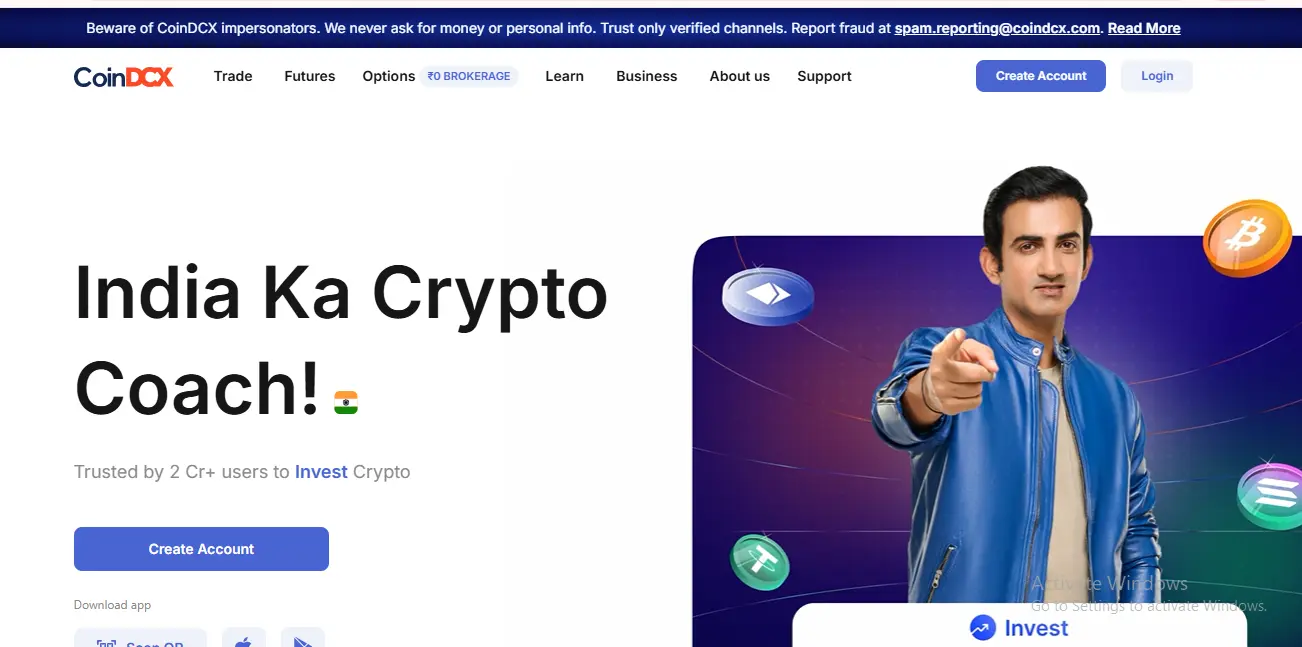
Best for: Traders who already use CoinDCX for spot trading and want futures in the same account.
Delta Exchange India
Delta Exchange India is a crypto derivatives platform that focuses on the Indian market and settles in INR. It offers futures, perpetual contracts and options on Bitcoin, Ethereum and a range of altcoins, with leverage of up to 100x on selected contracts. It describes itself as registered with FIU-India. Its options sets it apart from platforms that stick to futures only.
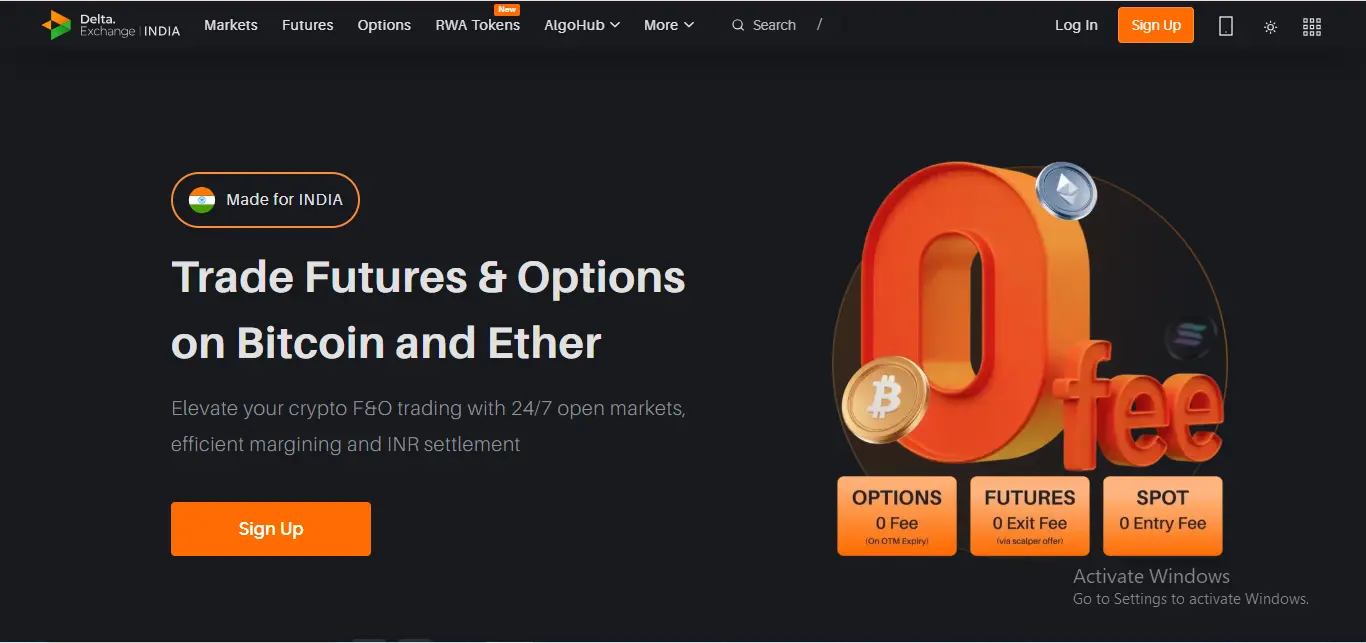
Best for: Traders who want options as well as futures on one platform.
Mudrex
Mudrex offers INR-margined futures, so traders can fund their account in rupees and skip the USDT purchase step. It lists 500+ futures pairs and offers leverage of up to 100x. Its app also supports UPI deposits and combines futures with spot trading and other crypto products.
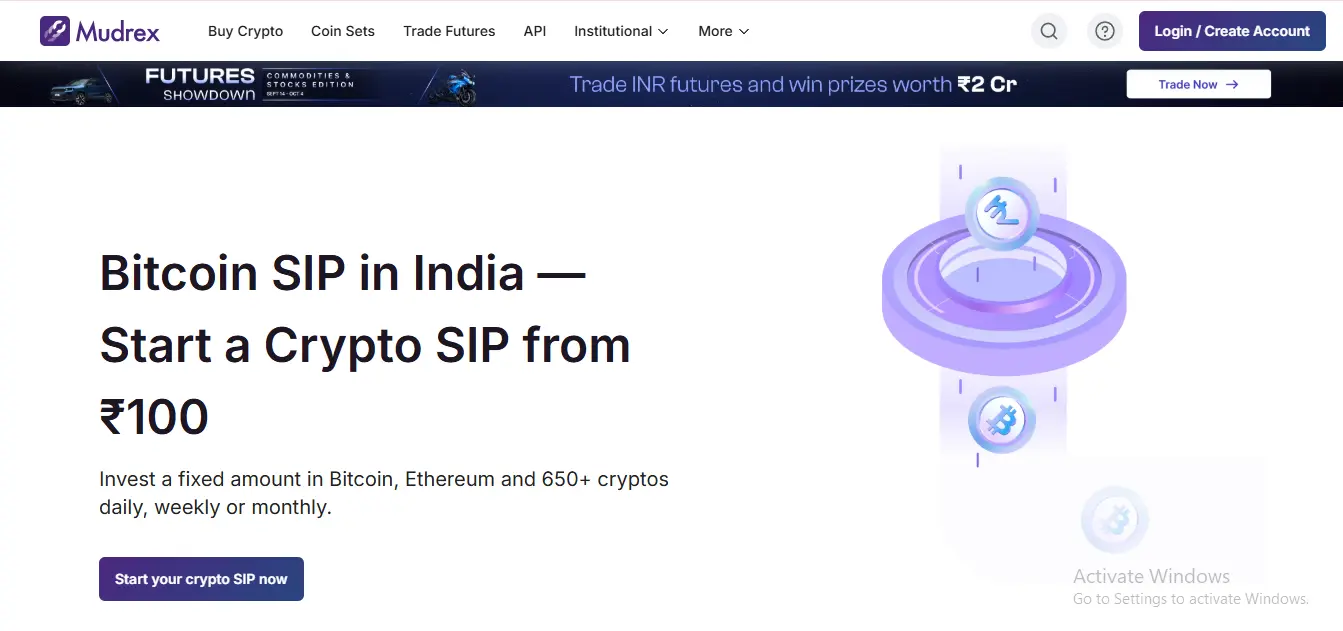
Best for: Traders who want an app-first experience with INR margin and a large number of futures pairs.
Don’t choose a platform based on maximum leverage or the number of listed coins alone. Look at fees, margin type, risk tools, INR payment support, security and compliance.
SunCrypto futures at a glance
SunCrypto offers a futures-focused experience built around INR and USDT markets.
- INR- and USDT-margined contracts: INR-margined futures let you use your rupee balance directly as margin, with no separate P2P conversion into USDT.
- Leverage up to 150x on selected pairs: Higher leverage raises liquidation risk significantly, so choose a level that matches your experience and risk tolerance rather than defaulting to the maximum.
- Risk-management tools: Stop-loss and take-profit orders, professional charting and multiple order types.
- Long and short positions: Respond to both bullish and bearish conditions.
- INR deposit options: UPI, IMPS, NEFT and RTGS.
- 600+ trading pairs across INR and USDT markets.
How to start crypto futures trading on SunCrypto
- Sign up on SunCrypto and create your account.
- Complete KYC verification.
- Deposit INR using UPI, IMPS, NEFT or RTGS.
- Choose a futures contract (INR- or USDT-margined).
- Select your direction and leverage. Beginners should start low.
- Set a stop-loss and take-profit, then place your order.
Tips for crypto futures trading in India
- Understand leverage before using it. It increases both potential gains and losses.
- Start with small position sizes. Avoid putting a large share of your capital into one trade.
- Always use a stop-loss. Define your exit before you enter.
- Know your liquidation price and margin requirements before opening a leveraged trade.
- Account for funding costs on perpetual contracts.
- Don’t trade on hype. Base decisions on a strategy and your risk tolerance.
- Never assume profits are guaranteed. Futures can lead to substantial losses.
What is crypto futures trading in India?
It involves trading derivative contracts based on cryptocurrency price movements. Traders can take long or short positions and may use leverage, depending on the platform and contract.
Is crypto futures trading risky?
Yes. Leverage can amplify both profits and losses, and a position can be liquidated if its margin falls below the required level. Understand leverage, margin and liquidation before trading.
What is the difference between spot and futures trading?
In spot trading you buy and own the actual cryptocurrency. In futures trading you trade a contract based on its price, can go long or short, and can use leverage.
How much leverage can I use on SunCrypto?
Up to 150x on selected futures pairs. Higher leverage raises liquidation risk, so choose it carefully and use risk-management tools.