

Ethereum has outperformed Bitcoin and top 20 coins this month and is trading near $1,900. The ETH/BTC ratio hits a 3-month high and validators have stopped exiting. However, CryptoQuant counts only 2 of 5 signals at bottoming levels.
Ethereum is flashing three bullish signals in the final days of July, even as on-chain data suggests the asset hasn’t confirmed a bottom yet.
ETH/BTC ratio hit a 3-month high
The ETH/BTC ratio has surged to 0.030, marking its strongest reading in three months. Unlike price alone, this ratio isolates Ethereum’s relative strength against Bitcoin, holding steady whether the broader crypto market is rallying or correcting. A climbing ratio signals that ETH is outpacing BTC, often a sign of growing investor confidence in Ethereum specifically.
Bitmine chairman Thomas Lee has shared data about the ETH/BTC ratio on X. He cited the breakout when the company raised its Ethereum holdings and equity buyback.
He pointed to the climbing ETH/BTC ratio as a bullish signal for the broader crypto market, even as the odds of the Clarity Act passing in 2026 have dimmed. With the ratio now at a three-month high of 0.03000, Lee said he expects it to translate into further upside for ETH prices ahead.
Ethereum’s validator exit queue stopped
Ethereum’s validator exit queue has dropped to zero, according to ValidatorQueue data, meaning no validators are currently waiting to withdraw their staked ETH.
This is a sharp reversal from September, when the queue peaked at over 2.6 million ETH awaiting exit. Analyst Merlijn The Trader has pointed to this shift as a sign that seller exhaustion has run its course, noting that the queue cleared straight into a 47% drawdown and whoever wanted out is already out — calling that the shape of an ETH bottom.
Meanwhile, nearly 2.5 million ETH is queued for staking, with wait times stretching to 43 days. This imbalance signals supply lockup rather than a supply release, reinforcing the bullish structural setup.
Are whales accumulating Ethereum right now?
Beyond technical and on-chain signals, demand for Ethereum remains strong. Spot Ethereum ETFs outpaced Bitcoin ETFs in net inflows last week, marking a third consecutive positive week for the product.
That gap widened further on Monday. Ethereum funds pulled in $9.23 million on July 27, while Bitcoin funds saw outflows of $11.64 million, according to SoSoValue data.
Corporate accumulation added to the momentum. Bitmine added 9,946 ETH over the same period, lifting its total holdings to 5.79 million tokens, roughly 4.8% of ETH’s circulating supply.
Whale activity echoed the trend. Arthur Hayes has bought 7,213 ETH since July 15, worth approximately $13.87 million. Together, these moves point to broad-based accumulation, with funds, corporate treasuries, and individual whales all adding ETH at the same time.
- ETH funds gained $9.23M while BTC funds lost $11.64M on July 27
- Bitmine now holds 5.79 million ETH, about 4.8% of supply
- Arthur Hayes bought 7,213 ETH since July 15, worth $13.87M
Why should we stay careful about Ethereum?
Seasonal data adds a layer of cautious support. Ethereum’s average August return stands at 8.84%, though the median figure of -1.87% tells a different story, highlighting how sharply outcomes have swung from year to year.
This gap between the average and median suggests a handful of standout years may be skewing the historical average higher, while a “typical” August has more often leaned slightly negative. Seasonality alone shouldn’t be read as a guarantee of gains, but it also doesn’t stand out as a significant historical headwind for ETH heading into the month.
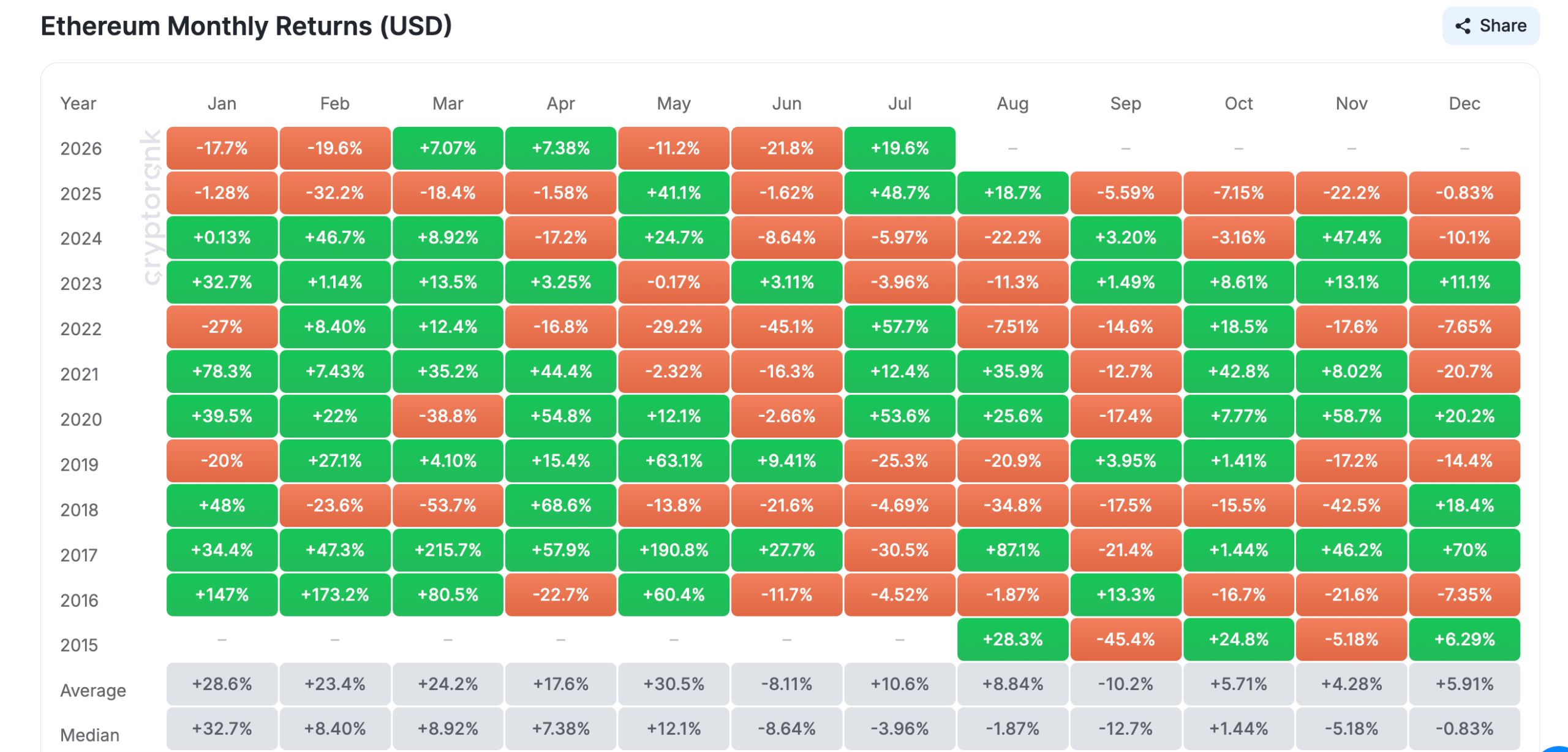
Ethereum monthly return, Source: CryptoRank
The ETH/BTC MVRV ratio has slid from 0.95 in August 2025 to around 0.65 currently. However, previous Ethereum bottoms against Bitcoin were marked by readings closer to 0.45, suggesting the ratio may still have room to fall before a genuine floor forms.
Relative selling pressure echoes this pattern. The ETH/BTC exchange inflow ratio has eased from above 1.5 to roughly 0.8, but remains well above the 0.4 zone that has historically coincided with market bottoms.
- ETH/BTC MVRV ratio sits at 0.65, above the 0.45 bottom marker
- Exchange inflow ratio at 0.8, still above the 0.4 bottom zone
Taken together, these metrics suggest that while Ethereum is showing several bullish signals, on-chain data indicates a market bottom has not yet been fully confirmed. Whether the current rally can extend further will likely hinge on sustained demand and broader market conditions.
Final Thoughts
Ethereum’s price action this month tells a mixed but leaning-bullish story. The ETH/BTC ratio touching a three-month high, a validator exit queue that has dropped to zero, and consistent ETF and whale accumulation all point to strengthening confidence in ETH relative to the broader market. Institutional voices like Thomas Lee and whale activity from Arthur Hayes add further weight to the bullish narrative.
That said, on-chain metrics like the ETH/BTC MVRV ratio and exchange inflow ratio suggest the market hasn’t fully bottomed out yet, with both still sitting above levels seen at previous cycle lows. Seasonal data adds another layer of nuance, showing August has historically been unpredictable for ETH despite a positive average return.
For now, Ethereum’s structural setup looks constructive, but traders should watch for confirmation from these on-chain indicators before treating the current move as a confirmed reversal rather than a relief rally.
Why is Ethereum outperforming Bitcoin right now?
Ethereum is outperforming Bitcoin due to a rising ETH/BTC ratio, which recently hit a three-month high of 0.030.
What does the ETH/BTC ratio hitting a 3-month high mean?
A rising ETH/BTC ratio means Ethereum is gaining value relative to Bitcoin, regardless of overall market direction.
Has Ethereum’s validator exit queue really stopped?
Yes, Ethereum’s validator exit queue has dropped to zero, down from a peak of over 2.6 million ETH in September. Meanwhile, nearly 2.5 million ETH is now queued for staking, suggesting supply lockup rather than sell pressure.