

SKYAI is up 105% over the past 7 days on CoinMarketCap, but that window captures both the June 9 crash to $0.15 and the subsequent bounce to $0.358, so the actual recovery from the low is what’s driving that number. “105% in 7 days” is technically measured from the lowest point in that 7-day window, which happened to be the post-crash floor on June 9. So the 105% reflects the full recovery move from the bottom, not a steady 7-day climb; the token was actually crashing for the first half of that window and bouncing hard in the second half.
In the past two weeks, SKYAI has delivered one of the most dramatic price sequences of the 2026 altcoin cycle: a parabolic blow-off top, an 80% wipeout, a leveraged dip bounce, and a fragile recovery that is still playing out in real time. Here is the complete picture, week by week.
Week 1 (June 2–8): The Post-ATH SKYAI Hangover
SKYAI entered the first week of June riding extraordinary momentum. Over the preceding 30 days, the token had surged approximately 708%, driven by a combination of its Bitget exchange listing, the launch of its MCP Hub product, and an aggressive AI agent narrative that pulled speculative capital away from large caps like Bitcoin into smaller, higher-beta tokens.
The all-time high of $0.8535 was printed on May 6, but by June 2, the price had already pulled back to the $0.18–$0.19 price range as early buyers began taking profits. What followed was a textbook post-parabola distribution phase. By June 5, SKYAI had shed over -23.15% from its peak, sliding into the $0.55–$0.65 range. The bleed continued through the end of the week, with prices drifting into the $0.20–$0.30 zone as the broader AI token basket cooled.
Two warning signs were flashing all week that most traders ignored. First, on-chain data showed 73 coordinated whale wallet clusters controlling 296 million tokens, a concentrated ownership that creates asymmetric downside risk when those wallets decide to distribute. Second, the RSI had been printing above 81 near the ATH, a level that historically precedes sharp corrections in high-beta altcoins. The setup was there. Most traders chasing the AI narrative were not watching it.
Week 2 (June 9–16): Crash, Capitulation, and the Bounce
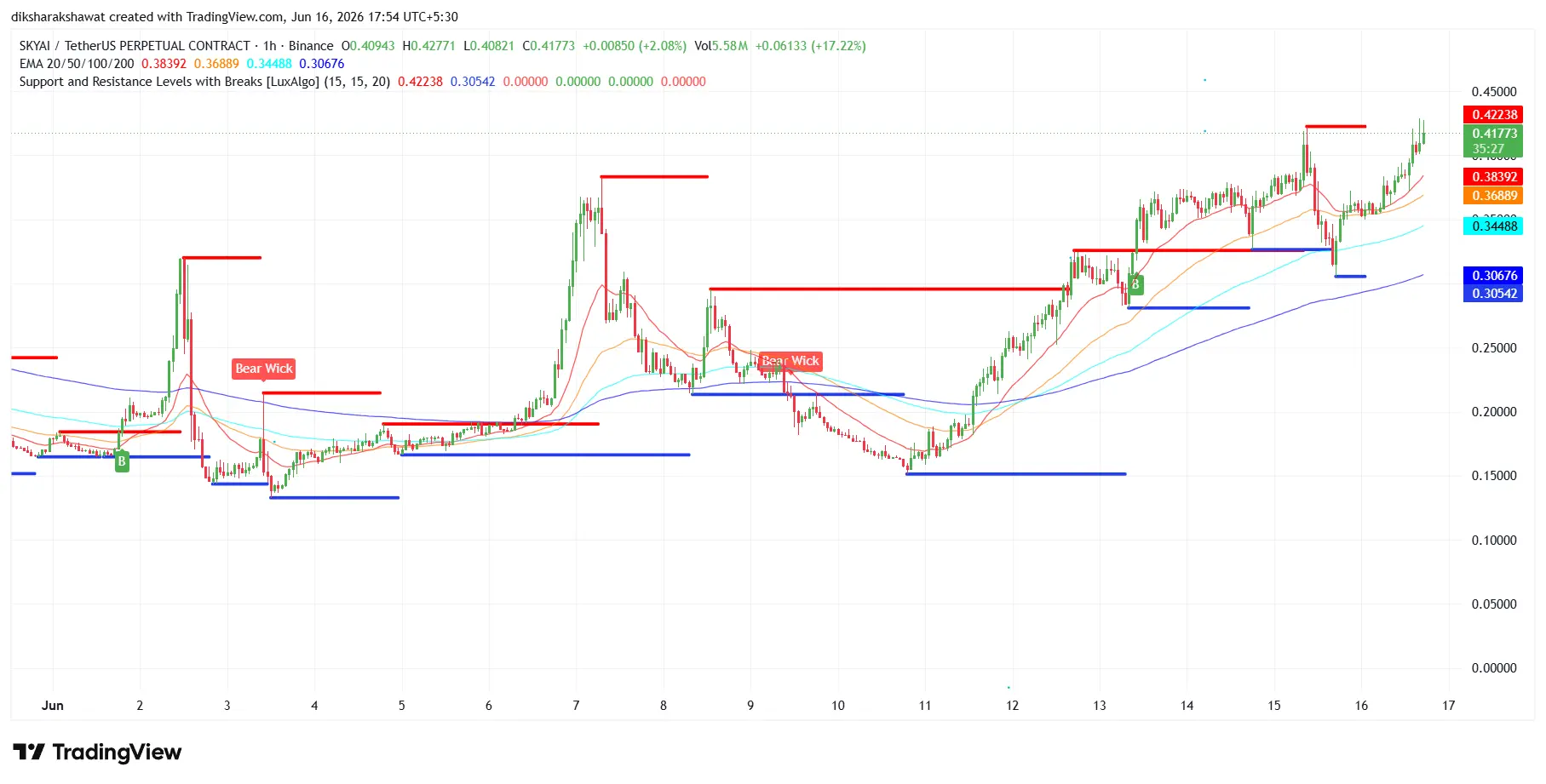
June 9 was the moment of maximum pain. SKYAI collapsed to a low of approximately $0.15, wiping out roughly 80% of its value from the all-time high in a matter of days. This was not a slow grind lower; it was a capitulation flush, the kind that clears out leveraged longs and shakes loose weak hands in a single violent session.
The recovery began almost immediately. Within 24 hours, dip buyers pushed SKYAI back to $0.20–$0.22, a 26% intraday move. The volume data confirmed this was real buying: trading volume rose 56% to $88 million, open interest climbed 54.8% to $110.4 million, and derivatives volume jumped 46% to $97 million. Fresh capital was entering the market, not just short sellers closing positions.
However, conviction was split. Despite the price strength, activity in both spot and futures markets showed many traders using the rally to reduce exposure rather than add.
The most significant move of the second week came in the days that followed, when SKYAI broke a multi-month downtrend in a single session, posting an 80% gain in 24 hours to reach approximately $0.3070. Open interest exploded 80% to $128.4 million, the clearest signal yet that new leveraged capital was entering rather than existing shorts getting squeezed. The Trump-Iran peace deal, BTC bouncing to $66,000, and a broad revival in AI token sentiment all provided the macro tailwind that turned a technical bounce into a genuine breakout attempt.
As of June 12–13, SKYAI was breaking out of its consolidation range, pushing through the $0.32 resistance zone, with price climbing toward $0.34–$0.36 as all four EMAs began stacking bullishly beneath price action. By June 16, the breakout had fully extended SKYAI is currently trading at $0.406, printing a session high of $0.4097, having reclaimed all four EMAs, including the 20 EMA at $0.38008, and now testing the key LuxAlgo resistance zone at $0.42238. A clean daily close above $0.42238 would be the strongest technical confirmation yet that the recovery from the June 9 low at $0.15 has transitioned from a bounce into a genuine trend reversal.
What happens next to SKYAI?
SKYAI is an extremely high-volatility token. The token is trading above its 50-day EMA ($0.2694) and 200-day MA ($0.2491), with RSI at 57.50 and a positive MACD technically neutral to mildly bullish. Not overbought, not oversold.
The bull case requires three events to happen. First and most critically, the token must break and hold above $0.38 a daily close above $0.3809 flips that level from resistance to support and opens the door to $0.4658; without that, the rally stalls right here.
Second, the planned MCP Marketplace needs to go live, which would be the first genuine fundamental catalyst since the Bitget listing, creating real on-chain data demand rather than pure speculative momentum and triggering a significant volume spike.
Third, the broader AI token rotation must continue SKYAI was the top gainer in the top 100 during peak rotation days, and if the macro backdrop holds with the Trump-Iran deal keeping oil prices low, the Fed pausing rates, and BTC sustaining above $65K, capital will keep flowing into high-beta AI tokens, with SKYAI benefiting disproportionately. All three must fire together; any one missing and the bull case falls apart.
The bear case for SKYAI targeting $0.19–$0.15 within 14 days is actually the more data-supported short-term scenario, and the warning signs are stacking up. The most immediate red flag is the $0.35 resistance rejection, AMBCrypto confirmed SKYAI failed to reclaim that level on the daily chart, preserving the broader downtrend, and failure to break it now means a direct revisit of $0.19–$0.20.
Behind that, open interest collapsed 20.38% to $83.7 million after the June 6 rebound lost strength, signaling that traders stepped away from leveraged positions quickly weak open interest means weak conviction behind the bounce. Making it worse, seller dominance in derivatives is clear: on Binance, perpetual sell volume has been consistently outpacing buy volume with net buying sitting at negative $111 million, confirming that smart money is using every bounce as an exit opportunity rather than adding exposure.
Layered on top is the whale concentration risk; 73 wallet clusters controlling 296 million tokens means a coordinated or even partial distribution into this recovery rally would instantly overwhelm retail buyers. And if all of that materializes and the price loses the 200-day MA at $0.2491 on a daily close, the entire recovery thesis is invalidated; below that level, the next real support is $0.152, and below that, historical support near $0.06–$0.07 comes back into play.
Disclaimer: All data and price figures referenced in this article reflect market conditions at the time of writing and may have changed since publication. This content is for informational purposes only and does not constitute financial or investment advice. Cryptocurrency markets are highly volatile and unpredictable. Always conduct your own research (DYOR) before making any investment decisions.
What is Skyai crypto?
SkyAI (SKYAI) is a decentralized Web3 data infrastructure project that bridges artificial intelligence and blockchain technology. It aggregates billions of rows of on-chain data and uses an extended Model Context Protocol (MCP) to feed real-time, multi-chain information to AI models and autonomous agents.
What is the total supply of Skyai?
SKYAI has a circulating supply of 1B SKYAI and a max supply of 1B SKYAI.
Can Sky Coin reach $1?
Skycoin (SKY) reaching $1 is theoretically possible but highly improbable in the near term. With SKY currently trading at roughly $0.014, achieving $1 would require a massive price increase of around 6,600%.