
AKE price has experienced a massive bull run of around 3500% after a 8 month consolidation phase. It has dropped slightly after this bull run due to profit booking. The price is still trading over a buying zone which is a bullish sign. By analyzing the current scenarios, here is the price prediction of AKE price till 2030.
AKE price overview
AKEDO (AKE) price was trading at $0.03921 at press time and dropped by 6% in the past 24 hours. The market capitalization was $88.93M and the 24-hour trading volume had dropped by 26% to 9.18M in a day. It has a circulating supply of 22.79B AKE with a total supply of 100B AKE.
AKE price prediction for 2026
AKEDO price has witnessed a maximum surge of around 3500% in the second half of August. However, it failed to maintain the momentum and has experienced profit booking. Furthermore, the falling momentum has slowed down which indicates that buyers are still there.
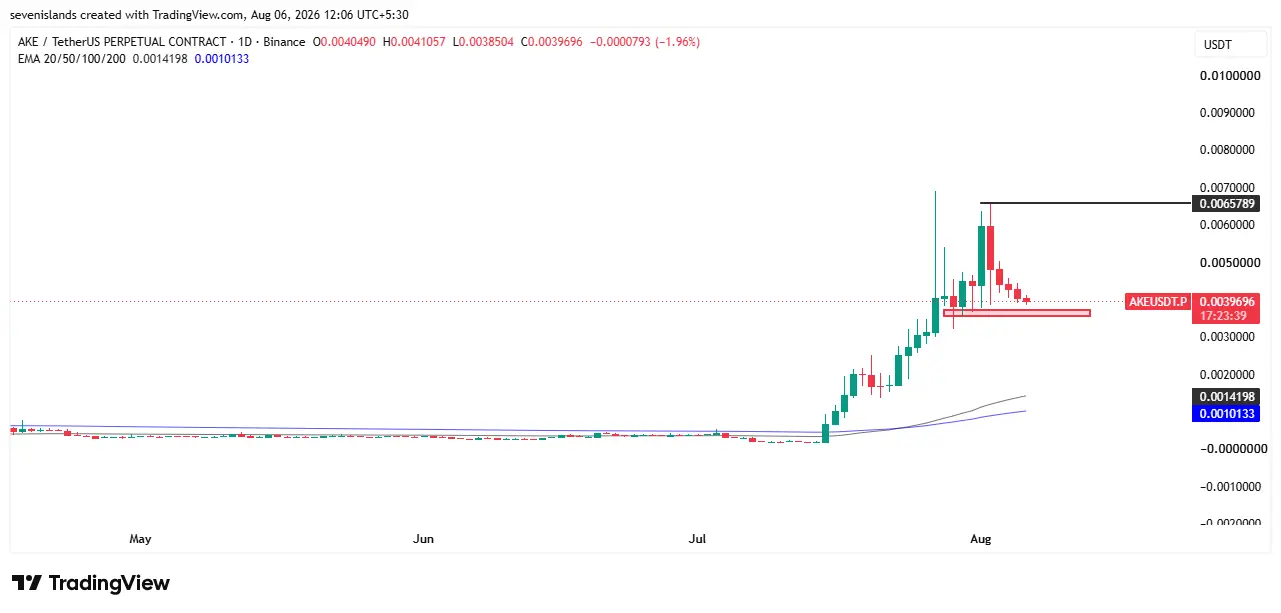
In the last 4 days of July, the price has received buying pressure near the $0.003700 level. Furthermore, the price is currently approaching this level on a daily timeframe. Buyers might try again to push the price from this zone.
Suppose the AKE coin receives buying momentum in this zone, a bullish momentum for the short-term can be seen. Once the price surpasses the recent high of $0.00650, buyers may become confident and the price may reach $0.00800 level by the end of 2026.
Conversely, if the price slips below the $0.003700 level then buyers may lose confidence. Once the price sustains below this level, it could be tough for bulls’ to bounce back.
AKE price prediction for 2027
AKEDO price has remained in a consolidation phase since December 2025 to mid-July 2026. However, the price has triggered a wild breakout from this zone and rewarded investors with a great return of around 3500%. Furthermore, AKE coin has still potential to continue the bullish momentum because the price is still trading over the buying zone of $0.003700. The price is expected to reach the $0.0100 level in 2027.
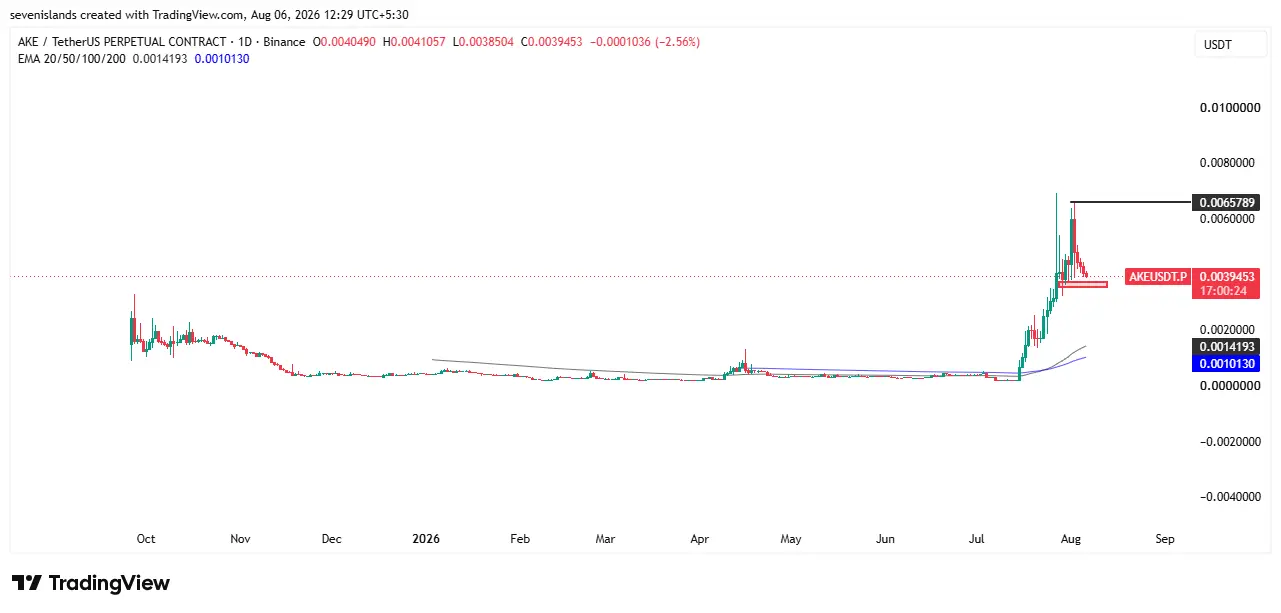
The technical chart suggests that the price has experienced selling pressure due to profit booking. If the profit booking increases then the price may drop to another support level of $0.001700.
What are bullish drivers for AKEDO for 2027
- Utility is transactional, not narrative: AKE is required to use the AI game engine roughly $0.1 per prompt and $10 per publish and new game tokens launched on the platform are paired with AKE in liquidity pools, creating structural buy pressure. That’s a demand mechanism tied to usage, which most micro-caps lack.
- Burn mechanism partially offsets inflation: A 33% fee burn may counteract supply growth if platform usage scales. The 2027 case depends entirely on whether burn volume outruns unlock volume.
- AI-gaming narrative positioning: Akedo is a multi-agent AI framework generating functional games from natural-language prompts in roughly two minutes, with creator revenue through advertising, protocol sharing, and token incentives. If the AI-x-gaming sector rotates in 2027, AKE is pre-positioned.
- Exchange distribution already achieved: Trading is concentrated on Binance with roughly $303M of volume, plus LBank, Bybit, Gate, Bitunix and MEXC. Futures volume of $225M against just $3.4M spot, with $105M open interest, means derivatives infrastructure exists unusual at this cap.
- Comparable-model precedent: Analysts draw parallels to Virtuals’ AI agent tokenization model, where demand surged as ecosystem usage grew.
What are bearish drivers for AKEDO for 2027
- Dilution is the dominant variable: Only 22.8% of the 100B supply circulates. Roughly 40% of supply unlocks by 2026, which may pressure prices. Any 2027 forecast is really a forecast about absorption capacity.
- Extreme holder concentration: Top 100 wallets hold 98.82% of supply; whales alone control 99.96%; a handful of holders can swing price hard. This is the single largest risk in the model.
- Adoption hasn’t been proven yet: Only 10,000 users participated in the August 2025 TGE, against a stated 3-billion-creator target though even 1% conversion could see daily burns and LP demand outpace current sell pressure.
AKE price prediction for 2028
According to the current bullish scenario, the price can trade between $0.0100 to $0.0150 level in 2028. As we see the chart, the price is trying to hold after this bullish move which could be a bullish signal.
Conversely, if traders and investors prefer to book the profit then the price may trade between the $0.00150 to $0.00200 levels in 2028.
Supply-side reasons
- Vesting largely completes before or during the window: Two allocations have already fully been released, the 1.00B Community Airdrop on August 21, 2025 and the 1.70B KOLs & Service tranche on February 21, 2026. Advisors sit at 697.87M of 5.00B unlocked, meaning long-tail schedules extend well past 2027. By 2028, the marginal unlock stops being a monthly headline, the single biggest structural change in the token’s life.
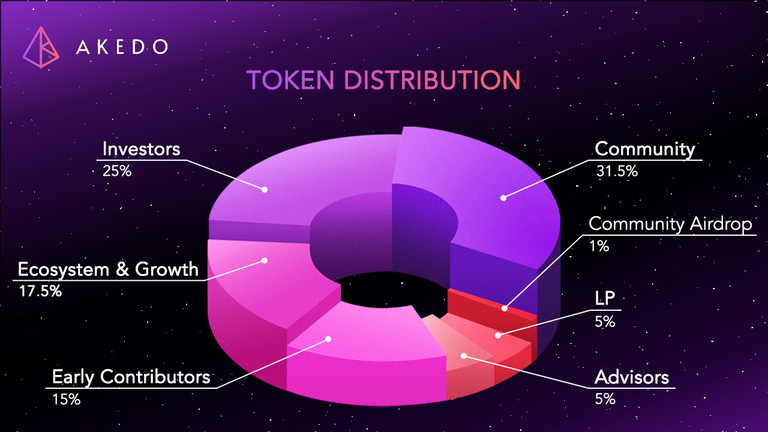
- Insider-heavy allocation is the counterweight: Distribution runs Community 31.50%, Investors 25.00%, Ecosystem & Marketing 15.80%, Early Contributors 15.00%, Advisors 5.00%, LP 5.00%, KOLs & Service 1.70%, Community Airdrop 1.00%. Investors plus Early Contributors plus Advisors is 45% that cohort has a cost basis far below market and multi-year exit motivation running into 2028.
- Recurring unlocks are still sizable in the interim: Current cadence shows tranches like 642.6M AKE ($2.69M, 2.8% of market cap) and 2.11B AKE ($7.20M, 9.25% of market cap) the path to 2028 gets absorbed monthly, and each one is a test.
- FDV-to-cap gap must close somehow: Market cap sits near $89M against FDV around $340M. By 2028 the gap resolves in one of two directions: price holds and cap converges upward, or price compresses to keep cap flat while supply quadruples. There is no third outcome, this is arithmetic, not forecasting.
Demand-side reasons
- Burn accumulation compounds over time: The 33% fee burn may offset inflation if usage grows. A burn mechanism is negligible over one year and material over three 2028 is the first horizon where cumulative burns could plausibly matter against the unlock schedule.
- Platform revenue would need to be visible by then: AKE drives game creation, staking rewards, liquidity for new tokens, fee sharing and burns. If usage hasn’t produced measurable protocol revenue by 2028, the utility thesis is falsified rather than pending.
AKE price prediction for 2029
AKEDO price has gained 2189% from its all-time low and is trading near the all-time high zone. It has the potential to perform well further. The price is expected to surpass the $0.0200 level by 2029.
On the other hand, the price can also trade below the $0.00200 level in the worst scenario.
Structural drivers unique to 2029
- Dilution ends, and with it the dominant bear case: 37 upcoming unlocks will release 56.99 billion tokens 57% of total supply between now and full vesting. By 2029 that pressure is exhausted. Every prior year’s forecast is a bet on absorption; 2029 onward is a bet on demand alone.
- Circulating supply roughly 4.4x from here: About 22.8% circulates today with 57% still locked. Holding market cap flat, that mechanically implies a much lower per-token price so any bullish 2029 target requires market cap to grow faster than supply, not merely to grow.
- The community-weighted allocation softens the tail: Unlocks distribute to Community, Private Investors and Insiders, with the largest allocation (55%) going to Community and unlocks to investors and insiders are generally higher-risk for price impact than community or ecosystem pools. The riskiest tranches vest earlier; later years skew the community.
- Burn mechanics compound over four years: A 33% fee burn may offset inflation if usage grows. Burns are cumulative while unlocks are finite; the crossover point, if it ever arrives, arrives on a multi-year horizon, not a one-year one. This is the strongest genuine argument for a 2029 target above current levels.
- Platform maturity has time to prove out: Only 10,000 users participated in the August 2025 TGE against a 3-billion-creator target, though even 1% conversion could see daily burns and LP demand outpace sell pressure. A 2027 forecast can’t assume that adoption curve; a 2029 one plausibly can, or can just as plausibly conclude it never happened.
- LP demand scales with launchpad throughput: New game tokens launched on the platform are paired with AKE in liquidity pools, creating buy pressure. This demand is a function of cumulative games launched, so it strengthens with time if the launchpad works.
What undermines any 2029 number
- Whale concentration doesn’t resolve with time: Top 100 wallets hold 98.82% of supply and whales control 99.96%, meaning a handful of holders can swing price hard. Full vesting doesn’t decentralize ownership, it just makes the concentrated holdings liquid.
- The token has no long price history to extrapolate: TGE was August 21, 2025. The all-time high of $0.004949 was set July 28, 2026 barely a year of data, of which the informative portion is a few months. Sparse and inconsistent market data reduces the reliability of traditional indicators.
- Recent price action is catalyst-driven, not trend: The 36% single-day surge was tied to a Binance Wallet Alpha Box airdrop. There is no organic trend to project four years forward.
- AI-gaming sector risk is unhedgeable at this horizon: AKE is a single-narrative asset. If AI-generated gaming consolidates around non-crypto incumbents by 2029, the token’s utility premium disappears regardless of execution.
- Micro-cap survivorship: At a #248 market cap ranking, the base rate for tokens still trading meaningfully four years out is poor. Most 2029 forecasts implicitly assume survival, which is itself the largest unmodeled probability.
AKE price prediction 2030
AKEDO price can experience great changes till 2030. It can surge to $0.0500 or $0.100 level if whales show interest. If Bitcoin surpasses the $100K zone then all the altcoins might experience bullish momentum.
Conversely, if sellers dominate then the price can record a new all-time low. This momentum would depend upon the crypto market. If Bitcoin remains bearish then the AKE price may decline further.
Structural factors that resolve by 2030
- Emissions end, so supply stops being the story: 43.02 billion AKE is unlocked against 56.98 billion still locked, $146.84M versus $194.53M of FDV. By 2030 that overhang is fully distributed. A 2030 forecast is therefore a forecast of the token at full dilution, near the 100B max supply.
- The FDV becomes the real market cap: Today’s ~$89M cap sits against a ~$270M FDV. Only 22.79B of the 100B max supply circulates. Any 2030 price target must be sanity-checked against what market cap it implies at 100B tokens, a $0.01 price is a $1 billion cap, which requires the platform to be genuinely successful, not merely alive.
- Burn economics become the only deflationary force left: One-third of protocol fees go to platform revenue, one-third to stakers, and one-third are burned, a structure that could support stronger long-term token economics than an inflation-only rewards model, if usage becomes meaningful. Post-vesting burns are the sole mechanism working against the fixed supply.
Bullish case for 2030
- Utility compounds if the platform survives: Users need AKE to prompt and publish games, stakers earn from protocol fee revenue, and new tokens launched on Akedo are paired with AKE in LP pools — concrete uses rather than abstract future possibilities. Each launched game adds a permanent LP sink.
- AI-gaming as a sector may mature into real demand: A 2030 horizon spans at least one full crypto cycle plus the maturation of AI-generated content as a category. Akedo generates functional games from natural-language prompts in roughly two minutes using specialised agents for world building and rule design. If AI game creation becomes normal, first-movers with distribution benefit disproportionately.
- Exchange and derivatives infrastructure already exists. Futures volume of $225M against $3.4M spot, with $105M open interest, means the plumbing for institutional-scale participation is built a barrier most micro-caps never clear.
Bearish case for 2030
- Base-rate survivorship is brutal: The overwhelming majority of 2025-vintage micro-cap gaming tokens will not exist meaningfully in 2030. Platform adoption risk is very high. A good whitepaper and attractive use case do not guarantee creators will use the system at meaningful scale.
- Adoption evidence remains thin: Only 10,000 users participated in the August 2025 TGE against a 3-billion-creator target. Four more years of that ratio is a dead protocol regardless of tokenomics design.
- Concentration risk may never resolve: Top 100 wallets hold 98.82% of supply; whales alone control 99.96%. Vesting completion doesn’t automatically distribute ownership; it may simply hand whales more sellable inventory.
- Long-dated models are near-worthless here: CoinCodex’s model projects $0.0009225 by 2030 but that forecast was published in February 2026 when AKE traded near $0.00037, and the token has since roughly 10x’d past that “2030 target.” Akedo’s price history is still early-stage, which makes it harder to analyse than mature tokens with several completed market cycles. Any 2030 number you see was almost certainly extrapolated from a price that no longer exists.
- Competitive erosion over five years: Nothing about AI game generation is defensible IP. By 2030 the same capability may be a free feature inside a major engine, removing the reason to hold a token for it.
Tokenomics
The $AKE token has a total supply of 100 billion tokens, released over a four-year period with distinct allocations designed to support platform growth and sustainability.
Token Allocation
- Community (31.5%)
- Distribution details:
- 16% allocated for node rewards.
- 8% for creator rewards.
- 7.5% reserved for players rewards.
- 2.08% of it will be released at TGE, with the remaining amount unlocking linearly over 48 months.
- Distribution details:
- Investors (25%)
- Followed by a 3-month cliff and a subsequent 24-month linear unlock.
- Ecosystem & Growth (17.5%)
- 15.8% is allocated to ecosystem and marketing, to be fully unlocked at TGE.
- 1.7% is allocated to KOLs, service & etc, with 20% unlocked at TGE and the remaining fully unlocked over 6 months.
- Early Contributors (15%)
- Subject to a 6-month cliff, then unlocked linearly over 42 months.
- Advisors (5%)
- Also subject to a 6-month cliff, then unlocked over 42 months.
- LP (5%)
- Liquidity Provision will be released during the TGE.
- Community Airdrop (1%)
- As a community airdrop reward during the TGE period.
Final thoughts
AKEDO has shown one of the sharpest rallies in recent memory, surging nearly 3500% after breaking out of its 8-month consolidation phase. While the coin has cooled off due to profit booking, the fact that it’s still holding above the crucial $0.003700 buying zone keeps the broader bullish structure intact.
That said, this kind of parabolic move typically comes with heightened volatility. The $0.003700 level is the line in the sand for the near term, a strong bounce from here could see AKE testing $0.00650 and eventually $0.00800 by the end of 2026, while a breakdown below it could open the door to deeper corrections toward $0.001700 and lower.
Looking further out to 2027–2030, AKE’s trajectory will likely be shaped less by its own chart patterns and more by the broader crypto market cycle, particularly Bitcoin’s price action. A sustained BTC rally past the $100K mark could pull altcoins like AKE along with it, potentially pushing prices toward the $0.0500–$0.100 range in a best-case scenario. On the flip side, a broader market downturn could see AKE retest or even breach its all-time lows.
Given the coin’s relatively small market cap (~$89M) and low liquidity, price swings in both directions: are likely to be sharper than for larger-cap tokens. Investors should treat these projections as scenario-based technical outlooks rather than guarantees, keep position sizing in check, and track both AKE’s own support/resistance zones and overall market sentiment before making decisions.
What is the current price of AKEDO (AKE)?
AKEDO (AKE) is trading at $0.03921 at press time, down 6% in the last 24 hours, with a market capitalization of $88.93M.
What is the AKE price prediction for 2026?
If AKE holds above the $0.003700 support zone and surpasses its recent high of $0.00650, the price could reach $0.00800 by the end of 2026. A break below $0.003700 could weaken bullish momentum.
What is the AKE price prediction for 2030?
By 2030, AKE could surge to $0.0500 or even $0.100 if whale interest picks up and Bitcoin surpasses $100K, pulling altcoins higher. However, a bearish Bitcoin market could push AKE toward new lows.