
The Pyth Network has had a sharp rally this week that has pushed the oracle sector back into the headlines, a category typically dominated by other altcoin categories like meme coins or Layer-1 tokens. Following several weeks of choppy, range-bound action, the token has seen a rough 14% rally in the past seven days, which has seen traders who follow altcoin momentum hot on their heels.
But what’s happening with the Pyth network price is not the entirety of the story; the rally is coinciding with the launch of a new business model for the project, as well as the expansion of the project’s services into traditional finance.
In this article, we’ll examine what’s causing the rally, what the fundamentals look like, and what price you could realistically expect the token to push to in the rest of 2026.
What is happening with the Pyth coin price right now?
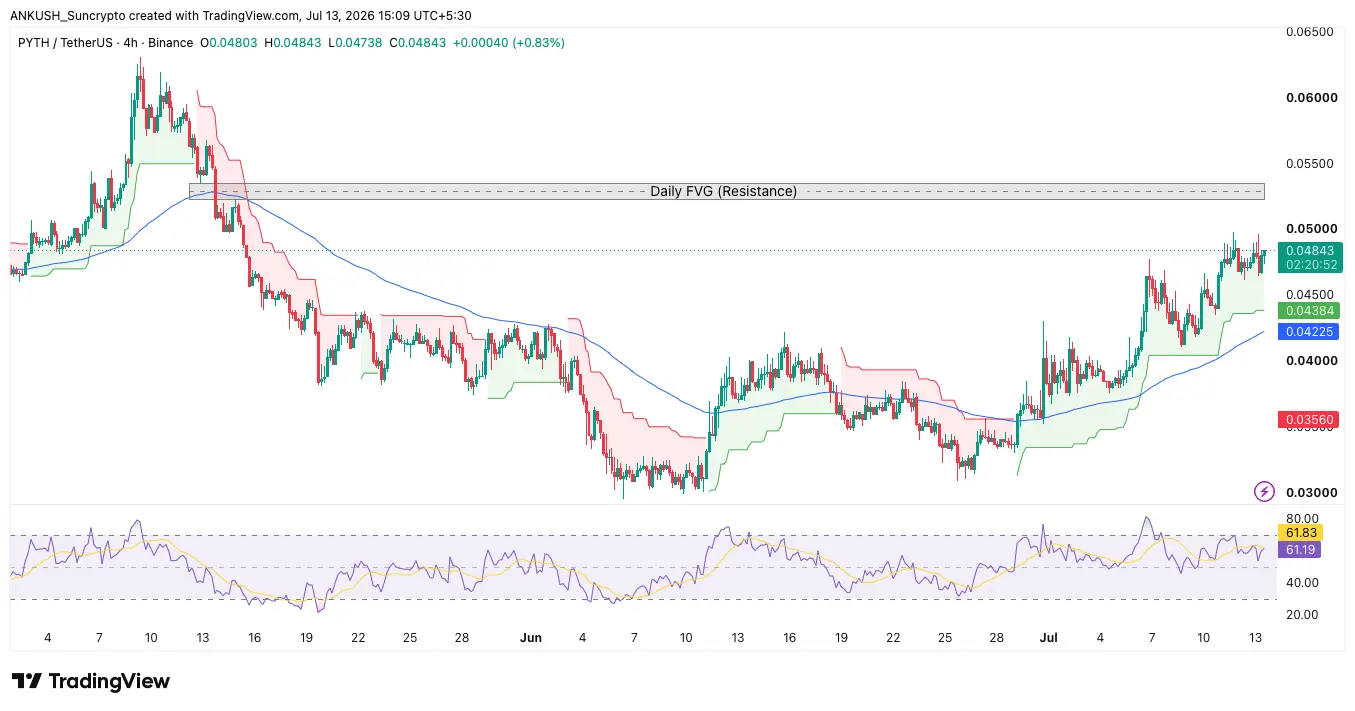
As of July 13, 2026, Pyth is trading roughly around $0.04886 (₹4.67), staying near its seven-day high of $0.04982 after it picked up momentum off a low of about $0.038 early in the week. Trading volume for Pyth network in the last 24hours is around $17.42M, down from higher levels earlier in the week, and looks like the rally is starting to lose some of the momentum that it had earlier, despite the fact that the token has not lost any of its recent gains in price. Its market cap is close to $385.37M, and its fully diluted valuation is near $489.36M, after 7.87B Pyth coins have been issued from a maximum supply of 10B.
This gain seems to have been largely decoupled from a headline worth watching , it appears to be more a confluence of oversold conditions, altcoin risk rotation and anticipation of a scheduled protocol upgrade later in the month. The market has been choppy overall, with Bitcoin having been on the decline in recent days, this coin is still performing well despite the broader environment. It remains to be seen if the strength in the price action holds, as it heavily depends on how the market responds to upcoming developments and if the support at $0.046 region nabs.
Key factors fueling Pyth Network’s price action this week
- Resilience versus a falling market, as the token gained even while Bitcoin slipped nearly 1.6% in the same session.
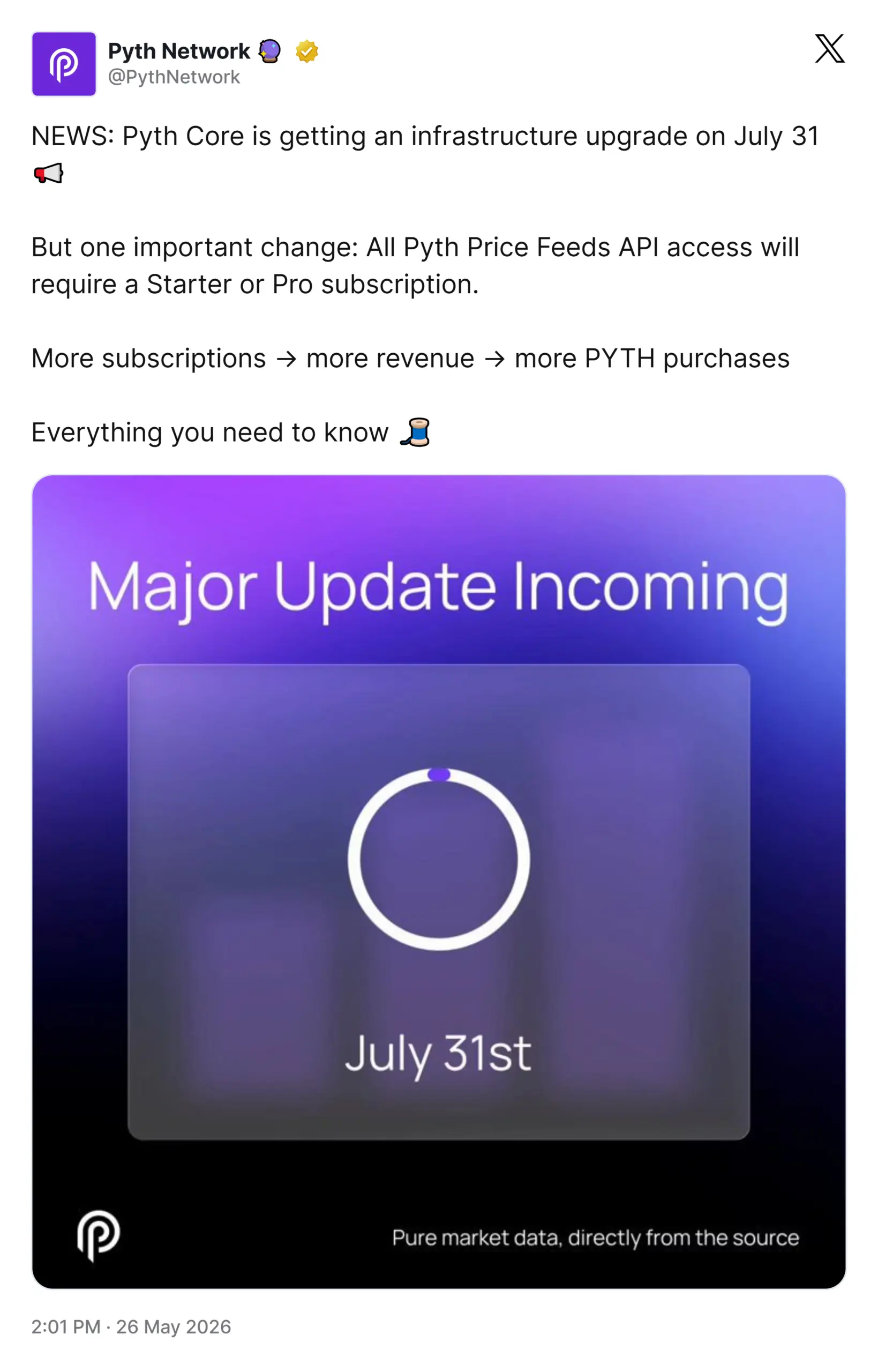
- Anticipation of the July 31 Core Upgrade, which shifts the network from free access to a paid subscription model.
- Growing recognition of the project’s role in real-world-asset perpetuals, now covering roughly half of that entire market segment.
- Renewed altcoin rotation as traders seek oversold names after the June 2026 market-wide correction hit smaller tokens hardest.
- Coverage from crypto media naming the token a top weekly gainer, which tends to draw fresh speculative trading volume.
Why is Pyth Network’s core shift to a paid model a big deal?
On July 31, 2026, the Pyth Network will officially end its free, permissionless data model. Every one of the more than 600 applications that are currently pulling price feeds will have to subscribe to the paid tier (the lowest tier costs around $500/month) in order to continue accessing the service. These subscription fees are pooled into the Pyth Reserve, and used to perform recurring token buybacks on the open market, directly linking real network usage to token demand.
This is perhaps the most significant fundamental change the project has made since launch, converting the token from an engagement token primarily for governance purposes into a token with revenue-backed value creation. As you might expect, some people have come up with the hypothesis that even a modest single-digit percentage of the broader multi-billion-dollar market-data industry would derelate enormous revenue. Of course, the only real answer will come after July 31, after the market gets to see real subscription numbers rather than guesses.
How is Pyth powering half of the RWA Perpetuals market?
While it can be easy to overlook, one of the biggest success stories that has unfolded in the crypto market over the last year is real-world-asset derivatives. In May 2026 alone, perpetual trading volume for real-world-asset derivatives crossed a new record at about $211B across the industry, and at the heart of about $110B of that volume, roughly 52% of the total, was the Pyth Network, a price data provider.
Traded on numerous exchanges and trading platforms, more than half of all leveraged real-world-asset positions came from venues that source all of their pricing data from one single source. It’s a unique and impressive achievement, especially given that most retail traders don’t have any idea where the prices of the underlying assets actually come from. What’s more, increases in Pyth’s data offerings in the past few months should only increase its reach.
This has positioned it as the dominant channel for on-chain RWA pricing, largely due to its first-party data model. Jam, which aggregates price feeds in real-time from exchanges, market makers and institutions and disseminates them on-chain to more than 100 blockchains, has expanded its feed offerings in recent months to include commodity markets like WTI crude and Brent as well as large equity indices, and has become the default channel for venues like Hyperliquid that are building synthetic RWA markets. The risk is concentration , with a sizable portion of global RWA leverage now hinged on the uptime and accuracy of a single oracle network, which is worth monitoring closely as it scales.
What does the Hong Kong stock feed expansion mean for Pyth?
On July 11, 2026, the project’s “Fresh Markets” update added 85 new Hong Kong equity feeds alongside fresh U.S. stock, ETF, and even Solana meme-token coverage. The new asset classes represent a deliberate push deeper into Asian traditional finance, an area where on-chain, real-time equity pricing has historically been difficult for DeFi builders to access reliably.
Feed expansion of this kind doesn’t move prices overnight. But it does reliably expand the addressable market for the Pyth network’s paid subscription business that will launch later this month. Each new asset class covered , Hong Kong equities, commodities, FX , gives institutional clients another reason to pay for data rather than try to get it elsewhere, strengthening one aspect of the token’s new economic model.
Can token unlocks impact Pyth coin price in the future?
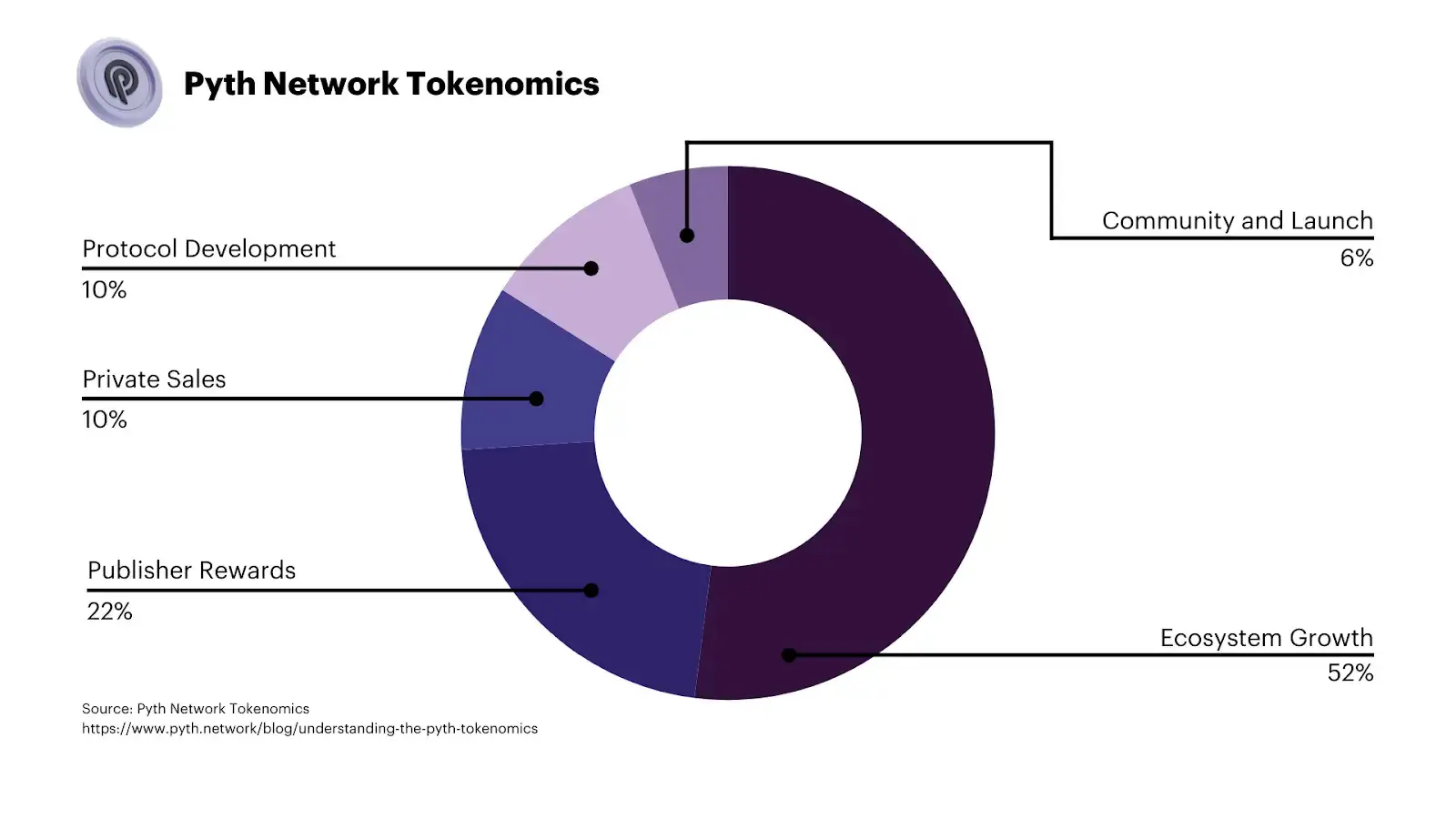
Tokenomics are a real swing factor here. Out of the entire 10 billion max supply, about 7.87 billion are already circulating and about 2.1 billion are at large, locked up to slowly drop level for level with the next significant unlock expected in May 2027. Unlocks of this magnitude in the past are usually linked with periods of price weakness, again because they increase the amount of sellable supply the market can access all at once.
For people building longer term Pyth coin price predictions, the dynamic between subscription driven token demand and this ongoing supply overhang is arguably the most important variable to follow. If buyback from the new revenue model is fast enough to quickly outpace the rate of new unlocks appearing on exchanges, the dilution can be relatively easily absorbed; if not unlocks will always be a factor in downside risk.
What technical Pyth coin price levels should traders watch out?
- Immediate support sits near $0.046, a level defended through most of this week.
- A daily close below $0.046 risks a retest of the $0.04122 support zone.
- Stronger support lies close to $0.038, last week’s swing low point.
- Nearest resistance is forming around $0.0523 to $0.0568.
- A confirmed breakout above $0.050 could open the path toward $0.0568.
- Bitcoin’s reaction to upcoming U.S. inflation data may set broader direction too.
What should investors expect from Pyth for the rest of 2026?
As usual, 2026 will be driven by execution and not speculation. The near-term catalyst here is July 31 subscription launch, how easy institutional clients will be to move to paid plans will likely dictate whether the current rally will hold or paint another consolidation chart. The expansion of RWA perpetual volume, another feed expansion in new geographies, and any new institutional partnership with Pyth Network would all provide bullish medium-term case legitimacy.
At that point, it will be up to the sustainability of that adoption to drive a price toward $0.06–$0.08 this year. That could happen with a healthy subscribe adoption rate or a healthy market for altcoins, but even low adoption and a slump in the altcoin market can keep the token at or back to its bottom in June. In any event, the underlying token unlocks and macro sentiment about risk assets will at least mean that volatility is to be expected rather than avoided.
Final Thoughts
This week’s rally in Pyth Network may be short-term speculation, but it’s happening due to profound structural changes – from shifting to paid data subscriptions to a footprint in real-world-asset markets and traditional equities, amongst other factors. None of these guarantee a further rise, and there remains a tokenomics overhang from the unconstrained unlocks to invest in this week.
But for a technology that is increasingly becoming the core infrastructure for on-chain finance, the coming weeks around the Core Upgrade launch look like a genuine inflection point worth watching closely, regardless of which way the next leg of price action ultimately breaks.
What is Pyth Network?
It is a decentralized oracle protocol that delivers real-time, institutional-grade market data to blockchain applications. Unlike traditional oracles that scrape data from public websites, Pyth sources prices directly from over 120 first-party financial institutions, including major global exchanges and market makers.
What is the Pyth Core Upgrade and when is it happening?
The Pyth Core Upgrade is a major architectural shift ending Pyth’s free-data model by requiring applications to use paid subscriptions and API keys. The upgrade delivers significantly reduced latency, expanded asset coverage, and superior data quality across all integrated networks.
What asset classes does Pyth currently cover?
Pyth aggregates real-time data from over 120 institutional publishers, covering standard cryptocurrencies and extensive traditional finance markets. This includes real-time commodity indices, extended-hours global equity data, and immediate feeds for same-day initial public offerings (IPOs).