

The KOSPI went through another violent session on Thursday, and the pattern is becoming uncomfortably familiar: a Wall Street tech wobble arrives overnight, foreign investors hit the exit on Samsung Electronics and SK hynix, and because those two companies dominate the KOSPI to an extraordinary degree, a modest American move becomes a Korean rout.
By mid-morning, the Korea Exchange had suspended program trading on the KOSPI. It was not the first time this fortnight.
For anyone tracking Asian markets, the KOSPI has become the most sensitive barometer of global AI sentiment there is, and Thursday demonstrated exactly why that is both useful and dangerous.
KOSPI selloff: what happened, hour by hour
The session deteriorated in stages rather than all at once, which is worth tracing because it shows how the selling built.
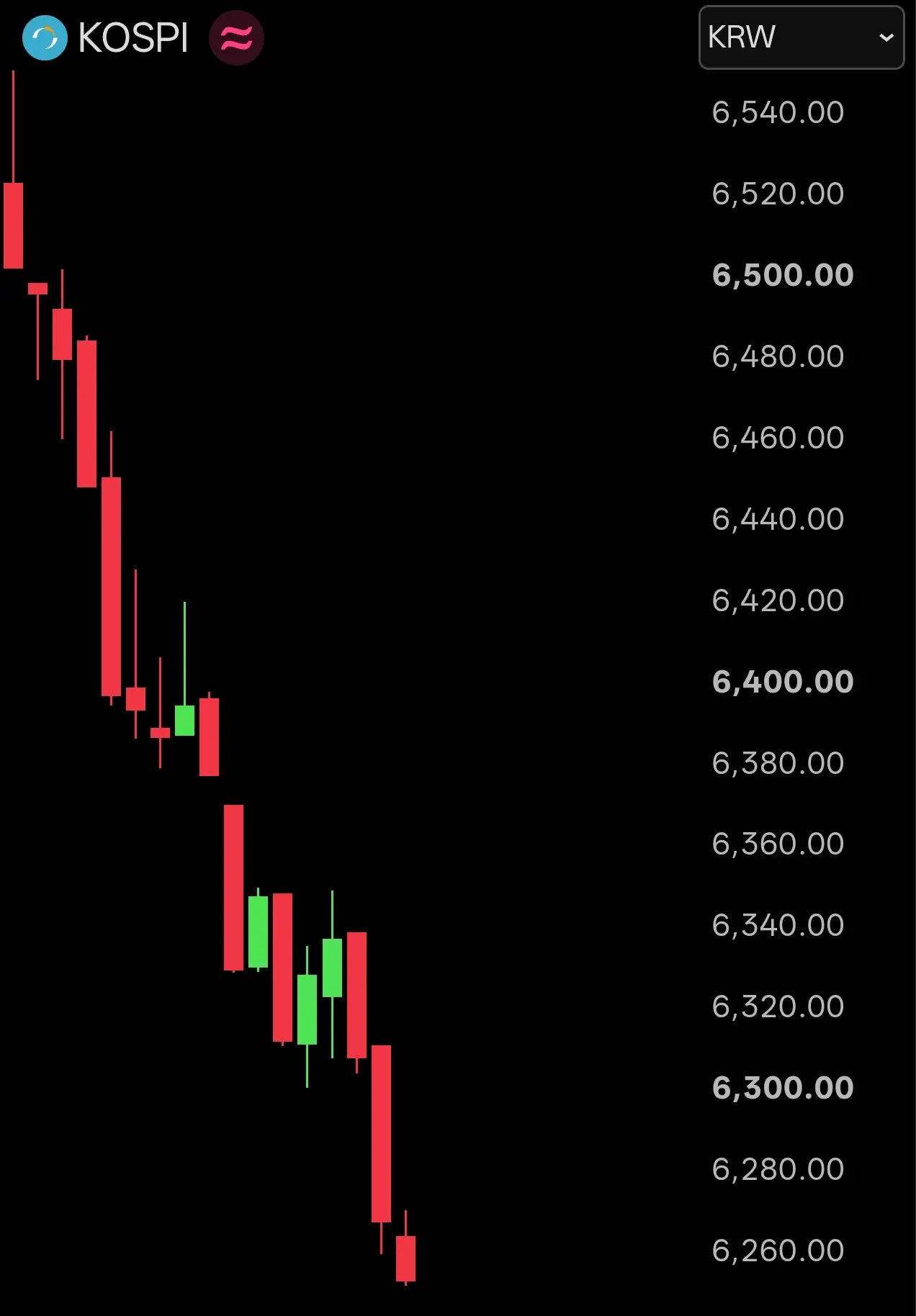
- 9:00 a.m. KST — The KOSPI opened down 1.81% at 6,478.75, a fall of 119.51 points, following weakness in US technology stocks overnight.
- 9:15 a.m. KST — The KOSPI had recovered slightly to 6,492.31, down 105.95 points or 1.61%. Early trade briefly pushed it as high as the 6,540 level before it turned back below the opening price.
- 9:34 a.m. KST — Samsung Electronics traded at 237,000 won, down 3.66%, while SK hynix fell harder to 1,549,000 won, down 7.13%. Foreign investors, who had been net buyers in recent regular sessions, flipped to net sellers, the decisive shift.
- Around 10:18 a.m. KST — The Korea Exchange activated a sell-side sidecar for the KOSPI, suspending program trading in listed shares for five minutes. The KOSPI had fallen more than 4%.
- Intraday low — The decline reached as much as 5% at one point. SK hynix bottomed around 8.27% lower at 1.53 million won, with Samsung Electronics down 5.69% at 231,500 won.
 Note the asymmetry: SK Hynix fell roughly twice as hard as Samsung. That is consistent across recent sessions and reflects SK hynix’s tighter exposure to high-bandwidth memory demand tied directly to AI data center spending.
What is a KOSPI sidecar actually?
The term appears in every Korean market story but is rarely explained.
A sell-side sidecar is an automatic circuit-breaker-style mechanism operated by the Korea Exchange. It triggers when the KOSPI 200 Futures Index falls 5% or more and holds that level for at least one minute. Once triggered, program trading, automated, algorithm-driven basket orders is suspended for five minutes.
The purpose is not to stop the market falling. It is to interrupt the feedback loop in which algorithmic selling begets more algorithmic selling. Program trades execute far faster than human decisions, and in a concentrated market they can cascade. The five-minute pause forces a breath.
It is a blunt instrument, and its activation is best read as a signal of mechanical stress rather than a judgment on fundamentals.
What triggered the KOSPI drop?
The proximate cause came from an American memory company, not a Korean one.
SanDisk released fiscal fourth-quarter 2026 results overnight. On the face of it, the numbers were extraordinary: revenue surged 372% year over year to $8.96 billion, and adjusted earnings per share reached $39.25. Both figures beat expectations comfortably.
The problem was the forecast. SanDisk guided first-quarter fiscal 2027 revenue to a range of $10.3 billion to $10.8 billion, a midpoint of roughly $10.55 billion, below the roughly $10.8 billion the market had priced in.
That gap, a few hundred million dollars against a double-digit-billion base, was enough. In a sector trading on the assumption of uninterrupted AI-driven demand, guidance that merely fails to accelerate reads as deceleration.
Korean chipmakers were sold as a proxy. Broader US markets, for the record, finished mixed overnight rather than collapsing, which is precisely the point about amplification.
KOSPI context: an extraordinary fortnight
Thursday’s session did not happen in calm conditions. The KOSPI has been in a state of extreme volatility for weeks.
- July 28 — Sell-side sidecars and circuit breakers were both triggered amid heavy selling.
- July 31 — The KOSPI staged a record single-day rally of roughly 17.91%, an almost unheard-of move for a major developed-market index.
- August 3 — The index gave back much of it, falling 5.12% to close at 6,257.45, a drop of 338 points. Samsung tumbled 8.76% to 239,500 won and SK hynix fell 8.79% to 1,567,000 won as investors locked in profits. Foreign and institutional investors sold a combined net 4.77 trillion won. Turnover reached 26.1 trillion won on 270.9 million shares.
- August 4-5 — A rebound across two consecutive sessions, driven partly by easing Strait of Hormuz tensions.
- August 6 — Thursday’s KOSPI reversal, wiping out much of that rebound.
An index swinging 18% up and 5% down within days is not behaving like a normal equity market. It is behaving like a leveraged instrument, which brings us to the regulatory response.
Regulators move on leveraged products behind KOSPI swings
Korean authorities have concluded that market structure is contributing to the violence of these moves.
As of early August, regulators were proposing legislative reforms including an “emergency action authority” that would allow leveraged ETF ratios to be cut from 2x down to 1.5x or 1x during periods of instability. Additional measures under consideration include stricter margin requirements and caps on speculative investment.
The logic is straightforward. Leveraged ETFs must rebalance daily to maintain their stated exposure, which means they mechanically buy into rallies and sell into declines, amplifying whatever direction the market is already moving. In a market as concentrated as the KOSPI, that amplification compounds.
Whether these reforms pass, and in what form, is now a live question for anyone trading Korean equities.
What does the KOSPI selloff mean beyond Korea?
For global investors, Thursday is a data point in a larger question: how much of the AI trade is priced for perfection?
SanDisk beat on revenue and earnings by wide margins. It was punished for guidance that implied growth would merely be very strong rather than accelerating. That is the signature of a sector where expectations have run ahead of even excellent results and where the risk is no longer that AI demand disappears, but that it fails to compound at the rate embedded in valuations.
For Indian investors, the read-across is indirect but real. Korean chip stocks function as an early-warning system for global tech sentiment during Asian trading hours. Sharp KOSPI selloffs frequently precede pressure on Indian IT and technology counters and on emerging-market risk appetite generally, particularly when foreign institutional investors are reducing exposure across the region simultaneously.
What to watch next?
- Whether foreign investors keep selling: Thursday’s decisive moment was foreigners flipping from net buyers to net sellers. Sustained outflows matter far more than any single session’s percentage.
- Upcoming memory sector guidance: With SanDisk’s forecast having triggered this, the market will scrutinize every subsequent update from the memory chain for confirmation or contradiction.
- Progress on the leveraged ETF reforms: If enacted, they would structurally dampen the amplitude of these swings.
- Whether the KOSPI sidecar gets triggered again: Three activations within two weeks would indicate the volatility is structural rather than episodic.
The bottom line
The KOSPI’s problem is not that Samsung and SK hynix are bad companies. It is that the KOSPI is, functionally, a concentrated bet on the global AI semiconductor cycle, and that cycle is currently priced with almost no tolerance for disappointment.
Until either the KOSPI diversifies or AI expectations reset, sessions like Thursday’s are likely to keep recurring. The sidecar can pause the selling for five minutes. It cannot fix the concentration that makes the selling so violent in the first place.