
South Korea’s stock market is in the middle of its worst rout in years. The KOSPI, the country’s benchmark index and rough equivalent of the S&P 500, which has plunged roughly a third from its June 2026 peak, making July its worst month on record. The scale of the wipeout runs into the hundreds of trillions of won in lost market value. Panic has spread among retail and institutional investors alike, and the government is now scrambling to respond.
What was the reason behind the KOSPI crash?
The immediate spark was disappointing earnings from a market heavyweight. The selloff deepened Wednesday after SK Hynix reported weaker-than-expected earnings, raising doubts over the artificial-intelligence investment boom and accelerating retail selling. That’s despite the fact that SK Hynix actually posted a six-fold surge in quarterly operating profit to a record ₩60.5 trillion (roughly $41.2 billion), the results simply fell short of sky-high analyst expectations, and the company offered little clarity on shareholder returns or long-term pricing.
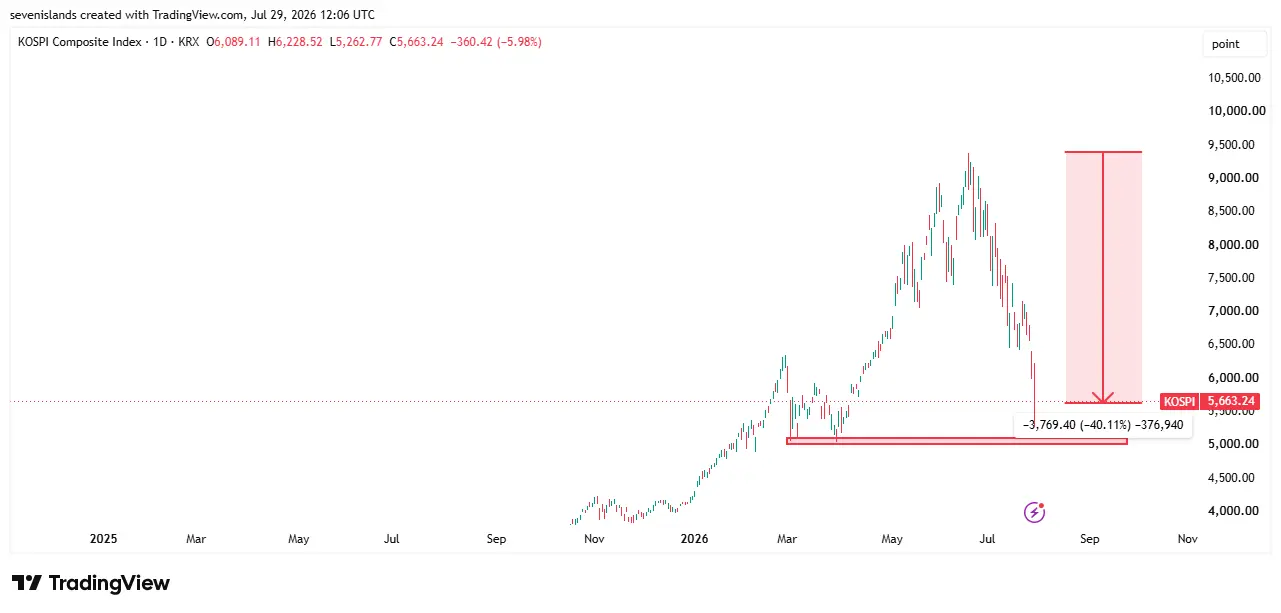
Source: KOSPI price chart on 1-D timeframe by TradingView
The damage wasn’t limited to one stock. SK Hynix sank as much as 15%, Samsung Electronics dropped below the ₩200,000 level, and the Kosdaq index of smaller companies fell more than 8%, tripping its own circuit breaker. The KOSPI itself fell as much as 9.8% on Wednesday, dropping below 6,000 to its lowest level since early April 2026.
Government response
South Korea’s top financial authorities held an emergency meeting Wednesday evening, hosted by Finance Minister Koo Yun-cheol. The Bank of Korea Governor, the Financial Services Commission Chairman, and the Financial Supervisory Service Governor all attended to examine what caused the market plunge.
Officials didn’t shy away from accepting responsibility. At a parliamentary hearing, Koo apologized, acknowledging that regulators should have scrutinized the leveraged products more closely before their launch. He added that the government would roll out further measures if needed to help stabilize the market.
Lawmakers had questioned senior officials repeatedly in parliament on July 29. They traced part of the selloff to the single-stock leveraged products launched in May.
What happened to Samsung Electronics and other big companies?
Samsung Electronics Co. Ltd. is South Korean based company which has a market capitalization of around ₩1,369.128T. It is one of the leading companies in the KOSPI index. It has crashed by more than 44% in a month.
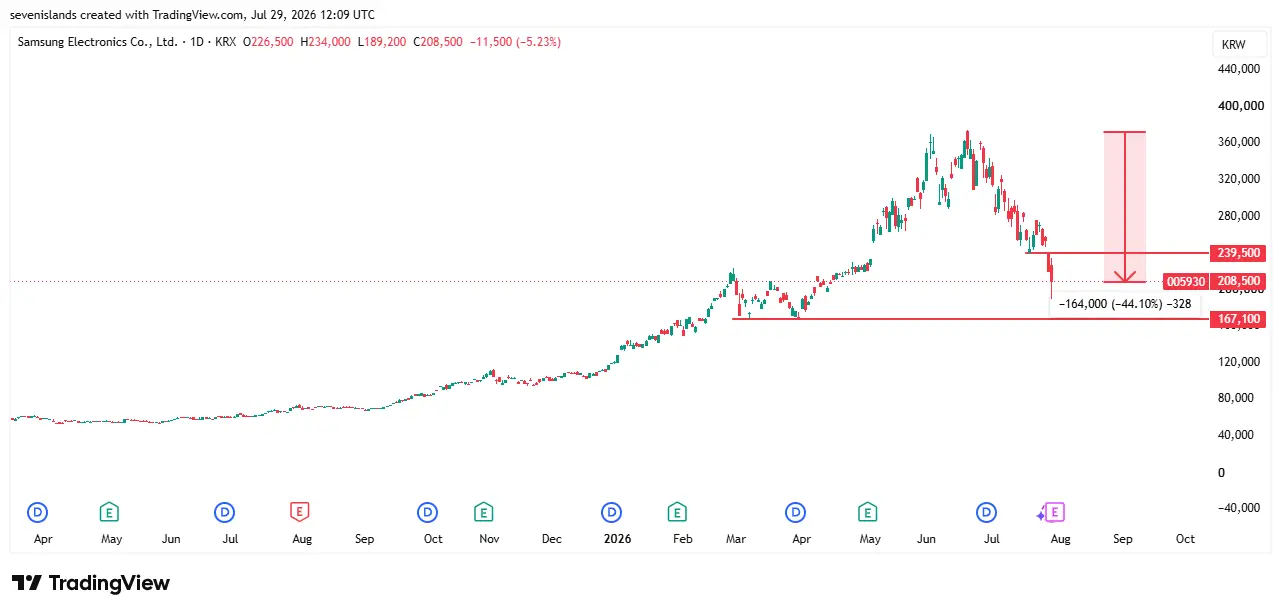
Source: SAMSUNG price chart on 1-D timeframe by TradingView
SK Hynix and Samsung Electronics which together account for more than half of the Kospi index which have pulled the broader benchmark sharply lower as leveraged bets on the AI chip cycle unwind. Semiconductors sit at the core of both South Korea’s economy and the global AI trade, so the fallout is rippling well beyond Seoul: the correlation between the Kospi and Nasdaq 100 has climbed to about 0.50, its highest level since 2021.
Final thoughts
The Kospi’s near-40% collapse in a single month is a sharp reminder of how concentrated South Korea’s market really is with SK Hynix and Samsung Electronics together accounting for more than half the index, any crack in the AI chip narrative was always going to hit hard. The government’s emergency meeting and Koo Yun-cheol’s admission that leveraged products weren’t scrutinized closely enough suggest more regulatory tightening could be on the way, which may add near-term volatility even as authorities try to calm markets.
For investors, the bigger takeaway is the rising correlation between the Kospi and Nasdaq 100, now at its highest since 2021. That signals AI-driven markets worldwide, semiconductors, tech equities, and by extension risk assets like crypto, are becoming more tightly linked. A stumble in one corner of the AI trade can now ripple far beyond its home market, making diversification and risk management more important than ever for traders navigating this cycle.
Why did the KOSPI crash in 2026?
The KOSPI crashed after SK Hynix reported earnings that fell short of sky-high analyst expectations, despite posting a six-fold surge in quarterly operating profit to a record ₩60.5 trillion. This raised doubts over the AI investment boom and triggered heavy retail selling across the market.
How much has the KOSPI fallen from its peak?
The KOSPI has plunged nearly 40% from its June 2026 peak, making July its worst month on record and wiping out hundreds of trillions of won in market value.
What did the South Korean government do in response to the crash?
Finance Minister Koo Yun-cheol led an emergency meeting with the Bank of Korea Governor, the Financial Services Commission Chairman, and the Financial Supervisory Service Governor.