

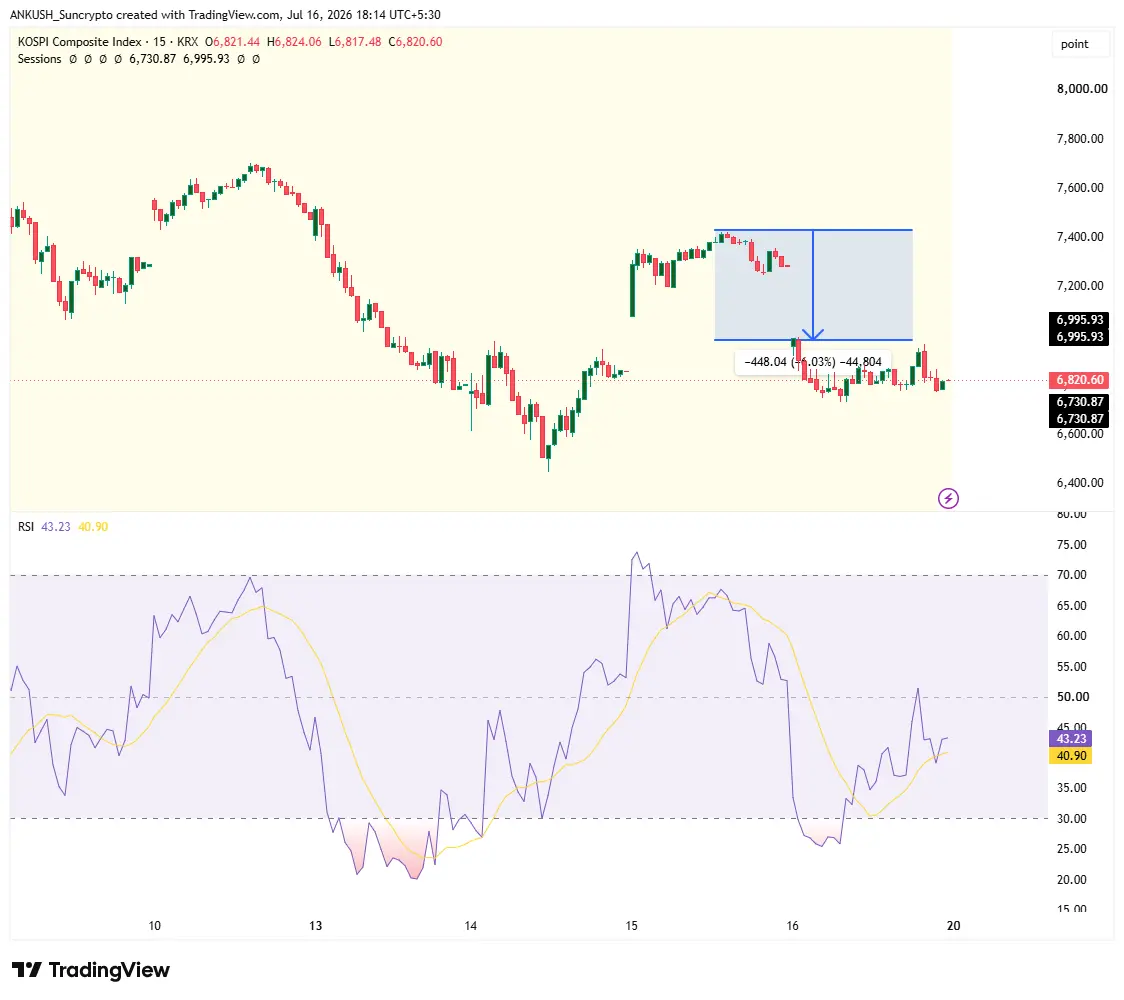
South Korea’s benchmark stock market gauge, the KOSPI index, has become one of the most volatile major indices in the world this July, and it just triggered its latest emergency trading halt. After the KOSPI plunged as much as 6% in a single session, the Korea Exchange suspended program selling, wiping out more than ₩372 trillion (roughly $250 billion) in market value.
The rout came just a day after President Lee Jae-myung publicly described market conditions as “unstable,” and regulators have now moved to temporarily halt new single-stock leveraged ETF listings while sharply raising deposit requirements for existing leveraged chip funds. Here’s a full breakdown of what happened, why the KOSPI index has become so volatile, and what South Korea’s government is doing about it.
What is the KOSPI Index?
The KOSPI (Korea Composite Stock Price Index) is South Korea’s primary stock market index, tracking all common shares listed on the main board of the Korea Exchange (KRX) in Seoul. It functions much like the S&P 500 in the US or the Nikkei 225 in Japan, a broad barometer of the health of the national stock market.
However, the KOSPI index is unusually concentrated: two companies, Samsung Electronics and SK Hynix, carry outsized weight and influence over the index’s daily moves, since both rank among the largest companies in the world by chip and memory-related market capitalization. That concentration is central to understanding why the index has swung so dramatically in recent weeks.
After a 6% plunge, what happened?
On the day in question, the KOSPI opened sharply lower, and losses accelerated almost immediately after trading began. As KOSPI 200 futures fell more than 5% from the previous session’s close and held at that level for at least one minute, the Korea Exchange automatically activated a sell-side circuit breaker known locally as a “sidecar,” suspending program sell orders for five minutes. This is a standard, rules-based market-stabilization mechanism, not a discretionary decision by regulators; it triggers automatically whenever KOSPI 200 futures move 5% or more against the prior close and hold that level.
This was far from an isolated event. The KOSPI index had already triggered its 18th sell-side sidecar of the year even before this latest plunge, an extraordinary number of circuit-breaker activations for a single calendar year, reflecting just how turbulent 2026 has been for Korean equities. Days earlier, the index had also triggered a full Level 1 circuit breaker, halting trading in all KOSPI-listed securities for 20 minutes after the index cratered more than 8% in a single session, only its seventh such full tra
ding halt of the year, and the second within a matter of days.
| Items | Figures reported in the provided text |
| Circuit breaker trigger time | 1:51 p.m. |
| Trading halt duration | 20 minutes |
| Circuit breaker trigger rule (KRX) | KOSPI down 8% for 1 minute |
| Level at trigger (one account) | 7,401.56 (down 649.77 points, -8.07%) |
| Intraday low (one account) | 7,392.04 (-8.19%) |
| Other levels cited during sell-off | 8,199.81 (-8.18%), 8,203.84 (after halt lifted), 8,362.24 (-8.2%) |
| Foreign selling cited | KRW 3 trillion, KRW 4 trillion ($1.6 billion), KRW 355 billion ($131.40 million) |
| Market breadth cited | 848 down vs 61 up |
The scale of the wipeout in this latest episode was severe: more than ₩372 trillion, approximately $250 billion, was erased from the South Korean stock market in the plunge. That figure captures just how much value can evaporate within hours when a market this concentrated in a handful of mega-cap chip stocks turns sharply lower.
Why is the KOSPI so volatile right now [in July]?
Several forces have combined to make the KOSPI index unusually erratic in mid-2026:
- A concentrated, chip-driven rally turned volatile: The Korean stock market rallied roughly 75% in 2026 at its peak, fueled almost entirely by AI and semiconductor demand for Samsung Electronics and SK Hynix. That kind of narrow, sector-driven rally left the broader index highly exposed to swings in chip sentiment.
- Leveraged single-stock ETFs amplifying moves: Regulators approved single-stock leveraged ETFs tracking Samsung Electronics and SK Hynix in an effort to deepen Korea’s capital markets, with the first products listed on May 27, 2026.
- Demand for these products exploded far beyond expectations; one Hong Kong-listed leveraged SK Hynix ETF alone ballooned to roughly $13 billion in assets within just nine months and, on especially volatile trading days, accounted for as much as two-thirds of SK Hynix’s entire daily trading volume.
- Because these funds must rebalance and hedge their exposure constantly to maintain their leverage ratio, that rebalancing activity itself pushes the underlying stocks and, by extension, the whole KOSPI index further in whichever direction the market is already moving, creating a feedback loop.
- Global semiconductor sentiment swings: Much of the volatility has been imported from overseas. Sharp overnight moves in US chip stocks like Micron, Intel, and AMD, tied to concerns over data center construction delays, competing Chinese memory-chip IPO plans, and shifting AI trade sentiment, have repeatedly spilled over into Korean trading the next morning, since Samsung and SK Hynix sit at the center of the same global memory-chip supply chain.
- Heavy institutional and foreign selling: During several of the sharpest recent plunges, foreign investors and domestic institutions have both been net sellers of billions of won worth of shares in a single session, while retail investors have often been left as the primary buyers attempting not always successfully to absorb the selling pressure.
- Geopolitical shocks: External shocks, including reported tensions in the Strait of Hormuz pushing oil prices higher, have added further risk-off pressure onto an already jittery market.
The President’s “Unstable” Comment and the Political Backdrop
Just a day before this latest plunge, President Lee Jae-myung told a policy meeting with top government officials that “our domestic stock market is quite unstable,” explaining that the market had surged so dramatically in such a short period that it would need time and further fluctuation to stabilize. His comments followed weeks of extreme two-way volatility, including an 8-9% single-day plunge followed by a dramatic intraday rebound and later an 8%+ single-day surge that had already drawn public criticism.
The volatility has become a genuine political flashpoint. The opposition People Power Party accused the Lee administration of encouraging excessive risk-taking by promoting ambitious stock-market targets while overlooking the leverage building beneath the market’s headline gains, with one party floor leader remarking that recent swings were “enough to make people feel dizzy just watching Kospi. ” President Lee has made narrowing the so-called “Korea discount,” the long-standing tendency for Korean stocks to trade at lower valuations than global peers, one of his signature policy goals, which adds extra political weight to any sustained market instability under his administration.
South Korea’s Regulatory Response: Curbing Leveraged Chip ETFs
Following the president’s comments and mounting criticism from lawmakers, financial regulators moved quickly. Following a meeting of the country’s top financial policymakers, including the heads of the Finance Ministry, the Financial Services Commission (FSC), the Financial Supervisory Service (FSS), and the Bank of Korea, officials announced two major measures aimed specifically at single-stock leveraged ETFs tied to Samsung Electronics and SK Hynix:
- A temporary halt on new single-stock leveraged ETF listings: The Financial Services Commission confirmed that no new single-stock leveraged exchange-traded products will be listed until market conditions stabilize.
- The suspension applies broadly to new products of this type, not just those tracking chipmakers, reflecting how central this single product category has become to the broader volatility problem.
- A sharply higher minimum deposit requirement: The minimum cash deposit required for investors trading single-stock leveraged products will nearly triple, rising from 10 million won (about $6,800) to 30 million won (about $20,300).
- Under the previous rules, investors could meet the 10 million won threshold using cash or substitute securities such as stocks, other ETFs, or bonds, a flexibility that made it relatively easy for retail investors to access highly leveraged, high-risk products.
- The new, cash-based requirement is designed to meaningfully raise the bar for retail participation in these products. The higher deposit rule is expected to take effect in August 2026, while an associated change to trading unit sizes is expected to follow in November.
Notably, the brokerage industry itself had already begun moving in this direction before the government’s formal announcement. The Korea Financial Investment Association convened an emergency meeting of major brokerage CEOs, where firms agreed in principle to raise deposit requirements, with one industry proposal even floating a threshold as high as 50 million won alongside commitments to introduce more tailored risk warnings based on an investor’s age and portfolio, expand investor education, and spread rebalancing and hedging trades more evenly throughout the trading day to reduce concentrated buying and selling pressure near the market close.
Regulators Admit There’s No Easy Fix
FSS Governor Lee Chan-jin told asset managers privately that “a straightforward solution was unlikely,” calling the leveraged ETF problem “structural,” a notable admission since regulators approved these same products just weeks earlier, on May 27, 2026, to deepen Korea’s capital markets.
Their leverage to act is limited: the 16 Samsung/SK Hynix leveraged ETFs still held roughly ₩9.65 trillion (~$6.48 billion) in combined assets even after a sharp decline, and on one volatile day their trading alone hit ₩12.14 trillion, 31.6% of all ETF turnover, more than the entire Kosdaq market.
Is Regulation the Right Answer?
The financial industry disagrees that leveraged ETFs are the main culprit and warns tighter rules could repeat 2012’s derivatives-market contraction after similar restrictions were imposed.
Critics also note an FSC commissioner warned in April 2026 before the products launched that single-stock leverage was unusually risky for retail investors; that warning went largely unheeded.
What does this mean going forward?
The episode reflects a broader tension: a genuine AI/chip rally amplified by a risky new product in a market where two stocks dominate the index. The government’s fix targets the amplifying mechanism, not the underlying AI trade itself.
Whether it works depends on chip sentiment and how quickly leveraged ETF holders de-risk as new rules phase in through August and November. For now, KOSPI remains one of the world’s most volatile major indices, with more circuit breakers likely.
KOSPI’s Impact of Crypto Market
- Direct correlation and shared liquidations
- The connection isn’t just theoretical; it’s showing up in price action. Bitcoin fell from $64,300 at Sunday’s weekly close to an intraday low near $61,850 during one of the KOSPI’s sharpest drops, stabilizing around $62,500–$63,000 by mid-morning in New York, with $253 million in leveraged crypto positions force-liquidated.
- On another volatile day, Bitcoin traded at $62,600 after tumbling from $64,400 to $61,800, with $283 million in 24-hour liquidations skewed roughly 74-26 toward long positions.
- Same institutional capital, two different markets:
- Analysts at Anchorage Digital attributed roughly 30% of Bitcoin’s recent weakness to capital rotating away from AI and semiconductor equities, since institutional investors who hold Bitcoin through ETFs often also hold AI-infrastructure equities, meaning a sharp reassessment of AI-chip valuations in Seoul ripples into crypto risk appetite in New York, not because the markets are directly linked, but because the same institutional capital touches both.
- A genuine “seesaw” money rotating between KOSPI and Korean crypto exchanges
- This is the most distinctly Korea-specific dynamic. During the KOSPI’s earlier rally, retail funds that had been flowing into the domestic cryptocurrency market were assessed to have moved into stocks instead; after the plunge, some of that money has been flowing back into bitcoin and major cryptocurrencies.
- The scale of this rotation has been dramatic: South Korea’s KOSPI lost 10% in a matter of days, prompting Upbit trading volume to surge 1,426% as Korean investors rotated back into crypto.
- Separately, the Korea Exchange has triggered nearly 30 circuit-breaker-related halts so far in 2026, a volatility level exceeding even the 2008 financial crisis, and Upbit’s 24-hour trading volume reached $4.12 billion, an increase of 436%, with Bitcoin, XRP, ETH, Threshold Network, and BLAST as the top five traded tokens.
- The rotation isn’t guaranteed to be durable
- Not every data point supports a clean “stocks-to-crypto” story. One analysis found that when the KOSPI fell as much as 8.22% and triggered a trading halt, Upbit volume rose only modestly, showing little evidence of a durable shift from stock trading to crypto trading, suggesting any rotation may be short-lived rather than structural.
- Risk of a broader risk-off spillover, not just a rotation:
- Analysts are split on which way this cuts. One analyst warned that broadening equity panic puts downside pressure on crypto risk assets and that if US markets follow Asia lower, crypto selling could intensify since a shock like the KOSPI plunge is the kind of cross-asset event that can break correlations and drag Bitcoin below support.
- Others were more sanguine, with one market watcher noting Bitcoin’s price action was “holding up well” despite the pressure, testing the $65,000 area while maintaining support around $61,000.
- Structural background: why Korean retail money is so linked to both markets
- South Korean retail investors, particularly those aged 40 to 50, have a pattern of moving funds between domestic/US stocks and crypto, with XRP in particular seeing outsized volume during past KOSPI declines.
- On the regulatory side, South Korea has eased rules on corporate crypto investment and confirmed a spot Bitcoin ETF launch for 2026, though the country is also tightening FX controls on crypto transfers starting December 2026.
Is Bitcoin directly connected to the KOSPI index?
Not directly; there’s no structural link between the two markets. The connection is indirect, running through shared institutional capital (funds holding both AI/chip equities and Bitcoin ETFs) and, uniquely in South Korea, retail investors who rotate money between domestic stocks and crypto exchanges depending on which market looks riskier or more attractive at the time.
Why does a South Korean stock crash affect global Bitcoin prices?
Because Samsung Electronics and SK Hynix sit at the center of the same AI/semiconductor narrative that many institutional Bitcoin holders are also exposed to through AI infrastructure stocks. When that narrative wobbles in Seoul, the same funds are often de-risked across both equities and crypto simultaneously.
Has Korean crypto trading volume actually increased because of the KOSPI crash?
Yes, in several instances, Upbit volume spiked over 1,000% on some days during the worst KOSPI sessions. However, other data shows the increase was sometimes modest and short-lived, so it’s unclear whether this represents a lasting rotation or just short-term volatility-driven trading.
Could the new leveraged ETF restrictions push more Korean money into crypto?
It’s plausible but unconfirmed. If leveraged single-stock ETFs become harder to access due to the tripled deposit requirement, some of that speculative retail appetite could shift toward crypto exchanges instead echoing the pattern seen after previous KOSPI selloffs but this hasn’t been directly confirmed by regulators or analysts as an intended or observed effect yet.
Which cryptocurrencies are most affected by KOSPI-driven Korean trading activity?
Bitcoin and XRP have consistently led trading volume on Korean exchanges like Upbit and Bithumb during past KOSPI volatility, with XRP notably outpacing Bitcoin and Ethereum in daily volume during some downturns.
Does this mean crypto and Korean stocks are now “risk-on” together rather than separate assets?
Largely yes, in the current market environment. Analysts note that Bitcoin and major cryptocurrencies have behaved as risk-on assets in 2026, meaning shocks in other markets like Korean equities tend to be reflected quickly in crypto prices, rather than crypto acting as an uncorrelated safe haven.