
Gold and silver price have been volatile nowadays and sellers have dominated since September. Silver has dropped more as compared to gold which showcases the strength of gold. Both assets are trading near their previous support zones. Let’s see how these assets can perform further.
Gold and Silver: A complete guide for investors and collectors
Gold and Silver: An overview
Gold and silver are the two most widely recognised precious metals in the world. For thousands of years, civilisations have used gold and silver as money, jewellery, and a store of wealth. Today they serve all three roles, plus a growing role in modern technology.
A Brief history of Gold and Silver
- Ancient currency: Gold and silver coins appeared in Lydia (modern-day Turkey) around the 7th century BCE and spread across the Greek, Persian, and Roman worlds.
- Gold and silver standards: For centuries, many nations backed their currencies with gold, silver, or both (bimetallism).
- End of the gold standard: The US formally ended dollar convertibility to gold in 1971, but central banks still hold large gold reserves today.
- Cultural value: In India, gold and silver play a central role in weddings, festivals like Dhanteras and Akshaya Tritiya, and family savings.
Why Gold and Silver hold value
- Scarcity: Both metals are limited in supply and costly to mine.
- Durability: They do not decay, so they can be stored for generations.
- Universal acceptance: Gold and silver are recognized and tradable worldwide.
- Inflation hedge: Investors often turn to gold and silver when the purchasing power of paper currency falls.
- Safe-haven demand: During economic uncertainty, geopolitical tension, or market volatility, demand for gold and silver typically rises.
Gold vs. Silver: Key differences
| Feature | Gold | Silver |
| Primary role | Store of value, reserve asset | Store of value and industrial metal |
| Price level | Much higher per ounce/gram | Much lower per ounce/gram |
| Volatility | Generally lower | Generally higher |
| Industrial use | Limited (electronics, dentistry) | Extensive (solar, EVs, electronics, medical) |
| Market size | Larger and more liquid | Smaller, so prices can swing sharply |
| Storage | Compact, high value per volume | Bulkier for the same value |
Industrial and practical uses
Gold is used in jewellery, central bank reserves, investment bars and coins, electronics (connectors and circuit boards), and dentistry.
Silver has far more industrial demand, which is a major price driver. It is used in solar panels, electric vehicles, 5G and electronics, batteries, medical devices, water purification, and photography, as well as in jewelry, silverware, and coins.
Because silver is tied to industrial growth, its price is influenced by both investor sentiment and manufacturing demand, while gold is driven more by monetary and safe-haven factors.
Factors that affect Gold and Silver prices
- Interest rates: Higher rates can reduce demand for non-yielding assets like gold and silver, while lower rates tend to support them.
- US dollar strength: Both metals are priced in dollars, so a weaker dollar often lifts prices.
- Inflation: Rising inflation increases interest in precious metals.
- Central bank buying: Large purchases of gold by central banks can support prices.
- Geopolitical events: Wars, sanctions, and political instability boost safe-haven demand.
- Industrial demand: Mostly relevant to silver, especially from clean energy and electronics.
- Currency movements: In India, the rupee-dollar exchange rate, import duties, and taxes strongly affect local prices.
Why gold and silver price are falling sharply?
Gold and silver have been falling in recent weeks, with silver dropping harder. Several factors explain it.
Recent pressure (late October 2026)
- Oil, dollar, and rates: On October 23, gold and silver fell as rising crude oil, dollar strength and interest-rate concerns pressured bullion. A stronger dollar makes the metals costlier for buyers in other currencies, and higher rate expectations make non-yielding assets less attractive.
- Sharp weekly and monthly losses: By October 27, silver was down about 8.5% over the week and 17.5% over the month, while gold was down about 2.7% over the week and 5.7% over the month.
- Still up on the year: Even after the drop, gold is up more than 17% over the past year and silver is up almost 35%. So this looks like a correction after a huge rally, not a collapse.
Gold price technical analysis on a daily timeframe
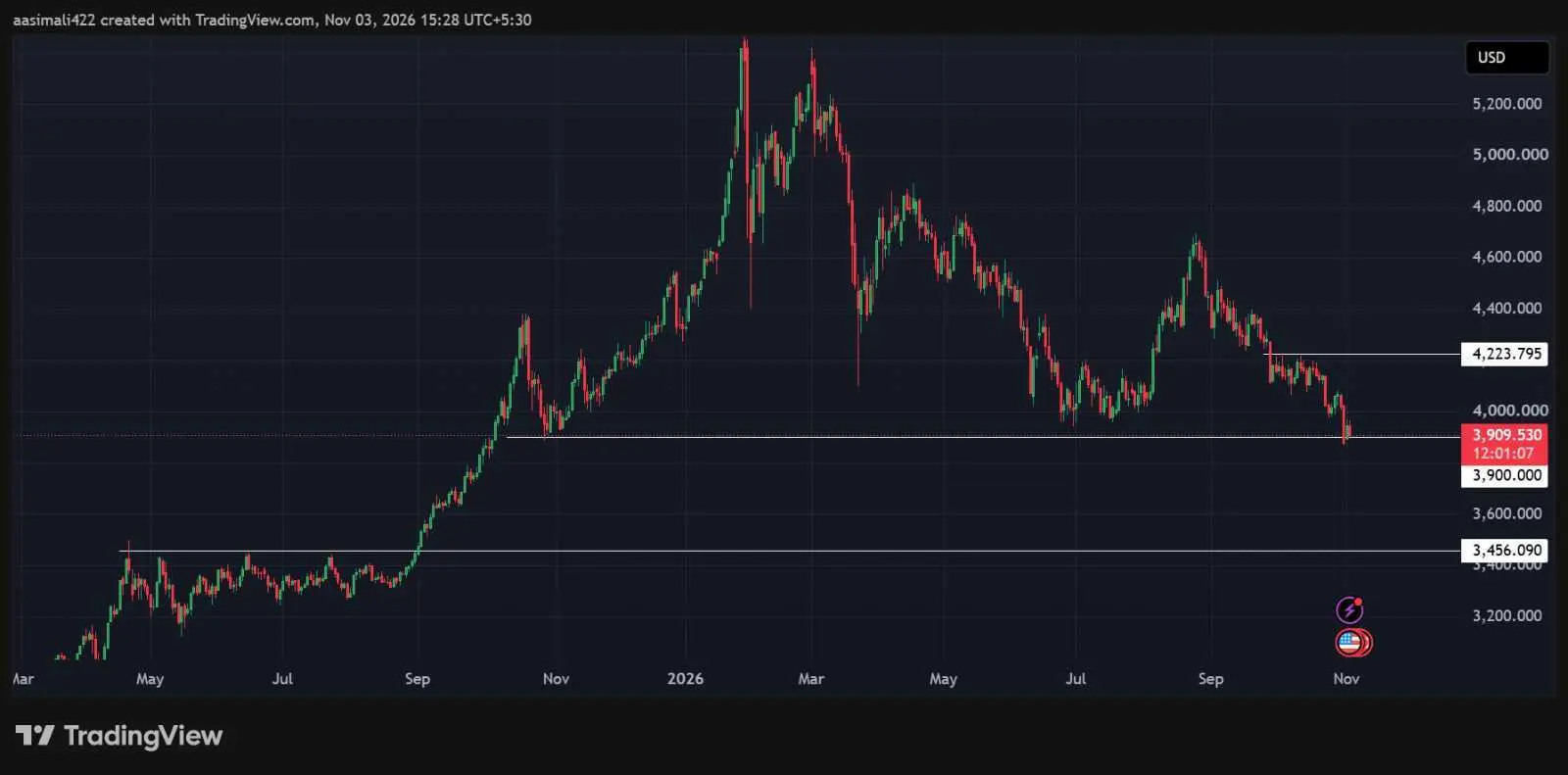
Gold price was trading at $3,901 with an intraday fall of $1.10%. Gold price has been in a bearish trend since it has recorded an all-time high of $5,602.225 on January 29, 2026. It has dropped by 30% since its all-time high and is trading near a previous support zone of $3,900.
Source: XAU/USD price chart over 1-D timeframe by TradingView
This could be a crucial support zone on a daily timeframe because the next support level is on $3,456. If the price manages to hold over the support zone of $3,900, buyers might bounce back. Once the price forms any bullish candlestick pattern on a daily time frame, a bullish rally can be seen.
Conversely, if the gold price slips below this level and makes a closing on a daily time frame then sellers may keep dominating. If sellers dominate then the price could witness a decent fall and it may drop to the next support level of $3,456.
Silver price technical analysis over 1-D timeframe
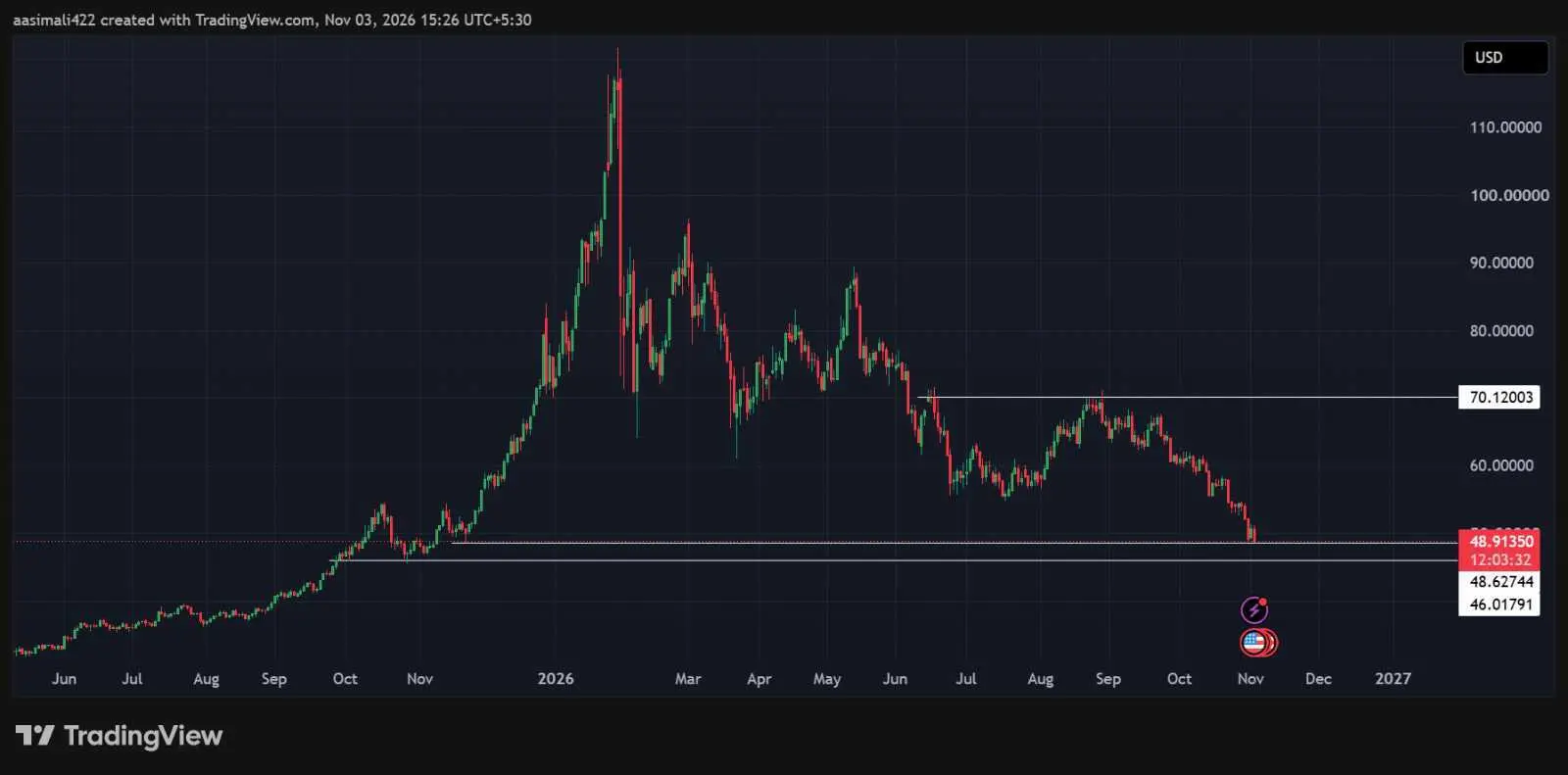
At press time, silver was trading at $48.8400 with an intraday loss of 3.57%. Silver price has witnessed continuous fall in 2026 and has dropped by 60% from its all-time high. It has dropped by 27% since September which showcases that it could be the best price to buy.
Source; XAG/USD price chart over 1-D timeframe by TradingView
Currently, Silver price was trading near a previous support level of $48.6000. If the price holds this level then buying momentum can be triggered. Once silver price gains bullish momentum and surpasses the $70 mark, the bearish trend can flip to bullish and decent buying pressure can be experienced.
On the other hand, if the price starts trading below the $48.6000 then sellers could keep dominating and can drop to the immediate support zone of $46.0000. If buyers fail to hold this zone then it could be difficult for buyers to bounce back.
Final thought
Gold and silver are in a sharp correction, but the larger picture is less alarming than the headlines suggest. Silver has fallen harder, down roughly 60% from its peak and 27% since September, while gold is about 30% below its January all-time high. Even so, gold remains up over 17% and silver almost 35% on a one-year basis, so this looks like a pullback after a huge rally rather than a collapse. Pressure has come from a stronger dollar, rising crude oil, and worries about interest rates, all of which weigh on non-yielding assets.
Technically, both metals sit near key supports: gold around $3,900 (next level $3,456) and silver near $48.60 (then $46). Holding these zones could spark a rebound, while a daily close below them may invite further selling. Silver’s higher volatility makes it riskier than gold. Whether they are truly “on discount” is debatable, so investors should consider buying gradually, avoid overexposure, and wait for confirmation, such as a bullish candlestick pattern, before committing heavily.
Why are gold and silver prices falling sharply?
Prices have been under pressure from a stronger US dollar, rising crude oil, and concerns about higher interest rates. These factors make non-yielding assets like gold and silver less attractive, and silver has fallen harder because of its higher volatility.
How much have gold and silver fallen from their peaks?
Gold has dropped about 30% from its all-time high of $5,602 recorded on January 29, 2026. Silver has fallen roughly 60% from its all-time high and about 27% since September.
What are the key support levels for gold and silver right now?
Gold is trading near a support zone of $3,900, with the next support at $3,456. Silver is near $48.60, with the next support at $46.00. Holding these levels could trigger a rebound, while a close below them may extend the fall.