What is Uniswap?
UNI is the official cryptocurrency of Uniswap, the largest decentralized platform for trading crypto.
You do not need to own UNI to trade on Uniswap. However, holding the token gives you a say in how the platform is run. Instead of being owned by a single company, Uniswap is controlled by the people who hold UNI tokens.
- Voting Power (Governance)
- The more UNI tokens you own, the more weight your vote carries.
- Holders decide on major changes, like adding new features or deciding how to spend the platform’s shared savings (the treasury).
- The “Fee Switch” (Value Boost)
- Uniswap has a feature that takes a small portion of the platform’s trading fees to buy back and permanently destroy (“burn”) UNI tokens.
- Destroying tokens reduces the overall supply, which can make the remaining UNI tokens more valuable over time.
- Owned by the Community
- In 2020, Uniswap gave away free UNI tokens to everyone who had used the platform before.
- This move ensured that the users, not a single boss or corporation, actually own and control the network.
How to buy Uniswap on SunCrypto?
You can rely on the Suncrypto exchange to purchase the UNI token in India:
- Download the SunCrypto app from the Google Play Store or the Apple App Store.
- Register and complete the KYC process, then link your bank account within the app.
- Deposit INR using IMPS or a bank transfer.
- Search for the token in the INR market section and select it. Also UNI is available to trade in Suncrypto futures in both INR and USDT pairs.
- Tap the “BUY” button, enter the desired purchase amount, and proceed by clicking “PAY.”
- Enter your MPIN to confirm and complete the transaction.
Buy, sell, and own Uniswap instantly
SunCrypto’s spot trading facilitates buying and selling of the UNI crypto at live market prices, where you own it instantly once the order is executed. Users can buy and sell this coin for a minimum INR margin of ₹150 and above for the long term or capitalize on short-term price movements; the platform offers a seamless trading experience supported by real-time charts, market data, and intuitive order execution tools.
Go long or short on UNI futures in INR & USDT margin
SunCrypto’s Futures Trading feature allows users to trade crypto derivatives with both INR and USDT margin options on Uniswap. The platform allows eligible users to trade UNI crypto futures with the lowest INR of ₹100. Users can trade with up to 50x leverage, thus amplifying the profit potential to a great extent. Instead of purchasing the underlying asset, traders speculate on future price movements and can take either long or short positions depending on market sentiment.
What are the key features of Uniswap?
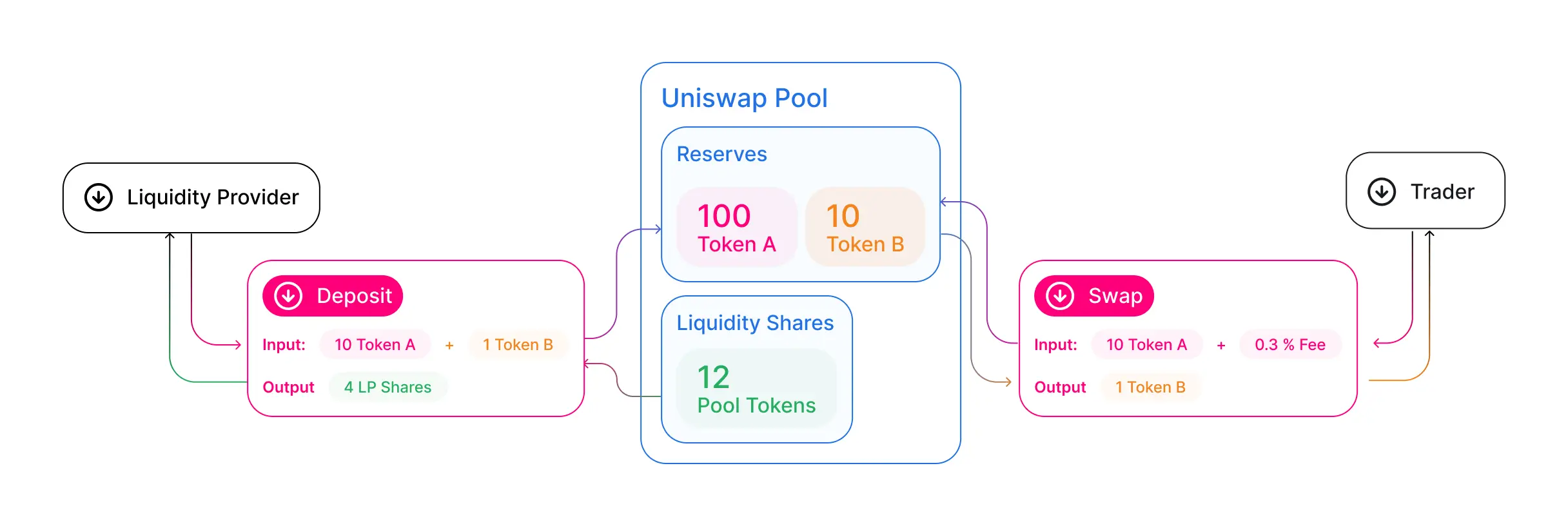
- Automated Market Maker (AMM): Instead of using traditional order books, Uniswap uses math to automatically price and execute trades based on the ratio of tokens in a pool.
- Liquidity Pools: Users pool their assets together in smart contracts to ensure there is always a supply of tokens for buyers and sellers, effectively eliminating the need to find a direct matching counterparty.
- Passive Income for Providers: Liquidity providers (LPs) earn a share of the transaction fees generated from the trades made within their respective pools.
- Capital Efficiency: Through upgrades like Uniswap v3 and v4, LPs can use “concentrated liquidity,” which allows them to allocate their funds to specific custom price ranges rather than spreading them across a broad spectrum.
What is the current price of Uniswap?
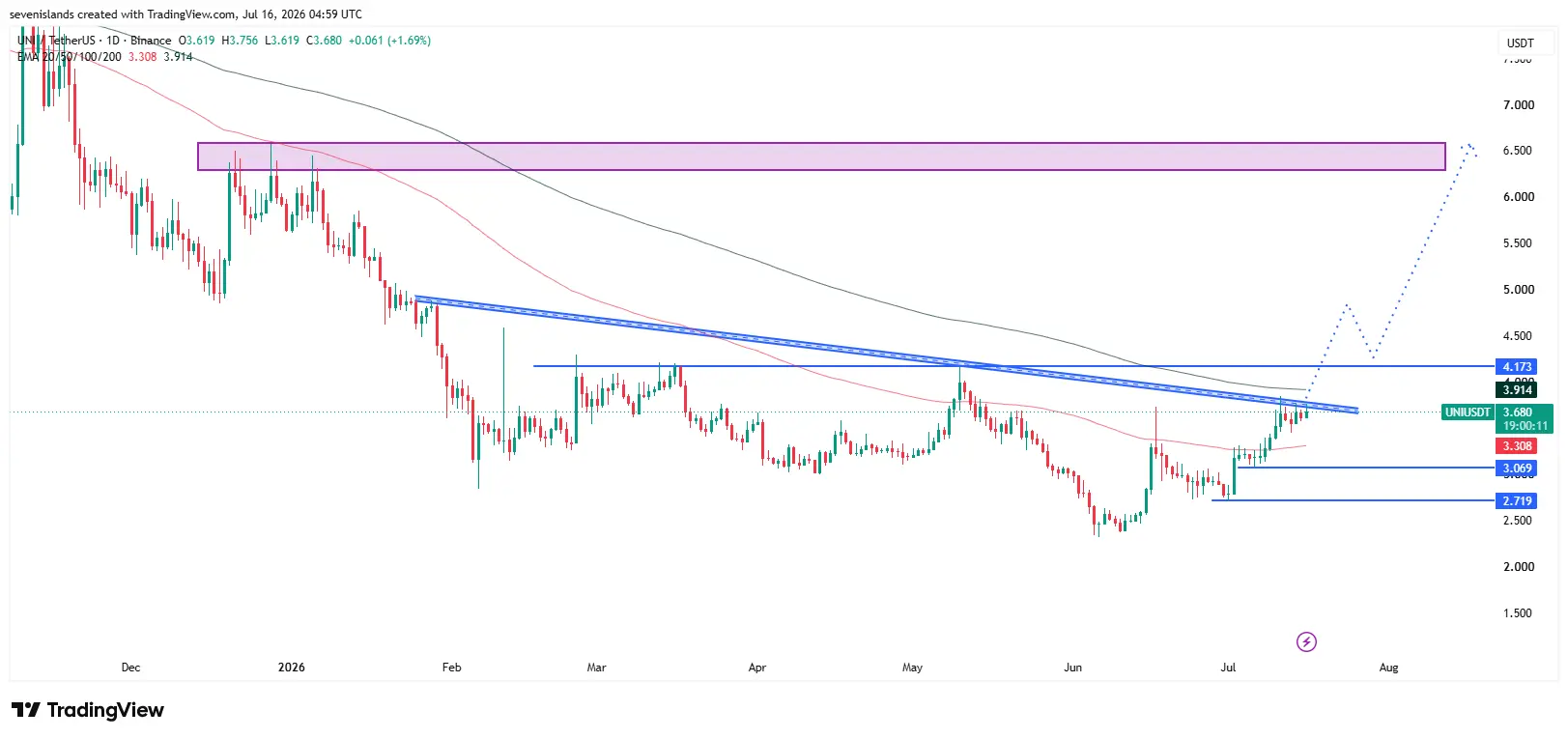
Uniswap’s price was trading at $3.69 (₹350.30) at press time with an intraday gain of 2.18%. It has remained bullish for the past 2 weeks, and investors’ investment has grown by 33%. Amid this bullish move, the price has surpassed the 100-day EMA and has sustained above it on the daily timeframe. It has a market capitalization of $2.3B and ranks 34th in the cryptocurrency market. The 24-hour trading volume was $177.99M, while the Total Value Locked (TVL) was $3.15B.
The current circulating supply is 625.56M UNI, and the total supply is 892.69M, as mentioned on CMC. Based on current technical analysis, the immediate support levels on the daily timeframe are $3.069 and $2.71, while the resistance levels are $3.845 and $4.17, respectively. Momentum has shifted from bearish to neutral, and the price is hovering near a breakout zone.
Uniswap Price Prediction From 2026 to 2030
2026: The Robinhood Chain & RWA Catalyst Year
This has been UNI’s most fundamentally significant year so far. Uniswap v2, v3, v4, and UniswapX went live on Robinhood Chain, an Arbitrum-based layer 2, on July 1, 2026, with Uniswap serving as the primary public AMM from day one, enabling 24/7 trading of tokens and stock tokens for users in over 120 countries.
Around the same time, tokenized versions of shares including SpaceX, Apple, Tesla, and NVIDIA became available for trading on Uniswap’s web app, wallet, and API, building on its earlier integration with BlackRock’s BUIDL tokenized treasury fund. On the liquidity side, major protocols like Spark migrated $150 million in stablecoin liquidity to Uniswap v4 using a new hook system.
Near-term technicals are turning constructive too, UNI surged over 7% in a single session in early July, breaking above a multi-month descending trendline, with a sustained breakout above $3.40 seen as opening the door toward the $4.50 resistance zone.
2026 outlook: roughly $2.80–$4.50, with $3–3.50 as the realistic base case barring a broader altcoin rally.
2027: DeFi–TradFi Convergence Takes Shape
If the Robinhood Chain and RWA integrations scale as planned, 2027 is the year analysts expect real usage data (fees, TVL, swap volume) to start justifying higher valuations rather than speculation alone.
Layer-2 expansion (Unichain, Robinhood Chain), reducing gas costs and widening retail access, is the key swing factor.
2027 outlook: roughly $4–$9, contingent on RWA volume actually materializing on-chain and Ethereum L2 activity continuing to grow.
2028: The Tokenized Asset Market Inflection Point
This is the year Standard Chartered’s thesis hinges on. Analyst Geoff Kendrick’s research expects the tokenized real-world asset market to grow from roughly $340 billion to around $4 trillion by 2028, with DeFi’s share of that market climbing from about 3.5% to 30% over the same stretch and Uniswap, as the largest DEX, is positioned as a direct beneficiary of that shift.
2028 outlook: roughly $7–$15, assuming the RWA growth thesis is on track; a miss on that timeline could keep UNI closer to the 2026-27 range.
2029: Regulatory Clarity as the Wildcard
US market-structure legislation remains the biggest unresolved variable. Note that the CLARITY Act seen as the most important US crypto market-structure bill of the year missed its July 4, 2026 target, though it isn’t considered dead.
Clear regulatory footing for DeFi tokens like UNI (governance rights, fee-switch legality, securities classification) would materially de-risk institutional allocation in this window.
2029 outlook: roughly $9–$18, with regulatory clarity being the single biggest upside/downside lever.
2030: The Long-Term Bull Case
The most-cited long-range target right now is Wall Street’s, not a random forecast aggregator’s: Standard Chartered set a headline target of $100 by the end of 2030, which at UNI’s early-July price implied roughly a 31-fold gain a genuinely aggressive call built entirely on the RWA-tokenization thesis playing out at scale, not on typical technical extrapolation.
2030 outlook: a wide realistic range of $12–$30 in a base/bull scenario, with $100 as the (openly speculative) blue-sky case if Uniswap captures a meaningful share of a multi-trillion-dollar tokenized-asset market.
Reasons Uniswap’s price could grow by 2030
- Robinhood Chain integration: Uniswap v2, v3, v4, and UniswapX are now live as the native AMM on Robinhood Chain, giving it direct exposure to Robinhood’s retail user base across 120+ countries and round-the-clock trading access.
- Tokenized real-world assets (RWA) going mainstream: Uniswap already supports tokenized shares of companies like Tesla, Apple, NVIDIA, and SpaceX through its integration with Ondo Finance, positioning it as an early infrastructure layer for on-chain stock trading rather than just crypto-to-crypto swaps.
- Institutional-grade backing: Uniswap’s earlier integration with BlackRock’s tokenized treasury fund (BUIDL) signals growing comfort from large institutional players in using Uniswap’s liquidity rails.
- Wall Street validation: Standard Chartered’s analyst Geoff Kendrick initiated coverage with a $100 target by 2030, built on the thesis that the tokenized asset market could grow from roughly $340 billion to $4 trillion by 2028, with DeFi protocols capturing a rising share of that flow from about 3.5% to 30%.
- Protocol-level upgrades (v4 hooks): Custom hook systems (like the new DualPool hook) are driving liquidity migrations; Spark alone moved $150 million in stablecoin liquidity to Uniswap v4, showing that capital efficiency improvements are attracting serious volume, not just retail speculation.
- Layer-2 expansion lowering costs: Continued scaling through Unichain and now Robinhood Chain reduces gas fees and friction, which historically correlates with higher swap volume and fee generation for the protocol.
- Dominant market position: Uniswap remains the largest decentralized exchange by most volume and TVL metrics, giving it a first-mover advantage as DeFi-TradFi convergence accelerates.
- Potential regulatory tailwinds: While the CLARITY Act missed its July 2026 target, continued progress on US market-structure legislation could eventually give governance tokens like UNI clearer legal footing, opening the door to broader institutional allocation.
- Fee-switch potential: Ongoing governance discussions around activating a protocol-level fee switch (directing a share of trading fees to UNI holders/treasury) could give the token a more direct value-accrual mechanism, a factor several analysts flag as a re-rating trigger.
Uniswap price prediction table 2027–2030
|
Year |
Minimum Price | Average Price | Maximum Price |
|
2027 |
$4.17 | $4.87 | $8.00 |
|
2028 |
$4.87 | $8.170 |
$10.296 |
| 2029 | $8.00 | $10.00 |
$12.00 |
| 2030 | $10.36 | $12.300 |
$20.00 |
Final Thoughts
Uniswap remains one of the most fundamentally strong projects in the DeFi space, and the recent fee switch and burn mechanism give UNI a genuine deflationary edge that many other governance tokens lack. Combined with Unichain’s growing volume and Uniswap’s dominant market share in DEX trading, the long-term outlook for UNI does look promising heading into 2030.
That said, crypto markets remain highly volatile, and price predictions, however data-backed, should never be treated as guaranteed outcomes. Broader market cycles, regulatory developments, and competition from emerging Layer 2 DEXs could all influence UNI’s actual trajectory.
If you’re looking to add Uniswap to your portfolio or trade UNI futures with leverage, SunCrypto offers a secure, FIU-regulated platform to do so with both INR and USDT margin options. As always, invest based on your own research and risk appetite.
How can I buy Uniswap in India?
You can buy UNI easily through SunCrypto by downloading the app, completing KYC, linking your bank account, depositing INR, and purchasing UNI from the INR market section with a minimum order of just ₹150.
What could the Uniswap price be by 2030?
Based on technical analysis, UNI could potentially reach between $12.300 and $20.00 by 2030, driven by factors like the fee-burn mechanism, Unichain adoption, and rising trading volumes. However, these are projections and not guaranteed outcomes.
Can I trade Uniswap futures on SunCrypto?
Yes, SunCrypto allows users to trade UNI futures with both INR and USDT margins, starting from as low as ₹100, with leverage of up to 50x for both long and short positions.