
Cryptocurrency markets no longer revolve around simply buying and holding coins. A large share of daily trading volume today comes from derivatives, and crypto futures trading has become one of the most popular ways for traders to speculate on price movements, up or down, without owning the underlying asset. If you are new to this or just want a clear breakdown, this guide walks through everything from the basics to margin, indicators, strategies, taxes, and which platform makes sense for Indian traders.
What is crypto futures trading?
A futures contract is an agreement between two parties to buy or sell an asset at a predetermined price on a future date. When this concept is applied to digital assets like Bitcoin or Ethereum, it’s called crypto futures trading.
Instead of purchasing the actual coin, you’re trading a contract that tracks its price. This means you can take a “long” position if you expect prices to rise, or a “short” position if you expect prices to fall, giving you the ability to potentially profit in both bullish and bearish markets. Most crypto exchanges today offer “perpetual” futures contracts, which don’t have a fixed expiry date and can be held indefinitely as long as margin requirements are met, unlike traditional futures that settle on a specific date.
This flexibility is a major reason crypto futures trading has grown so quickly; it’s no longer limited to institutional players and is now widely accessible to retail investors through mobile apps and web platforms.
How does crypto futures trading work?
Understanding the mechanics is essential before placing your first trade. Here’s the general flow:
- Choose a trading pair and direction: for example, BTC/INR, and decide whether to go long or short.
- Select your leverage: this determines how much exposure you get relative to the capital you put up.
- Place your order: using either a market order (executed instantly) or a limit order (executed only at your specified price).
- Set risk management tools: such as stop loss and take profit levels, to automatically close your position at predefined price points.
- Monitor and manage: track your open position, adjust margin if needed, and close the trade when your target is reached.
Because you are trading a contract rather than the coin itself, settlement typically happens in cash, and profits or losses are credited or debited directly to your account balance rather than involving delivery of actual crypto.
What is margin in crypto futures trading?
Margin is the amount of capital you put up to open a position, and it’s central to how crypto futures trading works. Rather than paying the full value of a trade, you deposit only a fraction of it; the margin and leverage cover the rest.
For example, with 20x leverage, a margin of ₹5,000 lets you control a position worth ₹100,000. This makes futures trading capital-efficient, but it cuts both ways: gains are amplified, and so are losses. If the market moves against your position beyond what your margin can absorb, the exchange automatically closes it, a process called liquidation, to prevent losses from exceeding your deposited funds.
There are two common margin modes: isolated margin, where only the margin allocated to a specific position is at risk, and cross margin, where your entire account balance backs all open positions. Beginners are usually advised to start with isolated margin and lower leverage.
Best Indicators for Crypto Futures Trading
Technical indicators help traders read trend, momentum, and volatility instead of reacting to raw price movement. Some of the most widely used ones include
- Moving Averages (SMA/EMA): Smooth out price data to reveal the underlying trend direction and are often used to confirm whether the broader market is bullish or bearish.
- RSI (Relative Strength Index): Measures the speed of recent price changes on a 0–100 scale. Readings above 70 typically suggest overbought conditions, while below 30 suggests oversold conditions, and divergence between RSI and price is often seen as an early reversal signal.
- MACD (Moving Average Convergence Divergence): Tracks the relationship between two EMAs to highlight momentum shifts and potential trend reversals, often through crossovers between the MACD line and its signal line.
- Bollinger Bands: Measure volatility by plotting bands around a moving average price touching the outer bands can signal potential overextension.
- VWAP (Volume Weighted Average Price): Shows the average price weighted by volume, commonly used by intraday traders to gauge fair value during a session.
No single indicator is reliable alone; most traders combine two or three, such as a moving average for trend plus RSI for momentum, to reduce false signals.
Best strategies for crypto futures trading
Strategy matters as much as indicators when it comes to crypto futures trading. A few commonly used approaches include:
- Trend following: Entering long positions in an uptrend or short positions in a downtrend, using moving averages or MACD to confirm direction rather than trading against the prevailing momentum.
- Breakout trading: Watching for price to move decisively beyond a defined support or resistance level, often with increased volume, and entering in the direction of the breakout.
- Range trading: Buying near support and selling near resistance when a market lacks a clear trend, typically confirmed with RSI or Bollinger Bands.
- Hedging: Opening a short futures position to offset potential losses on existing spot holdings during periods of expected volatility.
- Risk-first position sizing: Deciding your stop-loss level and maximum acceptable loss before entering a trade, rather than choosing leverage first and figuring out risk afterward.
None of these guarantee profit; each depends heavily on consistent risk management, particularly appropriate leverage and disciplined stop-loss use.
How to make money Trading Crypto Futures
There’s no guaranteed way to profit, like all derivatives trading; it carries substantial risk. Traders generally combine directional bets, hedging, and the indicator-based strategies above, while relying on disciplined stop-loss usage. Leverage significantly increases risk, and a large share of leveraged traders lose money over time, so treat it as a skill built through practice, not a shortcut to quick profits.
How to calculate profit in crypto futures trading
Profit and loss (PnL) depends on entry price, exit price, position size, and direction.
Long position: PnL = (Exit Price − Entry Price) × Position Size Short position: PnL = (Entry Price − Exit Price) × Position Size
For example, opening a long position on BTC/INR worth ₹100,000 (using leverage) at ₹500,000, with the price rising 2% to ₹510,000, gives a gross profit of ₹20,000, a 40% return on a ₹500 margin at 20x leverage. Trading fees and periodic funding payments also affect your final net profit, so factor those in rather than relying on gross price movement alone.
How to report Crypto Futures Trading on Taxes
In India, profits from Virtual Digital Assets (VDAs), including gains from crypto futures, are taxed under Section 115BBH at a flat 30%, plus cess and surcharge, regardless of income slab or holding period. Losses cannot be set off against other income or carried forward. Section 194S additionally mandates a 1% TDS on transfers once annual thresholds are crossed. These must be reported under Schedule VDA in your ITR, with TDS credit reflected in Form 26AS. Given how strict these rules are, maintain detailed trade records and consult a chartered accountant when filing.
Which app is best for crypto futures trading?
With multiple exchanges now offering crypto futures trading in India, choosing the right platform matters. Based on features built specifically for Indian traders, SunCrypto stands out as one of the strongest options available:
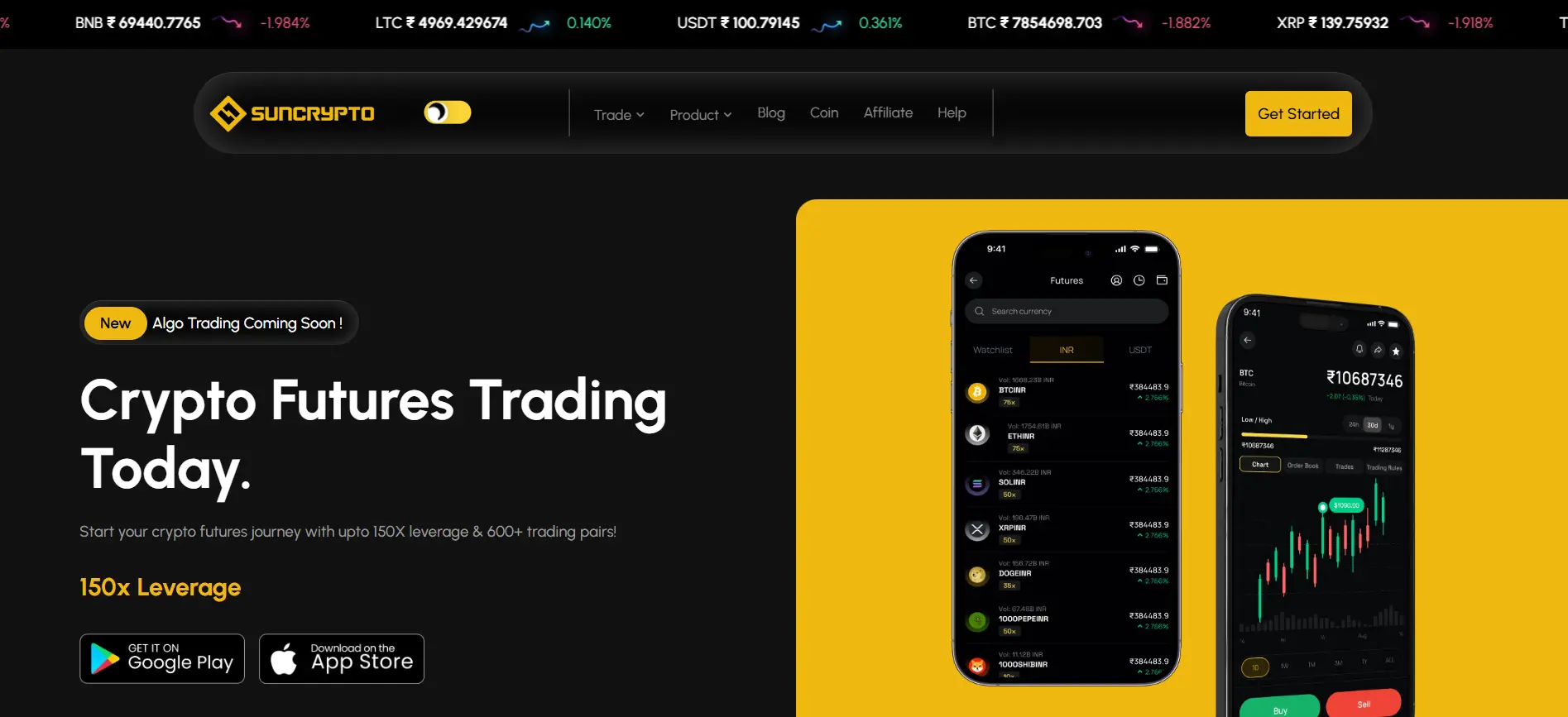
- INR-margined futures: Trade directly using your INR balance as collateral, removing the need to convert funds to USDT first.
- Wide range of pairs: Several hundred futures pairs across major assets like BTC and ETH as well as altcoins.
- Built-in risk management tools: Stop Loss, Take Profit, and adjustable margin available directly within the app.
- Regulatory compliance: SunCrypto is an FIU-registered exchange in India.
- Tax compliance support: A partnership with KoinX helps simplify tracking and reporting futures activity for tax purposes.
Given the combination of INR-based trading, broad pair selection, and India-specific compliance support, SunCrypto is a practical starting point for Indian traders exploring crypto futures trading.
What is the funding rate in crypto futures trading?
Since perpetual futures contracts don’t expire, exchanges use a funding rate mechanism to keep contract prices aligned with the underlying spot price. This is a periodic payment exchanged directly between traders, usually every 4 to 8 hours. When the funding rate is positive, long positions pay short positions, indicating bullish sentiment; when negative, the reverse happens. A consistently high funding rate in either direction can signal an overheated market and directly affects the cost of holding a leveraged position over time.
Final thoughts
Crypto futures trading offers a powerful way to speculate on price movements in either direction, hedge existing holdings, and trade with capital efficiency through leverage. But that same leverage that amplifies gains can just as quickly amplify losses, which makes understanding margin, indicators, strategy, and tax obligations essential before you start. Whether you’re just getting familiar with the basics or ready to place your first trade, choosing a platform with strong risk management tools and India-specific compliance support, like SunCrypto, can make the learning curve considerably smoother.
Is crypto futures trading legal in India?
Yes. Crypto futures trading is legal in India, though cryptocurrencies remain unregulated as currency. Profits are taxed at a flat 30% under Section 115BBH, with 1% TDS applicable under Section 194S, so trading is permitted but comes with strict tax compliance requirements.
How much money do I need to start crypto futures trading?
You can start with a relatively small amount since leverage allows you to control a larger position with limited capital. For example, platforms like SunCrypto let users begin with as little as ₹100, though beginners are generally advised to start small and use low leverage while learning risk management.
What is the difference between spot trading and crypto futures trading?
In spot trading, you buy and own the actual cryptocurrency at the current market price. In crypto futures trading, you’re trading a contract that tracks the asset’s price without owning it, allowing you to profit from both rising and falling markets, and to trade with leverage, which spot trading typically doesn’t offer.