
Crypto staking has become one of the most popular ways to generate passive income in the crypto market in 2026 by allowing you to make your idle coins work for you, and earn rewards straight from the blockchain.
Whether you’re a long-time HODLer looking to optimize your returns, or a newbie who wants to know how decentralised finance actually pays you, this guide will walk you through everything you need to know, from the basic principles of crypto staking, all the way to staking your crypto smartly on SunCrypto. So without any delay, let’s jump right into it!
What Is Crypto Staking?
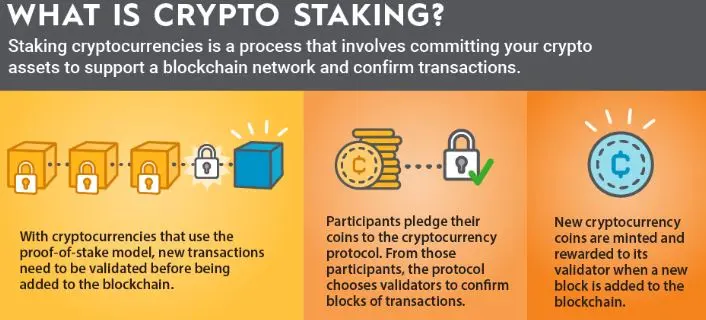
In simplest terms, crypto staking is the process of locking up a portion of your cryptocurrency holdings to support the security and operations of a blockchain network, and in return earning periodic rewards. Think of it as a digital equivalent of a fixed deposit, where your funds are committed for a specific period of time, and the network will pay you in newly minted coins or a share of the network’s fees.
The idea exists for a reason. Modern, efficient blockchains, such as Ethereum, Solana, Cardano, and Polygon, have moved away from the energy-intensive Proof-of-Work mining model used by Bitcoin. Instead, they run on a consensus model called Proof-of-Stake (PoS), which bases validation power on capital staked rather than computing power. It’s this innovative approach that enables crypto staking to become a tool for earning passive income while actively contributing to the decentralization and health of the blockchain you trust.
How does Crypto Staking work?
At the core of the staking crypto model is the role that validators play in the network. Validators are nodes that stake their tokens and are chosen by the protocol to validate transactions and create new blocks on the chain. The more tokens you stake, the higher the probability of being selected to validate a block. In exchange, the network distributes a reward in the form of new tokens or a share of the transaction fees paid in that block.
Enforcing honest conduct is necessary for the resilience and performance of PoS networks. To satisfy this requirement, PoS networks aggressively seize the staked tokens from validators that are offline from time to time or from validators that have validated fake transactions. This penalty mechanism of confiscating a portion of the staked tokens ensures that the economic interest of the validators contributes to the success of the network.
When you stake on a centralised exchange such as SunCrypto, you are delegating this technical responsibility to the exchange, which will take care of the validator operations, the risk and the uptime of your stake. distributing your proportional share of the earned rewards directly to your wallet.
Why doesn’t Bitcoin support Crypto Staking?
This is the most asked question Indian investors ask whenever they first try to understand the nuances of crypto staking. The reason is simple: Bitcoin doesn’t use the PoS algorithm, it rather operates on a Proof-of-Work (PoW) consensus mechanism, where miners use specialized hardware (ASICs) to solve complex mathematical puzzles in order to validate blocks and earn block rewards. There is no concept of “locking up” tokens to secure the network; instead, computational power is the security mechanism.
Staking is only possible on blockchains that use Proof-of-Stake or a variation of it (such as Delegated Proof-of-Stake or DPoS, or Nominated Proof-of-Stake or NPoS). Bitcoin, which is PoW based by design, never accepted any change in PoW and, as such, BTC cannot be staked.
What are the different methods of Staking Crypto?
Not all staking works the same way. The method you choose determines your control over assets, technical complexity, and potential return.
| Staking Method | How It Works | Best For | Key Risk |
| Exchange / Pooled Staking | You lock assets on a CEX like SunCrypto. The exchange pools funds, runs validator nodes, and distributes rewards. | Beginners and small investors | Potential custodial risk (assets held by exchange) |
| Delegated Staking | You delegate tokens to a validator of your choice through a wallet. The validator runs the node; you share rewards. | Intermediate users who want non-custodial options | Validator reliability and slashing risk |
| Solo / Native Staking | You run your own validator node with the minimum required amount (e.g., 32 ETH for Ethereum). | Advanced users with high capital | High technical burden; risk of self-inflicted slashing |
| Liquid Staking | You deposit tokens into a protocol (e.g., Lido) and receive a Liquid Staking Token (e.g., stETH) in return. | DeFi-savvy users seeking liquidity | Smart contract risk; de-pegging risk |
For retail investors in India, exchange staking via a regulated platform like SunCrypto is the easiest starting point it requires no hardware setup, small amounts are supported and there is no validator management required
What are the risks of staking in crypto?
Understanding the downside is just as important as chasing yield. Here are the core risks every Indian investor must evaluate before committing to a staking position
- Market risk: Since you receive rewards in your staked coin, a price fall can wipe your return gains.
- Lock up and liquidity risk: If you are a staker during the lock up period, you can’t sell your capital even in a market correction.
- Slashing risk: If the validator that receives your stake is malicious or goes offline a lot of times, the protocol can slash and burn (destroy) part of your stake.
- Smart contract risk: Liquid staking and DeFi staking products are built on chain code, which can have a bug that potentially destroys your profits or entire capital.
- Counterparty risk: Staking on a CEX means you are delegating custody to the platform, so should it go insolvent or experience a hack, there’s a real (although unlikely) risk.
- Inflation risk: Very high APY offerings often indicate excessive token emission — the inflation in token supply can devalue your rewards faster than they accumulate.
Is Staking Crypto worth it in the long run?
The answer to this question is a solid yes, and it’s far beyond just the concept of APY. The thing that makes crypto staking so good is what it does to your portfolio in the long run: It takes what is a passive holding strategy and turns it into a compounding one. Those rewards that you keep earning can be put back into the staking pool, creating hundreds or thousands of times the amount of original holdings in months or years.
Consider a HODLer who believes in the long-term value of Ethereum or Cardano. Without staking, those tokens simply sit in a wallet, appreciating (or depreciating) solely based on market price. With staking, the same HODLer accumulates an increased number of tokens and so when the market does move up, they end up with more number of tokens that they started with. That is what makes staking crypto worth it.
Beyond compounding, crypto staking is a much-needed psychological anchor in bear markets. There’s nothing more demoralizing than watching your holdings sit idling around and lose value with nothing to show for it. Staking rewards that you earn at low prices can compound indefinitely and become a very large amount of value , which makes them more significant than the potential of having idle holdings, which is largely what pure passives have.
On a regulated platform such as SunCrypto, you can be assured that the rewards you earn will be transferred directly to your wallet. So the decision is yours whether to reinvest, hold on or withdraw them. From a tax perspective, it is also worth mentioning that The 1% TDS (Section 194S) does not apply to receiving staking rewards. But yes, staking rewards are taxable as income from other sources at your applicable income tax slab rate in the year you receive them, based on the Fair Market Value (FMV) on the date of receipt and when you later sell those reward tokens, a further 30% flat tax applies on any capital gains under Section 115BBH.
Crypto SIP vs. Crypto Staking
Now that we have understood the fundamentals and the long term benefits of crypto staking, now it’s time to shed some light on another major contender providing long term growth in crypto: Crypto SIP.
Many investors often confuse or conflate these two strategies and wonder which one would be ultimately beneficial for them. While both are systematic ways to grow a crypto portfolio over time, they operate on fundamentally different principles. Here’s a breakdown:
| Parameter | Crypto SIP | Crypto Staking |
| Objective | Accumulate more tokens gradually through periodic purchases | Earn rewards on existing holdings |
| Returns | Depends on price appreciation of the purchased asset | Fixed APY paid in the staked token |
| Market Exposure | High, you buy at various price points over time | Moderate, rewards are earned, but price still fluctuates |
| Lock-up | None — you can stop SIP anytime | Varies, some platforms have unbonding periods |
| Ideal For | Long-term builders who want to average purchase cost | HODLers who want passive income on current holdings |
Both strategies complement each other. A practical approach for Indian investors is to accumulate tokens via SIP and simultaneously stake those holdings on SunCrypto to earn continuous rewards on the growing portfolio.
How to start Crypto Staking on SunCrypto?
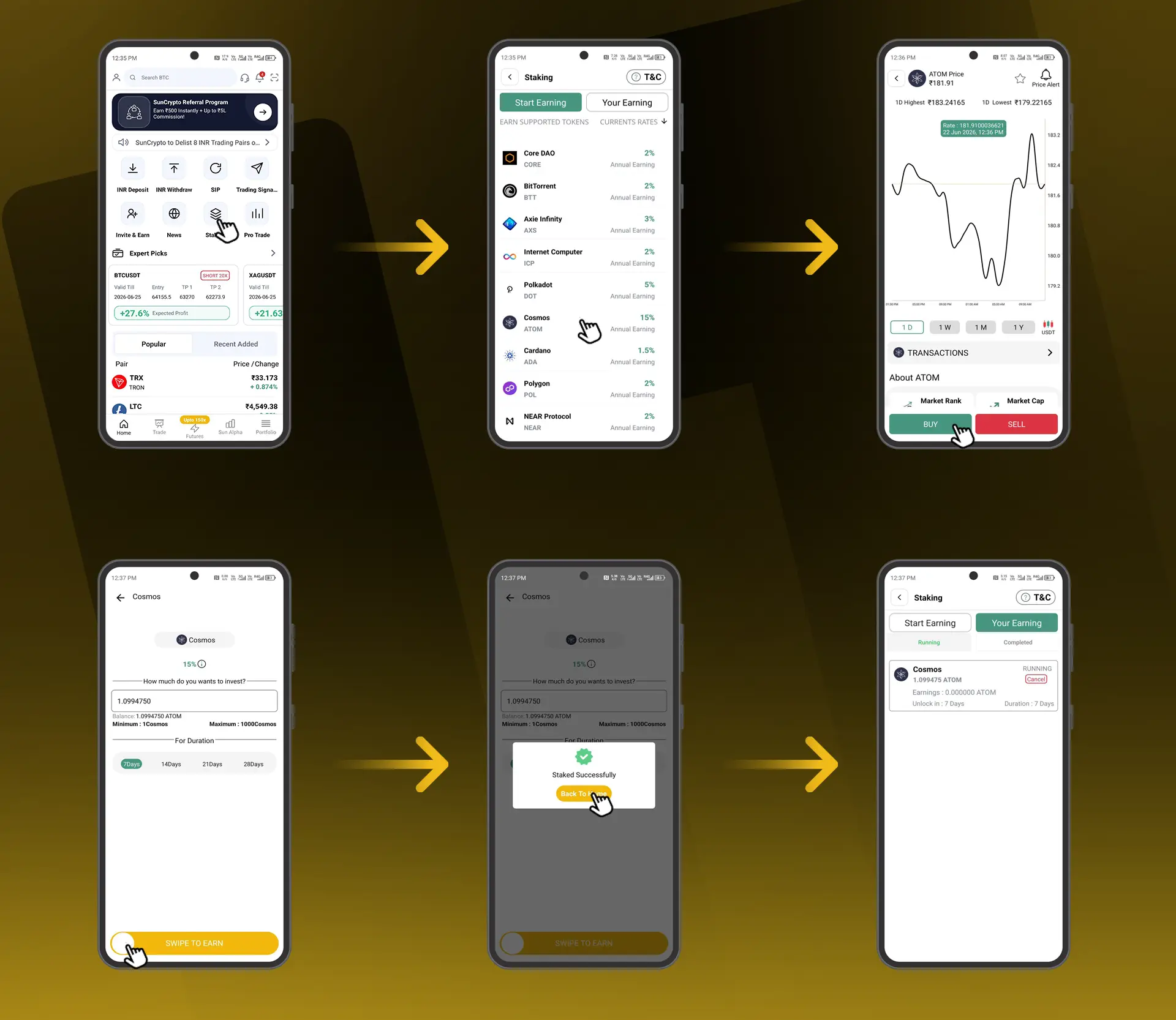
SunCrypto is an FIU-IND-registered Indian crypto exchange based in Jaipur. It offers a simple, beginner-friendly experience for crypto staking in India, all within its app , with no Web3 wallet, DeFi protocol, and crypto technicality to go through. Follow these step-by-step instructions to get started:
- Download the SunCrypto application in the Google Play Store or Apple App Store.
- Register, complete the KYC process, and connect your bank account.
- You will first need to buy the coin that you want to stake from the INR Market Section.
- After that, come to the home page and click on the Staking option in the middle of the page.
- Now you have to select the coin you wish to stake. Let’s say Cosmos (ATOM), since it provides the highest APY in crypto staking at 15% on SunCrypto.
- All you need to do is enter the amount of coins you have and the staking period.
- Now all you have to do is swipe to confirm, and your coins will be staked.
Why is SunCrypto best for Crypto Staking in India?
Staking crypto in India comes with its own set of considerations: regulatory compliance, INR accessibility, platform security, and tax reporting, all matter more here than in many other markets. SunCrypto is tailored for Indian investors, and its crypto staking product is very much focused on that.
The platform’s FIU-IND registration signifies that it operates under the umbrella of India’s Prevention of Money Laundering Act (PMLA), a vital compliance condition that sets it apart from the unregulated offshore platforms. You receive your staking rewards in INR-equivalent value inside the same wallet where you hold your assets, making it seamless for the purpose of filing your taxes.
The SunCrypto platform is an ideal solution for the investors who prefer a regulated staking platform with no complexities of having a self-custody wallet or interacting with smart contracts. It offers a highly secure manner to engage in a reliable mechanism for passive income in crypto with compliance at its core.
Final Thoughts
Crypto staking is one of the most time-honored ways of making your crypto portfolio work harder for you without doing any active trading. From understanding the Proof-of-Stake mechanism and validator economics to navigating India’s tax framework and choosing the right asset, the learning curve is real but manageable. The good news? The journey doesn’t become any harder if you start staking crypto with a platform that is regulated, FIU-registered and can abstract away all the complexities .
And that is exactly what SunCrypto’s staking offering is designed for, enabling Indian investors to earn passive crypto income off their existing crypto holdings with full compliance and complete transparency on the rewards and all, with the security of an FIU registered exchange platform. Start small, understand the risk profile and let compounding do the rest.
Is crypto staking legal in India?
Yes, staking crypto is legal. However, the Indian Government and the Income Tax Department strictly treat crypto assets as Virtual Digital Assets (VDAs). You are legally permitted to stake, provided all your activities and earnings are accounted for and declared in your tax filings.
Which is the coin with the highest APY in crypto staking on SunCrypto?
With 15% APY, Cosmos (ATOM) is the coin with the highest APY in crypto staking on SunCrypto
Do I have to pay the 1% TDS on staking rewards?
No, not when you receive them. The 1% Tax Deducted at Source (TDS) under Section 194S only triggers when a “transfer” or sale of a Virtual Digital Asset (VDA) happens.