
The Ethereum Glamsterdam upgrade has finally reached the last devnet phase in which core developers are running test networks that include the entirety of the set of EIPs that are planned for the upgrade. This is the final internal checkpoint before the upgrade is bootstrapped onto public testnet and then ultimately deployed to mainnet.
Ethereum Foundation DevOps engineer Parithosh Jayanthi wrote, “This is the last phase before we work on hardening and then shipping the testnets. There isn’t a timeline, but we have made massive progress.” If you want to keep track of the race track for where Ethereum is heading in the second half of 2026, this is the most important story on the roadmap.
What is the Ethereum Glamsterdam upgrade?
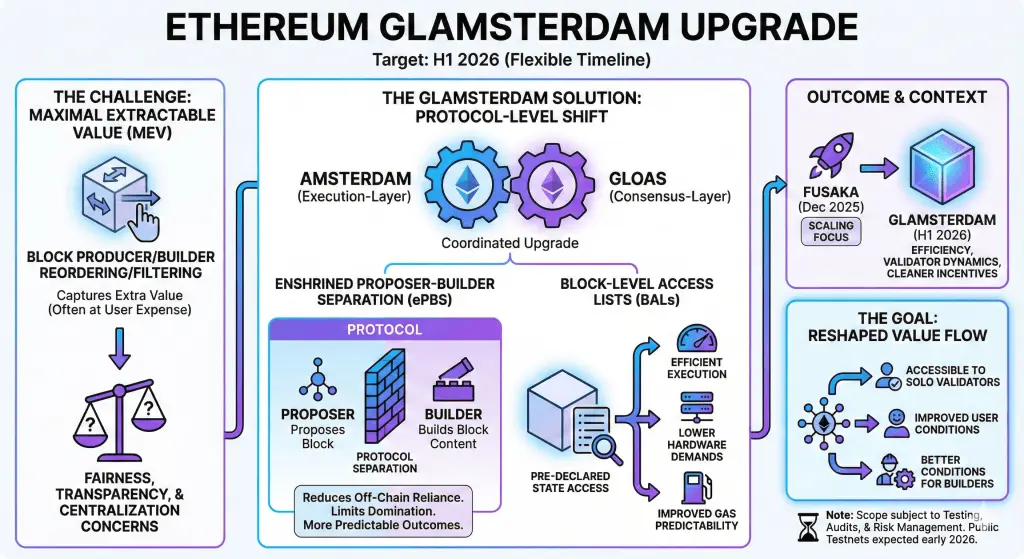
The name “Glamsterdam” is a portmanteau of “Gloas,” the consensus-layer component, and “Amsterdam,” the execution-layer component. Together, the Ethereum Glamsterdam Upgrade 2026 will address the two areas where Ethereum has historically felt most structural pressure: how blocks are built and how transactions are executed.
It builds on the work done by Fusaka, which dealt with blob capacity and validator upgrades, and goes further into L1; not to push more activity into rollups, but to make L1 itself more capable and ask node operators less hardware spend. Ethereum presents Glamsterdam as a scaling and sustainability-focused upgrade, rather than a thin UX upgrade. In scope and ambition for the architecture, Jayanthi has said it’s “probably the largest fork we’ve had since the Merge.”
What are the key changes in the Ethereum Glamsterdam Upgrade?
The Ethereum Glamsterdam Upgrade details are organized under Meta EIP-7773, which currently schedules ten core EIPs for inclusion, with additional networking proposals such as EIP-7975 and EIP-8159 alongside the upgrade. Rather than listing these EIPs one by one outside a logical structure, they’re divided into logical groups they’ll be addressing in under three categories:
- Block architecture changes: EIP-7732 (ePBS) and EIP-7928 (BALs) are the two most structurally heavyweight pillars.
- EVM developer improvements: EIP-7954 increases the max contract size from 24 KiB to 32 KiB; EIP-7843 introduces a SLOTNUM opcode; EIP-8024 adds backward-compatible SWAPN, DUPN, and EXCHANGE opcodes.
- Gas and state sustainability: EIP-7708 has ETH transfers and burns emit a log; EIP-7778 changes block gas accounting without inducing a refund; EIP-8037 sets a static cost per state byte and creates a dedicated gas reservoir for state growth; EIP-7975 and EIP-8159 introduce partial block receipt lists and block access list exchange at the networking layer.
The May 2026 finalization of EIP-8037 was the final piece that gave client teams a sustainability ceiling under which a 200M gas limit could be raised without bloating the database past 120 GiB per year. That dropped the internal argument about whether ePBS and BALs were too far-reaching to ship together and shared the full bundle to move forward as a single upgrade.
How does ePBS affect block building on Ethereum?
Of all the proposals in this Ethereum Glamsterdam upgrade, EIP-7732, Enshrined Proposer-Builder Separation, represents the most significant shift in how Ethereum’s block production works at a structural level. Today, the split between the validator that proposes a block and the specialized builder that assembles the execution payload is handled off-protocol through external relays like MEV-Boost.
This arrangement has helped the network manage maximum extractable value efficiently, but it has also introduced centralization risks and trust dependencies that developers have wanted to eliminate for years. Enshrining that separation is designed to reduce reliance on off-protocol systems and make block production more transparent at the consensus layer.
ePBS increases the data propagation window from roughly two seconds to about nine seconds, critical headroom for larger payloads and more parallelized execution without choking the network’s ability to disseminate blocks. This expanded window is precisely what makes a 200 million gas limit technically viable; validators now have enough time to validate larger blocks without degrading propagation across the network.
What do block-level access lists actually enable?
The second headline proposal of the Ethereum Glamsterdam upgrade 2026, EIP-7928 (Block-Level Access Lists or BALs), attacks Ethereum’s throughput problem from a different angle. Ethereum nodes now replay transactions serially and have no idea in advance which accounts or storage slots a transaction will touch.
EIP-7928 (Block-Level Access Lists or BALs) requires a block to include a list of all the state entries accessed by each transaction in that block, along with the post-execution values of all the entries it writes to. Developers claim that with this information, Ethereum nodes can pre-load this data into their caches and execute non-conflicting transactions in parallel. The aggregate throughput potential for ePBS along with BALs is up to 10,000 TPS-equivalent under realistic workloads, a number that would bring the practical throughput of Ethereum up into range with real-world sustained throughput on Solana.
BALs also unlock a secondary benefit: executionless sync. New nodes joining the network can update their state from the access-list digest without replaying the full transaction history, significantly reducing the time and compute required to spin up a fresh validator.
What does the Ethereum Glamsterdam Upgrade mean for users, validators, and layer 2s?
Changes from the Ethereum Glamsterdam Upgrade impact all three major Ethereum stakeholder groups and do so in a role-specific way:
- For regular ETH users: If included, EIP-2780 would reduce the intrinsic gas cost of simple ETH transfers, with estimates predicting ETH transfers can be up to 71% cheaper. EIP-7708 also enables ETH transfers to emit a log natively, a change wallets and exchanges have requested for years to eliminate the need for custom transaction tracing.
- For validators and staking pools: ePBS implements a Payload Timeliness Committee that separately attests to consensus blocks and execution payloads. A successful congregation will also require staking architecture to adapt to the new flow. Again, if included, EIP-8080 would make it easier for validators to exit by allowing standard exit payloads to borrow unused capacity from the consolidation queue using a three-for-two extraction rate.
- For Layer 2 rollups: The longer block propagation window allows Ethereum to fit more blobs per block. This expands the data-availability budget for rollups, which previously was fixed by Fusaka. This ultimately allows rollups to decouple rollup data costs from Ethereum L1 execution congestion.
- For dApp developers: The higher contract size cap (EIP-7954) and the new EVM opcodes are the solutions to the problem that has driven developers to artificially split complex contracts into multiple parts.
- For the network’s long-term health: EIP-8037 introduces a state pricing mechanism that ensures that the higher gas limit does not mean unlimited database growth, keeping node requirements feasible and decentralization intact.
What is the current devnet status and when can we expect mainnet?
As of mid-June 2026, the Ethereum Glamsterdam upgrade date picture is clearer than it was even a month ago, though no mainnet date has been set. Public devnet notes show a rapid iteration cycle: glamsterdam-devnet-5 targeted or ran around June 4, 2026, and devnet-6 was slated for mid-June, reinforcing that engineering teams are actively validating block-building, propagation, and pricing interactions. The next stage is public testnet deployment across Holesky and Hoodi, where multi-client stability must hold for several epochs before a mainnet activation can be scheduled.
Past forks have run two to four months of public testnet seasoning; on that cadence, mainnet would land between September and December 2026. Market consensus has largely coalesced around Q3 2026, with end-August cited in several analyst notes, though Ethereum’s development culture has consistently prioritized correctness over calendar commitments.
It’s also worth noting that the 200 million gas limit is a design target enabled by the Ethereum Glamsterdam upgrade, not a value the fork enforces directly. Validators control the gas limit through standard signaling, and the step-up from the current 60 million range would happen incrementally as nodes demonstrate they can handle larger blocks without propagation degradation.
Final Thoughts
The Ethereum Glamsterdam upgrade 2026 is less of a refresh and more of a reassembly of the puzzle pieces of block building, transaction execution, and resource pricing. Now that the final devnet phase is underway, running all ten EIPs in parallel for the first time, the upgrade is closer to public testing than any point in its history. ePBS, BALs, and a transparent gas sustainability framework together provide Ethereum a viable roadmap to a three-fold increase in L1 capacity while keeping under the decentralization radar.
Whether that potential fully materializes will depend on how public testnets hold up over the coming months. But for the first time since the Merge, Ethereum’s base layer itself is being scaled, not just the ecosystem layered on top of it.
Will Ethereum Glamsterdam upgrade lower gas fees?
Yes. Through general gas repricing (EIP-7904) and increased block capacity, the upgrade is projected to reduce the cost of simple ETH transfers by up to 78%.
When will Glamsterdam upgrade launch on the mainnet?
The upgrade is targeted for the second half of 2026, with an aspirational timeline leaning toward the end of August.
Do I need to do anything with my Ethereum?
No. ETH holders, whether in a hardware wallet, exchange, or an ETF, do not need to take any action. Your balances will remain accessible and unaffected