
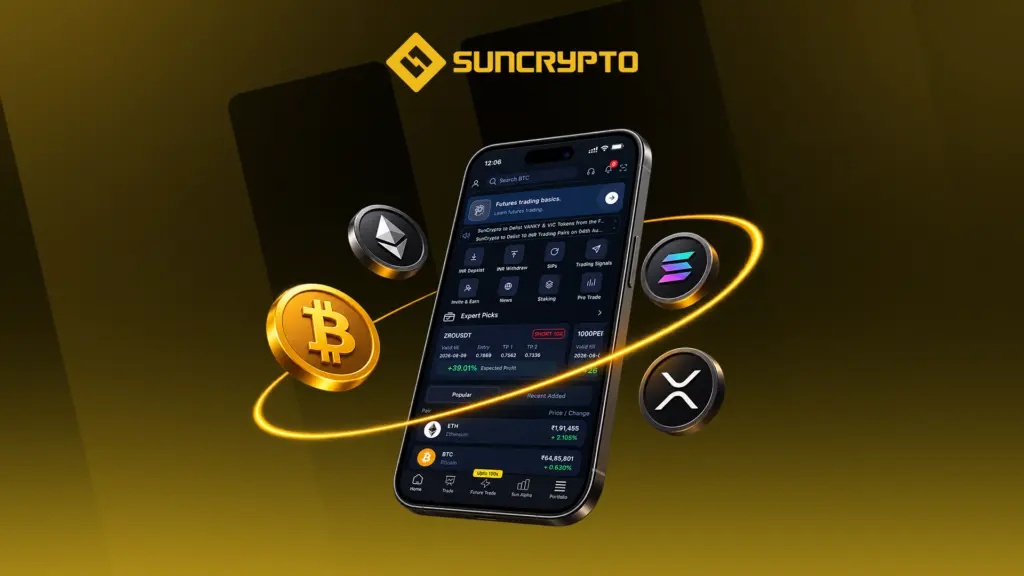
Key Takeaways
- An all in one crypto trading platform brings spot, SIP, futures, staking, OTC, and DEX access under a single login, single KYC, and single INR wallet.
- SunCrypto’s stack runs from ₹100 instant buys through to 150x futures and SunAlpha, an in-house DEX aggregator opening up 1,00,000+ tokens all settled in rupees.
- Consolidating your activity on one all in one crypto trading platform cuts transfer fees, network costs, duplicate KYC, and the tax-reporting mess of scattered records.
- Every layer carries its own risk profile. Futures and DeFi tokens are not beginner territory, whatever platform you use them on.
Most Indian crypto users end up with the same problem after about a year. One app for buying Bitcoin in rupees. A second for futures, because the first one didn’t offer them. A MetaMask wallet plus a stash of BNB for gas, because the interesting new tokens only live on decentralized exchanges. Maybe a Telegram contact for large trades. Come tax season, four sets of records that refuse to reconcile.
Each transfer between those silos costs money in network fees and spreads. Each new signup means fresh KYC. And every rupee that leaves the regulated Indian system creates a compliance question you’d rather not answer.
This is the gap an all in one crypto trading platform is built to close. This article walks through SunCrypto’s full stack, from the simplest spot purchase to on-chain DEX trading, and examines what actually gets consolidated, what it costs, and who each layer is genuinely suitable for.
What makes an all in one crypto trading platform?
The phrase gets used loosely, so it’s worth setting a definition before evaluating anything against it. A true all in one crypto trading platform should give you:
- One identity: A single KYC that unlocks every product on the platform, not a separate verification per feature.
- One funding rail: Rupees in via UPI or bank transfer, rupees out to the same account, with no forced conversion into USDT just to access a product.
- The full risk ladder: Somewhere to start at zero leverage, and somewhere to graduate to when your skill and appetite grow, without changing apps.
- Passive and active options: Not everyone wants to trade. Automated investing and yield products should sit alongside the charts.
- One tax trail: Consolidated statements and automated TDS handling, so filing is an export rather than an archaeology project.
- Regulatory footing: FIU registration and compliant fiat rails, because the cheapest route is worthless if your bank account gets frozen.
Measured against that list, most Indian exchanges cover three or four points. Here’s how SunCrypto’s stack maps onto all six.
Layer 1: Spot Trading
Spot trading is where nearly everyone begins, and it’s the simplest thing an all in one crypto trading platform can offer: the immediate exchange of a digital asset for another asset in rupees or a stablecoin at the current market price, giving you direct ownership of the coins without the complexity or risk of leverage.
On SunCrypto this runs as instant buy and sell. You see the live price, enter your amount, confirm, and the asset lands in your wallet. Entry starts at ₹100, which matters more than it sounds; it means a beginner can learn the mechanics of a real trade with money they genuinely won’t miss.
The platform covers 550+ cryptocurrencies on the centralized side, with both INR and USDT market listings. Deposits and withdrawals move through UPI, IMPS, NEFT, and RTGS.
Best for: first-time buyers, long-term holders, and anyone who wants ownership without leverage.
Layer 2: Crypto SIP
The single biggest reason retail investors lose money in crypto isn’t picking bad assets. It’s buying at the top out of excitement and selling at the bottom out of fear. A systematic investment plan removes the decision entirely.
You choose an asset, an amount, and a frequency. The platform buys on schedule, regardless of price. On SunCrypto you can start crypto SIP from ₹100 per installment, with Bitcoin, Ethereum, leading altcoins, and digital crypto gold selectable directly in the SIP section of the app, and no charge for starting one.
The mechanism at work is rupee cost averaging: when prices are high, your fixed amount buys fewer units, and when prices are low, the same amount buys more, so your average purchase price over a long horizon lands below what you’d have paid buying everything at a peak.
It’s worth being clear about the limits, though. A SIP does not protect you from loss; it reduces the impact of buying at the wrong time. If the asset itself is fundamentally weak, disciplined investing into it is still a bad investment.
Best for: salaried investors, anyone who can’t or won’t monitor markets, and first-timers building exposure gradually.
Layer 3: Crypto Futures Trading
This is where an all in one crypto trading platform earns its keep, because it’s the point at which most users would otherwise open an account somewhere else.
SunCrypto’s futures product is designed as a progression: you can start with 1x leverage, which behaves just like spot, and scale up to as much as 150x as confidence grows, with an “Expert Picks” section that lets beginners copy authenticated trades. Both INR and USDT-margined contracts are supported, so you can trade directly in rupees without a stablecoin conversion step.
Order types get richer here than on the spot side. Market orders execute instantly at the current price, limit orders let you set a specific entry price, and take-profit and stop-loss levels can be set when opening a trade or adjusted later on open positions. Stop market and stop limit orders are also available for more precise risk control.
Fees. Futures start at 0.030% maker and 0.058% taker at VIP Level 0 and fall to 0.0075% at VIP Level 7, roughly a 75% reduction, with the 30-day volume thresholds between tiers cut by nearly 10x compared to the earlier structure, putting the lower tiers within realistic reach of active retail traders rather than institutional accounts only.
A necessary warning. Leverage magnifies losses exactly as efficiently as it magnifies gains. Liquidation occurs when a position’s losses exhaust its margin, forcing closure often at a loss. High leverage is not a beginner tool, and no platform feature changes that arithmetic. If you’re new, 2x–5x is a far more survivable place to learn than 150x.
Best for: experienced traders, hedgers, and anyone who has already proven they can manage risk on the spot.
Layer 4: Crypto Staking
If you’re holding assets long-term anyway, staking lets them earn rather than sit. SunCrypto offers crypto staking with an APY of up to 15% on selected assets.
Two caveats belong here. Advertised APY is variable, not a guaranteed return; it moves with network conditions and protocol rewards. And rewards may create a taxable event depending on how they’re characterized, which is worth raising with a chartered accountant before you build a strategy around it.
Best for: long-term holders with assets they have no intention of trading soon.
Layer 5: SunAlpha
This is the layer that most meaningfully distinguishes an all in one crypto trading platform from a conventional exchange, because DEX access is precisely the thing that normally forces users off-platform.
The traditional friction is well known. For Indian investors, accessing the wider token universe has meant dealing with decentralized wallet complexity, gas fees, and cross-chain transfers. You need a self-custody wallet, base assets like ETH or BNB purely to pay for gas, and the confidence to navigate an interface built for people who already know what they’re doing.
SunAlpha is SunCrypto’s answer: a DEX aggregator built into the centralized platform, which doesn’t host decentralized exchanges itself but aggregates liquidity from many of them to secure better price execution. Its aggregation layer polls high-volume venues and reroutes trades across multiple protocols and chains to find optimal pricing.
What that means in practice:
- Scale. Access to over 1,00,000 tokens, with new listings added continuously.
- Rupee-native. Every trade executes directly in INR, with no juggling USDT, ETH, or other base assets, and no swapping just to reach a token.
- No repeat KYC. Your existing SunCrypto KYC carries over to SunAlpha.
- Automated tax handling. Because the transaction executes inside your regulated account, the platform deducts the 1% TDS automatically.
- Curation. Tokens are selected using market data and community signals rather than listed indiscriminately, with real-time risk monitoring built in.
Two honest limitations. SunAlpha is not a self-custody wallet; assets are managed by the platform in an integrated Web3 environment rather than under your own private keys. And to maintain compliance, external crypto generally cannot be deposited directly into the SunAlpha wallet; trades originate from your INR balance. If genuine self-custody is your priority, this is a convenience trade-off you should make knowingly.
The broader risk deserves stating plainly: a universe of 1,00,000+ tokens contains a great many worthless ones. Aggregated access makes buying easy; it does not make any given token a good idea. Position sizing matters enormously here.
Best for: users who want early-stage and Web3 token exposure without managing wallets, gas, and bridges themselves.
Layer 6: The OTC Desk
Large orders have a problem retail traders never encounter: executing them on the open market moves the price against you. Over-the-counter desks exist to solve exactly this.
SunCrypto runs an OTC desk trade with a dedicated relationship manager and 15-minute instant settlement for large trades. For high-net-worth individuals, treasury operations, or anyone converting a significant position, this is the difference between a clean fill and paying several percent in slippage.
Best for: large-volume traders, businesses, and institutional users.
Layer 7: Compliant USDT-to-INR Conversion
Freelancers paid in stablecoins, traders booking profits, and businesses settling invoices all hit the same question: how do I turn USDT into rupees in my bank account without creating a problem?
The P2P route often shows better headline rates, but the risk is concrete and documented: Indian banks and the Enforcement Directorate have frozen accounts that received P2P inflows later traced to fraud proceeds, even where the seller had no knowledge of the source.
SunCrypto offers a compliant USDT-to-INR conversion process; you sell into the USDT/INR pair, then withdraw the rupee balance to your linked bank account via IMPS, NEFT, or RTGS. Routing through registered VDA service providers keeps funds inside the banking system’s expectations and produces automatic tax records. The effective rate after fees may be marginally worse than a P2P quote. Set against the possibility of a frozen account, most users will find that a reasonable price.
Best for: anyone regularly converting stablecoins to rupees, especially with income involved.
What does it cost?
Consolidation only makes sense if the platform is competitive on price. Current published rates:
https://suncrypto.in/fee-structure
All trading fees carry 18% GST on top, and SIPs are free with no account maintenance charges.
That GST layer is the detail global fee comparisons consistently omit, and it applies on any Indian exchange worth factoring in when you compare against offshore platforms whose headline numbers look lower than they effectively are for an Indian resident.
Compliance, security, and why it matters?
SunCrypto was founded in 2021 by Umesh Kumar Prajapati and Pramod Yadav and has established itself as one of India’s leading FIU-registered exchanges.
FIU registration has moved from a nice-to-have to a baseline requirement. With regulation tightening, using an FIU-registered platform is what ensures compliance and prevents legal complications for Indian users. Non-compliant platforms face heavy fines, regulatory orders, and the possibility of being blocked in India altogether, a scenario in which your access to your own funds becomes someone else’s problem to resolve.
There’s a tax dimension to consolidation too. Indian crypto rules are unforgiving of sloppy record-keeping: gains are taxed at a flat 30% under Section 115BBH plus cess, with 1% TDS under Section 194S, and losses cannot be set off against other income or carried forward. Exchanges report transactions separately to the tax department, which means your declaration is cross-checked. Running everything through one all in one crypto trading platform means one consolidated statement to reconcile at filing time instead of four that don’t agree with each other.
Is an all in one crypto trading platform right for you?
The beginner starts at a spot with ₹100, sets up a small SIP, and ignores everything else for six months. That’s the correct use of the platform; the other layers are there for later, not for now.
The systematic investor may never leave layers one, two, and four. SIP in, stake what’s held, and withdraw compliantly when needed. No charts required.
The active trader uses spot for the core position and futures for tactical trades and hedging, with VIP tier progression steadily cutting the cost of frequency.
The Web3 explorer uses SunAlpha for early-stage token exposure while keeping settlement in rupees and TDS handled automatically.
The large-volume user routes size through the OTC desk instead of eating slippage on the open book.
The real argument for an all in one crypto trading platform is that these are not five different people. They’re often the same person at different stages or in different moods on the same day. A platform that covers all five means your history, your KYC, your funding rail, and your tax records travel with you as your needs change.
Closing Thoughts
Consolidation isn’t valuable for its own sake. It’s valuable because fragmentation has real costs: transfer fees, gas fees, spread on every conversion, duplicated verification, and a reconciliation headache every July.
SunCrypto’s stack spot and instant buy, crypto SIP, INR and USDT futures with tiered fees, staking, the SunAlpha DEX aggregator, an OTC desk, and compliant rupee conversion cover the range from a first ₹100 purchase to institutional-scale execution without leaving the app or repeating a single KYC.
That said, a platform that offers everything is not an instruction to use everything. The most sensible way to approach any all in one crypto trading platform is to start at the layer that matches your current experience and move up only when you genuinely understand the risk of the next one. The features will wait for you.