

Zcash (ZEC) has staged one of its sharpest weekly moves in recent memory, jumping more than 10% in a single session on July 7, 2026, and briefly reclaiming the psychological $500 level for the first time since early June. But for a privacy coin that is still shaken by the ramifications of a security disaster just weeks ago, this late surge is being read by traders and analysts as an early sign of restored confidence rather than a purely speculative spike.
What is Zcash?
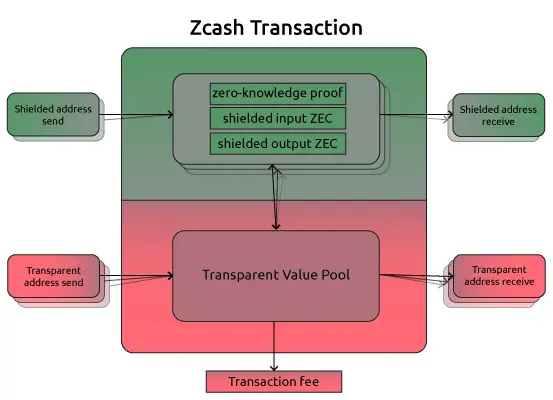
Born at a time when the Bitcoin industry was pairing highly publicized statistics with vague concepts of “privacy” and “anonymity,” Zcash offers a unique solution allowing users to both transact publicly and anonymously and send shielded transactions that hide details of each transaction. ZEC uses zero-knowledge proofs called “zk-SNARKs” to prove that transactions are valid while concealing all of the transaction information, including sender, receiver and amount.
Alongside fully transparent addresses, this dual system gives holders a choice between openness and confidentiality. Like Bitcoin, the supply is capped at 21 million coins, with issuance slowing through periodic halvings, and the project has increasingly positioned itself as a hedge against growing blockchain surveillance.
What caused the Zcash price to surge this week?
The immediate trigger in the Zcash price was a disclosure of a technical detail, not a new product or exchange listing. Project Tachyon and the broader development community indicated they are about to finish creating a formal mathematics proof that Ironwood, the new pool replacing the currently used Orchard pool, has no undetectable counterfeiting bug.
Using AI to expedite the generation of proofs reduced a verification process that would normally take years into a matter of weeks. Since this announcement resonated with a deep concern about the integrity of the supply of Zcash, it had a strong impact as a sentiment trigger, pushing up the ZEC price, while the broader market, including Bitcoin, remained largely unchanged over the same period.
Why did the Orchard vulnerability shake the Zcash price?
To understand the magnitude of this week’s Zcash price action, let’s rewind a bit and have a look at what happened about a month ago. Developers found a flaw in the Orchard shielded pool that would (theoretically) make it possible for someone to mint fake tokens without leaving a trace. The bug was fixed quickly, and the team claimed no evidence that it had been abused.
But saying no even remotely for sure was impossible, given the network’s own privacy guarantees. The uncertainty led to wholesale dumping: Zcash lost more than 40% of its value in less than two days. Experts compared the episode to Bitcoin’s 2010 inflation bug, noting that Bitcoin’s transparent ledger allowed the issue to be spotted and reversed almost instantly, whereas privacy coins need formal documentation, not mere observation, to prove that inflation hasn’t been hidden.
What is the current Zcash price now?
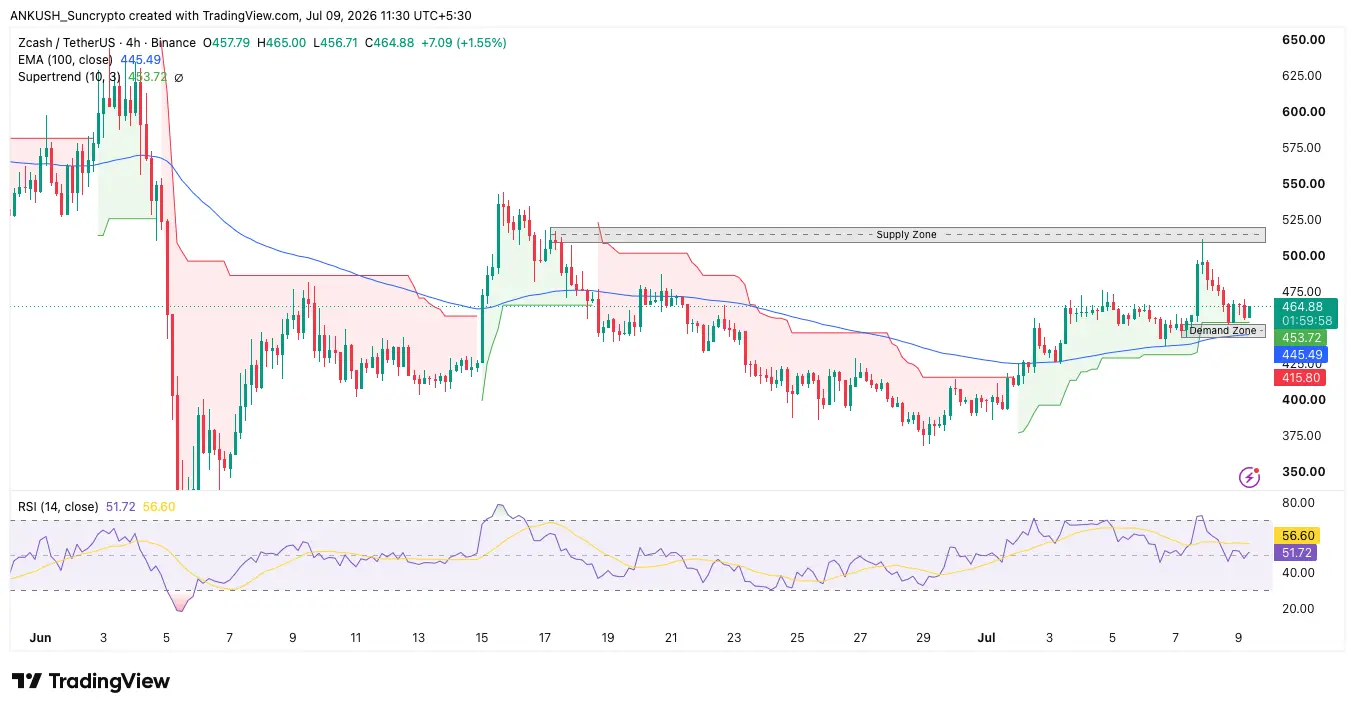
As of July 9, 2026, the Zcash price is trading in the $462.91 range, having cooled off from its intraday peak of roughly $507 reached during Tuesday’s surge. The move represented an intraday swing of well over 10%, with the asset briefly outperforming almost every other large-cap altcoin before profit-taking set in. With a market cap hovering close to $7.78B placing it among the top cryptocurrencies by that measure, on a circulating supply of approximately 16.76M coins out of a 21M maximum.
Daily trading volume has stayed robust, topping around 326.2M in the last 24 hours, which suggests genuine participation rather than a thin, easily manipulated move. The asset is remaining well up after the recent pullback from its local high compared to a week ago, when it hovered around $410 – and sentiment indexes such as LunarCrush have suggested a rise in the network’s mentions on social media and a bullish sentiment score in tandem with its price move.
Key technical levels to watch out for are as follows:
- Immediate support sits near $450, last week’s breakout base zone
- Stronger support cluster forms around $390 to $400 historically
- Key resistance band lies between $480 and $500 psychologically
- A confirmed close above $500 could open path toward $620
- Extended bullish target near $650 to $700 if momentum holds
- Deeper pullback risk emerges only on daily close below $450
- Long-term trendline support since February has repeatedly cushioned corrections well
Why are privacy coins like Zcash rebuilding momentum?
- Rising concerns over blockchain surveillance support confidentiality.
- Adoption in shielded pools has reached record highs across the entire network. Institutional desks take privacy assets as a strategic hedge.
- Regulatory clarity debates keep privacy technology in mainstream financial conversations.
What does all this mean for Zcash’s future?
None of that mitigates volatility risk. Zcash is still extremely headline-sensitive, and a delay or complication in finalizing the Ironwood proof could just as easily trigger a sharp reversal as the original announcement triggered a rally.
But the direction of travel matters: a project that incurred a credibility-denting bug just weeks ago is now being talked about as being at the frontier of faster, AI-enhanced security audits, and its price has regained a large proportion of the ground it lost. For anyone following the space, the weeks leading up to Ironwood’s planned activation will be the next real test of whether this bounce has any staying power.
Final Thoughts
The double-digit rally that Zcash enjoyed this week was lifted less by hype and more by a specific, verifiable bit of tech news: developers are getting close to mathematically closing the door on a counterfeiting risk that pummeled confidence a month ago. Trading just below $460 to $470 after briefly touching $500+, the asset is at a crucial technical point heading into the second half of 2026.
Whether this will usher in a sustained rebound or just a relief bounce will largely hinge on the successful, verified roll-out of Ironwood and on the market’s positioning of privacy-focused assets over the next few months.
What caused the Zcash crash?
In early June, developers disclosed a critical, 4-year-old counterfeiting flaw hidden within Zcash’s Orchard shielded pool. While the vulnerability was swiftly fixed and there was no evidence of active exploitation, the revelation triggered spot selling, sending ZEC prices from around $624 down to $309 within 48 hours.
What role does AI play in the Zcash recovery?
Developers utilized AI-assisted formal verification, which significantly reduced the time required to review cryptographic and economic parameters from years to just weeks, helping accelerate fixes and mathematical audits.
What is the upcoming Zcash Ironwood upgrade?
Following the June vulnerability reveal, developers proposed the upcoming Ironwood network upgrade. The primary goal of Ironwood is to completely seal the old Orchard pool and introduce a new, independently verifiable privacy pool.