
Sui coin underwent a public experiment on its blockchain on 4th July 2026 which swirled the blockchain network to a top speed of over 6 million transactions per second, a number few networks have ever reached, even in laboratory conditions. The headline figure has already sparked heated debate across crypto social media about whether this Layer-1 network has just outperformed its rivals to become the fastest blockchain on the planet.
But before jumping into that conclusion, it’s worth taking a moment to understand what actually happened, how the number was achieved, and what it does and doesn’t prove about the platform’s real-world capacity.
What is Sui?
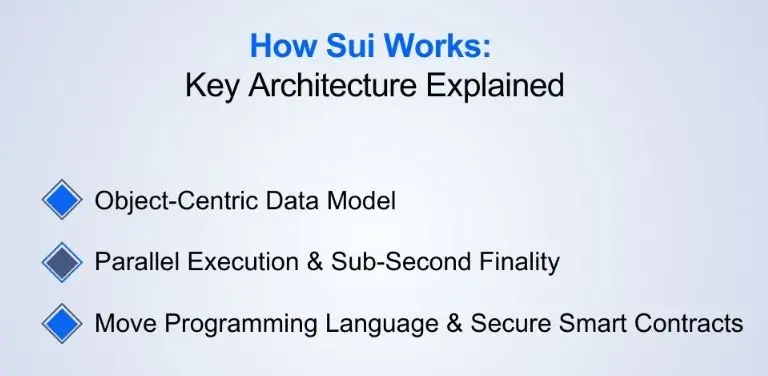
Sui coin is a Layer-1 blockchain that’s based on an object-centric data model rather than the account-based ledger that old-school chains like Ethereum use. Instead of treating assets as entries in a shared account balance, this network treats every coin, NFT, and piece of state as an independently owned object that can be transacted in parallel.
The team behind the project, several of whom previously worked on Meta’s stablecoin initiative, built the Sui blockchain around the idea that money should move as easily as a text message. Features like the zkLogin, let people sign in with an existing Gmail account. The idea is to make it painless for mainstream users to get on board, even if they’re not crypto natives.
What exactly happened during the July 4 livestream test on Sui?
The July 4 test on the Sui blockchain was not a snapshot of the network in its day-to-day normal state; rather, it was a public stress test intended to get as many people and as many AI agents as possible involved and participating simultaneously. Logging into a special explorer with an email address is all that was needed to get involved, after which participants and autonomous agents entered competition in simple games, chat and micro-payments, all streamed live for thousands of viewers.
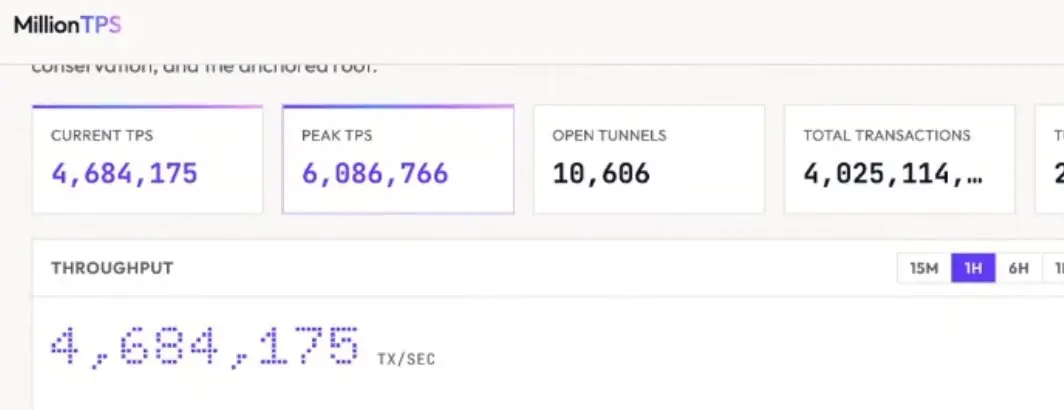
The test organizers had set a goal of one million transactions per second between all participants, but the network achieved a peak of 6,086,766 transactions per second (TPS) around 12:30 p.m. ET, more than six times that goal.
A few figures from the day stand out on their own:
- Peak throughput reached 6,086,766 TPS around 12:30 p.m. ET.
- The result was over six times the original one-million TPS target.
- The figure was nearly twenty times the prior 297,000 TPS benchmark.
- A test token called MTPS was used, with gas fully sponsored.
- Games included blackjack, Quantum Poker, and a shared chat canvas.
How did programmable tunnels make this possible?
This high-throughput figure was achievable thanks to a component known as programmable tunnels: off-chain payment and state channels, similar to the Lightning Network in concept, that settle to the base layer upon channel closure. Two participants, be they human or AI agents, secure a tunnel, transact within it at virtually limitless speed, and finally rendezvous with a joint signature that is subsequently verified on-chain.
This approach maintains a minimal load on the base layer, while also ensuring that a closed channel is cryptographically verifiable, cosigned by both participants, and easily confirmable by any third party.
What comes next for this Tunnel Technology?
Mysten Labs, the engineering team behind the network, consider it an experiment, not something polished. Planned upgrades will add confidential transfers via a privacy tool called Nautilus .
This tunnel technology that plays the role of secure off-chain computation will support more than two people at once, instead of pairs, and will enable agent-to-agent prediction markets where AI systems could bet or hedge against each other entirely off-chain; ship those as designed, the same tunnel architecture could underlie everyday products like machine-to-machine commerce, gaming economies, and disaster-resilient offline payments, use cases the project’s cryptography lead mentioned directly when explaining the demo’s relevance, ranging from grocery payments in the earthquake zone to millions of poker games among corporate trading agents.
Does 6 Million TPS make Sui the best L1 blockchain today?
Numbers this big deserve analysis, and context matters more than headline grabbing. Several previous Sui blockchain benchmarking efforts show context, and they tell a far less flashy story than a single livestream dosage.
The 6 million-plus number came from a controlled, sponsored demonstration using off-chain tunnels, not organic day-to-day mainnet load, an important distinction given how similarly large throughput claims from other networks have been misattributed or exaggerated in the past. Historical benchmarks are more modest: a December 2025 mainnet test recorded roughly 103,435 certificates per second under controlled conditions.
Meanwhile, the testnet event with 100 validators measured from 10,871 tunnels up to approximately 297,000 certificates per second. That final test ran at a finality of roughly 480 milliseconds. In terms of operational mainnet usage, daily Sui L1 TPS volume has hovered in the low hundreds, but it has had short term peaks near ~1000 TPS.
That gap between a headline-grabbing demo and everyday usage doesn’t make the July 4 result meaningless; coordinating six million actions a second, even off-chain, is a genuine technical achievement, but it does mean the “best L1 blockchain” title is better earned through sustained adoption than a single event.
How did this impact the Sui coin price?
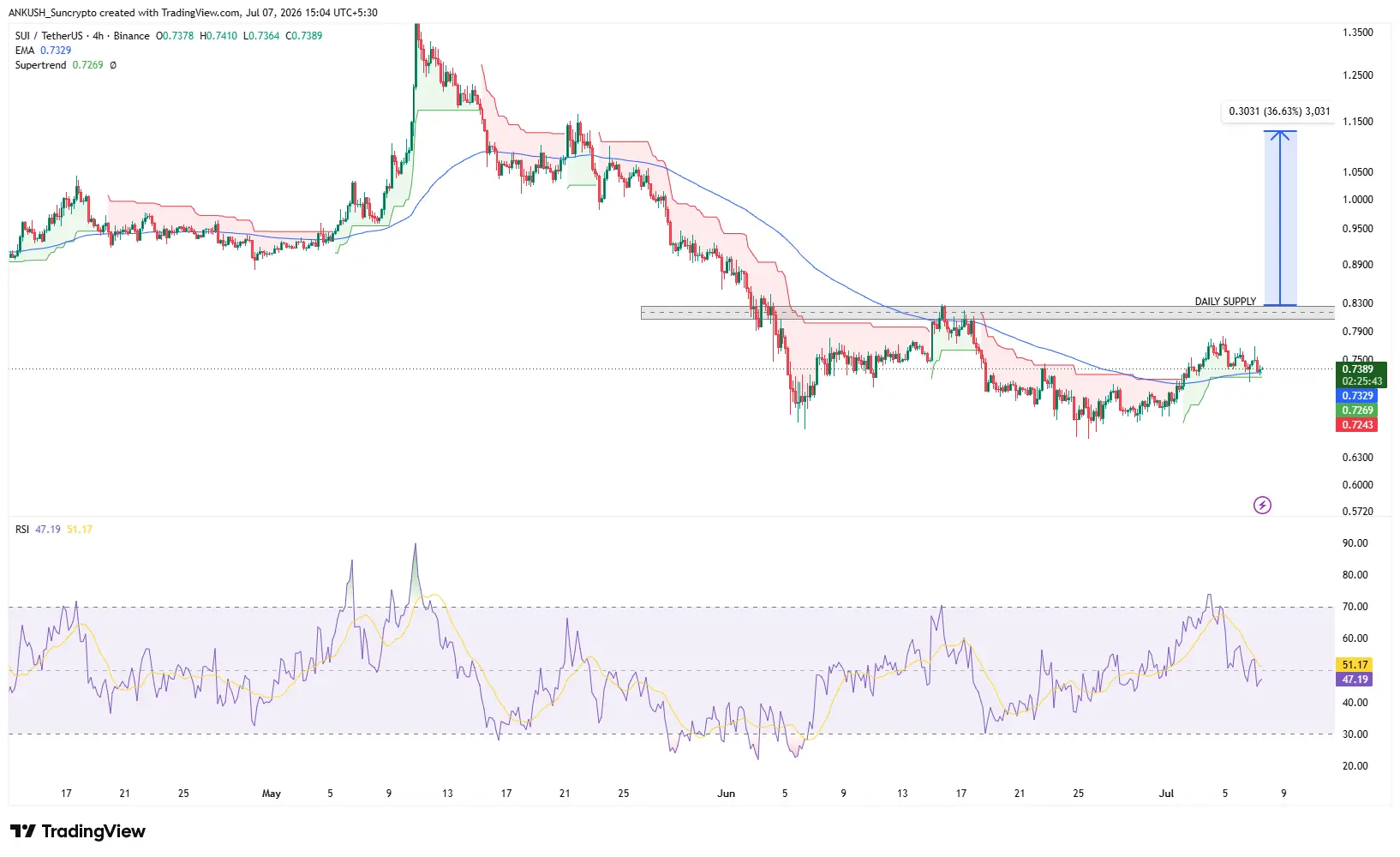
In crypto markets, not all technical milestones drive a token’s price linearly. The July 4 experiment is a prime illustration of this phenomenon. Post the livestream, Sui coin is currently trading around $0.7383, well past last week’s trading range, a price increase that more aligns with a mild market-wide upswing than a single headline-driven rally.
It is still down around 86.19% down from its January 2025 all-time high of about $5.35, with a market cap near $2.99B, a fraction of what it had during the 2024–2025 hype cycle. That dual phenomenon matters: it not only suggests traders don’t see the throughput milestone as a “buy” signal on its own, but they are treating it more as an engineering triumph to watch out for rather than a market-making force.
Momentum indicators suggest the same sentiment, as the relative strength index continues to remain near-neutral, and the price action remains largely ranging, rather than experiencing a breakout at this point, which is typical in a scenario where a network delivers a notable technical milestone without a corresponding jump in real-time transaction volume or new inflows.
A few technical levels are worth tracking are as follows:
- Immediate support sits near $0.70, tested multiple times recently.
- The stronger support zone lies between $0.65 and $0.45 lower.
- Nearest resistance stands at $0.80, capping recent bounce attempts.
- Key breakout level remains $1.00, a major psychological ceiling.
- Bigger resistance zone sits around $1.18, a historical pivot point.
- RSI reading near 47 shows neutral, balanced market momentum.
- 200-day moving average near $0.93 still capping bullish attempts.
What should Sui traders and investors expect next?
Rather than fixating on a single demo number, it makes more sense to track a handful of steady, verifiable indicators for the Sui blockchain. Developer activity, active applications launched on the network, and most importantly the number of applications that were shipped and commerce built over time is far more important than a single benchmark. The fact that applications ship and users remain over time is what is really validating a network.
The total value locked in native native DeFi protocols of a network is also a strong indicator of a network’s long term viability, as applications net out their capital in pools of native DeFi protocols. It demonstrates that people truly believe in a network enough to leave their capital parked there. Officially declared performance numbers are far more important than an army of social media videos all touting different numbers for the same platform, especially when we consistently hear accelerated throughput numbers attached to a project that is actually not developing at all.
Final Thoughts
The July 4 experiment on the Sui blockchain was a genuinely impressive piece of engineering , six million-plus transactions processed live, off-chain, and cryptographically verifiable is not a small feat, and it points toward real products like agent-to-agent commerce and offline-resilient payments. But let us remember that a controlled demo isn’t the same as real-world usage, and the journey of Sui coin towards becoming the best L1 blockchain in the world will be visible only through consistent adoption and journals of the trailblazers helping to build it.
For now, it’s fair to call this a strong signal worth watching closely, not a final verdict.
What makes Sui different from other blockchains?
Unlike older networks that process transactions in a single sequential queue, Sui treats digital assets as independent “objects”. This architecture allows the network to process independent transactions in parallel, resulting in massive scalability and sub-second finality.
How fast are transactions on Sui?
Thanks to upgrades in its consensus mechanism (such as Mysticeti), Sui is capable of processing transactions in roughly 390 milliseconds with micro-penny fees. Live public throughput experiments have demonstrated massive scale capacity.
What is zkLogin?
zkLogin is a unique user-onboarding feature on Sui. It allows users to interact with decentralized applications (dApps) using their standard Google, Facebook, or Apple accounts, eliminating the need to write down seed phrases or download specialized crypto wallets.