

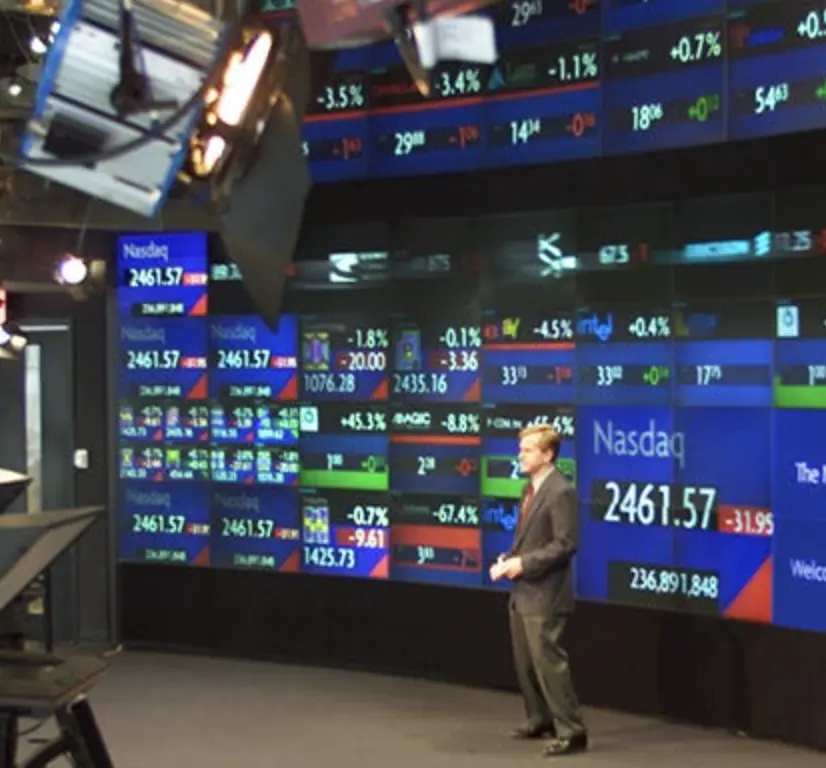
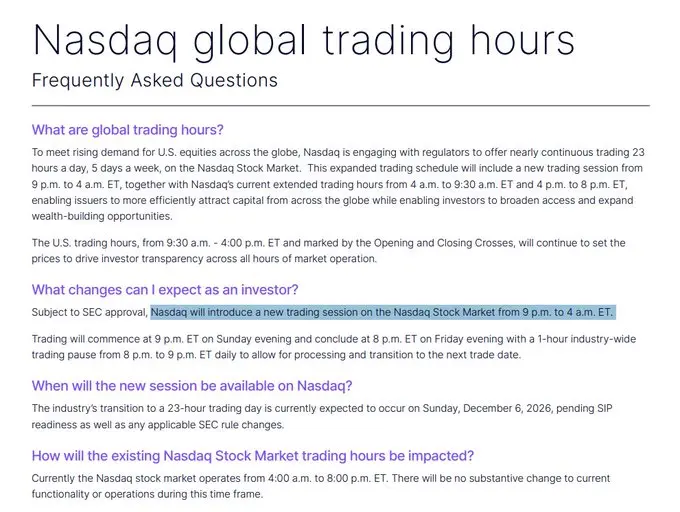
Nasdaq will extend US equity trading to 23 hours a day, five days a week, beginning December 6, 2026. The initiative, branded Global Trading Hours, leaves American stocks closed for just one hour each weekday, between 8:00 and 9:00 p.m. Eastern.
“Whether you like it or not, TradFi exchanges are now playing by crypto’s rules,” ETF specialist Nate Geraci commented on the announcement.
He is broadly right, though the details complicate the picture in ways worth understanding.
What is Nasdaq actually building?
The structure splits the day in two. A daytime session runs from 4:00 a.m. to 8:00 p.m. ET, largely unchanged from Nasdaq’s existing pre-market, regular, and post-market hours. A new overnight night session then runs from 9:00 p.m. to 4:00 a.m. ET, with the intervening hour reserved for system maintenance and corporate action processing.
The SEC approved the underlying proposal on April 10, 2026, following a filing Nasdaq submitted in late December 2025. What remains outstanding is not the substantive decision but a readiness confirmation and upgrades to the Securities Information Processor infrastructure that consolidates market data. Reporting that describes the December launch as “subject to SEC approval” is technically accurate but understates how far the regulatory process has already run.
Overnight trading will operate under meaningful constraints. Only limit orders are permitted in the night session; unpriced and pegged orders are not. Participants require a separate night session port and must acknowledge additional risk disclosures. Nasdaq’s Limit Order Protection and clearly erroneous execution rules continue to apply. And the traditional 9:30 a.m. to 4:00 p.m. session, including the opening and closing crosses, remains the primary price benchmark for the market.
Nasdaq is candid about the trade-off: overnight liquidity will be thinner and volatility more pronounced than during regular hours.
Why did Nasdaq now decide to go with the crypto operating model?
The demand is geographic. Foreign holdings of US equities have reached roughly $17 trillion, and investors across Asia and other time zones have long been forced to trade American stocks either at inconvenient hours or through a small number of alternative trading systems offering round-the-clock access. Nasdaq’s filing is explicit that competing for that order flow is a central motivation.
It is also not acting alone. The New York Stock Exchange, Cboe, and the London Stock Exchange are all advancing extended-hours plans. The SEC has scheduled a roundtable for September 17 to examine the operational implications of near-continuous trading, and Chairman Paul Atkins has confirmed the agency will open a broader study this autumn.
Round-the-clock trading has stopped being a proposal and become an industry direction.
What does this mean for crypto?
Crypto’s structural advantage has never been only that it trades continuously. It is that continuous trading was the default rather than a feature bolted onto a legacy schedule. That distinction is now narrowing, and the honest reading is that it narrows in crypto’s disfavour.
For years, the argument for holding digital assets included the ability to act on news at any hour a Sunday geopolitical event or a Tuesday-night earnings surprise while equity holders waited for a bell. Come December, an investor in Mumbai or Singapore reacting to overnight news can trade Apple almost as readily as they can trade Bitcoin.
But the convergence is partial, and the differences matter. Nasdaq is moving to 23/5, not 24/7. Weekends stay closed. There is a maintenance hour every day. Order types are restricted overnight, and liquidity is explicitly expected to be worse. Crypto markets have no maintenance window, no weekend closure, no separate port requirement, and no distinction between a “real” price and an overnight one.
The more consequential development may be adjacent. Nasdaq has received SEC approval for tokenized securities and partnered with Kraken to build a trading gateway, targeting a 2027 launch. Extended hours are an operational change; tokenized settlement is an infrastructure change, and it borrows from crypto far more directly.
Geraci’s framing captures the direction accurately. Traditional exchanges are converging on crypto’s model because that model answered a demand their own structure could not. What crypto retains is not the novelty of being open; it is being open without conditions.
When does Nasdaq’s 23-hour trading start?
December 6, 2026, a Sunday, with the first overnight session opening that evening. The launch depends on Nasdaq confirming readiness and the Securities Information Processor infrastructure being in place.
Hasn’t the SEC already approved this?
Yes, on April 10, 2026. Coverage describing the December launch as “subject to SEC approval” refers to a remaining readiness filing, not the substantive decision, which has already been made.
What hours will US stocks trade?
A daytime session runs 4:00 a.m. to 8:00 p.m. ET, and a night session runs 9:00 p.m. to 4:00 a.m. ET. The single closed hour, from 8:00 to 9:00 p.m. ET, is reserved for system maintenance and corporate action processing.
Is this 24/7 trading like crypto?
No. It is 23 hours a day, five days a week. Weekends remain closed, there is a daily maintenance hour, and the arrangement covers weekdays only. Crypto markets run continuously with no closure of any kind.
Can I use the same order types overnight?
No. The Night Session permits limit orders only; unpriced and pegged orders are not allowed. Participants also need a separate night session port and must acknowledge additional risk disclosures. Nasdaq’s Limit Order Protection and clearly erroneous execution rules continue to apply.
Will overnight prices be reliable?
They will be real prices, but the regular 9:30 a.m. to 4:00 p.m. session, including the opening and closing crosses, remains the primary benchmark for price discovery. Nasdaq expects overnight liquidity to be thinner and volatility more pronounced than during regular hours.
Are other exchanges doing the same thing?
Yes. The New York Stock Exchange, Cboe, and the London Stock Exchange are all advancing extended-hours plans, and the SEC has scheduled a September 17 roundtable on round-the-clock trading, with a broader study to follow this autumn.
Does this weaken crypto’s advantage?
Partly. The ability to react to news outside US market hours has been a genuine selling point for digital assets, and that gap narrows in December. What crypto retains is unconditional access: no weekend closure, no maintenance window, no restricted order types, and no distinction between an overnight price and a real one.
What about tokenized stocks?
Separate from the hours change, Nasdaq has received SEC approval for tokenized securities and partnered with Kraken to build a trading gateway, targeting a 2027 launch. That is an infrastructure shift rather than a scheduling one, and it borrows from crypto more directly.