

Bitcoin’s more than 50% pullback from its October 2025 all-time high has raised questions about whether the cryptocurrency’s long-term investment story has changed. However, according to BlackRock’s latest report, published this week, the sharp decline does not necessarily weaken the broader investment case for Bitcoin.
The world’s largest asset manager attributed the correction primarily to market-specific factors, including deleveraging, weaker capital flows and slower buying activity from digital asset treasuries. These factors created significant selling pressure and contributed to a sharp decline in its price, but BlackRock indicated that they should not be confused with a fundamental shift in the asset’s long-term potential.
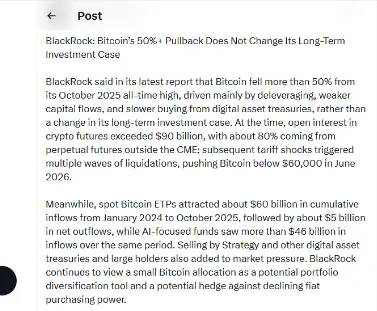 BlackRock explains why Bitcoin’s 50%+ pullback does not change its long-term investment case.
At the time of the market correction, open interest in Bitcoin crypto futures had exceeded $90 billion. As BTC came under pressure, a liquidation cascade on October 10 wiped out roughly $20 billion of that open interest in a single day, with further waves of forced liquidations following in February and June. When highly leveraged positions are forced to close, selling pressure can increase rapidly, often pushing prices lower in a short period of time. This dynamic played an important role in Bitcoin’s decline, which eventually pushed the cryptocurrency below the $60,000 level in June 2026.
What’s Driving Bitcoin’s Correction
For investors, the distinction between a market-driven correction and a change in long-term fundamentals is important. Bitcoin has historically experienced periods of extreme volatility, including significant drawdowns during broader market stress. While such corrections can create uncertainty in the short term, BlackRock’s assessment suggests that the recent pullback should be viewed in the context of market structure and capital flows rather than as evidence that Bitcoin’s long-term investment thesis has disappeared.
One of the key points highlighted in the report is the continued institutional interest in Bitcoin through spot exchange-traded products, or ETPs. Since their January 2024 launch through Bitcoin’s October 2025 peak, spot Bitcoin ETPs attracted roughly $60 billion in cumulative inflows.
That trend reversed after the October peak. In the months since, the products have seen around $5 billion in aggregate net outflows as institutional demand cooled and investors adjusted their exposure during the downturn.
Institutional demand, however, was not consistent across all parts of the market. BlackRock noted that over that same post-October stretch, AI-focused funds attracted more than $46 billion in inflows — more than nine times what left Bitcoin ETPs over the same window. This indicates that investor capital has increasingly been competing across different investment themes, with artificial intelligence emerging as a major rival draw for institutional money.
At the same time, selling activity from Strategy and other digital asset treasuries added further pressure to the Bitcoin market. Companies and investment vehicles that hold substantial amounts of digital assets can influence market sentiment when they reduce their holdings or adjust their strategies. Combined with slower buying activity, this created additional pressure during an already difficult period for Bitcoin.
Still, BlackRock continues to see a potential role for a Bitcoin allocation within a diversified investment portfolio. The firm’s trailing 10 year analysis found that allocating just 1% to 2% of a traditional 60/40 portfolio to BTC, funded from equities, would have improved risk-adjusted returns while broadly maintaining comparable portfolio risk characteristics. The asset manager views Bitcoin as a possible diversification tool because of its characteristics and its position outside traditional financial assets. While BTC remains highly volatile, its long-term behaviour and market structure have encouraged some investors to consider it as an alternative asset rather than simply a speculative trade.
BlackRock also pointed to Bitcoin’s potential role as a hedge against declining fiat purchasing power. Inflation, monetary expansion and concerns surrounding the long-term value of traditional currencies have increased interest in assets that are viewed as having limited supply. Bitcoin’s fixed maximum supply of 21 million coins is one of the features that has contributed to this narrative.
However, this does not mean BTC is free from risk. Its price remains highly sensitive to changes in investor sentiment, liquidity, leverage and broader economic conditions. The recent correction is a clear example of how quickly market conditions can change when excessive leverage begins to unwind.
For long-term investors, BlackRock’s analysis appears to separate Bitcoin’s short-term price movements from its broader investment thesis. A 50%+ decline can significantly affect sentiment, particularly among short-term traders, but the report argues that the underlying reasons for the correction matter when evaluating the asset’s future.
The combination of strong historical ETP inflows and continued (if now smaller-scale) institutional participation suggests that interest in BTC has not disappeared. Instead, the market has experienced a period of adjustment driven by weaker flows, deleveraging and increased selling pressure.
As Bitcoin moves forward, its ability to recover may depend on the return of stronger capital inflows, reduced leverage and renewed institutional demand. Market conditions could remain volatile in the near term, especially if macroeconomic uncertainty continues to influence risk assets.
Nevertheless, BlackRock’s latest assessment sends a clear message: Bitcoin’s 50%+ pullback does not automatically invalidate its long-term investment case. The report describes the decline as a “positioning correction rather than a change in its investment case.” The recent decline may have been severe, but the report suggests it was largely driven by market mechanics rather than a fundamental change in Bitcoin’s role as a potential alternative investment.
For investors, the key takeaway is that Bitcoin’s volatility remains one of its biggest risks, but short-term price corrections and long-term investment potential should be evaluated separately. According to BlackRock, the recent pullback may have changed the market environment, but it has not changed the broader long-term case for BTC.
Why did Bitcoin fall more than 50% from its all-time high?
BlackRock attributes the decline mainly to market mechanics rather than a change in fundamentals, heavy leverage in futures markets (open interest above $90B in October 2025), a series of liquidation cascades (starting with ~$20B wiped out on October 10, with further waves in February and June), and slowing ETP inflows as institutional attention shifted elsewhere.
Does BlackRock still recommend holding Bitcoin in a portfolio?
Yes. Its trailing 10 year analysis found that allocating 1–2% of a traditional 60/40 portfolio to BTC, funded from equities, improved risk-adjusted returns without meaningfully changing the portfolio’s overall risk profile. BlackRock still frames it as a diversifier and a potential hedge against declining fiat purchasing power, while acknowledging that BTC remains highly volatile and sensitive to leverage and liquidity conditions.
What could influence Bitcoin’s next move?
Bitcoin’s future price movement could depend on factors such as renewed capital inflows, institutional demand, market liquidity, leverage levels and broader macroeconomic conditions.