
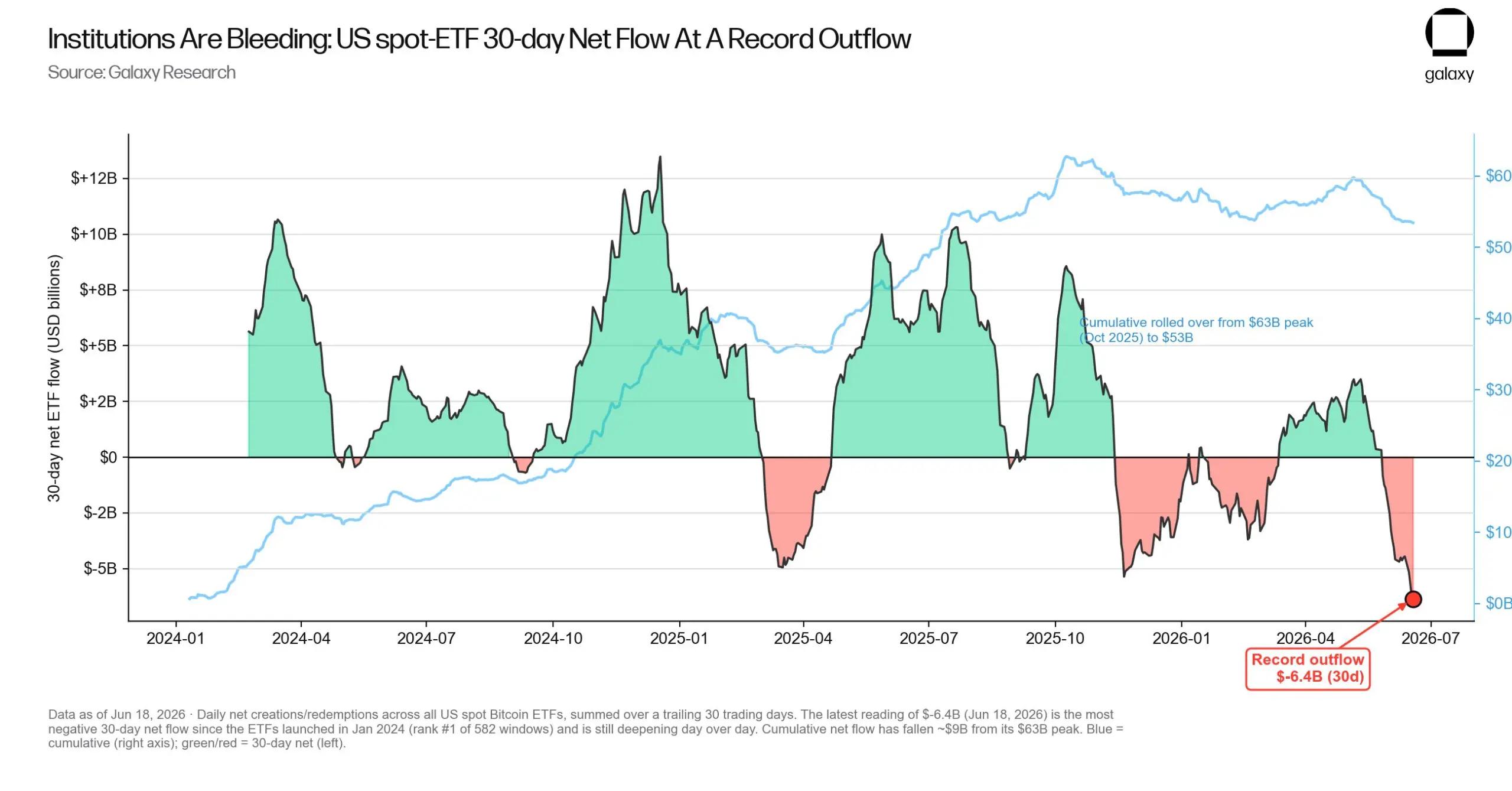
US spot Bitcoin ETFs pulled a record $6.35 billion outflow during a rolling 30-day period, and Galaxy Research ranks it the worst of 582 such windows tracked since the funds launched. That is an eye-catching number, especially for products that have been presented as the key to mainstream institutional adoption of the asset.
But what really matters right now is not how bad it was, it’s whether the worst is already behind us. Weekly outflows have since cooled considerably, and long-term holders appear to be absorbing the supply.
This article breaks down what a Bitcoin ETF is, what drove the record drain, and what the data says about where we go from here
What is a Bitcoin ETF?
A Bitcoin ETF is a regulated investment product that tracks the price of Bitcoin, just like shares of a company, and buys and sells on traditional stock exchanges . Instead of having to manage crypto wallets or use exchange platforms, investors buy and sell Bitcoin ETF shares without needing a dedicated crypto brokerage or crypto custodian .
When the ETF receives investor money, it uses that money to buy Bitcoin and keep it in custody. When investors sell ETF shares, the ETF sells Bitcoin and returns investor money. That’s how the product brings the crypto market into the regulated world, allowing non-crypto-registered investors such as pension funds, hedge funds, and wealth managers to gain exposure to BTC .
In January 2024, the US SEC approved 11 spot Bitcoin ETFs at once , a groundbreaking moment after almost 10 years of rejections. BlackRock’s iShares Bitcoin Trust (IBIT) became the largest Bitcoin ETF immediately, and is one of the fastest-growing ETFs of all time with $48-$69B in AUM as of 2026. The launch of these products fundamentally altered how institutional money could access Bitcoin, and how quickly it can exit as macro winds blow.
How bad were the Bitcoin ETF Outflows?
As per Galaxy Research data, the $6.35 billion 30-day outflow ranks atop all 582 rolling 30-day windows tracked since the funds entered the market in January 2024, the heaviest sequence of redemptions ever. To give context, from roughly May 15 to June 3, 2026, the US spot Bitcoin ETF suite saw 13 days in a row of net outflows totaling about $4.33–$4.4 billion, or roughly 59,400 BTC, and the longest string of daily net redemptions since launch.
Galaxy Research pointed to a 20-day trailing window of $5.42 billion and 73,080 BTC, the heaviest reading ever in both measures, while the 7-day and 10-day windows each set new records for Bitcoin outflows at 39,338 BTC and 42,941 BTC respectively. The impact on aggregate assets was drastic: total fund AUM slid from $104.29 billion to $80.40 billion over the period, while total holdings fell to about 1.277 million BTC, roughly 7.2% down on an October 2025 near-term high.
Why did institutional investors pull back?
The record-setting Bitcoin ETF outflows were the result of several overlapping drivers:
- The FOMC’s June 2026 statement stripped out prior language acknowledging progress toward the Fed’s 2% inflation target, a hawkish signal that prompted two voting members to suggest rate cuts penciled in for Q3 2026 could slip to 2027.
- Strong US jobs data significantly reduced expectations for an imminent rate cut, making yield-bearing bonds more attractive compared to non-yielding Bitcoin, while geopolitical uncertainty surrounding Iran intensified risk-off sentiment.
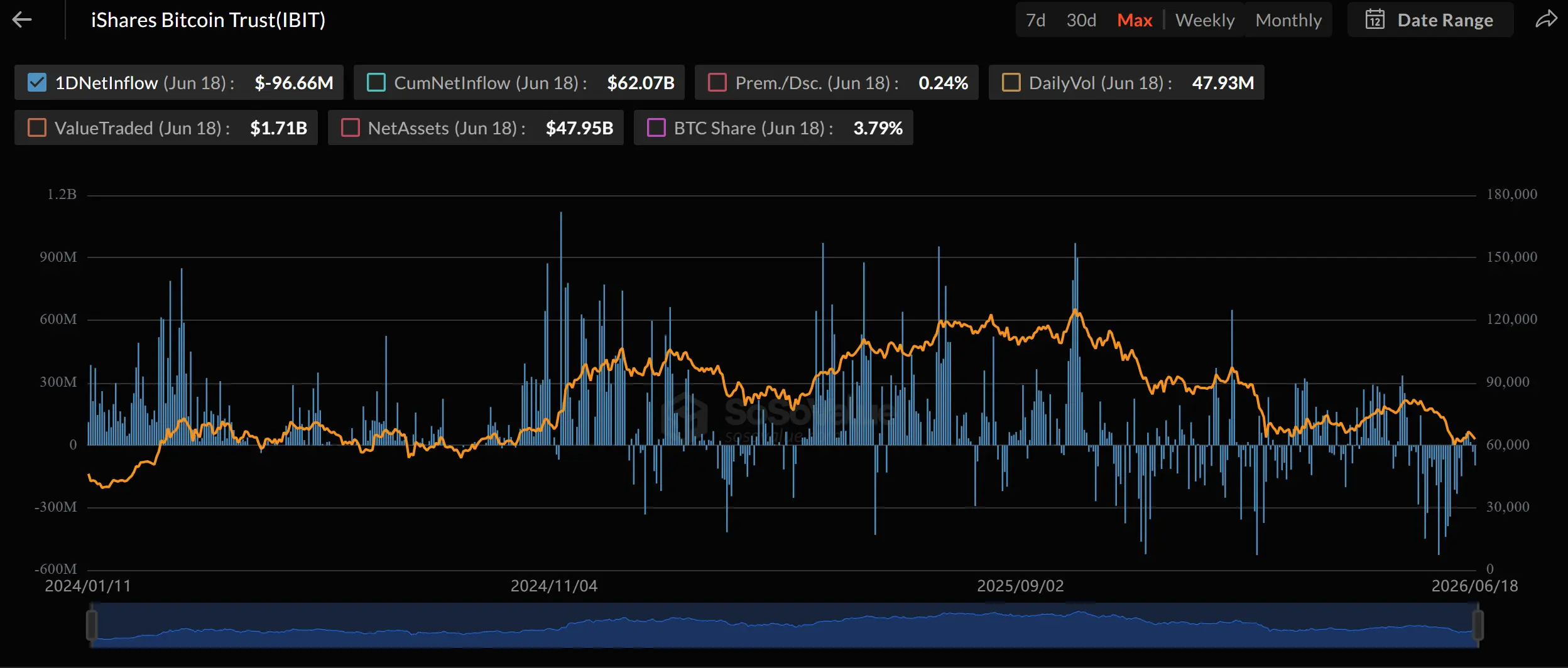
- One fund dominated the bleeding: BlackRock’s iShares Bitcoin Trust, IBIT, is the largest spot Bitcoin ETF by assets, so it tends to dominate the flow ledger in both directions. BlackRock’s IBIT lost about $2.04 billion across the outflow streak.
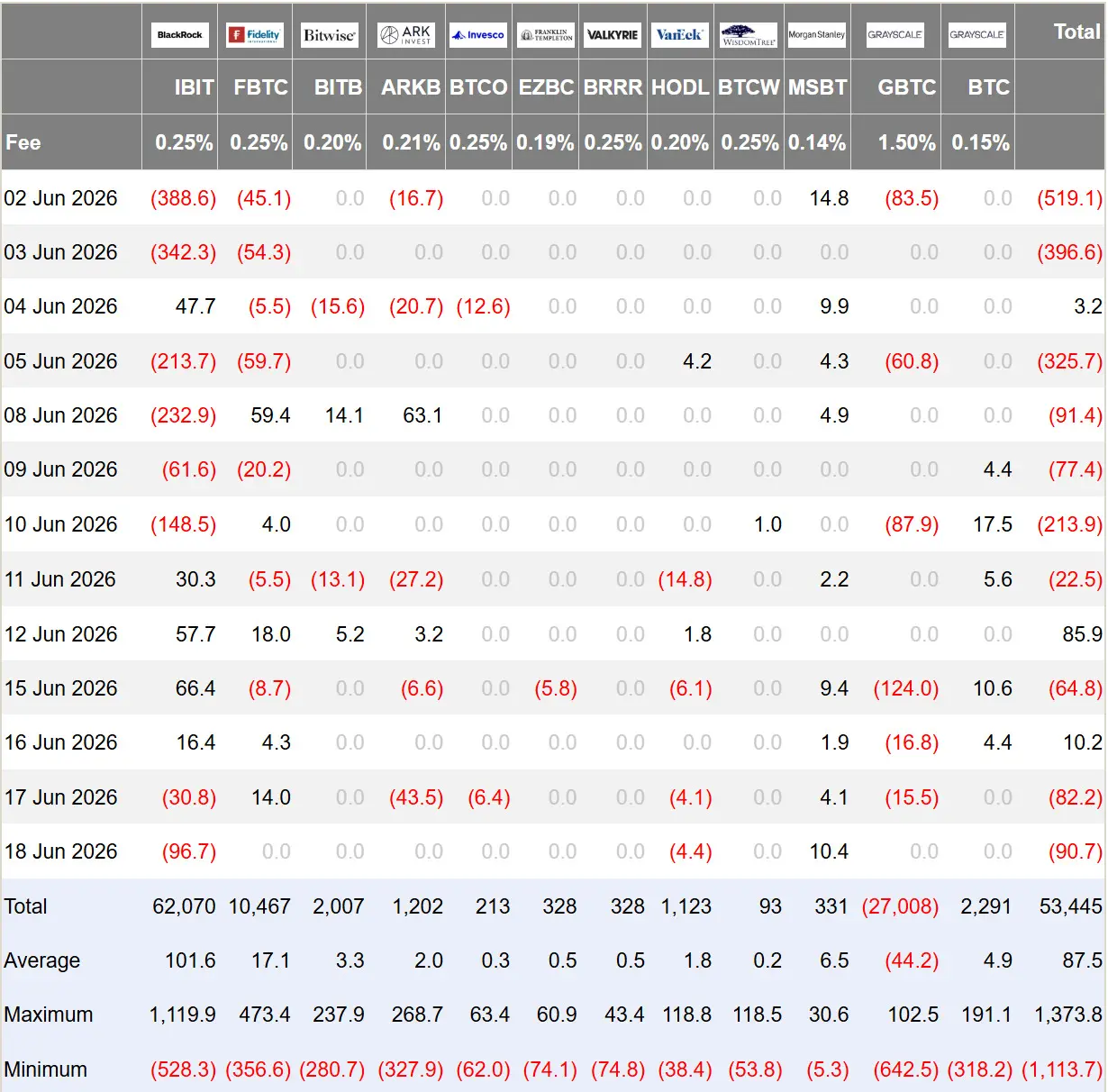
- In a single session, ETFs recorded $733.43 million in net outflows, their ninth consecutive withdrawal day, with IBIT alone accounting for $527.84 million of that figure.
- A $1.29 billion IBIT dark-pool block pointed to institutional reallocation, not broad retail panic. Macro pressure, AI stock rotation, and Strategy’s Bitcoin sale all converged during the outflow run.
- In Q1 2026, institutional investors pulled 17% from US spot Bitcoin ETF holdings, from 313k BTC to 261k BTC. In dollar terms, their holdings fell 35% to $17.8B, and 13F investors’ share of total Bitcoin ETF assets fell 20.8% from 24.7%.
What is the current status of the BlackRock Bitcoin ETF?
While it’s no surprise that the BlackRock Bitcoin ETF is the biggest absolute outflow driver, the longer-term story for BlackRock is fascinatingly resilient. BlackRock’s IBIT captured roughly 70% of the category’s $2.44 billion in April 2026 flows: a “winner-take-most” pattern built on BlackRock’s institutional distribution network, brand trust, tight spreads, and a competitive 0.25% sponsor fee.
The streak finally ended on 5 June, when the sector plus logged a $3.05M net inflow, most of which IBIT reported as $47.66M, with rivals like HBIT, BLOK, GBTC and .GBTC bleeding across the board. Momentum continued to build the week after. On 12 June, Bitcoin spot ETFs captured a $85.85M net inflow, going unredeemed across all 12 funds tracked, with IBIT rounding up $57.69M, or almost 2/3 of the total. The fee differential between Grayscale’s GBTC at 1.5% and IBIT at 0.25% is stark. Investors are still pulling money from GBTC, dampening the numbers for the premium products as they settle back into place.
Are Bitcoin ETF outflows finally slowing down?
The data suggests the most intense phase of institutional selling may be passing. Weekly outflows dropped from $1.72 billion in the week ending June 5, the largest since February 2025, to a far more modest level in the week that followed, representing an 87% cooldown in redemption pace. Analysts said that the roughly $4.4 billion that has pulled out over the last month sent year-to-date flows last into negative territory, erasing a recovery that funds had made, but also summarized that on a cumulative net lifetime inflows all funds together received a total of $53.4 billion (down from a $63B peak), and IBIT still has this year and is still in the green.
Bitcoin has remained largely above the $60,000 support band so far, but there’s no meaningful upside follow through. The resilience at this support level, combined with long-term holders absorbing supply released by ETF managers, is exactly the pattern that has historically preceded a demand recovery.
What does it mean for Bitcoin ETF India investors?
For Indian investors watching this space, the global ETF drama carries an important local dimension. As of 2026, SEBI has not approved any domestic Bitcoin ETF or crypto ETF for trading on Indian exchanges.
But the Bitcoin ETF India access story has not ended. An Indian investor can still legally purchase a US-listed Bitcoin ETF such as BlackRock’s IBIT, through RBI’s Liberalized Remittance Scheme (LRS) capping at $250k per annum abroad via international brokerages. For Indian retail investors, the 2026 correction aggravates those losses in a uniquely painful way: Indian cryptocurrency tax rules do not allow crypto losses to be set off against stock, mutual fund, or any other asset class gains, and so the asymmetric tax treatment is an ongoing grievance for the crypto investor community.
For anyone looking at this route, the current outflow cycle is a potent reminder that Bitcoin ETFs come with full market risk, the regulated wrapper doesn’t protect against price drawdowns.
Final Thoughts
The record $6.35 billion 30-day Bitcoin ETF outflows marks a real test for a product class barely two years old, triggered by a confluence of macro headwinds, a hawkish Fed, geopolitical uncertainty, AI sector rotation, and profit taking following Bitcoin’s October 2025 all-time high near $126,000.
In contrast, cumulative net outflows remain positive at $53.4 billion (down from a $63B peak) , IBIT continues to outpace other Bitcoin ETFs on recovery days, and weekly outflows have already cooled 87% from their peak, indicating the market is processing the shock instead of crumbling.
Unlike earlier crypto downturns that caused exchange collapses, the 2026 correction is happening through regulated ETF markets with transparent pricing, institutional custody, and proper settlement — a structural maturity that is itself a significant development. For long-term observers, the data is beginning to look less like a breaking point and more like the kind of reset that precedes the next leg higher.
Are Bitcoin ETFs available to invest in India?
No. Currently, domestic spot Bitcoin ETFs do not exist on Indian exchanges like the NSE or BSE. Indian investors can only gain exposure to international Bitcoin ETFs (like those listed in the US) through global brokerages or specific mutual fund “Fund of Funds”
Why hasn’t SEBI approved Bitcoin ETFs in India?
SEBI has adopted a cautious stance toward cryptocurrencies. Because the Reserve Bank of India (RBI) and the government do not recognize cryptocurrencies as legal tender, regulatory authorities have barred mutual funds from making crypto-related investments until formal digital asset legislation is enacted.
What are the risks of investing in Bitcoin ETFs?
While ETFs eliminate the need to manage private crypto keys, they do not shield investors from the inherent volatility of the cryptocurrency market. Additionally, investing through foreign brokerages introduces currency conversion risks, international transfer fees, and exposure to offshore regulatory changes.