

For most of the past four years, Japan has fought the yen’s decline alone and mostly lost. Solo interventions bought days of relief before the currency resumed sliding. Last week something changed. When Tokyo moved to defend the yen, the United States moved with it.
On Monday, 3 August 2026, Japan’s Ministry of Finance and the US Treasury jointly confirmed that they had conducted a coordinated yen-buying intervention the previous Friday. It is the first time the two countries have jointly bought yen since 1998 and the first coordinated currency action of any kind between them since 2011, when, notably, they acted in the opposite direction, selling yen to weaken it after the Tōhoku earthquake.
This is not a routine market operation. It is a significant shift in how the world’s largest and third-largest economies are managing a currency relationship that has become destabilizing for both.
What actually happened?
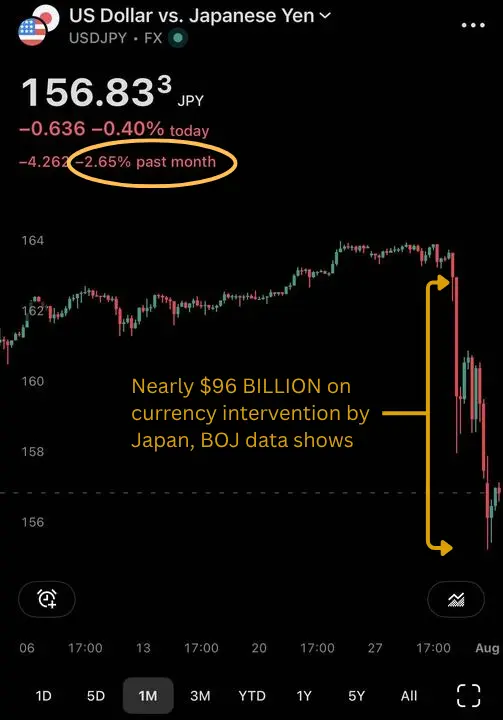
The immediate trigger was the yen’s collapse to 163.73 per dollar on Thursday, 30 July, its weakest level in nearly four decades, and territory not seen since 1986.
Japan appears to have acted alone first. Bank of Japan data indicated Tokyo may have sold as much as $58.97 billion to buy yen in New York markets on Thursday. That solo operation was followed on Friday by the coordinated action with the US Treasury. By Friday’s close, the yen had rebounded to 157.57, a recovery of roughly six yen from the low.
Japan’s Finance Ministry said the intervention was carried out in accordance with the “Joint Statement of the Japanese and U.S. Finance Ministers” issued in September 2025 and was aimed at addressing recent excessive volatility and disorderly movements in the yen. Tokyo added that it “will not hesitate to conduct further coordinated interventions in the future.”
US Treasury Secretary Scott Bessent confirmed the action in near-identical language, stating that Friday’s coordinated foreign exchange actions countered disorderly yen movements and that Treasury “will not hesitate to participate in further joint intervention.”
President Donald Trump had already signaled US involvement on Sunday, framing it in characteristically informal terms. Asked why Washington was supporting the currency, he said Japan had a weakening yen and wanted some help, adding that the US is always there for Japan.
There was also an unusually visible piece of stagecraft. At a Camp David press event before the confirmation, Bessent was photographed with a notepad in front of him bearing a to-do list that read, “Buy Japanese Yen (JPY) $5-10 bil.” Whether accidental or deliberate, the signal reached markets before the official announcement did.
Japan’s Finance Minister is Satsuki Katayama, who has consistently emphasized her alignment with the US Treasury on currency matters.
The mechanics, how they do it?
Two details in the execution are worth understanding, because they reveal the constraints both sides are operating under.
- The US sold euros, not dollars: The New York Fed, acting on Treasury’s behalf, reportedly sold euros to buy yen. This is a meaningful choice. Selling dollars directly would run against the administration’s broader dollar posture and would have a different signalling effect. Selling euros achieves yen support while sidestepping that problem, though it also means the operation’s scale is limited by Treasury’s euro holdings in the Exchange Stabilization Fund.
- Japan flagged the FIMA repo facility: Japan’s Finance Ministry announced plans to use the Federal Reserve’s Foreign and International Monetary Authorities repo facility going forward. The FIMA facility allows approved foreign central banks to obtain short-term dollars by temporarily exchanging US Treasury securities rather than selling them outright.
That second point is not a technicality. It goes to the heart of why Washington got involved at all.
Why did the United States join?
This is the question that puzzled markets, because the US does not typically help other countries strengthen their currencies. Three motivations explain it, and none are purely altruistic.
1. Protecting the US trade position
A weaker yen makes Japanese exports cheaper in dollar terms and American exports more expensive in Japan. Washington wants to prevent its trade deficit from widening as a result of yen weakness. With trade policy central to this administration’s agenda, a currency moving this far this fast cuts directly against stated objectives.
2. Protecting the Treasury market
This is the most consequential reason and the least discussed publicly.
When Japan intervenes alone, it needs dollars. Historically, it has raised them by selling US Treasury securities and Japan is among the largest foreign holders of US government debt. Large-scale Treasury sales push US yields up and borrowing costs with them.
Washington wants to avoid a scenario in which Japan repeatedly dumps Treasuries to defend the yen. Participating in joint intervention and steering Japan toward the FIMA repo facility achieves the same currency outcome while keeping Treasuries off the market. Japan gets dollars by pledging its holdings rather than liquidating them.
In other words, the US is not only helping Japan defend the yen. It is protecting its own bond market from the consequences of Japan defending the yen alone.
3. Financial stability in Japan
Analysts have pointed to concerns about the stability of Japan’s financial system. A disorderly currency decline drives up import costs for energy and food, feeds inflation, pressures household consumption, and complicates an already delicate monetary policy normalization. Instability in the world’s third-largest economy is not contained to Japan.
5 years of persuasion
This did not happen spontaneously. According to officials involved in the negotiations, the September 2025 bilateral statement authorizing currency intervention to combat excessive volatility was the culmination of a five-year Japanese effort to bring Washington on board.
There was also a clear intermediate step. In January 2026, the New York Fed conducted an unusual “rate check,” contacting market participants for yen quotes, a recognized signal that authorities are considering intervention. At the time, analysts were skeptical it would go further. JP Morgan’s chief Japan currency strategist Junya Tanase noted that past coordinated interventions occurred only in rare circumstances such as financial crises or major natural disasters, and that the distance from joint rate checks to coordinated intervention was considerable.
Seven months later, that distance has been closed.
Why did the yen fall so far in the first place?
Intervention treats the symptom. The cause is the interest rate gap.
The Bank of Japan raised its policy rate to 1.0% in June 2026, the highest level since September 1995 then held steady at its July meeting in an 8-1 vote, with board member Hajime Takata dissenting in favour of a hike to 1.25%. The BoJ has signaled that upside inflation risks could justify another hike as soon as September.
Meanwhile, the US federal funds rate sits at roughly 3.50%–3.75%. That leaves a gap of around 250–275 basis points, and that gap is what drives the yen carry trade: borrowing yen cheaply, converting to dollars, and earning the spread on higher-yielding US assets.
In its July quarterly outlook, the BoJ cut its FY2026 inflation forecast to 2.5% from 2.8%, reflecting government measures to ease household energy costs, while nudging its FY2026 GDP growth projection up to 0.6% from 0.5%. For FY2027 it raised inflation to 2.4% and growth to 0.8%.
Board member Naoki Tamura has argued the BoJ should keep raising rates every few months toward a neutral level around 2%. But at the current pace, the differential will remain wide for some time, which is precisely why analysts doubt intervention can do more than slow the decline.
Does intervention actually work?
The honest answer: sometimes, briefly, and better together than alone.
Solo interventions have a poor track record. Their effects are typically short-lived because a single authority is fighting the market’s directional view with finite reserves, and traders know it.
Coordinated intervention is different in kind, not just degree. When two governments act together, the perceived limit on available firepower rises sharply, and the political signal that both sides consider the move disorderly carries weight beyond the transaction itself. Analysts note that with US backing, interventions could prove more effective and more lasting.
But market strategists are notably unconvinced about a sustained reversal. UBS strategists Teck Leng Tan and Dominic Schnider wrote that Japan’s policy mix remains unlikely to generate sustained yen strength and that with the BoJ expected to continue gradual normalization while real rates remain negative, the yen will be supported more by intervention risk than by domestic monetary fundamentals.
That phrase supported by intervention risk rather than fundamentals is the key to understanding the current market. Traders are not buying yen because they believe in it. They are avoiding short positions because they fear being run over by the next joint operation.
What does this mean for global markets?
The wider significance runs through the carry trade.
The yen has served for decades as one of the world’s primary low-cost funding currencies. Estimates of outstanding yen carry positions have run to several hundred billion dollars. That borrowed money is invested across US technology stocks, emerging market assets, high-yield credit, and crypto.
Carry trades do not respond to today’s rate. They respond to the expected path. If the combination of BoJ tightening and credible, repeatable joint intervention convinces traders that yen weakness has a ceiling, the calculus changes and positions built on cheap yen funding start to unwind.
The precedent is recent and unpleasant. In August 2024, a smaller-than-expected BoJ move combined with a Fed pivot signal compressed the rate gap suddenly and triggered a sharp global equity selloff. The assets that benefited most from cheap yen liquidity felt it most.
This is why a currency operation in Tokyo matters to portfolios everywhere. It is not really about the yen. It is about the cost and availability of one of the cheapest funding sources in global finance.
The India angle
For Indian markets, the transmission runs through three channels.
- Foreign portfolio flows: A yen carry unwind tends to drain liquidity from emerging markets as leveraged positions are closed and capital returns to Japan. Indian equities have historically been sensitive to these episodes.
- External debt: A portion of India’s external debt is yen-denominated, meaning yen appreciation raises the rupee cost of servicing it. During the August 2024 episode, the yen appreciated sharply against the rupee within a single week, and Indian corporates with yen-denominated borrowings felt the currency impact directly.
- Risk sentiment: Global volatility episodes driven by funding-currency stress typically hit emerging market currencies and risk assets together, regardless of domestic fundamentals.
None of this argues for alarm. It argues for awareness that a policy decision in Tokyo is not a distant foreign story.
What to watch next?
- Whether they act again and how quickly: Both sides said they will not hesitate. The credibility of that statement is now the single most important variable in yen positioning.
- The BoJ’s September meeting: Policymakers have signaled a hike could come as early as September, with economists split between then and later in the year. Monetary tightening, not intervention, is what would durably change the currency’s direction.
- Whether Japan actually uses the FIMA facility: If it does, it confirms the Treasury-market protection thesis and suggests a more sustainable framework for future operations.
- Where the yen settles: A drift back toward 163 would indicate the intervention bought days rather than a floor. Holding near or below 157 would suggest the coordinated signal genuinely repriced expectations.
The bottom line
Japan has spent years trying to defend its currency alone, with limited success. Last week it finally got help, but the help came because Washington’s interests happened to align with Tokyo’s, not simply out of friendship.
The intervention has bought time and reset positioning. What it has not done is close the interest rate gap that caused the problem. Until that narrows, the yen’s floor rests on the credibility of two governments’ willingness to keep buying it, rather than on any economic reason to hold it.
That is a workable position. It is not a stable one.
Read More: How does Gold and Silver Prices Fell and What Investors Should Do Next?
Disclaimer: This article is for informational and educational purposes only and does not constitute investment, financial, or trading advice. Currency and market conditions change rapidly; all figures are as of 5 August 2026 and should be verified against live data before any decision. Please consult a qualified financial adviser before acting on market information.