
The rupee has fallen. And This Time, It’s Different. The Indian rupee has officially become Asia’s worst-performing major currency in 2026. In just 4.5 months, the INR has slid from ₹89.9 to a record low of ₹95.72 against the US dollar, a decline of over 6.5% that has stunned analysts, rattled foreign investors, and raised alarm bells about India’s external vulnerabilities.
This is not merely a story of a strong dollar. Every currency feels dollar pressure. But while export-driven economies like China and Taiwan are stabilizing or even gaining, India is on the wrong side of the chart, and the gap is widening.
This deep dive by SunCrypto examines why the rupee is falling, what structural forces are driving it, how it compares to Asian peers, and critically, what it means for India’s crypto market and the millions of Indian investors navigating this environment.
Key Stats at a Glance
|
INR/USD Now |
Start of 2026 | YTD Decline | Record Low |
| ₹95.72+ | ₹89.90 | −6.5%+ |
₹95.80 (May 13) |
Additionally, the INR has lost nearly 60% of its value since 2007 and posted its worst fiscal year decline since 2011, making this the most significant rupee stress event in over a decade. Foreign investors pulled $20B+ from Indian equities in 2026, one of the largest capital flight episodes in India’s market history.
How did the Indian Rupee hit rock bottom?
- January 2026: INR starts the year at ₹89.90, US dollar strength is building globally as the Fed holds rates at 3.50–3.75%.
- February 28, 2026: US-Israel-Iran conflict erupts. Global risk-off mood triggers immediate capital flight from emerging markets. FPI selling of Indian equities accelerates.
- March 2026: Crude oil surges from ~$60 to above $100 per barrel. India’s import bill spikes. INR hits ₹92.3–93.98 per dollar, a record low at the time. RBI begins aggressive intervention.
- March–April 2026: Tariff shock from US (26–50% on Indian exports) reduces dollar inflows. The RBI repo rate at 5.25% since December 2023 narrows the India-US interest rate differential, making Indian bonds less attractive.
- In the fiscal year 2025–2026, India’s gold imports surged over 24% to a record-breaking $71.98 billion, up from $58 billion the previous year. While the physical volume actually dipped slightly from 757.09 tonnes to 721.03 tonnes due to skyrocketing prices, the massive dollar outflow to pay for it heavily pressured the Indian rupee, pushing it to repeated record lows.
- May 4–5, 2026: USD/INR crosses the ₹95 mark for the first time in history — a psychological threshold that triggers fresh panic.
- May 13, 2026: INR hits its all-time record low of ₹95.8000 against the US dollar. The INR is confirmed as Asia’s worst-performing major currency of 2026.
INR vs. Asian Currencies Performance
India is not alone in facing currency pressure, but it is clearly the worst affected. Here is how major Asian currencies have performed in 2026:
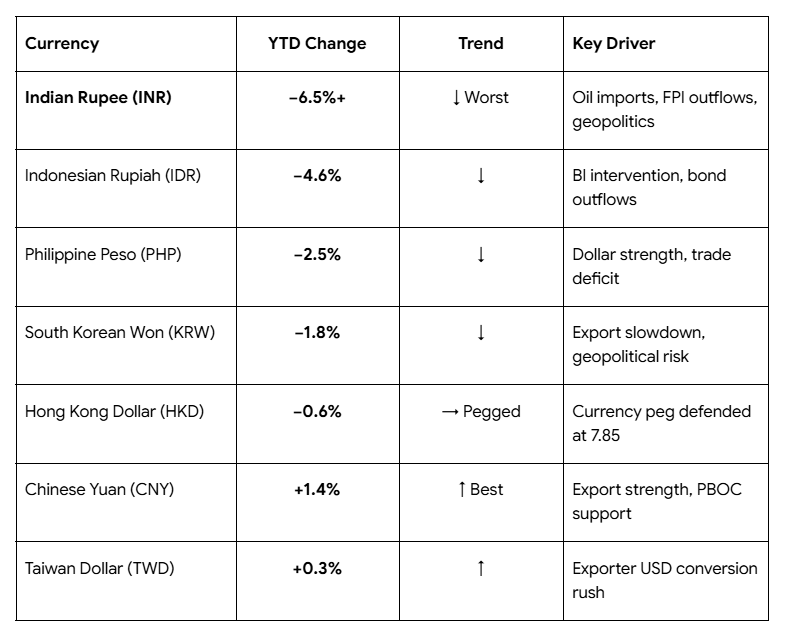
The contrast is stark. While China’s Yuan has appreciated 1.4% on export strength and Taiwan’s dollar has benefited from exporter USD conversion, India sits at the bottom of the table, down over 6.5% and still falling.
This divergence is not random. It reflects India’s structural positioning: high import dependence (especially crude oil), persistent current account deficits, and a capital account that is heavily reliant on volatile foreign portfolio investment rather than stable FDI.
8 Reasons the Indian Rupee Is Falling
Attributing the rupee’s freefall entirely to the US-Iran war or dollar strength is an oversimplification. The rupee’s weakness reflects years of structural vulnerabilities converging at the worst possible moment:
|
# |
Cause | Impact |
Scale |
|
1 |
Crude Oil Surge (Brent $100-$120) |
India imports ~85% of crude. Higher oil = more dollar outflow and a wider trade deficit |
Critical |
|
2 |
FPI Equity Outflows |
Foreign investors pulled ~$20B from Indian equities in 2026, converting INR to USD |
Very High |
|
3 |
US-Israel-Iran Conflict |
Risk-off global mood since Feb 28, 2026. Investors fled to USD safe haven |
High |
|
4 |
Fed Rate at 3.50–3.75% |
Narrow India-US rate differential. Indian bonds less attractive vs US Treasuries |
High |
|
5 |
Wide Current Account Deficit |
Estimated $40–50B deficit in FY26 — imports far exceeding exports |
Structural |
|
6 |
US Tariffs on Indian Exports |
26–50% tariffs on gems, jewelry, and electronics cut dollar inflows |
Medium-High |
|
7 |
RBI Rate Cut (Dec 2025) |
Repo cut to 5.25% narrowed interest rate advantage vs US, reducing capital attraction |
Medium |
|
8 |
Importer Hedging Demand |
Indian importers buying USD forward to protect against further depreciation |
Amplifier |
|
9 |
Gold Import Bill |
Gold acts as a luxury asset. It does not generate economic output but forces a massive, immediate sell-off of INR to purchase USD, triggering rapid currency depreciation during peak seasons. |
Amplifier |
|
10 |
Total Merchandise Trade Deficit |
The massive gap between total imports and exports. This structural deficit means India is permanently buying more global goods than it sells, weakening the currency long-term. |
High |
India imports approximately 85% of its crude oil. Every $10 rise in Brent crude adds roughly $15 billion to India’s annual import bill, and that dollar demand hits the Indian rupee directly.
What Is the RBI Doing?
The Reserve Bank of India has not been a passive spectator. The central bank has deployed a multi-pronged response to slow the Indian rupee’s fall:
- Selling dollars from forex reserves to increase dollar supply and absorb rupee pressure in spot markets
- Directing oil importers to buy dollars through a special RBI facility to reduce pressure on the open market
- Tightening bank FX position limits to restrict speculative currency trading
- Restricting offshore hedging activity to reduce arbitrage-driven pressure
- Active intervention in DNDF (Deliverable Non-Deliverable Forwards) and NDF markets
Market estimates suggest the RBI sold around $20 billion in reserves during the latest stress phase. However, as analysts have noted: “RBI intervention can smooth the fall; it cannot erase a persistent external shock.”
The Indian rupee is not pegged. The RBI’s role is to prevent disorderly moves, not target a specific level. If oil stays elevated and FPI outflows continue, intervention alone has limits. The RBI has already factored ₹94 per dollar into its official inflation and growth projections, signaling that it expects continued weakness.
Key RBI watchpoints: Brent crude direction, FPI flow trends, forex reserve levels, bond yields, and progress on a US-India trade deal.
To defend the rapidly falling rupee, the Indian government raised the import duty on gold and silver to 15%, a 9% increase, while restricting silver imports from free to restricted. These measures follow record-high imports of precious metals that accelerated the currency’s depreciation.
Who Wins and Who Loses?
A summary of which sectors will benefit from the Indian Rupee fall and which sectors will get impacted?
Sectors That Benefit From a Weak Rupee
- IT & Technology Exports: TCS, Infosys, HCL Tech, and Wipro earn in USD and report in INR. Every rupee that weakens improves their margins without any change in business performance.
- Pharma Exports: Sun Pharma, Dr Reddy’s same dynamic as IT. Rupee weakness directly boosts INR earnings.
- Textile & Apparel Exporters: Cheaper Indian exports become more competitive globally.
- NRI Remittances: Indians abroad send more rupees per dollar, benefiting families receiving remittances.
Sectors Under Pressure
- Oil & Energy: India’s OMCs (HPCL, BPCL, and IOC) face a double hit high crude prices AND a weaker rupee, inflating import costs.
- FMCG & Electronics: Raw material costs rise as imported inputs become more expensive.
- Aviation: Aviation fuel (ATF) is crude-linked, and dollar-denominated airline margins get squeezed.
- Automobile Industry: Import-dependent components become costlier, squeezing manufacturer margins.
- Retail Inflation: A weaker rupee raises the cost of imported goods and raw materials, feeding into broader inflation.
What a Falling Indian Rupee Means for Crypto Investors?
Here is the dimension that most mainstream financial coverage misses: the Indian rupee’s fall is one of the most important tailwinds for India’s crypto market in 2026.
|
Asset / Metric |
Effect of Weak INR |
Investor Implication |
|
Bitcoin (BTC) in INR |
BTC appears to rise faster in INR terms, even without a USD price change | Indian investors see amplified BTC gains vs global USD investors |
|
USDT Stablecoins |
USDT demand surges as Indians seek USD-pegged store of value | USDT/INR pairs see increased trading volume on Indian exchanges |
|
Crypto Adoption |
Currency pressure boosts digital asset adoption by ~25% YoY in 2026 | India already world’s largest crypto community by users, is set to grow |
|
BTC/INR Direct Pairs |
Foreign Crypto Exchanges launched BTC-INR direct trading on May 14, 2026 | Reduces friction, lowers conversion costs for Indian retail investors |
|
Crypto as Hedge |
Bitcoin is increasingly discussed as a hedge vs INR depreciation | Interest in Bitcoin as ‘digital gold’ rising among Indian HNIs |
|
Exchange Volumes |
Rupee weakness drives more Indians to explore crypto for wealth preservation | Indian crypto exchanges seeing increased user registrations and volumes |
Analysts estimate that currency pressures across emerging markets have already boosted digital asset adoption by up to 25% year-over-year in 2026.
Bitcoin INR: India’s Most-Watched Crypto Metric
A falling Indian rupee fundamentally changes how Indian investors perceive Bitcoin. Even if BTC’s USD price is moving slowly, Indian investors holding BTC see amplified returns when converted back to INR. This creates a perception shift: Bitcoin starts looking less like a speculative bet and more like a legitimate store of value and inflation hedge.
This shift is being validated by institutional moves. Foreign crypto exchanges direct BTC-INR trading, allowing Indian users to buy Bitcoin directly in rupees without USD conversion intermediaries. This is a landmark moment: it signals that global exchanges recognize India as a crypto market that is large enough and sophisticated enough to deserve its own direct fiat pair.
USDT: The Quiet Winner
When a national currency enters freefall, USD-pegged stablecoins become natural havens. USDT demand from Indian users surges during Indian rupee weakness, not for speculation but for wealth preservation. Holding USDT effectively means holding a USD-denominated asset that appreciates in INR terms with every rupee decline.
This is one of the most practical and underappreciated use cases for stablecoins in India, and the rupee’s 2026 performance is accelerating it.
The 30% Tax Problem Amplified
India’s 30% flat capital gains tax on crypto with no loss set-off was already a barrier to retail participation. A weaker Indian rupee makes this even more painful. When Indian investors earn crypto gains in USD terms and convert them back to INR, their nominal INR gains are inflated by currency effects, potentially pushing them into higher effective tax brackets while their real purchasing power gain is lower.
This is a structural policy issue that the crypto industry, including SunCrypto, continues to advocate changing. A weaker rupee makes the case for fair crypto taxation reform even more urgent.
What happens to the Indian Rupee outlook for 2026?
Rupee Strengthening Catalysts
- A sustained ceasefire in West Asia reducing Brent crude below $80 per barrel, SBI Research estimates a 14% oil correction could drive ~3% rupee appreciation
- A US-India trade deal announcement is the single biggest FDI and sentiment catalyst remaining
- Renewed FPI inflows into Indian equities if global risk appetite recovers
- A Fed rate cut signalling from Kevin Warsh (new Fed chair from May 15) that narrows the US-India rate differential
Rupee Weakening Catalysts
- Oil spike above $110-$120 if West Asia conflict escalates further
- Resumption of FPI outflows from Indian equities or bond markets
- A Federal Reserve hawkish shift under Warsh that strengthens the dollar broadly
- Any miss on India’s CAD data showing the deficit widening beyond $50B
Base case from major institutions: USD/INR is expected to trade in a ₹92–96 range through Q3 2026. MUFG sees ₹92 as the median. Bank of America and ING project recovery to ₹86–87 by the end of 2026 but only if oil cools and a US-India trade deal materializes. If neither happens, ₹96–98 is possible.
No mainstream institution projects ₹100 in 2026. But ₹96–98 is plausible if oil and outflows persist.
The Bottom Line
The Indian rupee’s fall to Asia’s worst-performing currency is not a one-line story. It is the convergence of structural vulnerabilities, a geopolitical shock, a hawkish global rate environment, and years of high import dependence all hitting at the same time.
For the average Indian, whether they are an investor, a business owner, or a salaried professional, a weaker rupee means higher fuel prices, costlier electronics, rising inflation, and shrinking real purchasing power.
But for India’s 25 million+ crypto investors, the rupee’s fall carries a different message: assets denominated in dollars, Bitcoin, USDT, and other global digital assets have just become significantly more valuable in INR terms.
The case for crypto as a partial hedge against currency depreciation has never been stronger in India. And with foreign exchanges launching direct BTC-INR pairs and adoption growing 25% year-on-year, the Indian crypto market is responding exactly as you would expect it to.
At SunCrypto, we are tracking every development from RBI intervention to FPI flows to oil prices because what happens to the rupee directly shapes the crypto opportunity for Indian investors. The rupee’s story is not just a forex story. It is a crypto story too.
Disclaimer: Crypto products & NFTs are unregulated and can be highly risky. There may be no regulatory recourse for any loss from such transactions. Please conduct your own research and consult a financial advisor before making investment decisions. SunCrypto is not liable for any losses incurred.
What does Jayant Mundhra mean by India becoming a “Consumer Economy” in the recent Raj Shamani podcast?
He points out that India is consuming wealth rather than generating it through production. Every time citizens spend money on imported luxury goods, global tech platforms, or foreign digital services, wealth flows out of India. He argues India must focus on aggressive domestic manufacturing and tech self-reliance instead of relying on short-term narratives.
According to Mundhra, what is the permanent solution to this crisis?
He states that short-term taxes or emotional appeals to citizens are not sustainable. India must emulate the early blueprints of manufacturing hubs like China, Vietnam, and Bangladesh by implementing aggressive, sector-specific industrial and mining policies to become a global exporter.
How does the Rupee’s performance compare to other Asian currencies?
The Indian Rupee is Asia’s worst-performing major currency in 2026, dropping over 6.5% YTD. While other import-dependent currencies like the Indonesian Rupiah have also fallen, export-heavy economies like China and Taiwan have actually seen their currencies gain value.
What steps is the RBI taking to control the currency freefall?
The Reserve Bank of India (RBI) is actively defending the rupee by selling dollars from its forex reserves, capping speculative trading, and routing oil import payments through a special facility. The government has also raised gold and silver import duties to 15% to stop dollar outflows.
What is a Current Account Deficit ?
A Current Account Deficit (CAD) occurs when foreign expenditure on imports exceeds revenue from exports, placing structural downward pressure on the rupee due to high dollar demand.
What are Foreign Portfolio Investment (FPI) outflows?
Foreign Portfolio Investment (FPI) outflows involve foreign investors selling domestic assets to convert rupees back to dollars, which significantly weakens the currency, particularly during times of global market volatility.