

For centuries, gold has stood as humanity’s ultimate symbol of wealth, trusted through wars, recessions, and currency collapses. Bitcoin, born in 2008, has emerged as its digital challenger, earning the nickname “digital gold” for its capped supply and decentralized nature. But which one truly deserves your trust in 2026? From price performance to storage risk to inflation protection, this article breaks down how these two very different stores of value stack up against each other today.
What are gold and bitcoin?
Gold: The Timeless Store of Value
Gold has been valued for over 5,000 years, used by Ancient Egyptians in jewelry and burial artifacts from 3000 BCE. By 600 BCE, Lydia minted the first gold coins, making it a medium of exchange. Its rarity and durability made it central to trade and eventually the “gold standard,” linking currencies to gold reserves. Though most countries (including the US, which exited in 1971) have abandoned this standard, gold remains a trusted store of value during uncertainty.
Bitcoin: The Digital Disruptor
Bitcoin began in 2008, when pseudonymous creator Satoshi Nakamoto published a whitepaper proposing a decentralized currency free from banks and intermediaries. In January 2009, Nakamoto mined the “Genesis Block,” launching the first cryptocurrency. Built on blockchain with a fixed supply of 21 million coins, Bitcoin became known as “digital gold” for the internet age.
Why is Bitcoin called “digital gold”?
- Scarcity: Just like gold has a limited physical supply, Bitcoin has a hard cap of 21 million coins. No one can “print” more; this mirrors gold’s core appeal as a scarce asset.
- Store of value narrative: Bitcoin was designed to hold value over time rather than be spent daily, similar to how gold is held for wealth preservation rather than everyday use.
- No central authority: Just as gold isn’t controlled by any government or bank, Bitcoin operates on a decentralized network; no single entity can manipulate its supply.
- Portability upgrade: It’s often called gold’s “digital upgrade” because it solves gold’s biggest weaknesses: it’s easy to transfer anywhere in the world instantly, doesn’t need physical storage, and can be divided into tiny fractions.
Why is gold called a “safe haven”?
- Proven track record: Gold has held or increased its value during nearly every major crisis for centuries: wars, recessions, and currency collapses. Investors trust it because it’s been tested repeatedly.
- Low volatility: Its price doesn’t swing wildly, so it doesn’t lose value fast when panic hits, unlike stocks or crypto.
- Universal acceptance: Every country, culture, and financial system recognizes gold’s value; there’s no dependency on technology, internet access, or trust in a specific network.
- Negative correlation with risk assets: When stock markets crash, gold often rises, because investors flee to it as a “safe” place to park money.
Liquidity: Ease of buying, selling, and trading
Gold is liquid, but not instant. You can sell gold at a local jeweler, bank, or bullion dealer, but converting it to cash often involves purity checks, making charges, or paperwork, especially for larger amounts. Trading gold ETFs or digital gold is faster, but physical gold takes more effort and time to offload.
Bitcoin is liquid 24/7. Crypto markets never close. You can buy or sell anytime, anywhere, in seconds, directly from your phone. Exchanges offer instant conversion to fiat currency, and there’s no need for a middleman to verify authenticity. The only friction is regulatory, like KYC checks or withdrawal limits on some platforms.
The trade-off in one line: Gold’s liquidity depends on physical access and market hours; Bitcoin’s liquidity is nonstop and borderless.
Bitcoin and gold supply
Bitcoin and gold are often compared because both have a defining feature: scarcity. Bitcoin has a hard-coded maximum supply of 21 million coins, and roughly 20.082 million have already been mined as of 2026, with the remaining supply released through periodic “halving” events that cut the mining reward roughly every four years, making its issuance schedule fully transparent and predictable.
Gold, by contrast, has no fixed cap; its supply grows steadily each year through mining, currently by about 1.5–2% annually, and total above-ground gold stock is estimated at roughly 210,000+ metric tonnes.
While gold’s scarcity comes from geological limits and the difficulty/cost of extraction, Bitcoin’s scarcity is enforced by code and consensus rules that no single entity can alter. This is why Bitcoin is frequently called “digital gold.” Both assets are valued partly for their resistance to unlimited supply expansion, unlike fiat currencies, which central banks can print at will.
Growth of Bitcoin and Gold since 2020
GOLD (XAU/USDT) technical analysis
At press time, XAU/USDT was trading at $4,400, which has increased by 1% in an intraday session. The XAU/USDT price chart suggests that the price has displayed a continuous rise in its price. The XAU/USDT price has surged by 182% since 2020 and is still in a bullish rally as per the chart structure.
The price has witnessed a decent gain of more than 60% in 2025. This bullish trend continued in 2026, and the price recorded an all-time high of $5,602.225 on 29 January 2026. Furthermore, profit booking was observed, which led to a 29.51% correction in the XAU/USDT price in a weekly timeframe.
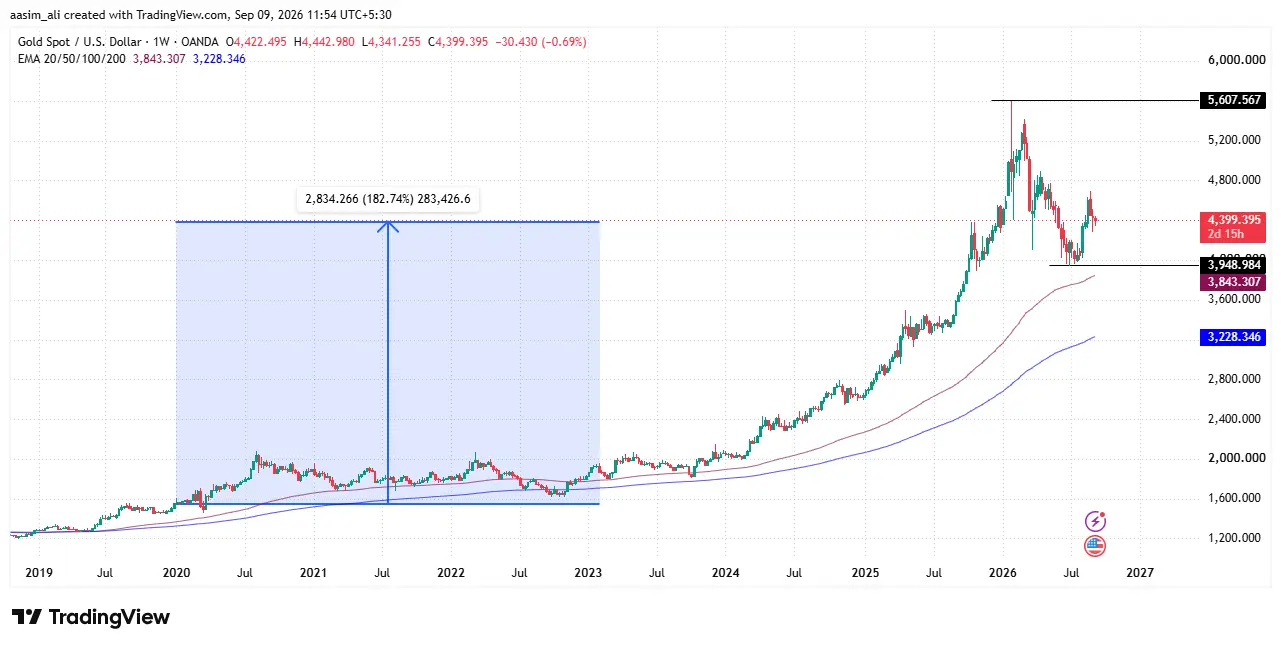
The price has surged by more than 10% after this correction and is generating a pullback scenario. If buyers remain strong, the price might record a new all-time high in a few months.
Bitcoin (BTC) price technical analysis
Bitcoin price has experienced a bullish trend on a weekly time frame. The overall trend is bullish, but it has experienced more ups and downs as compared to the XAU/USDT price chart. The XAU/USDT price has surged by 971% from 2020 till 09 September 2026.
The BTC price has recorded an all-time high of $126,199.63 on 06 October 2025. After this bull run, the price has experienced a 53% correction but buyers have bounced back and delivered the strongest weekly gain of 23.58% since 2024.
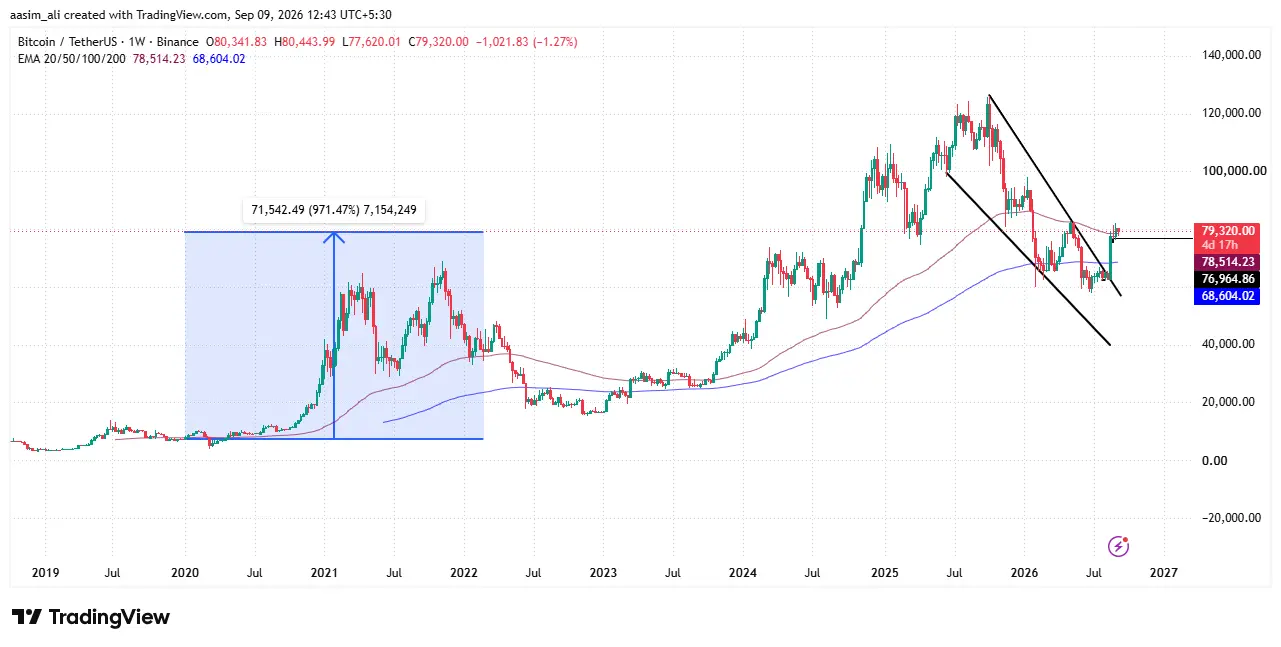
The BTC price has formed a falling wedge on a weekly timeframe. It has triggered a breakout and exceeded the key moving averages on a weekly timeframe, which showcases the bullish trend. This bullish move has triggered a buying potential in BTC to record a new all-time high.
Inflation Hedge: Which protects your money better?
There’s no single winner; it depends on your timeline and risk tolerance.
Gold wins for stability. With just 12-18% annual volatility and a proven track record across crises (2008, 2022, and again in 2026), gold is built for investors who want steady protection without wild swings. It reacts fast to short-term shocks and inflation spikes.
Bitcoin wins for long-term growth. Its fixed 21 million supply protects against slow currency debasement over years, and its 10-year returns have vastly outpaced gold’s. But it’s a bumpy ride with 45-60%+ volatility, and it actually fell during 2022’s inflation peak, failing its biggest real-world test as a short-term hedge.
The real difference: Gold protects your money right now. Bitcoin protects your money over the long run if you can stomach the drops along the way.
Security and Storage: Physical Risk vs. Digital Risk
Gold has physical risk. You need a safe, a locker, or a bank vault to store it and theft, fire, or loss are real concerns. Storing gold often means paying locker fees, and moving large amounts (like across borders) is cumbersome and closely regulated. But once it’s secured, there’s no “hacking” a gold bar, the risk is physical, not technical.
Bitcoin has digital risk. There’s no physical form to steal, but your holdings are only as safe as your private keys. Lose your keys or seed phrase, and your coins are gone forever: no bank to call, no recovery option. Exchanges can get hacked, and scams or phishing attacks are common ways people lose crypto. On the flip side, self-custody (using a hardware wallet) gives you full control without needing a vault or locker.
Bitcoin vs. Gold: The Inflation Hedge Showdown
Gold has decades of proof as a safe haven. Central banks keep buying it, which supports its price. In 2026, gold hit record highs as inflation rose again. Its biggest strength is stability, annual swings of just 12–18%, making it the go-to choice during wars, rate shocks, or banking crises. It held up well even in 2008 and 2022.
Bitcoin plays a different game. With a fixed supply of 21 million coins, it’s designed to protect against long-term currency debasement, not short-term panic. Over the past decade, its returns have crushed gold, real estate, and bonds and in countries with currency collapse, it’s been a genuine lifeline.
The catch: volatility. Bitcoin can swing 45–60% a year. In 2022, it dropped hard even as inflation soared, proving it’s not a reliable short-term inflation hedge, even if the long-term thesis still holds.
Use cases beyond investment
Gold has real-world utility outside investing. It’s used in jewelry, electronics (as a conductor), dentistry, and even aerospace. Culturally, it’s deeply tied to weddings and festivals in countries like India, making demand steady beyond just financial hedging.
Bitcoin is being used in ways that go beyond “digital gold.” It enables fast, low-cost cross-border remittances without banks. It powers decentralized finance (DeFi) lending, borrowing, and trading without middlemen. In countries with unstable currencies or capital controls, it’s used as a way to preserve and move wealth. It’s also becoming a base layer for smart contracts and Web3 applications.
Final Thoughts
Gold and Bitcoin aren’t rivals fighting for the same crown, they’re two different tools built for different jobs. XAU offers time-tested stability, cultural trust, and calm during short-term storms, making it ideal for preserving wealth right now. Bitcoin, powered by its fixed 21 million supply, is built for the long game, offering explosive growth potential for those who can stomach sharp swings.
In 2026, both have delivered record highs, proving there’s no single “correct” hedge against uncertainty. The smartest strategy isn’t choosing one over the other, it’s understanding what each asset does best, and letting them work together in your portfolio.
Is Bitcoin better than gold as an inflation hedge?
It depends on your time horizon. Gold offers steady, short-term protection with low volatility (12–18% annually), while Bitcoin has delivered stronger long-term returns but actually fell during 2022’s inflation peak, making it less reliable as an immediate hedge.
Why is Bitcoin called “digital gold”?
Bitcoin earned this nickname because it shares gold’s core traits: scarcity (a fixed 21 million coin supply), a role as a long-term store of value, and freedom from control by any government or central authority.
Which is more liquid, Bitcoin or gold?
Bitcoin is more liquid. Crypto markets run 24/7, letting you buy or sell instantly from your phone. Gold requires visits to dealers, purity checks, and paperwork, especially for larger transactions, making it slower to convert to cash.