
If you spend any time on Telegram, YouTube Shorts, or Instagram, you have probably seen it. A screen with red, green, and violet buttons. A countdown timer. A screenshot of someone’s balance jumping from ₹500 to ₹12,000. And a caption promising “daily income from colour trading.”
It looks like trading. It uses the word “trading.” Many of these apps even show candlestick charts in the background to complete the illusion.
But here is the honest answer, right at the top: colour trading is not trading at all. It is a betting game dressed up in financial language, and in India it is now a criminal offense. This guide explains exactly what colour trading is, how it works, why it is designed so that you cannot win in the long run, what the law says, and what to do if you or someone you know has already lost money.
No jargon. Simple examples throughout.
What is colour trading?
Colour trading is an online betting game where you pay money to guess which color, usually red, green, or violet, will appear at the end of a short countdown, often lasting between 30 seconds and 3 minutes.
If your guess is correct, the platform pays you a multiple of your stake. If your guess is wrong, you lose everything you staked in that round.
That is the entire activity. There is nothing else to it.
The word “trading” in the name is pure marketing. In real trading you buy an actual asset, a share, a bond, a commodity, or a cryptocurrency that exists independently of the platform you bought it on and whose price moves because of real-world supply and demand. In colour trading, you own nothing. There is no asset. There is only a number generated by the platform’s own server.
Apps in this space often brand themselves as “colour trading,” “prediction markets,” or “earn-from-home platforms” to appear legitimate, but regulators, police investigators, and courts treat them as chance-based gambling regardless of the label.
How does a round actually work? [example]
Let us walk through it exactly as a new user would experience it.
Meet Ravi. He is 24, works at a call center in Jaipur, and a school friend sends him a link on WhatsApp saying “bhai, ismein daily ₹1,000 aaram se ban jaate hain.”
Ravi downloads the app and deposits ₹500.
Round 1. A 60-second timer starts. Ravi taps Green and stakes ₹50. The timer ends. Green appears. His balance is now ₹548, he has “won” ₹48.
Round 2. Feeling good, he stakes ₹50 on Green again. Green appears again. Balance: ₹596.
Round 3. He stakes ₹100 this time. Red appears. Balance: ₹496.
Round 4. He stakes ₹200 to make it back. Red again. Balance: ₹296.
Within eleven minutes, Ravi has lost money, but more importantly, he has learned a false lesson: that he can win, and that his losses were just bad luck he can recover from.
That feeling is not an accident. It is the product.
Why can you not win at colour trading?
There are two separate reasons you lose. Understanding both is the fastest protection there is.
Reason 1: The house edge (this applies even if the app is honest)
Imagine a genuinely fair coin toss. Heads or tails, 50-50. Now imagine I offer you this bet: stake ₹100. If you call it right, I give you ₹196 back. If you call it wrong, you get nothing.
Sounds almost fair, doesn’t it? It is not.
Play it 100 times, staking ₹100 each time. You will win roughly 50 times and lose roughly 50 times.
- You paid in: 100 rounds × ₹100 = ₹10,000
- You got back: 50 wins × ₹196 = ₹9,800
- Your net result: –₹200
You lost ₹200 without ever being unlucky. That is simply what happens when the payout is less than the true odds. This gap is called the house edge, and it means the longer you play, the more certain your loss becomes. Not more likely, but more certain.
In colour trading, the edge is typically larger than in my coin example, and it applies to every single round.
Reason 2: The results are not random anyway.
The first reason assumed an honest platform. Colour trading apps are usually not honest.
The outcome is determined by a random number generator or a server-controlled draw, not by any skill you apply. Because that server belongs to the operator, and because these platforms are unregistered and unaudited, nobody checks whether the “random” number is actually random.
Investigations and user complaints consistently describe the same pattern: small early wins to build trust, followed by sustained losses once deposits get larger. In other words, the outcome you see is frequently a decision, not a draw.
The simple version: in a fair casino, the math is against you. In colour trading, the math is against you, and the dealer can see your cards.
Colour trading vs. real trading [Clear Comparison]
Many people search for colour trading because they genuinely believe it is a beginner-friendly entry into financial markets. It is worth being very explicit about the difference.
| Colour Trading | Real Trading (Stocks, Crypto, etc.) | |
| What you own | Nothing at all | An actual asset like shares, crypto, bonds |
| Who sets the outcome? | The platform’s own server | Open market of millions of buyers and sellers |
| Can analysis help? | No outcome is chance-based. | Yes, fundamentals, technicals, research |
| Regulated by | Nobody | SEBI (stocks), FIU-IND (crypto exchanges) |
| Time frame | 30 seconds to 3 minutes | Days, months, years |
| If the platform vanishes | Your money is gone. | Assets are held in demat/custody and protected. |
| Legal status in India | Illegal under the 2025 Online Gaming Act | Legal and regulated |
| Long-run expected result | Guaranteed loss | Uncertain, but genuinely possible to profit |
The “how to do colour trading” question misframes the activity entirely, because there is no skill involved and no analytical process to learn. There is no strategy, no chart pattern, and no “trick,” and anyone selling you one is part of the scheme.
Is colour trading legal in India?
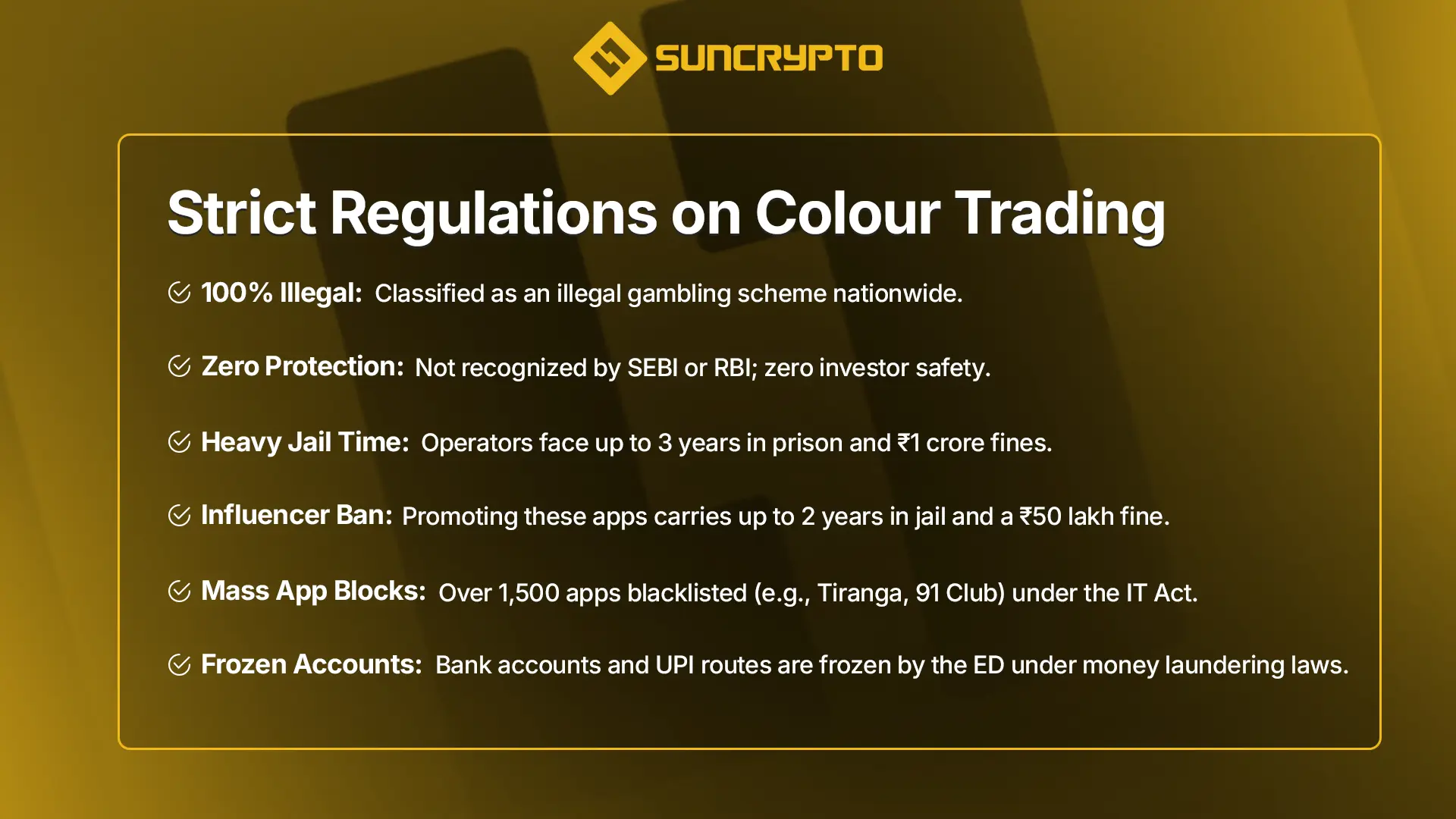
No. It is now a criminal offense.
The Promotion and Regulation of Online Gaming Act, 2025, received presidential assent on 22 August 2025, and the act, along with its rules, came into force on 1 May 2026. It bans all online money games, establishes the Online Gaming Authority of India under MeitY, and applies even to games that involve genuine skill, which colour trading does not.
The Act does not only target the people running these platforms. Offering, advertising, and facilitating online money games are all prohibited, with penalties of up to three years’ imprisonment and fines up to ₹1 crore.
This matters for ordinary users in three practical ways:
- You have no legal recourse: These platforms are not registered or recognized by SEBI, RBI, or any Indian financial regulator. When money disappears, there is no ombudsman, no grievance body, and no compensation scheme.
- Your bank account can be frozen: The Enforcement Directorate has frozen bank accounts and payment routes linked to several of these platforms under the Prevention of Money Laundering Act. If your account received funds through one of these networks, it can get caught in that net, even if you were a victim.
- Promoting them is itself an offense: Many young users are recruited as “agents” or referral promoters for commission. Under the new act, that is facilitation. Three agents linked to the Tiranga platform were arrested in a June 2024 bust, and enforcement has tightened considerably since.
How does the color-trading scam actually work?
Individual app names change constantly; once one gets blocked, three more launch on new domains. The names are not worth memorising. The pattern is. These apps follow a near-identical playbook, and learning it is the fastest protection.
Stage 1: Recruitment
A link arrives on WhatsApp or Telegram, often from someone you actually know who was recruited earlier and is now earning referral commission. The message promises daily earnings. Frequently the app is not on the Play Store at all; it is a direct APK download, which conveniently sidesteps app store review.
Stage 2: The small win
Your first deposit is small, and you win. Then you win again. This stage is engineered. Its only purpose is to convert skepticism into confidence.
Simple example: Priya deposits ₹1,000, and within twenty minutes her balance shows ₹1,650. She withdraws ₹500 successfully. The withdrawal working is the critical moment, it proves the app is “real.” She now trusts it with much more.
Stage 3: The scale-up
Encouraged by early success and often nudged by a “mentor” in a Telegram group sharing prediction tips, users deposit substantially more. Some borrow. Some use credit cards. Some dip into family savings.
The tips from the Telegram “expert” are worthless by definition; nobody can predict a server-controlled random number. But the group creates social proof, and the fake profit screenshots posted by other members (usually the operators’ own accounts) create urgency.
Stage 4: The turn
The wins stop. Losses become consistent and heavy.
Simple example: Priya has now deposited ₹85,000 in total. Her on-screen balance reads ₹240,000. She tries to withdraw.
Stage 5: The wall
The withdrawal fails. Now the reasons appear:
- “Account verification pending; pay ₹5,000 processing fee”
- “Minimum trading volume not reached; deposit ₹20,000 to unlock withdrawal.”
- “Tax clearance required before payout”
- KYC that never completes, no matter how many documents are uploaded
Every one of these is designed to extract more money from someone who believes they are protecting a ₹240,000 balance. That balance is just a number in a database. It was never real.
Eventually the account is blocked, the Telegram group deletes the user, or the app simply disappears and reappears under a new name.
How to spot colour trading in ten seconds?
If you see any of these, stop:
- Guaranteed or fixed returns: No legitimate financial product on earth promises this. A “minimum 10% return” claim is the oldest signal in the book.
- Not on the Play Store or App Store: Direct APK downloads bypass all review.
- Recruitment through WhatsApp or Telegram, especially with referral commission structures.
- You must deposit money to withdraw money: This is never legitimate under any circumstances.
- No verifiable company details: no CIN, no registered address, no named directors, no regulatory registration.
- Outcomes in under five minutes: Real markets do not resolve on a one-minute timer.
- A “mentor” or “expert” offering paid prediction tips. If they could predict it, they would not need your subscription fee.
- Pressure and urgency: limited-time bonuses, VIP tiers, and countdown offers.
What to do if you have already lost money?
- Act quickly. The first few hours matter most, because payment rails can sometimes be frozen before funds are moved onward.
- Call 1930 immediately: This is India’s national cybercrime helpline. Reporting within the “golden hour” gives the best chance of transaction reversal.
- File a complaint about cybercrime.gov.in: The National Cybercrime Reporting Portal handles financial fraud complaints directly.
- Contact your bank: Ask them to flag and block further transactions to the recipient accounts and request a transaction dispute.
- File an FIR at your local police station: An FIR strengthens any recovery attempt and is often required by banks.
- Preserve every piece of evidence: Screenshots of the app, payment records, UPI transaction IDs, WhatsApp and Telegram chat histories, and the referral link you received. Do not delete the app before capturing this.
- Ignore “recovery agents”: A second wave of scammers targets victims of the first, promising to recover lost funds for an upfront fee. Nobody legitimate charges you upfront to recover scammed money.
- Talk to someone: Losses of this kind carry heavy shame, and people frequently hide them and keep gambling to recover. If you or someone you know is struggling with the emotional impact or with compulsive betting, please speak to a family member you trust or contact a professional counselor. The financial loss is recoverable over time. Please do not carry it alone.
What to do instead of colour trading?
If the underlying goal was to grow money or build a side income, there are legitimate, regulated routes. They are slower and far less exciting, which is precisely why they work.
- Mutual funds and index funds through SEBI-registered platforms, ideally via SIP
- Fixed deposits and recurring deposits for capital you cannot afford to risk
- Direct equity through a registered broker, after learning the basics properly
- Public Provident Fund and government schemes for long-term, tax-efficient saving
- Crypto through FIU-registered Indian crypto exchanges like SunCrypto, understanding that this is genuinely volatile and taxed at 30% plus 1% TDS
- Skill-based income from freelancing, tutoring, and content work, which has no house edge at all
The uncomfortable truth is that no legitimate method turns ₹500 into ₹12,000 in an afternoon. Anything claiming to be either gambling or theft, and colour trading manages to be both.
The Bottom Line
Colour trading survives on one clever piece of misdirection: the word “trading.” Strip that away, and what remains is a rigged betting game with a mathematically guaranteed loss, run by unregistered operators, now criminalized in India, promoted through referral networks that turn victims into recruiters.
If someone sends you a link today, the correct response is not to research the app. It is to not open it and to warn the person who sent it because they are very likely losing money too.
Disclaimer: This article is for informational and educational purposes only and does not constitute financial, investment, or legal advice. It does not endorse or recommend any betting or gambling platform. Readers who have suffered financial loss should contact the National Cybercrime Helpline on 1930 and consult a qualified legal professional. Legal provisions and enforcement practices may change; verify current requirements against official government sources.
What is colour trading in simple words?
It is an online betting game where you pay money to guess whether red, green, or violet will appear after a short timer. It has nothing to do with actual trading; you never own any asset.
Is colour trading legal in India in 2026?
No. Real-money colour prediction games are banned under the Promotion and Regulation of Online Gaming Act, 2025, which came into force on 1 May 2026. Offering, promoting, or facilitating these games carries penalties of up to three years’ imprisonment and fines up to ₹1 crore.
Can you actually win money at colour trading?
You can win individual rounds that is essential to the design. But the payout structure guarantees losses over time, and the results are controlled by the operator’s own server. Sustained profit is not possible.
Is there any strategy or trick to win?
No. The outcome is chance-based and server-controlled. Anyone selling prediction tips, “hacks,” or paid VIP signals is part of the scheme or profiting from it.
Are colour trading apps registered with SEBI or RBI?
No. They hold no financial license from any Indian regulator, which is why victims have no formal recourse.
What if I only promoted the app and never played?
Promotion and facilitation are explicitly covered by the 2025 Act. Referral agents have already been arrested in India. If you are currently promoting such a platform, stop immediately.
Can I get my money back?
Recovery is difficult but not impossible, particularly if you report within hours. Call 1930, file at cybercrime.gov.in, alert your bank, and file an FIR. Never pay an upfront fee to anyone promising recovery.
Why do these apps keep appearing even after being banned?
Blocking is only partly effective. Operators relaunch on fresh domains and continue reaching users through VPNs, social media, and messaging apps. This is exactly why recognizing the pattern matters more than tracking individual app names.
Is colour trading the same as crypto trading?
No, and this confusion is deliberate on the operators’ part. Crypto trading involves buying real digital assets on regulated exchanges, with genuine market-driven prices. Colour trading involves no asset and no market.