

Investing in cryptocurrency can be difficult for anyone unsure about when to buy or how much to invest at once. A crypto SIP in India solves this by letting investors put in a fixed amount at regular intervals, instead of trying to time the market with a single lump-sum purchase.
The idea borrows directly from mutual fund SIPs, a format Indian investors are already familiar with. With crypto exchanges now offering automated recurring investment tools, a crypto SIP in India can be set up for assets like Bitcoin, Ethereum, XAUT, and PAXG. That said, crypto remains a volatile, market-linked asset class; a SIP changes how you invest, not whether you can lose money.
What is a Crypto SIP?
A Crypto SIP in India is a systematic investment plan where a fixed amount is invested in a chosen cryptocurrency at regular intervals, weekly, monthly, or whatever schedule the platform supports.
For example, an investor could set up a crypto SIP to buy ₹1,000 worth of Bitcoin every month, rather than committing a lump sum at one price point. Because purchases happen across many price points, the average cost per unit tends to smooth out over time, a concept known as rupee-cost averaging. This doesn’t guarantee a lower average price or a profit; it only spreads out the timing risk of a single large purchase.
How does a Crypto SIP work?
Setting up a Crypto SIP in India generally follows these steps:
- Download the Suncrypto app, available in both iOS and Android versions..
- Complete your Signup and KYC registration, and add your bank account.
- Visit the Suncrypto dashboard, and click the SIP icon.
- Choose the cryptocurrency, you want to start SIP in.
- Select the investment amount.
- Choose a schedule (daily, weekly or monthly).
- Confirm the recurring investment.
- The exchange automatically deducts the amount and buys the asset on each scheduled date.
- The purchased crypto is credited to the investor’s portfolio.
SunCrypto’s SIP feature, for instance, lets users pick a fixed amount and have it automatically invested in their chosen asset on the selected date, with the option to change the amount, shift the date, or pause it entirely whenever needed.
Crypto SIP vs Mutual Fund SIP
| Feature | Crypto SIP | Mutual Fund SIP |
| Investment | Cryptocurrency | Mutual fund units |
| Underlying asset | Digital assets | Equity, debt, hybrid or other securities |
| Frequency | Depends on platform | Usually monthly |
| Returns | Market-linked, high variance | Market-linked, generally lower variance |
| Risk | Can be highly volatile | Depends on the fund category |
| Diversification | Depends on assets chosen | Often built into the fund |
| Taxation | VDA tax rules (flat 30%) | Depends on fund type and holding period |
A Crypto SIP in India doesn’t convert crypto into a regulated mutual fund product, it’s simply a disciplined method of buying crypto. The regulatory and tax treatment stays entirely different from a mutual fund SIP.
Why investors use a Crypto SIP in India
Removes the guesswork of timing the market. Instead of trying to guess the “right” entry point in a fast-moving market, purchases happen automatically across multiple dates and prices.
Encourages disciplined investing. A fixed schedule reduces impulsive, emotion-driven decisions that often come from watching short-term price swings.
Lower entry barrier. Most platforms allow a Crypto SIP in India to start from as little as ₹100 a month, so investors don’t need a large sum to begin.
Fully automated. Once set up, recurring purchases happen on their own, no need to manually place an order every time.
Suited to long-term exposure. Investors who want consistent, ongoing exposure to crypto, rather than a single bet, often prefer this structured approach. That said, whether a Crypto SIP fits your goals still depends on your own risk appetite and financial plan.
Popular Crypto SIP investment options in India
1. Bitcoin SIP
Bitcoin is the most widely held and widely supported crypto asset on Indian exchanges, making it the default choice for many investors. A Bitcoin SIP means investing a fixed amount in BTC on a set schedule, gaining exposure to its price movements, which have historically been significant in both directions. Bitcoin’s long track record makes it a common starting point for a Crypto SIP in India, though past performance is never a guarantee of future results.
2. XAUT SIP
XAUT (Tether Gold) works differently, it’s a token backed by physical gold rather than a conventional cryptocurrency. Each XAUT token represents one fine troy ounce of London Good Delivery gold, held in a Swiss vault, and can be fractionalized down to six decimal places. An XAUT SIP gives recurring exposure to gold’s price movements, which tend to behave very differently from Bitcoin or Ethereum.
3. PAXG SIP
PAXG (Pax Gold) is a second tokenized-gold option. Each PAXG token also represents one fine troy ounce of London Good Delivery gold, held in LBMA-accredited vaults in London, with fractional ownership supported. Because it’s gold-backed rather than a standard cryptocurrency, PAXG’s price behavior typically diverges from BTC and ETH, useful for investors who want a Crypto SIP in India that isn’t purely tied to crypto-market sentiment.
4. Ethereum SIP
Ethereum, the network behind a large share of decentralized applications, is the other major asset used for crypto SIPs. An Ethereum SIP means buying ETH at fixed intervals rather than in one go. Like Bitcoin, ETH can see sharp price swings, so an Ethereum SIP carries the same market risk, it simply changes the timing of purchases, not the underlying volatility.
Returns and portfolio for Crypto SIP investors
A quick look at the cycle
Bitcoin’s most recent bear market bottomed in June 2022, when the price fell to around $17,600, and it held above that level even through the FTX collapse later that year. From there, it went on a long climb that ended with a record high above $126,000 on October 6, 2025.
The peak didn’t last. Days later, more than $19 billion in crypto positions were wiped out in the October 10–11 crash as leveraged bets unravelled. Bitcoin started 2026 near $87,500 and slid through the first half of the year, closing June around $58,500, roughly half its record high.
Since then, it has bounced back. It reached an intraday high of $82,283 on September 3, and as of September 16, 2026 it was trading near $77,500. That’s still well below the peak, but far above the June lows.
Here’s how that journey would have felt depending on when a SIP investor joined.
1. The early starters (2022–2023): Patience through the fear
People who started a crypto SIP in India during the 2022 bear market had the hardest emotional journey but the most favourable math. They were buying while headlines called crypto dead, exchanges were collapsing abroad, and friends were selling at a loss. For months, their SIPs showed red almost every time they opened the app.
But those monthly purchases were happening at some of the lowest prices of the cycle. By the time Bitcoin crossed $100,000, their early instalments had multiplied several times over. Even after the 2026 correction, investors who stayed consistent from that period would typically still hold an average cost well below today’s price.
Their lesson: the months that feel worst to invest in often do the most work for a SIP.
2. The middle wave (2024): Strong gains, then a reality check
Investors who started in 2024 bought across a wide range, from around $40,000 early in the year to above $100,000 by December. At the October 2025 peak, many of them were looking at strong gains on paper.
The 2026 decline erased a large share of that. Depending on when they began and whether they kept investing, many are still in profit today, but with far thinner margins than a year ago. Some who started late in 2024 hovered close to break-even during the June lows.
Their lesson: paper profits at a peak aren’t guaranteed. Volatility works in both directions.
3. The boom-time joiners (2025): Buying near the top
This is the group that drove the headlines. Crypto SIPs grew more than 60% year-on-year across major Indian exchanges in 2025, much of it from first-time investors. But enthusiasm peaked alongside prices, so many of these investors made most of their purchases between roughly $90,000 and $126,000.
For them, 2026 has been a tough introduction. At the June lows, someone who invested only during 2025 could have been down 40% or more. Even with Bitcoin back near $77,500, a large number of boom-time joiners are still below their average purchase price. Many are experiencing their first real crypto drawdown, and it’s testing whether they truly had a long-term plan or were simply following the excitement.
Their lesson: starting a SIP during a hype cycle doesn’t make you a long-term investor. Staying through the downturn does.
4. The ones who kept going: SIP working as designed
Among 2025 starters, the biggest dividing line is what they did after the peak. Consider this simplified illustration using rounded prices:
Investor A invests a fixed amount every month for 10 months while Bitcoin averages around $110,000, then stops after the crash. To break even, Bitcoin has to climb back to about $110,000.
Investor B invests the same 10 instalments, but keeps going for another 9 months while the price averages about $70,000. Those lower-priced purchases pull their average cost down to roughly $87,000.
Same start date, very different position. With Bitcoin near $77,500, Investor B is much closer to recovery and needs a far smaller rally to move into profit. This is rupee cost averaging doing exactly what it’s meant to do: buying more units when prices are low.
This is a simplified example with rounded prices, meant only to illustrate the concept. Actual results depend on exact purchase dates, prices, fees and exchange rates.
5. The ones who stopped or sold: Locking in the worst outcome
The investors with the most painful results are usually not the ones who started at the wrong time. They’re the ones who paused their SIP in panic, or sold during the June lows.
Pausing freezes your average cost at its highest point and skips the cheaper purchases that help recovery. Selling turns a temporary paper loss into a permanent one. In India, that hurts more than it might elsewhere, because crypto losses cannot be set off against other income, while any future gains are taxed at a flat 30%.
6. The new starters (2026): Buying at a discount, with no guarantees
Anyone who began a SIP in the first half of 2026 bought while prices were falling. Those who started near the June lows are already sitting on gains as of September. Investors who begin now are buying roughly 38% below the record high.
That doesn’t mean the bottom is in. Analysts remain divided on whether Bitcoin has fully recovered or faces another leg down, and nobody can reliably predict it. What a SIP offers new investors is a way to participate without needing to answer that question.
What this means for anyone considering a crypto SIP
The real story of crypto SIP in India isn’t “invest ₹100 and get rich.” It’s that results depend heavily on time horizon and behaviour.
Consistency matters more than timing, since the investors who kept buying through the worst months are generally in the best position. Your time horizon needs to be measured in years, because a crypto SIP in India running for six months tells you very little and a full market cycle can take three to four years. The amount should be something you can keep investing through a 50% drop without stress, because if a downturn would force you to stop or sell, the SIP amount is too large. And returns are never guaranteed: past cycles recovered, but Bitcoin’s history cannot promise the next one will.
A crypto SIP in India doesn’t remove risk. It simply gives disciplined investors a way to stay steady through a market that rarely is.
Top platforms offering Crypto SIP in India
Before picking a platform for a Crypto SIP in India, it’s worth comparing supported assets, minimum investment amount, fees, scheduling flexibility, and how easily a SIP can be paused or edited.
1. SunCrypto: Most flexible option
SunCrypto stands out among platforms offering Crypto SIP in India on a few fronts. Its SIPs start from as little as ₹100 a month and cover a wide asset range, BTC, ETH, XAUT, PAXG and other blue-chip tokens. Uniquely, SunCrypto allows users to run two SIPs in the same asset on different dates, which is useful for aligning purchases with a salary cycle or spreading risk across the month.

SunCrypto also gives users real control after setup: contributions can be adjusted, dates changed, and SIPs paused, without needing to cancel and restart. On cost, SunCrypto currently charges ₹0 to start a Crypto SIP, trading fees apply only when crypto is actually bought or sold, plus applicable GST on those trading fees. Between the flexible scheduling, wide asset coverage and no SIP-starting fee, it’s currently one of the more investor-friendly ways to run a Crypto SIP.
2. CoinDCX
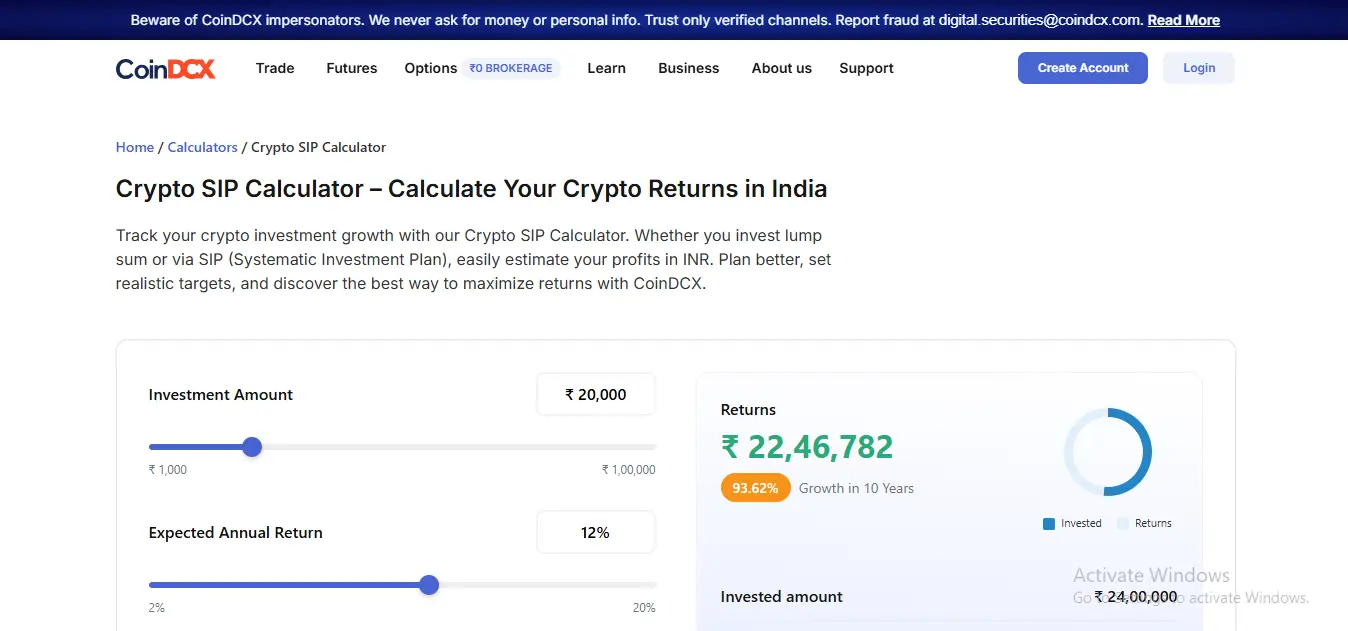
CoinDCX supports a Crypto SIP in India, letting users start from ₹100 with a choice of daily, weekly or monthly frequency. Per its support documentation, SIP instalments are deducted directly from the user’s INR/Spot Wallet on the scheduled date, with applicable fees taken out before the crypto is credited to the portfolio.
3. Mudrex
Mudrex is another Indian exchange offering a systematic, recurring-investment option for crypto assets. It supports scheduled purchases across major coins, giving investors another route to structure a Crypto SIP in India without manually timing each trade. As with any platform, it’s worth checking Mudrex’s current fee structure and supported assets directly before committing, since these details can change.
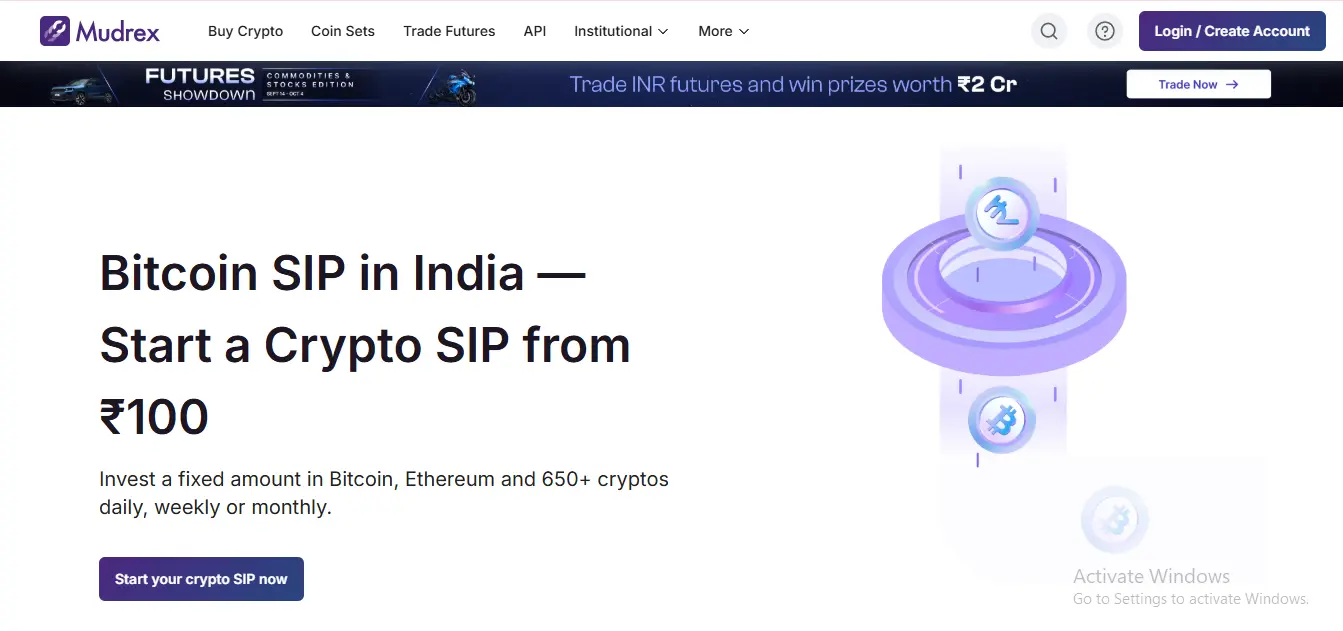
The availability of a Crypto SIP shifts as exchanges update their products, so it’s worth confirming the latest terms on the platform’s official site before setting one up.
On SunCrypto, this entire process, picking the asset, setting the amount, and choosing the schedule, takes just a few steps, with the option to tweak any of it later.
Charges and taxes on a Crypto SIP in India
There are two separate cost layers to understand: fees for running the SIP itself, and fees/taxes on the underlying crypto transactions.
SunCrypto, for example, charges ₹0 to start a Crypto SIP, with trading fees applying only on the actual buy/sell transaction, plus 18% GST on those trading fees.
Taxation: Crypto is classified as a Virtual Digital Asset (VDA) under Indian tax law. Per the Income Tax Department, income from transferring VDAs is taxed at a flat 30%, plus applicable surcharge and 4% cess, under Section 115BBH. These transactions must be reported under Schedule VDA in ITR-2 or ITR-3. TDS provisions also apply to certain VDA transfers, investors should check the current rules for the relevant financial year before filing.
Because of this, the real cost of a Crypto SIP in India isn’t just the exchange’s fee structure, it also includes tax on any gains when the asset is eventually sold.
Final thoughts
A Crypto SIP in India offers a structured, automated way to build crypto exposure over time, rather than depending on a single lump-sum entry. Bitcoin and Ethereum provide access to two of the largest crypto assets, while XAUT and PAXG offer a gold-backed alternative within the same recurring-investment format.
Still, a Crypto SIP in India isn’t a guarantee of profit or a way to remove volatility, it only changes how purchases are timed. Before starting one, it’s worth comparing platforms on fees, flexibility and asset support, and understanding VDA tax rules.
Among the platforms covered here, SunCrypto currently offers one of the more flexible setups, SIPs from ₹100 a month across BTC, ETH, XAUT and PAXG, the ability to run two SIPs on different dates within the same asset, full control to pause or edit a SIP anytime, and ₹0 fees to get started.
What are the top crypto SIP options in India?
Bitcoin, Ethereum, XAUT and PAXG are the most commonly used assets for a Crypto SIP in India, with the right choice depending on an investor’s goals and what the exchange supports.
What are the charges and taxes on a Crypto SIP in India?
Charges vary by platform, SunCrypto, for instance, charges ₹0 to start a SIP, with trading fees and 18% GST applying only when crypto is bought or sold. Separately, gains from selling VDAs are taxed at a flat 30%, plus surcharge and 4% cess, under Section 115BBH.
Can I start a Crypto SIP in India with a small amount?
Yes. Platforms like SunCrypto and CoinDCX allow a Crypto SIP to start from as little as ₹100 a month, making it accessible even for first-time investors.