

The New Macro Playbook for Crypto
April 2026 is throwing up some interesting signals. US stocks are hitting record highs despite tensions in the Middle East, while the BTC price is stuck below a key price ceiling. The S&P 500 has crossed 7,100 and the Nasdaq is above 24,200, driven by hopes around peace talks with Iran.
While BTC also breaks out of $70,000 resistance levels and is trading around $79,000, altcoins are lagging behind as money flow is mostly in selective coins. Money is now flowing into sectors like AI, Real World Assets (RWA), and Decentralized Physical Infrastructure Networks (DePIN).
Why is the BTC price linked to US stocks?
The idea that Bitcoin is an asset that moves independently of stocks is no longer valid. BTC now moves 84% in correlation with the S&P 500 and 87% in correlation with gold. This is a structural shift. Large institutions now treat BTC as a liquid asset they buy or sell alongside stocks to manage their risk.
The main reason is the Bitcoin ETF boom. In Q1 2026 alone, spot BTC ETFs pulled in $18.7 billion. With big names like BlackRock and Morgan Stanley deeply involved, BTC now behaves more like a stock than digital gold. This isn’t a problem for BTC; it’s the result of mainstream institutional adoption.
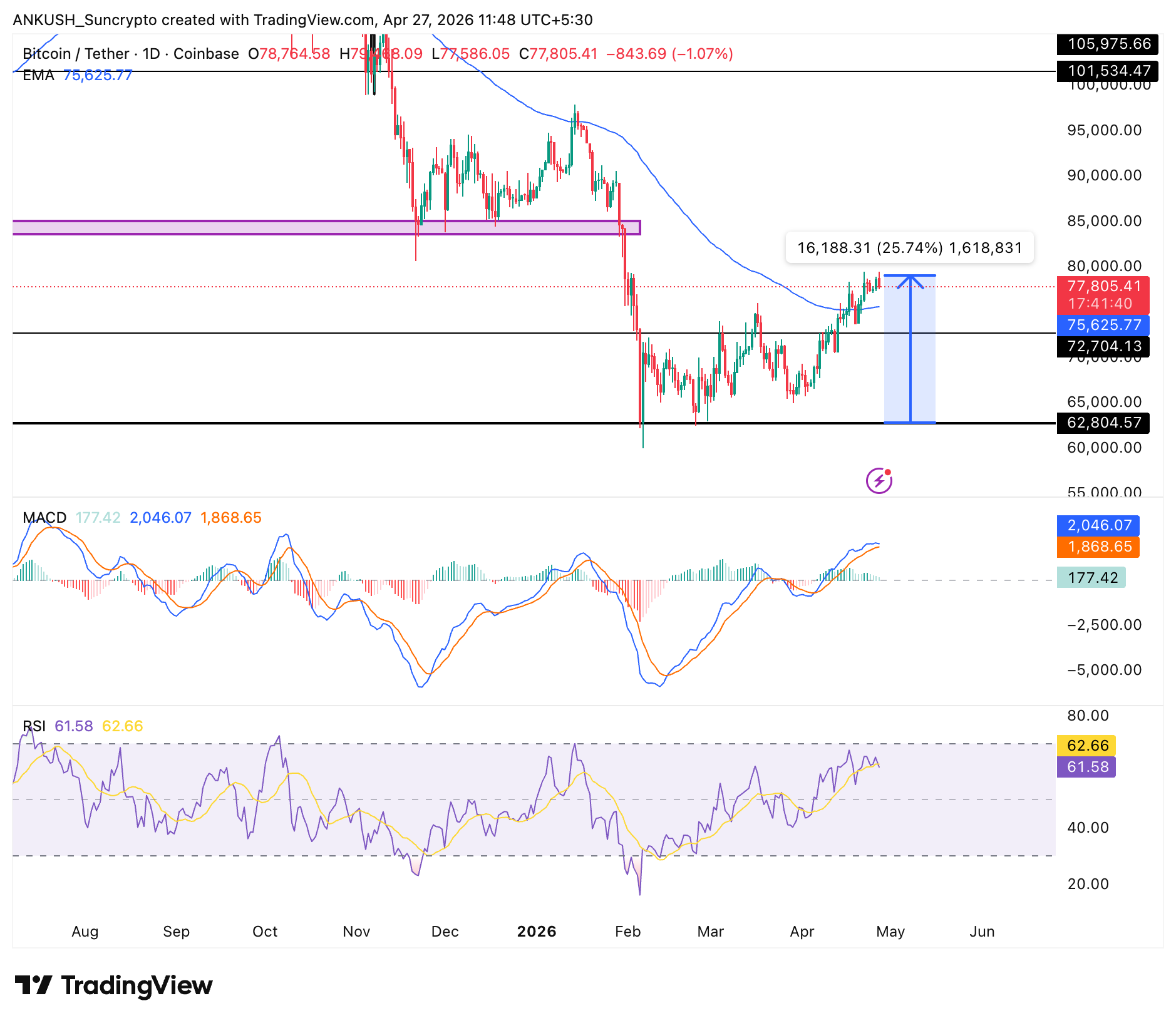
BTC vs US stocks
Stocks have been on a tear. Nvidia recently had an 11-day winning streak, and the Nasdaq posted its longest run of gains since 2009. Stocks are up roughly 11% from their March lows.
Bitcoin’s recovery is slower. While stocks hit new records, BTC is also getting ready to break resistance levels of $80,000 and is up ~$20,000 from its recent bottom.
When does BTC diverge from US stocks?
Despite the close relationship, certain events can push BTC off course. Interest rate policy is a big one. With the Federal Reserve holding rates at 3.50%–3.75%, any hint of future cuts weakens the dollar and boosts the case for Bitcoin as “hard money.”
Supply dynamics matter too. Less than 7% of all BTC remains to be mined, and millions are permanently lost. This fixed supply creates a scarcity story that stocks simply can’t match. Geopolitical events can also cause bigger percentage moves in BTC than in traditional markets.
What Drives BTC Price Beyond Stocks?
Internal factors still matter a lot. We’re in the late phase of the cycle that followed the April 2024 halving. On top of that, the amount of BTC available on exchanges is shrinking as long-term holders refuse to sell, creating a supply squeeze that shows up on-chain.
What does this mean for Indian investors?
Indian traders face unique challenges. A weakening rupee makes BTC a natural hedge against inflation, but the 30% flat tax on gains is a real obstacle. Since big macro moves often happen during US market hours, Indian investors need to plan rather than react after the fact.
How to trade BTC in a macro-driven market?
Watch Correlation Windows: Know whether the market is in “risk-off” mode (everything moves together) or a “liquidity-rich” phase (BTC follows its own path).
- Respect Resistance: Don’t rush into breakouts. Wait for a daily close above key price levels.
- Use the macro calendar: Plan trades around Fed meetings and CPI data releases.
- Limit Altcoin Exposure: Don’t pile into altcoins while BTC is still battling resistance.
Why Are Only Narrative-Driven Tokens Pumping in 2026?
Picking the right story is everything in 2026. RWA has grown into a $29.2 billion sector, and AI crypto is projected to reach $55 billion by 2035. Tokens that are “just another Layer 1” are struggling. Investors are only backing projects tied to big trends like AI, infrastructure, or institutional finance.
Conclusion
The 2021 era of “everything pumps” is over. In 2026, macro trends and specific narratives determine who wins. For traders, success means watching US market signals, respecting market structure, and focusing on high-conviction sectors.
Why does Bitcoin move with the stock market?
Institutional investors now manage Bitcoin alongside equities via Bitcoin ETFs and futures, causing them to adjust both assets simultaneously in line with global risk appetite. This shared liquidity means that when the macro environment shifts, Bitcoin and stocks often move in the same direction.
Can Bitcoin outperform US stocks?
Historically, Bitcoin has significantly outperformed equities during post-halving bull cycles and periods of aggressive Fed pivots or currency debasement. However, its higher volatility means it can also underperform stocks during “risk-off” phases, when investors seek safety.
Should traders track US markets before trading BTC?
Yes, monitoring the S&P 500, DXY, and Treasury yields is essential because Bitcoin technical setups are highly sensitive to the broader macro backdrop. A BTC breakout is much more likely to succeed when US markets are in “risk-on” mode rather than facing macro headwinds.
Is Bitcoin still a hedge against traditional markets?
While Bitcoin currently correlates with stocks in the short term, it remains a long-term structural hedge against dollar debasement and monetary system dysfunction. It functions less as a day-to-day diversifier and more as a multi-year insurance policy against traditional financial instability.