
As of April 2026, Ethereum (ETH) continues to trade in the $2,200–$2,400 range, a level that closely resembles parts of its 2021 market cycle. For many investors, this raises an important question: why has ETH not significantly outperformed its earlier cycle highs despite years of technological upgrades, ecosystem expansion, and increasing adoption?
The answer lies in a combination of structural changes within the Ethereum network, evolving market narratives, macroeconomic conditions, and shifting investor behavior. Ethereum has not stagnated in terms of development; in fact, it has evolved significantly, but the way value accrues to ETH has changed, and the market is still adjusting to this transformation.
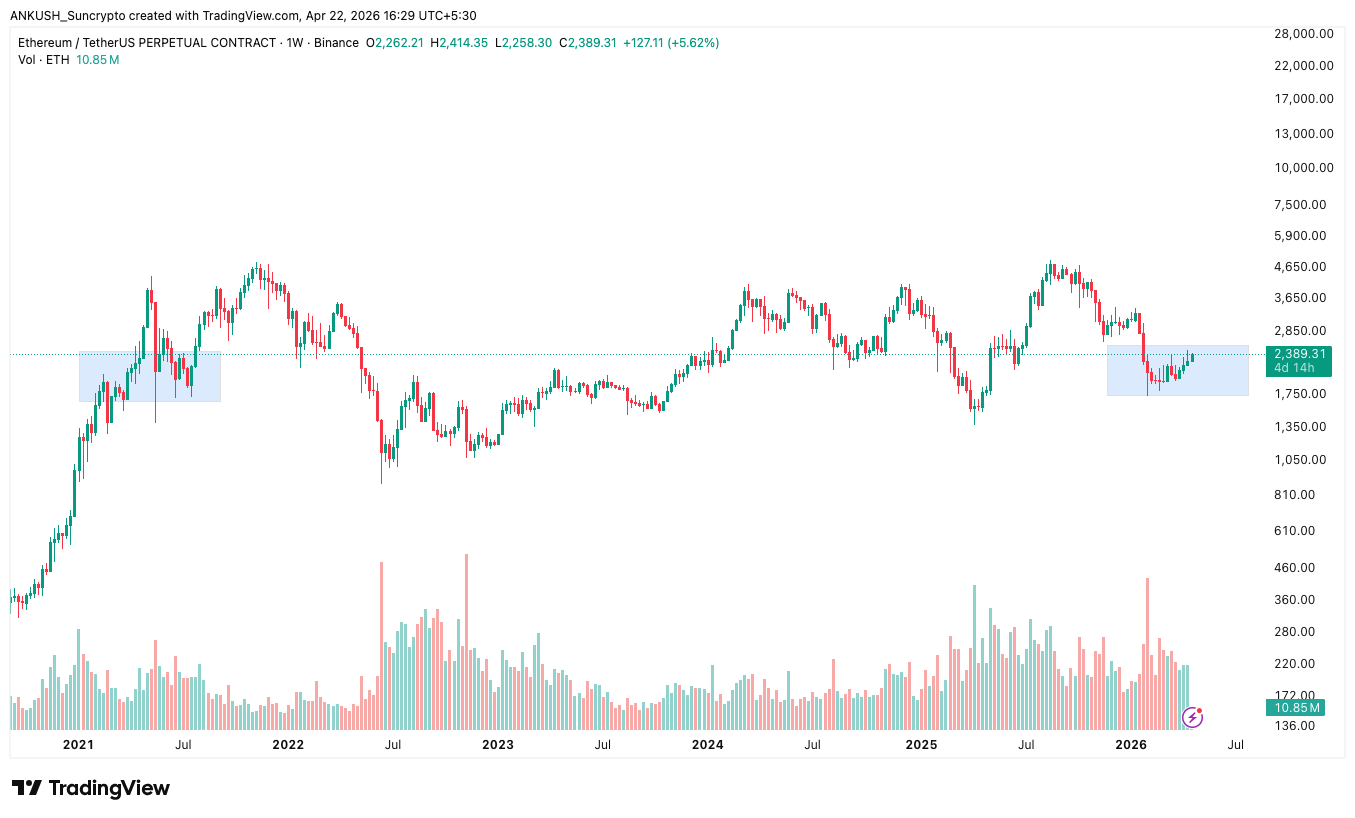
Below is a detailed breakdown of the key reasons behind Ethereum’s relatively flat price performance over the past few years.
From Strong Deflation Narrative to Variable Supply Dynamics
One of the biggest drivers of Ethereum’s bullish narrative in the 2021–2022 period was its transition toward deflationary tokenomics after the introduction of EIP-1559. This upgrade enabled a portion of transaction fees to be burned, reducing circulating supply and supporting the idea of ETH as “ultrasound money.”
However, this dynamic has changed following the Dencun upgrade in March 2024, which introduced EIP-4844 (proto-danksharding). This upgrade significantly reduced transaction costs on Layer 2 networks by providing dedicated data storage for rollups.
While this was a major step forward for scalability, it also had an unintended consequence: lower transaction fees on the Ethereum mainnet. Since ETH burn is directly linked to network fees, reduced fee levels led to a decline in the burn rate.
As a result, Ethereum has shifted into a more dynamic supply environment, alternating between deflationary and mildly inflationary phases depending on network activity. This has weakened one of the strongest narratives that previously drove price growth.
The Layer 2 Expansion and the Value Capture Challenge
Ethereum’s long-term roadmap has prioritized scalability through Layer 2 solutions such as Arbitrum, Optimism, and Base. These networks process transactions off the main chain and settle them on Ethereum, making transactions faster and significantly cheaper.
This strategy has been highly successful in terms of adoption and user experience. However, it has also created a value capture challenge.
In 2021, most activity occurred directly on Ethereum’s Layer 1, generating high fees and strong demand for ETH. In contrast, by 2026, a significant portion of activity has shifted to Layer 2 networks, where users pay much lower fees.
This means:
- Less fee revenue is generated on Layer 1
- Reduced ETH burn due to lower fees
- Lower direct economic activity tied to the mainnet
Ethereum is increasingly acting as a settlement and data availability layer, rather than the primary execution layer. While this is a positive evolution from a scalability perspective, the market is still in the process of understanding and pricing this new model of value accrual.
Rising Competition from Alternative Blockchains
Since 2021, the competitive landscape in the blockchain industry has changed significantly. Networks such as Solana have emerged as strong alternatives, particularly in areas that require high speed and low transaction costs.
Solana has gained traction in:
- Retail trading
- NFT ecosystems
- High-frequency applications
- DePIN (Decentralized Physical Infrastructure)
These use cases often demand performance levels that are difficult to achieve on Ethereum’s Layer 1 without relying on Layer 2 solutions.
While Ethereum still leads in terms of security, decentralization, and developer ecosystem size, competition has fragmented user activity and capital flows across multiple chains.
This has reduced Ethereum’s dominance in certain sectors and contributed to slower price appreciation compared to earlier cycles.
Institutional Capital Has Favored Bitcoin Over Ethereum
The approval of spot Bitcoin and Ethereum ETFs in 2024 marked a major milestone for the crypto industry. However, the impact on Ethereum has been more muted compared to Bitcoin.
There are several reasons for this:
- Ethereum ETFs typically do not include staking rewards, which reduces their attractiveness to yield-seeking investors
- Ethereum’s value proposition is more complex and harder to communicate compared to Bitcoin’s “digital gold” narrative
- Bitcoin has benefited from stronger institutional branding and macro positioning
As a result, Bitcoin has attracted significantly higher institutional inflows, especially through ETF products. This has led to a capital concentration in BTC, limiting Ethereum’s upside during the same period.
Market Cycles and Bitcoin Dominance
Crypto markets tend to follow cyclical patterns where capital flows in stages. Typically, Bitcoin leads the rally, followed by large-cap altcoins like Ethereum, and then smaller-cap tokens.
During the 2024–2025 cycle, Bitcoin dominance remained elevated for an extended period. This delayed the usual rotation of capital into Ethereum.
Even though ETH has historically benefited from altcoin cycles, it often lags Bitcoin in the early and mid phases of a bull market. This timing dynamic has contributed to Ethereum appearing stagnant despite broader market growth.
From DeFi and NFTs to AI and Infrastructure
Ethereum’s explosive growth in 2021 was largely driven by the rise of DeFi and NFTs. These sectors generated massive user activity, high transaction fees, and strong speculative interest.
However, the crypto market in 2024–2026 has shifted toward new narratives, including:
- Artificial intelligence (AI) integration
- Real-world asset (RWA) tokenization
- Infrastructure and scalability solutions
While Ethereum remains deeply involved in many of these areas, it is no longer the sole dominant platform driving narrative momentum.
This shift has diluted speculative demand for ETH, as investor attention is now spread across a wider range of emerging sectors and projects.
Macroeconomic Conditions and Risk Appetite
Broader macroeconomic conditions have also played a role in Ethereum’s price performance. Factors such as interest rates, global liquidity, and institutional risk appetite influence capital allocation across asset classes.
In periods of tighter liquidity or cautious investment sentiment, capital tends to favor lower-risk or more established assets like Bitcoin, rather than more complex platforms like Ethereum.
This macro backdrop has further contributed to Ethereum’s relatively subdued price action compared to expectations.
Is Ethereum Underperforming or Evolving?
Although Ethereum’s price appears to be near its 2021 levels, the network itself has undergone significant transformation.
Key developments include the following:
- Rapid growth of Layer 2 ecosystems
- Increased adoption of real-world asset tokenization
- Continuous improvements in scalability and infrastructure
- A strong and active developer community
Ethereum is transitioning from a monolithic blockchain into a modular, multi-layer ecosystem. This shift may temporarily reduce direct value capture at the base layer but could lead to stronger long-term scalability and adoption.
If Layer 2 networks continue to expand and contribute greater economic activity back to Ethereum, it could strengthen the burn mechanism and potentially restore deflationary pressure over time.
Final Thoughts
Ethereum’s price being close to its 2021 levels is not necessarily a sign of stagnation. Instead, it reflects a period of structural transition and market recalibration.
The combination of evolving tokenomics, Layer 2 expansion, increased competition, institutional preferences, and changing market narratives has reshaped how value flows within the Ethereum ecosystem.
While short-term price performance may appear muted, Ethereum’s long-term role as a foundational layer for decentralized applications, finance, and digital infrastructure remains strong.
For investors, the key takeaway is that Ethereum is not standing still—it is adapting to a more scalable and complex future, and the market is still in the process of pricing that transformation.
Bright future