
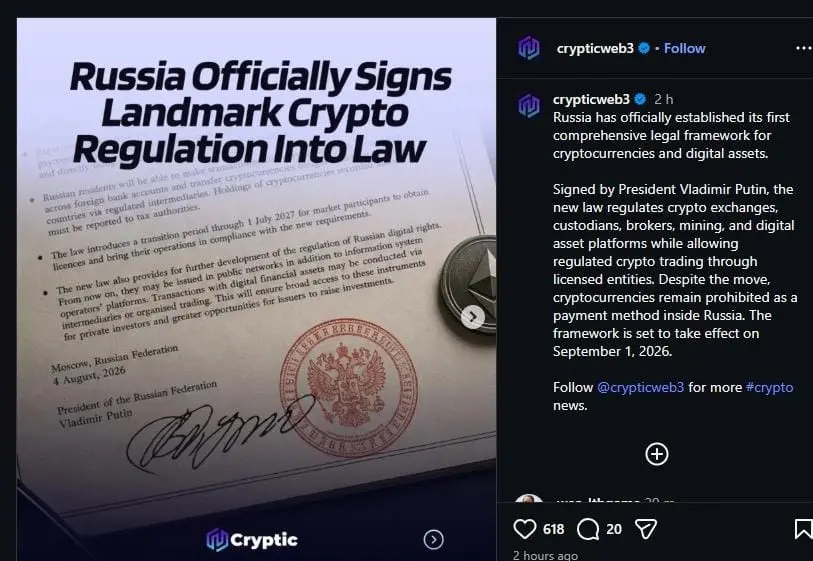
Russia has formally entered a new phase of digital-asset regulation after President Vladimir Putin signed the country’s first comprehensive crypto law, the Law on Digital Currencies and Digital Rights, on August 4, 2026. The nearly 300 page legislation establishes a legal framework for cryptocurrency trading and related activities, with its core provisions scheduled to take effect on September 1, 2026.
The move gives Russia a formal structure for crypto trading and related activities while the United States continues working toward broader digital-asset market legislation.
What Russia’s New Crypto Law Brings
The law creates a regulated route for cryptocurrency trading through licensed intermediaries, exchanges, digital depositories, brokers, trading venues, and clearing houses ,under the oversight of the Bank of Russia.
Both qualified and non qualified investors will be able to transact, but only in cryptocurrencies regulators classify as the most liquid; the Central Bank has indicated Bitcoin, Ethereum, and USDT currently meet that bar. Non qualified (retail) investors must pass a suitability test and face a purchase cap of 300,000 rubles (roughly $3,800) per year through a single licensed intermediary. Qualified investors also take the test but face no comparable annual purchase limit.
Banks have also been given the power to block suspicious crypto-related transactions, and a 48 hour cooling off period applies to wallet transfers, both framed as anti-fraud measures.
Crypto Is Not Becoming Domestic Money
Despite the scale of the legislation, Russia’s crypto law does not make Bitcoin or other cryptocurrencies legal tender alongside the ruble.
The ruble remains Russia’s sole domestic legal currency, and cryptocurrencies still cannot be used as a payment method for goods and services inside the country. The framework instead focuses on regulated trading and investment, while providing a legal channel for digital assets to be used in certain international transactions.
That distinction makes Russia’s approach more measured than simply opening the economy to unrestricted crypto payments. The government is bringing crypto activity under a formal regulatory structure while retaining control over how digital assets can be used domestically, this follows a multiyear experimental framework that had permitted limited mining and cross border crypto payments since 2024, which this law now makes permanent.
The international component could nevertheless prove significant. Digital assets can give Russian businesses another channel for cross-border settlements at a time when Ukraine related sanctions have severely restricted access to Western dollar and euro based payment systems.
Russia Moves While the US Works on Its Framework
The timing has also drawn attention because the United States is still working toward a broader framework for digital assets.
The US has already passed the GENIUS Act, establishing federal rules for stablecoins. The broader CLARITY Act, which would set clearer rules around digital asset market structure and regulatory responsibilities, remains stuck: the White House is still reviewing a bipartisan proposal meant to resolve an ethics dispute tied to the bill, and it wasn’t on the Senate’s schedule before the chamber’s August recess.
This doesn’t necessarily mean Russia has “won” a global crypto race, as some social-media posts have claimed. The more measurable difference is that Russia has moved from drafting its framework to sign legislation with a defined implementation date, while the US is still working through its broader market-structure rules.
What Happens After September 1?
The effectiveness of Russia’s crypto law will ultimately depend on how the new system works in practice. Not everything launches at once: provisions on certain transfer restrictions and non-resident digital depositories don’t kick in until July 1, 2027, and the technical rules for digital financial assets and nominal holders follow on September 1, 2027, with a transition window for existing operators until March 1, 2027.
The Bank of Russia will play the central supervisory role, while exchanges, digital depositories, and other participants adapt to the new licensing requirements. For investors, the September 1 launch will show how accessible regulated cryptocurrency trading actually becomes under the new system.
Russia’s move represents more than another crypto policy announcement, it establishes a formal regulatory path for digital assets while keeping the ruble as the country’s sole domestic currency. With the US still working through its own broader framework, the two countries are now approaching crypto regulation on very different timelines.