
EigenLayer entered 2026 as the dominant restaking protocol on Ethereum, with about 15 billion dollars and about 94% of the restaking market as of February 2026. However, the story of the restaking platform has now taken a drastic turn.
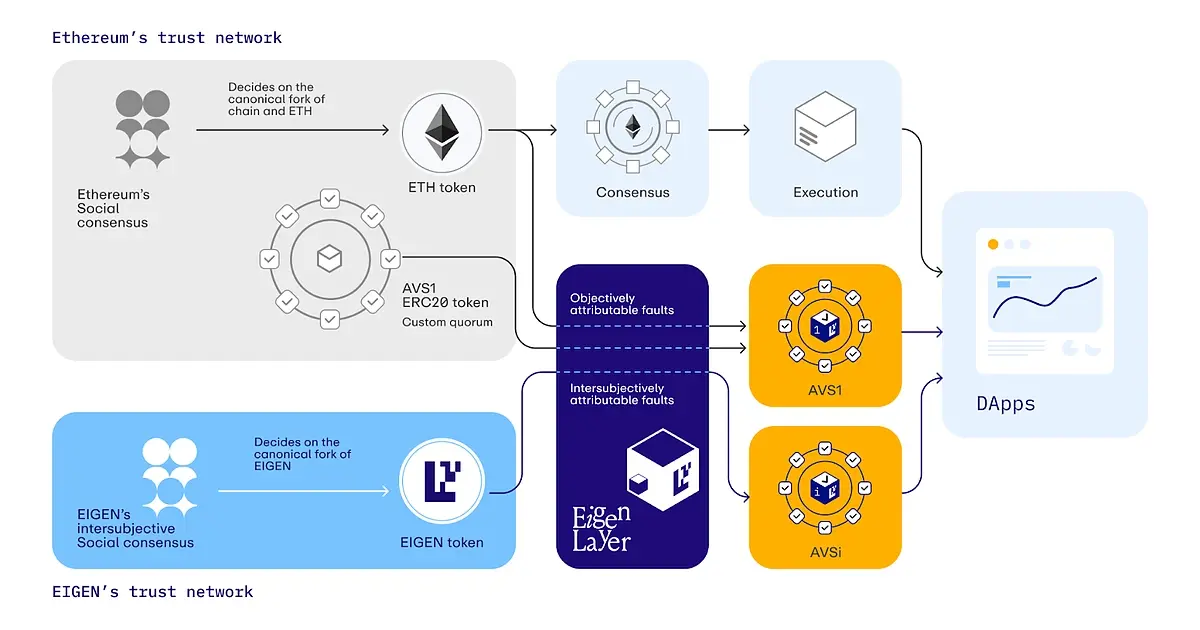
Reinventing themselves, Eigen Labs initially restructured in July 2025 and then cut 25% of workforce, making a significant shift in focus toward a mission that spans far beyond simple yield maximization, giving rise to this restaking platform’s evolution into a full-stack verifiable infrastructure platform, in the form of EigenCloud; a verifiable cloud platform that bundles EigenLayer’s restaking layer with EigenDA (data availability), EigenCompute (off-chain execution verification), and EigenAI (deterministic inference).
Yet the EIGEN token, which was last trading in the vicinity of $0.26 in late May 2026 per CoinGecko data, ranks about 95% lower than its December 2024 all-time high of $5.65, prompting the essential trader’s question: does the growing product surface reward itself with a lasting token value, or is the market already pricing in real structural risk?
How does EigenLayer’s restaking model work?
The EigenLayer restaking model fundamentally allows ETH stakers to reassign their already-staked assets to Actively Validated Services (AVSs), layering yields from multiple protocols simultaneously.
Currently, about 4.6 million ETH is staked to EigenLayer across about 1900 operators. EigenDA, the flagship data availability layer, delivers 100mb/s, which is about 1.2K times more that (8.2mb/block) Ethereum provides, thus making this infrastructure a particularly attractive solution for rollup, perpetual futures and prediction platforms that place high importance on speed and cost efficiency.
EigenCloud is not just a rename, it’s a whole new platform. Founder Sreeram Kannan’s thesis says that as AI agents become more capable, they need a trusted infrastructure to hold assets, manage treasuries, and prove to others what they are doing. The crypto supply chain is uniquely built to offer that level of verifiability.
What are the key product launches powering this shift?
Two early 2026 launches illustrate the EigenCloud product direction most clearly.
AgentKit (launched March 26, 2026)
- Developer toolkit for cryptographic agents that manage on-chain treasuries.
- Agents run inside a trusted execution environment (TEE) and sign outcomes.
- First demonstration agent, Sovra, auctions its own content and pays for its own compute.
- Nine agents were live on the infrastructure by April 2026
- Differentiates from enterprise alternatives by emphasizing crypto-native financial rails
April 15, 2026: Project Darkbloom
- Routes AI inference requests through idle Apple Silicon machines globally
- Offers an OpenAI-compatible API with hardware-backed privacy via Apple’s Secure Enclave.
- Provides OpenAI-compatible API, with hardware-backed privacy via Apple’s Secure Enclave
- Asserts that inference costs are 50–70% cheaper than major cloud vendors.
- Mac users of OpenAI-backed software receive 95% of inference revenue
- Eigen Labs launches 21-node prototype as a research prototype, with
- EigenLayer TVL compared to EIGEN Token performance.
How does EigenLayer TVL compare against EIGEN token performance?
The divergence between the protocol’s on-chain metrics and EIGEN’s market price is one of the starkest disconnects in the Ethereum ecosystem today. TVL topped out at $19.5B in late 2025, but a month-long wipeout by Kelp DAO (and the resulting $5.4B in restaking withdrawals) pushed it down to $8.9B by March 2026.
Each user of restaked assets was forced to pay out their choice of 3.3% or 2.9% fee, trimming the overall value in the vaults. By contrast, the token is actively traded around $0.26, or more than 95% below its $5.65 high in December 2024.
| TVL (May 2026)
~$8.9B Post-Kelp DAO event | EIGEN Price
$0.26 ~95% below ATH | Market Cap
~$190M Circulating ~741M | June 1 Unlock
36.82M ≈$9.35M at spot |
What risks should traders watch around EigenLayer?
Three structural risks are most concerning in the short-to-medium term.
First, cascading slashing risk: EigenLayer’s slashing governance is largely unproven and the Kelp DAO exploit underscored how a security event in a single liquid restaking protocol can expose others to sector-wide withdrawals from protocols that are not directly hit.
Second, token emission pressure: EIGEN’s uncapped total supply and monthly unlock cadence , unlocking 36 to 38 million tokens impose significant dilution and the lack of sustained fee revenue from AVS usage, EigenDA throughput, and EigenCompute demand means the token has little real active demand other than speculation and a 4.24% staking yield per annum. The June 1 unlock will introduce about $9.35 million in fresh supply.
And lastly, the threat posed by Celestia’s modular DA architecture, growth in native blob space on Ethereum, and Lido’s dominant position in the staking market with $18.32 billion TVL.
Does EigenLayer’s AI Infrastructure bet change the investment theory?
The EigenCloud AI strategy offers real optionality in the EIGEN token theory. If AgentKit or Darkbloom achieve sufficient developer adoption, the compute consumption would likely increase with protocol fee revenue, which would set a revenue floor that would be independent of emission schedules. That could have raised the price of EIGEN over a fee-generating infra comps.
The counter theory is also plausible, as Darkbloom started with 21 nodes and no production SLA, while AgentKit has nine growing experimental agents. Providers such as AWS, Google, and Azure already exist with enterprise-grade reliability. Whether crypto-native verifiability commands enough premium to win developers away from incumbents remains the central open question.
Final Thoughts
EigenLayer’s transformation from a restaking protocol into the EigenCloud verifiable infrastructure platform marks the most significant strategic pivot in the project’s history. Anchored by AgentKit, a verifiable AI training infrastructure, and Darkbloom, a Metaverse supplier of generative AI, is now in beta launch – and EigenLayer itself is moving in a new direction as a restaking protocol. EigenLayer’s 95% drawdown from its all-time high is not simply a bear market artifact, it reflects real structural headwinds including infinite supply and monthly dilution.
And more importantly, all of these go against the protocol’s business model (since fee revenue is unproven). What does it mean for traders? It means that for near-term, traders should focus on June’s unlock and the impact on the token’s demand. On the protocol side, EigenLayer’s AVS fee revenue disclosures will be key. And for Darkbloom, in particular, node count growth will be the clearest early indications.
Disclaimer: Crypto products and NFTs are unregulated and can be highly risky. There may be no regulatory recourse for any loss from such transactions.
What is EigenCloud and how does it relate to EigenLayer?
EigenCloud is a unified, verifiable cloud platform built to help developers build complex, high-performance applications (like verifiable AI agents or off-chain compute systems) that require blockchain-grade trust.
Why is the EIGEN token price so far below its all-time high?
EIGEN trades roughly 96% below its all-time high of $5.65 due to high incentive deficits, consistent token unlocks, and uncertainty regarding how the token captures value from the protocol’s fee revenue.
When is the next EIGEN token unlock?
The next EIGEN token unlock event is scheduled for June 1, 2026.