
Blockchain technology has conquered the world since the year it was started. In order to understand it, consider a government land records office in India filled with tons of paperwork and middlemen and less expected to be tampered with. Now think, all those paper records converted into digital tokens into thousands of computers working in parallel with not one record changing, except that all participants should know that it changed. Sounds amazing, right?
It is a revolution that influences changes in the world without anyone knowing; it powers Bitcoin and other crypto assets and is the ground for the revolution in healthcare, supply chains, and even voting.
This is a complete guide to everything about this blockchain technology and where it is headed in the future.
Introduction to blockchain technology
The blockchain technology is a distributed and unalterable online registry, just like a khata (account book), but a vast one that is not stored by a single bank/merchant but by thousands of computers around the world at the same time. All the transactions or entries made to this ledger are permanent. No one can change anything that is already written down, not even the bank, the government, or a hacker.
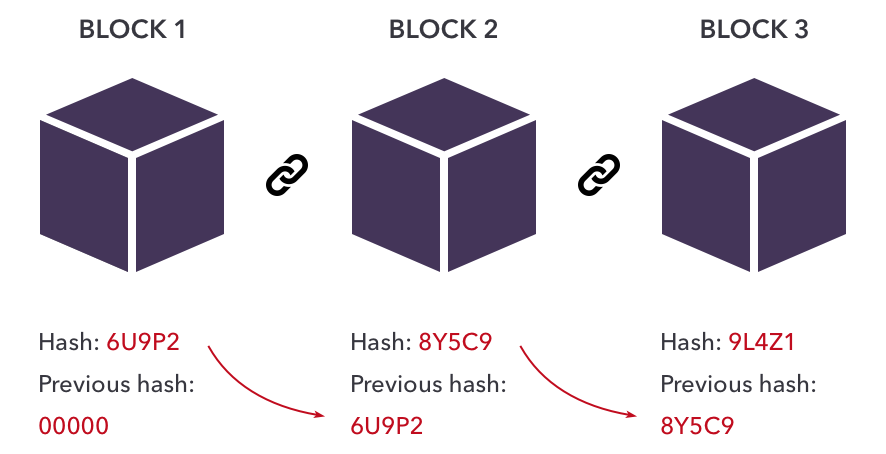
- Each block contains a list of transactions that have occurred and a cryptographic hash, which is just like a digital fingerprint. Imagine that it is a sealed mail package with an individual tracking number. You won’t be able to tamper with its content until and unless the seal is broken.
- The blocks are all connected to the previous one and create a chain of them in a row; that is why it is called a blockchain. Think of multiple receipts stapled together in order, where each receipt mentions the serial number of the one before it. Removing or altering on receipt breaks the entire chain.
- This chain is spread out in thousands of computers (nodes), which is why there is no central point of failure or control. Just like how a WhatsApp chat exists in every member’s phone, there’s no single server that controls the entire conversation.
- When data has been documented, it is practically impossible to alter it; thus, this technology is a gold standard when it comes to trust and transparency.
- It also removes the necessity to use middlemen like banks, notaries, or brokers: time savings, cost savings, and the possibility of human error.
It’s mostly associated with cryptocurrencies like Bitcoin and Ethereum. But its application goes beyond the realm of digital currencies and also includes the healthcare industry, supply chains, and identity management.
What are the key characteristics of blockchain technology?
The major advantages of blockchain technology are listed below:
- Decentralization: Unlike traditional banking systems that rely on a sole authority or organization, this technology works through nodes: individual computers that maintain the entire network/ledger without a central failing point, improving overall trustworthiness.
- Immutability: Every transaction and all data generated during a transaction can only be added to the blockchain and cannot be changed or deleted thereafter (immutable). This makes each data record immutable.
- Distributed ledger (transparency): The ledger is shared among all participants in the network. Providing transparency gives everyone an equal perspective, enabling all users to hold others accountable for their actions or validations.
- Use of consensus mechanisms: Transactions are verified through consensus algorithms (such as proof of work or proof of stake) to create the overall transaction record in a public ledger. In order for any transaction data to be added/modified to a public ledger from all nodes, a majority vote by all members is required before the transaction record is created and thus is protected.
- Elevated safety: Advanced methods of securing data (e.g., encryption; hashing; and digital signatures) can significantly reduce the likelihood of data loss, compromise, or tamper (unauthorized use/modification) by relying on the immutable nature of the blockchain to maintain data integrity in terms of security.
- Smart Contract: The use of smart contracts on a blockchain is a prominent use for decentralized networks. They are pre-defined self-executing agreements written directly into code that leverages automated processes.
How does blockchain technology work?
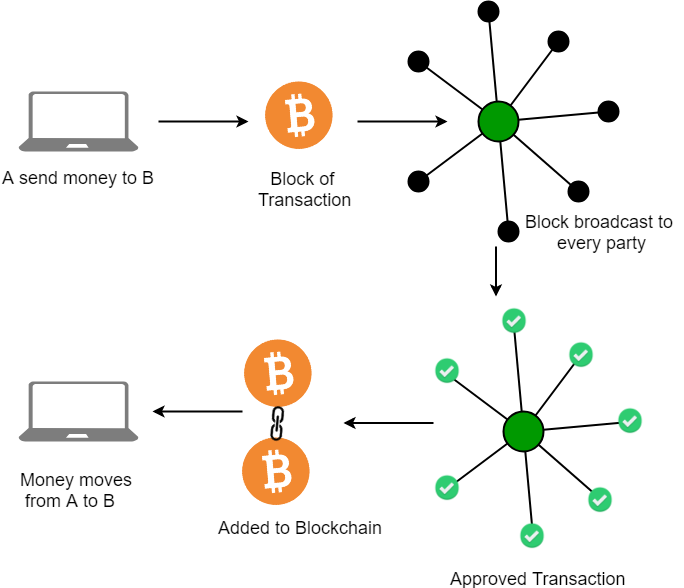
To understand how this technology works, let’s take an example of a simple transaction. Suppose Ramesh in Mumbai wants to transfer ₹5,000 Bitcoin to Priya in Delhi via a cryptographic ledger network. This technology will make sure that this transaction is made successful through the following steps:
Step 1: Starting the Transaction
The transaction is initiated by Ramesh through his digital wallet. It is coded up with two cryptographic keys: a public key (known to everyone) and a private key (known only to him), which gives it authenticity and security. Think of UPI, in this case, the UPI ID is the public key, which is easily visible to anyone. But your UPI pin, it’s the private key; only you can access it.
Step 2: Broadcasting to the Network
The payment is sent to a worldwide P2P network, with each node authenticating that Ramesh has an adequate balance and that both sides have validated nodes, so that only valid transactions are processed.
Step 3: Block Formation
Upon verification, the transaction gets into a mempool with other verified transactions. In this case, maximum transactions are bundled into one block, just like you would process several cheques in a bank.
Step 4: Consensus Algorithm
The network has to agree upon the validity of the block, Bitcoin uses Proof of Work (PoW), and Ethereum uses Proof of Stake (PoS). The miner/validator that earns the greatest block rewards from winning the block becomes the block bounty recipient.
Step 5: Adding the Block & Completing the Transaction
A cryptographic hash is formed for the last block and attached to the new block, thus rendering the chain tamper-proof. Priya is given the Bitcoin, all the nodes update their ledgers, and the transaction is complete, transparent, and immutable.
What are the different types of blockchain technology?
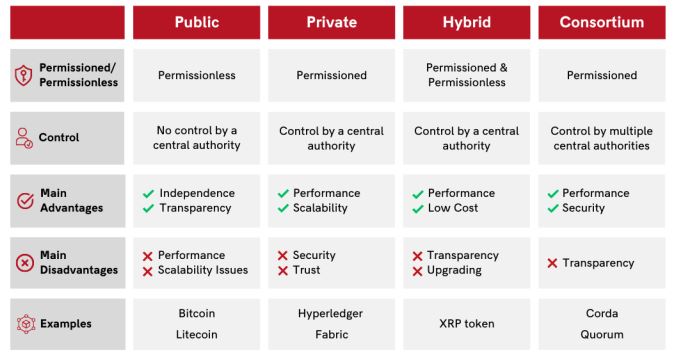
Now that we have understood the fundamentals, it’s time we talk about some advanced stuff. All of them are not created equal. With a variety of different types, each model has a different use. There are four major types of models mentioned below
Public Model
Open to all – anyone can participate, read, and add transactions. The best are Bitcoin and Ethereum. These are slow and energy-intensive, though highly decentralized and secure. Basically, it’s just like Wikipedia; it’s open for everyone to read
Private Model
In this case, only the participants with proper authority can have access. They are normally applied in organizations in internal processes. They are quicker, more scalable, and less decentralized. Just like an internal Slack workspace, which can only be accessed by the company employees.
Hybrid Model
A mixture of both public and private variants. There is some information here that is shared, and some confidential information that is not shared. Best suited to companies that require both transparency and secrecy in certain aspects. Just like a hospital which shares anonymous research, but keeps the patients’ data private.
Consortium Model
Operated by an organization or group instead of an individual. Typical in healthcare, supply chain, and banking sectors, where various parties are required to work together. The use of blockchain technology in India is also being considered using consortium models in areas such as trade finance. In India, this can be compared to the NPCI (National Payments Corporation of India), which is a consortium of banks which together run the UPI system.
What are its practical applications?
Blockchain technology has already elevated far beyond digital currency and is being utilized in industries all over the world. Its most important real-life applications are as follows:
Cryptocurrency & Digital Finance
This point was obvious. The beginning of this technology was with crypto, such as Bitcoin and Ethereum, which allowed users to have access to digital assets without banks. It has now extended to Decentralized Finance (DeFi), offering cross-border payments, reduced settlement durations, and access to finance by the 1.3 billion unbanked adults in the world.
Smart Contracts & Legal Automation
Smart contracts are self-executing in nature, and therefore, they help in removing middlemen in contracts, be it rental deposits, insurance claims, or any other contract.
Supply Chain & Healthcare
Companies like Walmart and Pfizer track the products and medicines with the help of cryptographic ledger technology. Blockchain technology in India goes up to agricultural supply chains and safe transfer of patient records between hospitals to enhance quality assurance and emergency services.
Governance, Identity & Public Records
It also has the potential to transform land registries, voting processes and identification systems by creating records that are tamper-proof and open to public scrutiny; and this can be a solution to some of the world’s most pressing challenges like fraud during elections and property disputes – particularly in India.
Creative Economy & Financial Compliance
NFTs enable artists to monetize work directly and a cryptographic ledger has a traceable record of transactions providing authorities with a potent instrument to identify and prevent financial offenses such as money laundering.
Is blockchain actually secure?
Security is among the most glorified strengths here. And these are some of the reasons why it is basically considered hack-proof:
- Cryptographic Chaining: The hash of the preceding block is stored in each block. The modification of a single block modifies the hash of that block, invalidating all subsequent blocks, and causing tampering to be instantly detected on the entire network.
- The 51% Attack Threshold: A hacker would have to take control of the network nodes that are in majority (more than 50%) at the same time to successfully manipulate it. In big networks such as Bitcoin (hashing with more than 900 exahashes/s), this is computationally and economically infeasible.
- The Byzantine Generals Problem: This will not add a new block unless at least 2/3 of the network participants concur, which means that a small group of malicious individuals cannot take the system down.
- Immutability: Once the data has been documented, it can never be removed or modified.
How is blockchain technology evolving in India?
India is evolving at a rapid scale and is therefore an ideal location to innovate blockchain initiatives with more than a billion Aadhaar-linked identities, a large population of the unbanked, and a vibrant fintech community.
The Telangana government has been pioneering blockchain land records. NITI Aayog has researched this technology and implemented it in the drug supply management chain to fight counterfeit medicines – a huge issue in India. The Indian banking industry, such as SBI and ICICI Bank, is exploring this technology as a trade finance and KYC (Know Your Customer) verification tool.
Agriculture also has a promising future in the country as this technology enables farmers to track their produce to the market, providing a fair payment and guaranteeing authenticity to end consumers. With the enhancement of digital infrastructure and regulatory clarity, Blockchain in India will experience exponential growth.
Conclusion
Blockchain Technology is not a fad; it acts as a catalyst of the new digital age. Its applications are as transformative as they are numerous: since they allow making financial transactions completely trustless, and can generate fraud-resistant land records in India.
Its story- how it originated in 2008 with a white paper by a pseudonymous Satoshi Nakamoto up to becoming a worldwide infrastructure that supports billions of dollars in transactions every day – is a demonstration of the strength of decentralized innovation. No matter whether you’re an investor, a developer, a business owner or just a curious person, learning about this technology is no longer a formality, it is the need of the hour.
That’s all then, everything on blockchain technology, covered. But hold on: one piece of information won’t teach it all. If you’re curious, dive deeper. Read more, explore what feels unclear. Who knows? You might come across something new every day!
Disclaimer: Crypto products and NFTs are unregulated and can be highly risky. There may be no regulatory recourse for any loss from such transactions.
Is Crypto Legal in India?
Yes, cryptocurrency is legal in India in the sense that it is not banned, but it is not considered legal tender.
How to start crypto trading in India with just ₹100?
On SunCrypto, you can start crypto trading with just ₹100.
Is SunCrypto safe?
Yes, SunCrypto is totally safe as it is FIU complaint and trusted by over 2.5 Million users.