

South Korea’s benchmark KOSPI price index crashed on Friday, 6 November 2026, falling about 8% to ₩4,923.47, its lowest level in nine months. The slide was steep enough to trigger a circuit breaker that briefly halted trading. Early reports on social media put the drop between 8% and 10%, and the move is already being described as one of the worst single-day falls the index has seen.
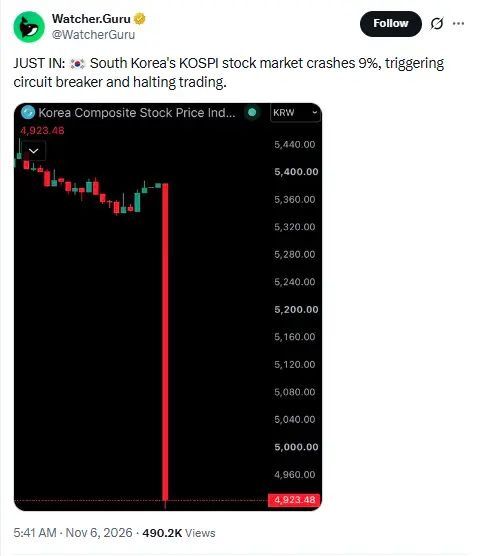
The chart tells the story. The index spent the early session drifting lower in small candles around the ₩5,400 mark, then dropped vertically to ₩4,923 within moments, the kind of move that signals panic selling rather than a gradual correction.
What triggered the sell-off
The sell-off began in the United States, where markets tanked on worries that investment in artificial intelligence may be slowing, along with fears of new U.S. regulations following the Democrats’ gains in the midterm elections. Technology stocks were hit hardest, and the shock travelled quickly to Asia, where chipmakers dominate the major indices.
Chip giants played the biggest role in the KOSPI crash
South Korea’s market is heavily tied to semiconductors, so the damage was concentrated there. Samsung Electronics fell around 10%, while SK Hynix plunged roughly 13%. Together with the broader sell-off, this wiped out about ₩432 trillion (around $288 billion) from Korean stocks in a single session.
The loss was not limited to Seoul. Broader Asian markets lost more than $1 trillion in value as investors dumped technology and AI-linked stocks. According to the summary circulating on X, four major indices, including South Korea’s, slipped into bear-market territory during the global tech rout. Losses narrowed later in the session, but sentiment remained fragile.
Another story trending alongside the crash is a Bank of America forecast of three Fed rate hikes in 2026 amid rising inflation. If that view gains traction, it could keep pressure on growth and tech stocks globally, since higher rates tend to hurt expensive, high-growth sectors the most.
KOSPI price technical analysis over 4-H timeframe
KOSPI price has been in a bearish trend on a wider timeframe and has dropped by around 26% since October. Recently, the KOSPI price has grabbed the liquidity beneath the March and April low of ₩5,060. During the liquidity sweep, volatility increased and the trading volume increased. During this liquidity sweep, Stop Out orders were absorbed by the huge buying orders which resulted in a bounce back.
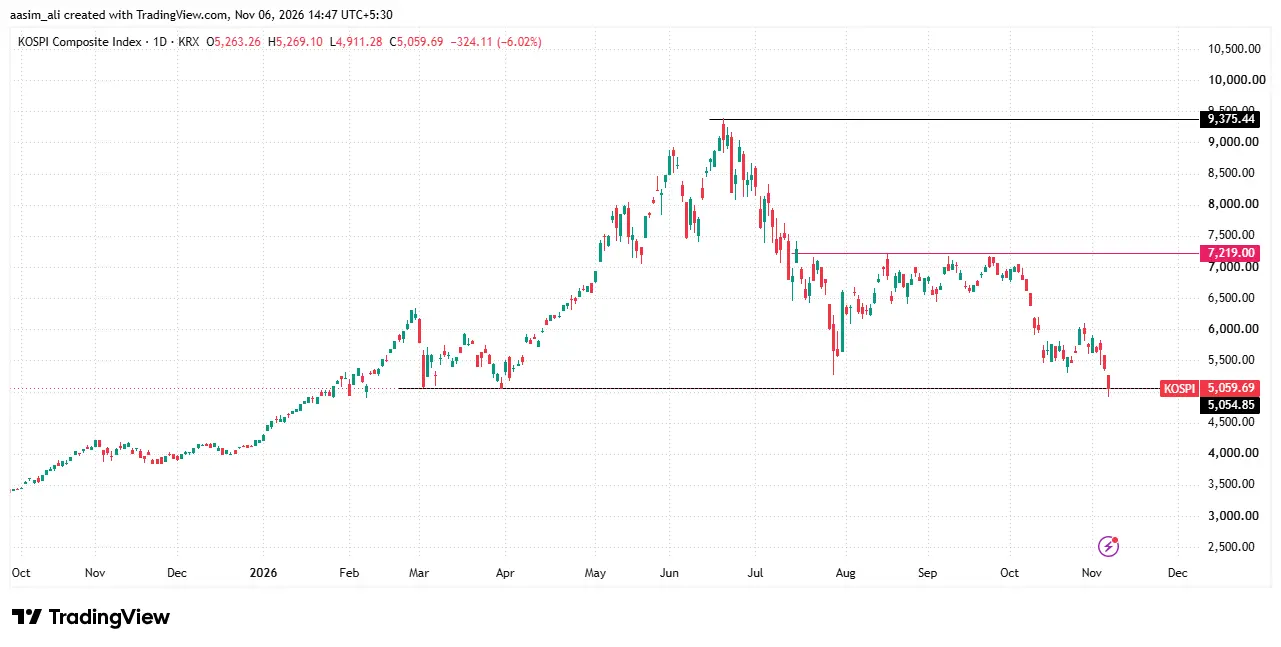
If the price holds above this level, a short term bullish momentum can be seen. If a 4-H candlestick closes over the March and April low, buyers might be confident and a bullish trend can be seen.
Conversely, if the KOSPI price slips below the support level of ₩5,060 then buyers may lose the momentum. Once the price sustains below this level, it would be difficult for buyers to bounce back.
What KOSPI crash means for crypto traders
For crypto traders, the KOSPI crash is a reminder of how closely global risk sentiment moves together. When equity markets, especially tech, sell off sharply, traders often cut leverage and reduce exposure across assets, and volatility can spill into crypto. Those trading futures should watch position sizes and stop-losses carefully, since sudden moves can trigger liquidations. Keep an eye on how U.S. markets open, any official response from South Korean regulators, and the next signals from the Federal Reserve.
Why did the KOSPI crash today?
The KOSPI fell after U.S. markets sold off on worries about slowing AI investment and new U.S. regulations following the Democrats’ midterm gains. Chip stocks such as Samsung Electronics and SK Hynix took the heaviest losses.
How much did the KOSPI fall?
It dropped about 8% to ₩4,923.47, its lowest level in nine months. Some reports cite a fall of 9% to nearly 10% at the lowest point of the session.
Was trading halted in South Korea?
Yes. The steep fall triggered a circuit breaker, which paused trading to calm panic selling.
How much value was wiped out?
Around ₩432 trillion ($288 billion) was erased from Korean stocks, while broader Asian markets lost over $1 trillion.